Larger conductor geometry
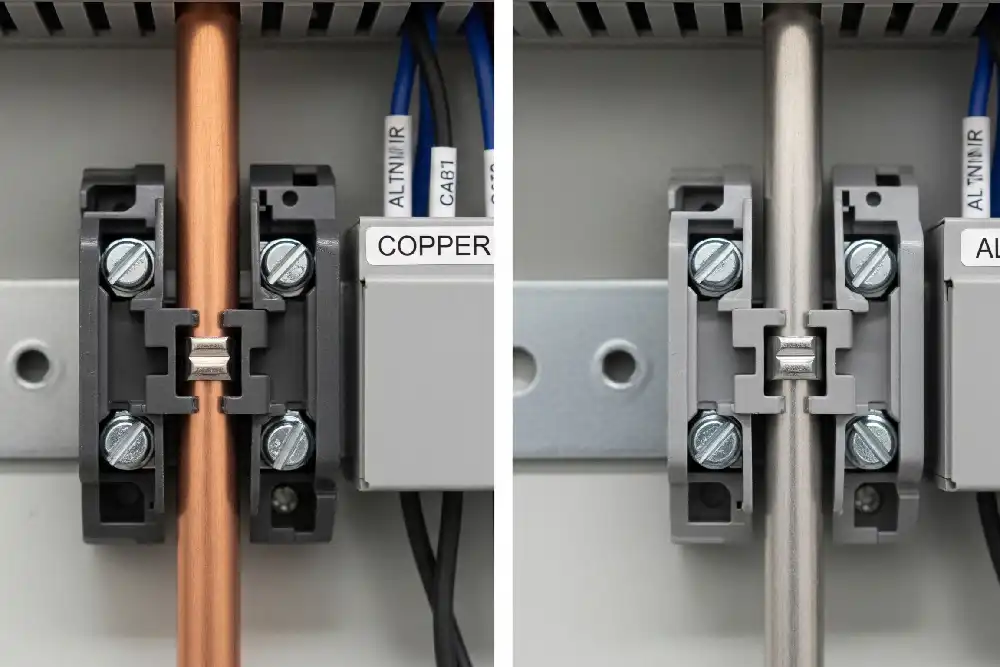
Aluminum commonly needs a larger cross-section than copper for the same design duty. That changes terminal range, bend space, routing, and enclosure fill.
Yes, but only when the exact terminal, exact conductor, and finished equipment are all documented for that use. A Cu-only record, physical fit, or a nearby AL/CU lug is not approval. If the controlled evidence does not identify the proposed aluminum conductor, the release decision is no.
The conductor identification, exact terminal documentation, and finished-equipment marking must all support the proposed connection. Verify the complete catalog number, conductor material and construction, size range, conductor count, temperature and current basis, required accessories, installation instructions, field-wiring status, certification conditions, and equipment marking. If the controlled evidence is silent or conflicting, the answer is no.
An AL/CU or Cu/Al marking is useful evidence. It is not the complete specification. You must still verify conductor alloy and construction, size, number of conductors per opening, temperature basis, accessories, mounting, manufacturer instructions, field-wiring status, and the panel conditions that apply.
Do not solve uncertainty with a generic compound, extra torque, a copper pigtail, or a same-footprint substitution. An unverified connection remains a hold point until the responsible engineering and compliance review is complete.
Aluminum is a legitimate conductor material. Its electrical, surface, and mechanical behavior still differs from copper in ways the terminal design must manage.
Aluminum commonly needs a larger cross-section than copper for the same design duty. That changes terminal range, bend space, routing, and enclosure fill.
Aluminum forms an electrically resistive oxide layer. A rated connection system addresses the surface through its evaluated contact design and exact instructions.
Aluminum exhibits more creep than copper under sustained mechanical stress. A suitable connection controls contact pressure through an evaluated clamp design and specified installation process—not a generic re-tightening rule.
Moisture at a copper–aluminum interface can increase electrochemical-corrosion risk. Plating, bimetallic surfaces, compounds, and enclosure controls matter only within the evaluated configuration.
Mechanism is not a field recipe. Knowing that oxide or contact-pressure loss can matter does not authorize brushing, applying compound, changing torque, or re-terminating a conductor. Those actions are exact-product procedures for qualified personnel under an electrically safe work condition.
A negative or unknown answer at any gate is a hold point. The gates deliberately move from the exact component to the complete panel.
Stop at the first missing record. Do not use later evidence to compensate for an unknown terminal part number or an unapproved conductor.
Identify the full terminal part number, connection positions, accessories, rail or bus interface, and document revision.
Confirm the terminal and equipment expressly cover aluminum at the proposed location.
Match alloy or material marking, size, class, stranding, compactness, shape, and insulation system.
Reconcile terminal, conductor, equipment, circuit loading, environment, and locally adopted requirements.
Verify the permitted number of conductors and whether any copper/aluminum combination is expressly allowed.
Provide the current product instructions, required accessories, controlled tools, and documented work method.
Confirm wire space, thermal design, labels, field-wiring scope, fault-duty evidence, and certification conditions.
Do not decide from the plastic housing alone. Depending on product category and size, material identification may appear on the connector, unit container, controlled information sheet, instructions, or certification record. Use the literal identification and current document for the installed catalog suffix; if none of those controlled sources identifies the proposed aluminum conductor, treat the terminal as not approved.
The identified terminal or equipment does not authorize aluminum. Fit, ampacity, compound, or a nearby AL/CU lug cannot change that marking.
The identified termination may accept the stated material within its documented range and conditions. Check every conductor and equipment detail.
In UL wire-connector marking practice, 7 and 9 are connector ampacity-level designations associated with 75°C and 90°C conductors. They are not a universal terminal-block code or an equipment temperature rating.
| Evidence item | What it can establish | What it cannot establish alone |
|---|---|---|
| Material marking | Whether the identified termination may accept copper, aluminum, or both. | The full wire range, construction, port count, or simultaneous mixed-material use. |
| Wire range and class | The stated minimum/maximum size and named solid, stranded, compact, or flexible construction. | Acceptance of a visually similar cable or a conductor at the edge of an undocumented range. |
| Temperature designation | The connector ampacity-level or temperature basis defined for the identified product category and conductor. | Permission to raise a lower equipment limit or to transfer AL7CU/AL9CU terminology to every terminal block. |
| Multiple-conductor statement | The permitted number, size combinations, and sometimes materials in a clamping point. | Automatic permission for two wires or copper plus aluminum in one opening. |
| Tool, torque, or treatment instruction | The controlled method for the exact connection system. | A generic process for a different terminal, conductor, or maintenance event. |
| Listing or Recognition | The certification scope and possible Conditions of Acceptability for the identified product. | Automatic approval of a substituted terminal, finished panel, or field installation. |
AL/CU does not automatically mean copper and aluminum can share one opening. It can mean that either material is permitted within defined conditions. In UL wire-connector guidance, direct intermixing needs additional identification for that use—such as an “INTERMIXED – DRY LOCATIONS” limitation—and remains subject to the exact port, conductor, and environmental conditions.
Record the conductor manufacturer and complete designation. Aluminum alloy, solid, concentric-stranded, compressed, compact, SIW, sector-shaped, fine-stranded, and copper-clad aluminum conductors are not interchangeable labels. The terminal must name or otherwise cover the actual construction. Copper-clad aluminum also has market-specific certification boundaries and must not be treated as ordinary aluminum or copper.
A cable jacket marking proves the cable identity. It does not prove that the selected terminal accepts that identity. The terminal marking proves a product capability only within its documented conditions. Both sides must match.

The article intentionally does not provide application instructions. It shows which records must reach the qualified installer.
The exact instructions may define how and when a surface is prepared. Do not invent an oxide-removal method or transfer one from another product.
A product may require a named compound, provide treatment, permit an option, or use another design. Antioxidant is product-specific and cannot convert a copper-only terminal into an aluminum-rated terminal.
Conductor dimensions, clamping depth, strands, sleeves, and insulation position must match the exact terminal instructions.
Use only the published value, tool, and sequence for the exact part. More torque does not cure material incompatibility and can damage the joint.
Do not prescribe a 24-hour, 48-hour, or periodic re-torque rule. Follow the exact product and equipment program; some aluminum-specific terminals are maintenance-free, and disturbing a sound termination can cause damage.
Changing the terminal, conductor, accessory, or treatment returns the connection to engineering review. Do not modify a damaged terminal for reuse.
Release package: Give the installer the controlled instruction revision, exact terminal and conductor identification, required accessories, approved drawing, documented process, and inspection criteria. A distributor description or past job is not a work instruction.
“Terminal block” is a practical description, not one universal approval category.
| Category | Aluminum may be possible when | Unsafe assumption to reject |
|---|---|---|
| Standard DIN-rail feed-through | The exact terminal position, conductor construction, and all stated conditions explicitly cover aluminum. | It accepts aluminum because the conductor fits or an AL/CU terminal sits nearby. |
| High-current Al/Cu terminal | The full catalog number names aluminum and the actual size, class, mounting, and application notes match. | Every high-current terminal supports the same aluminum range and panel use. |
| Distribution block or multi-port connector | Each used port is documented for the material, conductor count, common current path, and conditions. | Any copper/aluminum mix is allowed because the product has several holes. |
| Transition connector | A specifically identified product supports the exact materials, conductor forms, port arrangement, and end use. | A short copper pigtail or improvised adapter is automatically acceptable. |
| Panelboard or device terminal | The terminal and the finished-equipment marking both permit aluminum at the relevant location. | An aluminum-rated lug overrides a copper-only equipment label or space limit. |
| Control, signal, or PE terminal | The exact product and system documentation cover the conductor and electrical function. | Power-terminal approval transfers to a control or protective-earth terminal. |
Use SENTOP’s terminal block specification guide to build the data checklist, then compare exact product records. The terminal block selection guide covers broader function and connection-technology decisions.
A standard number is not material permission, and standards for similar-looking connection products are not interchangeable.
| Document or category | What it addresses here | Boundary to preserve |
|---|---|---|
| IEC 60947-7-1:2025 | The base scope covers terminal blocks for copper conductors. | Do not cite the IEC scope as general permission for aluminum. Exact product evidence is still required. |
| UL 60947-7-1 | The North American adoption includes national differences for specified aluminum conductors. | Do not collapse the UL adoption and IEC base text into one material claim. |
| UL 1059 Ed. 6 / CSA C22.2 No. 158:23 | Terminal-block component systems and their stated factory/field-wiring use. | Component compliance alone does not approve every finished panel or conductor. |
| UL 486A-486B Ed. 4 / CSA C22.2 No. 65:25 | Wire connectors for named copper and aluminum conductor constructions. | Do not transfer a wire-connector marking to an unrelated terminal-block category. |
| UL 486E / UL 1953 | Equipment wiring terminals and power distribution blocks, respectively. | Each category has its own markings, installation conditions, and end-use evaluation. |
Field wiring is a certification condition, not merely the side of a drawing. For a UL Recognized Component, review the current Conditions of Acceptability and the end-product certification. A certification mark or standard number does not certify a substituted connection or the completed panel.
Many panels use copper internal wiring while accepting an aluminum feeder. That arrangement can be valid, but the transition must be explicit. Do not place both materials in one clamp merely because the product is “dual rated.” Do not assume a pigtail resolves the issue.
Mixed-material rule: if the exact documentation is silent about the proposed simultaneous copper/aluminum arrangement, do not infer permission. Use a documented transition architecture or redesign the connection.

A component can pass its own material gate while the equipment still fails. Aluminum commonly uses a larger conductor for the same design duty, which can change bending space, entry hardware, gutter fill, support, access, and the physical terminal arrangement.
Check conductor diameter, bend radius, gutter capacity, entry route, clamping access, covers, and strain control.
Reconcile conductor, terminal, equipment, load, ambient, grouping, and the most restrictive temperature basis.
Verify the equipment label, allowed terminal locations, certification record, and any Conditions of Acceptability.
Review whether a changed terminal, route, accessory, or device affects SCCR, coordination, or panel documentation.
Confirm temperature, moisture, contamination, chemicals, vibration, corrosion, enclosure protection, and service access.
Update labels, drawings, BOM, instructions, inspection points, and restrictions that future maintenance teams need.
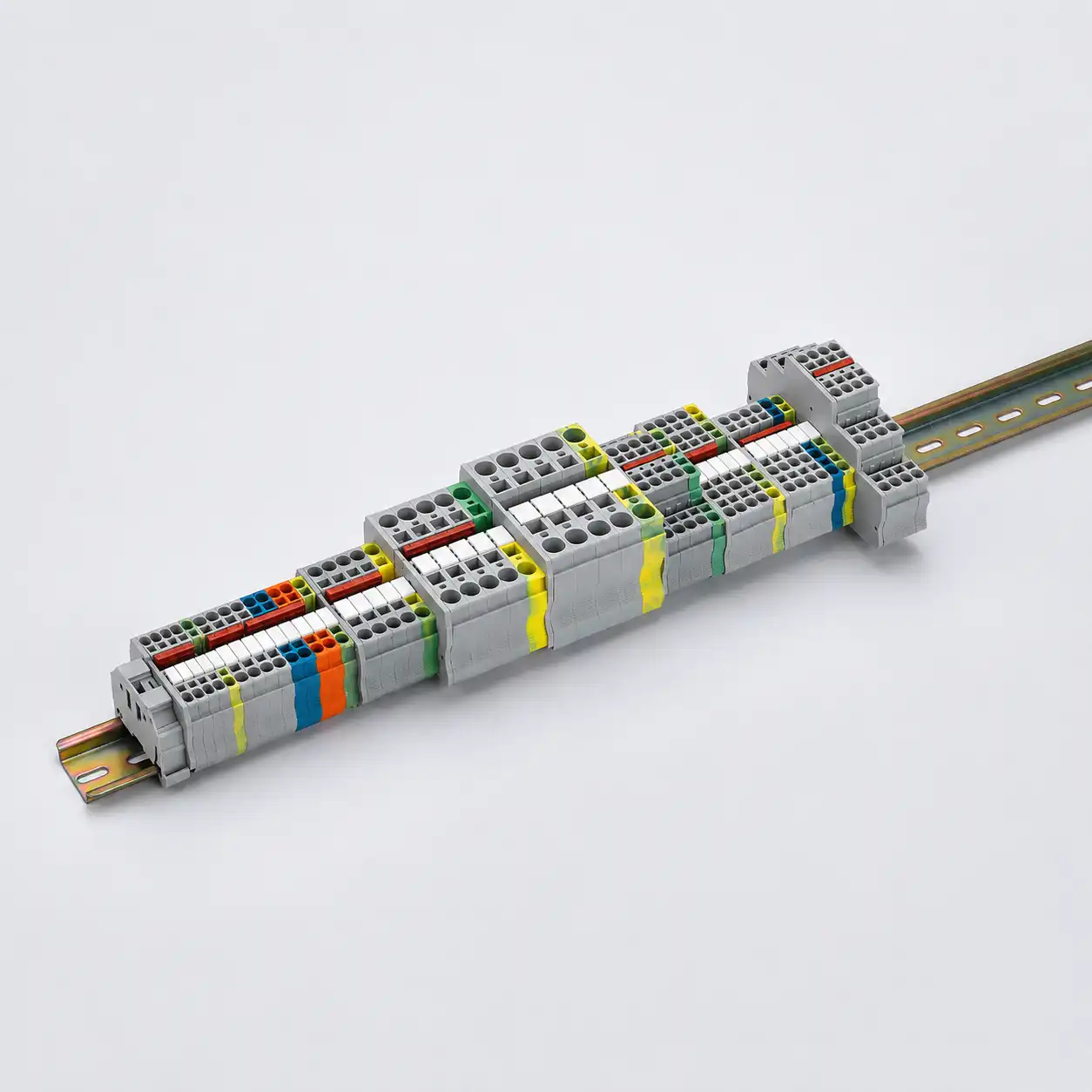
This is a documentary workflow for engineering, procurement, QA, and panel production. It is not an installation procedure.
Identify feeder, distribution, control, signal, protective earth, or material-transition duty. Record field/internal status and drawing location.
Record full terminal suffix, poles, ports, accessories, rail or bus interface, covers, jumpers, and mounting hardware.
Gather terminal data, conductor data, equipment marking, drawing, BOM, certification information, and current instructions.
Match every material, alloy, size, class, compactness, temperature, and conductor-count field. Record conflicts rather than interpreting them away.
Confirm space, thermal basis, labels, environment, field-wiring scope, protection, SCCR, and applicable assembly requirements.
Use only an exact documented architecture. Do not improvise a pigtail, adapter, shared opening, or unreviewed splice.
Retain the evidence, reviewer, restrictions, and allowed positions. Any changed terminal, conductor, accessory, instruction, or panel context returns to review.
Physical fit does not prove material, class, temperature, port-count, or process permission.
Approval at one location does not extend to another terminal row or override a Cu-only equipment label.
Current is only one input. Conductor range, material, geometry, temperature, instructions, and panel scope remain separate.
Compound cannot convert a copper-only terminal into an aluminum-rated connection. Product instructions control any treatment.
Unapproved torque can damage the conductor or clamp. Heating requires safe isolation, diagnosis, and exact-product corrective action.
A component certification does not automatically approve field wiring, the final assembly, or a substituted construction.
Quarantine the connection if there is abnormal heat, a burning odor, discoloration or charring, cracked or melted insulation, arcing evidence, stripped hardware, conductor movement, or repeated protection operation. Qualified personnel must remove the affected circuit or equipment from service when safe and determine the cause.
Do not touch a terminal to judge temperature. Do not open an energized enclosure for this article’s checklist. A qualified person establishes an electrically safe work condition, identifies every source and backfeed path, applies the required lockout/tagout controls, verifies absence of voltage, and follows the equipment and terminal instructions.
Correct the cause, not the appearance. Do not restore a visibly damaged connection by adding compound or re-torquing it. Replace the terminal, heat-damaged conductor, and affected accessories as the manufacturer requires; then correct the root cause before re-energizing.

Each example is a decision pattern, not approval for a specific product.
Do not assume the existing feed-through terminals are suitable because their copper version carried the load. Verify exact aluminum permission, conductor construction, wire space, field-wiring marking, and panel evidence. Select a dedicated high-current Al/Cu terminal only after every gate passes.
Same current, voltage, brand, or DIN-rail footprint does not establish compatibility. The contact system, suffix, aluminum range, accessories, certification category, and panel effect can differ. Keep the change open until exact evidence is approved.
Define a documented transition with separate approved positions or another exact architecture. Do not share one opening unless explicitly allowed. Put the transition, conductor data, accessories, instructions, and inspection requirements on the released drawing and BOM.
“Cu/Al compatible” is not enough for release. Send enough project data for the supplier to match the exact product, conductor, and panel boundary.
For a structured handoff, use the terminal block RFQ checklist.
No. A Cu-only controlled record—or the absence of aluminum authorization across the marking, packaging, instructions, information sheet, and certification evidence—is a rejection. Physical fit, matching current, compound, or an improvised copper transition cannot create material permission.
No. The marking is one part of the evidence. Verify the exact product’s conductor material, alloy or construction, size range, strand class, temperature basis, conductor count, accessories, mounting, certification scope, equipment label, and current instructions.
In UL wire-connector marking practice, 7 and 9 are connector ampacity-level designations associated with 75°C and 90°C conductors. They are not a universal terminal-block code, an equipment operating-temperature rating, or permission to use higher ampacity. The most restrictive limitation still controls.
Only when the exact documentation explicitly permits that material combination, conductor count, sizes, and port arrangement. A general AL/CU label does not automatically authorize copper and aluminum in one opening. If the record is silent, use a documented transition architecture or redesign the connection.
No universal rule applies. Products can require a named treatment, use a pre-treated or plated contact system, permit an option, or specify another method. Follow only the current instructions for the exact terminal and conductor. Compound cannot make a copper-only terminal aluminum-compatible.
No. Visual material, color, plating, or clamp style does not establish the product’s evaluated conductor scope. Use the exact marking, data sheet, certification record, and instructions. A terminal can use a copper-alloy contact system and still be aluminum-rated only when its complete design is identified for that use.
Only if the exact terminal and conductor instructions expressly permit the specific ferrule or sleeve, conductor construction, size, and tooling. A ferrule does not solve an unapproved material or conductor-class mismatch and should not be added by analogy with copper wiring.
Do not apply a universal re-torque schedule or turn a screw simply to check it. Follow the exact product instructions and the equipment maintenance program. Maintenance-free spring connections are not routinely re-tightened, and disturbing a sound termination can cause damage.
No. Confirm every affected field-wiring position plus enclosure space, routing, thermal design, labels, accessories, SCCR or protection evidence, certification conditions, and service access. The finished equipment can be more restrictive than the component.
Send the equipment and terminal part numbers, current instructions, conductor manufacturer and complete designation, material, size, class and temperature data, voltage/current/application, number of conductors, accessories, environment, drawings, BOM, target market, certification needs, quantity, and destination.
Always use the current exact product data and local project requirements for a released connection.