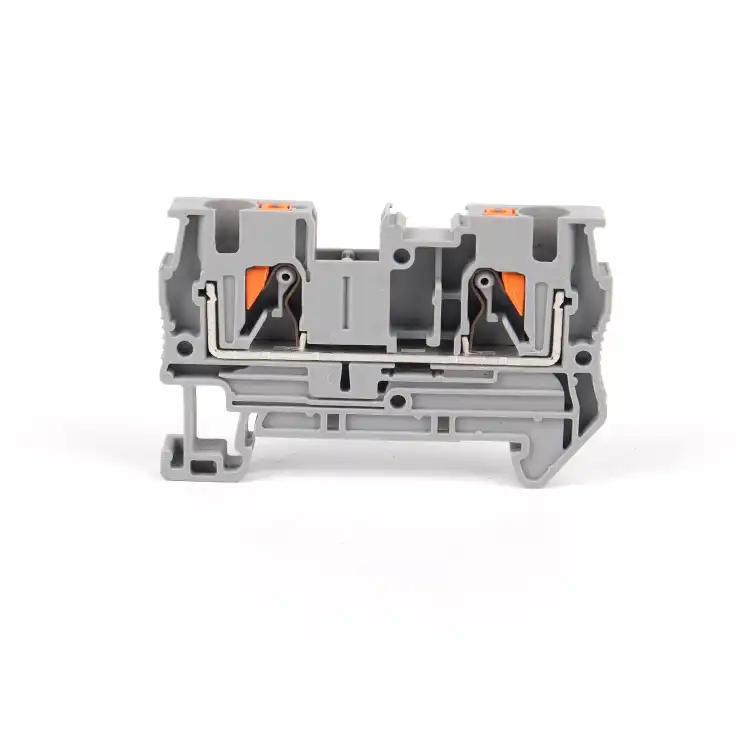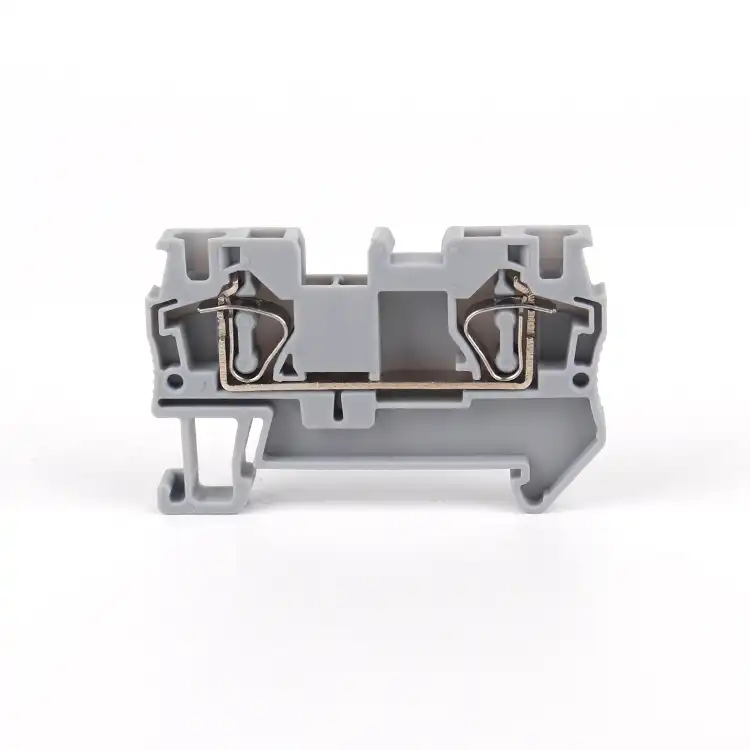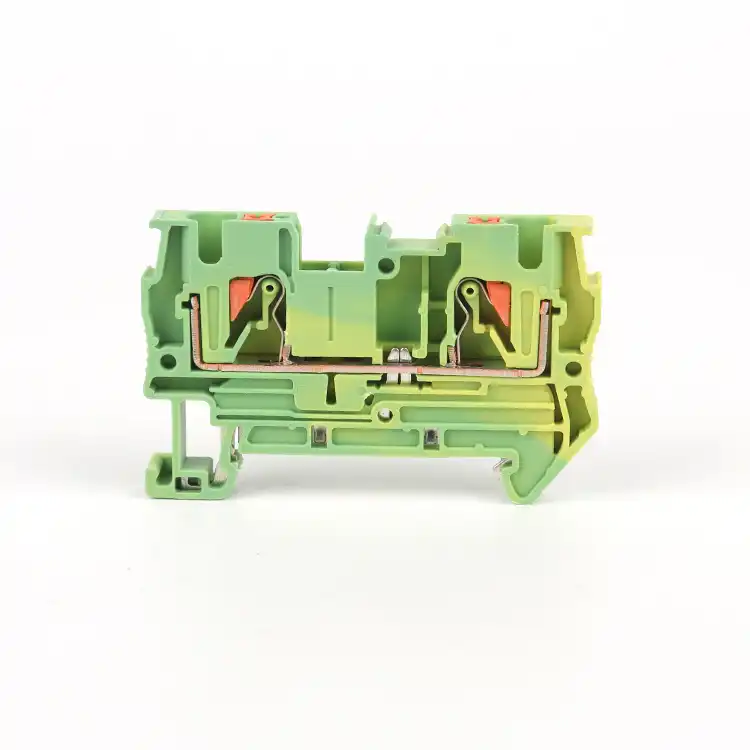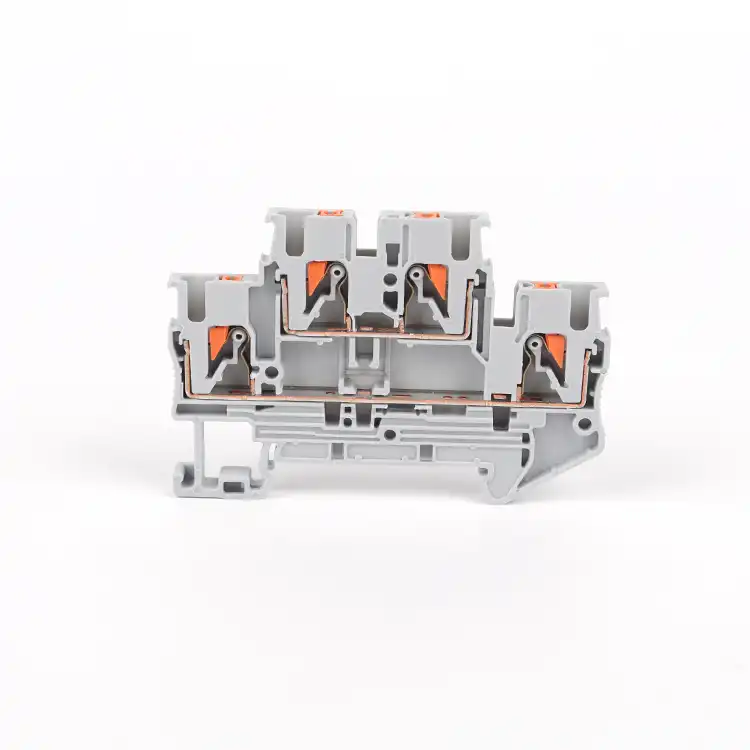
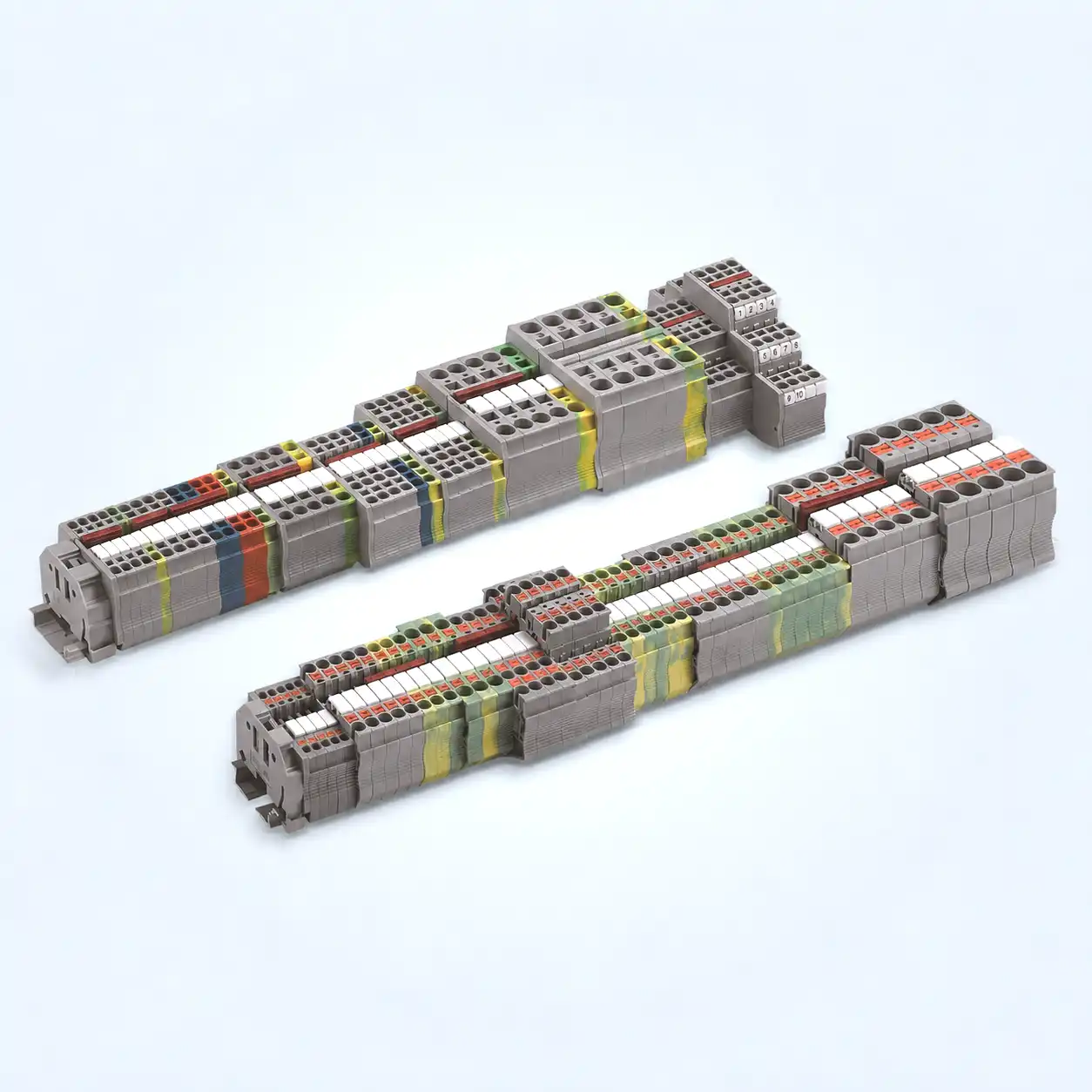
Spring Terminal Blocks Manufacturer
Reliable Spring Terminal Block Manufacturer
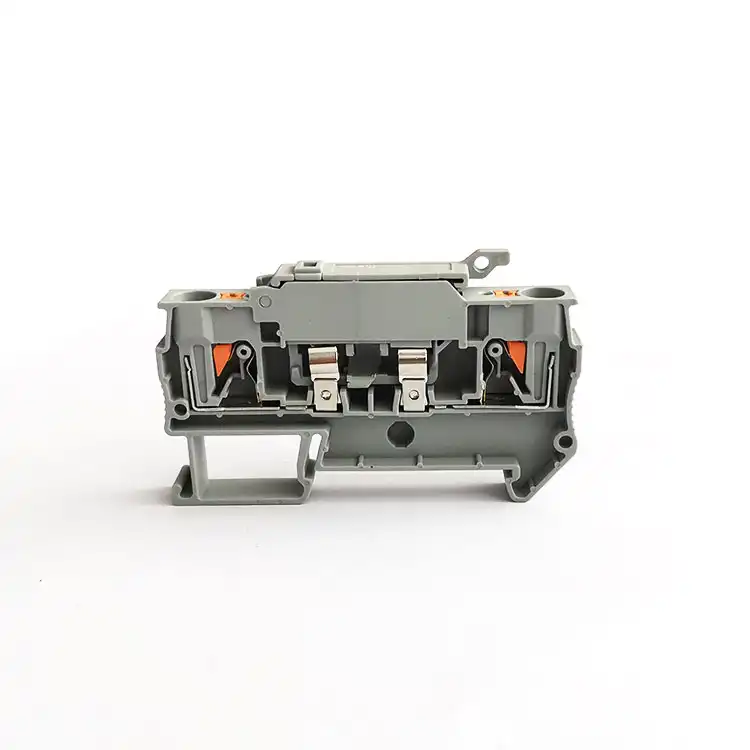
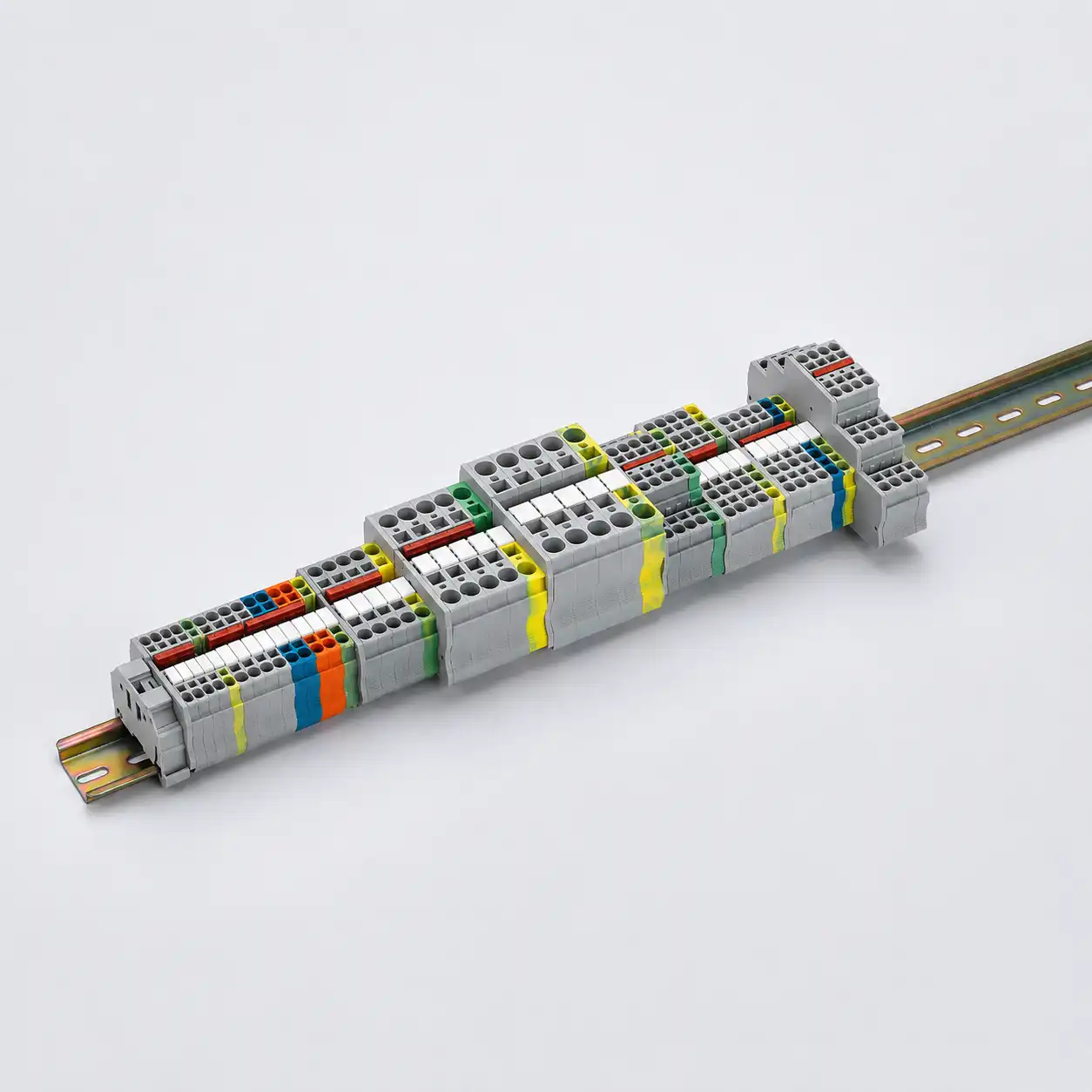
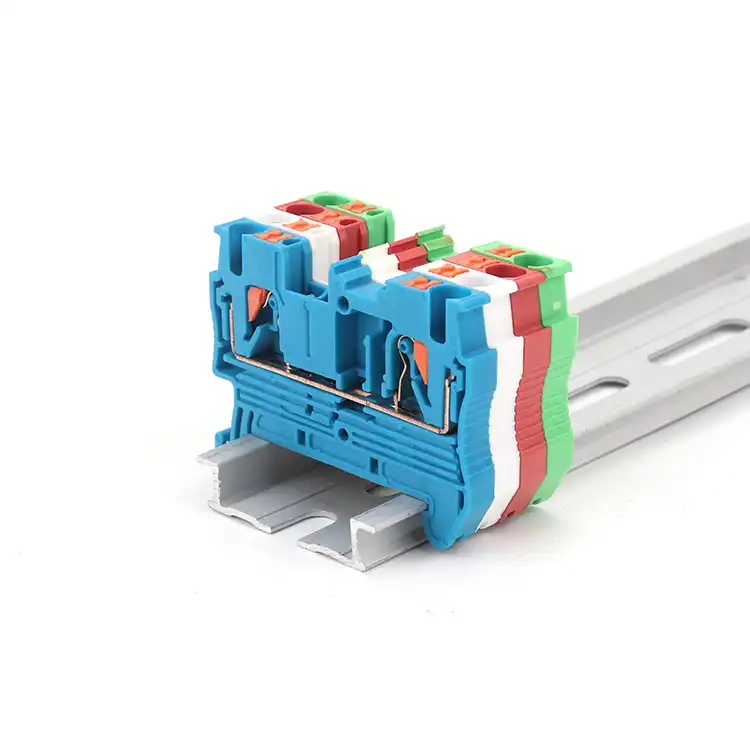
SENTOP supplies spring terminal blocks for fast, organized, and space-efficient wiring in control panels, electrical cabinets, automation equipment, machinery, and industrial power systems. Our product range includes spring feed-through terminals, push-in terminals, protective earth terminals, multi-level terminals, and matching DIN rail accessories.
Spring Terminal Block Product Range
SENTOP supplies spring terminal blocks for normal circuit wiring, protective grounding, high-density installation, signal distribution, testing, and complete DIN rail terminal-strip assembly. Product selection should be based on the terminal function, conductor type, wire size, connection method, DIN rail profile, and required accessories.
Spring Feed-Through Terminal Blocks
Spring feed-through terminal blocks connect an incoming conductor to an outgoing conductor through an internal conductive path. They are suitable for organized power, signal, control, and automation wiring on DIN rails.
- Conductor-to-conductor circuit connection
- Suitable for repeated control-panel wiring
- Compact terminal-strip installation
- Compatible marker and bridge options
Push-In Spring Terminal Blocks
Push-in spring terminal blocks are designed to simplify conductor insertion and reduce repetitive wiring time. Direct insertion capability depends on the selected terminal model, conductor construction, and conductor preparation.
- Efficient wiring for repeated production
- Suitable for selected rigid conductors
- Supports selected ferruled conductors
- Model-dependent tool operation
Spring Ground Terminal Blocks
Spring ground terminal blocks connect protective earth conductors to the compatible grounded DIN rail. They are used alongside normal spring feed-through terminals to complete the PE wiring structure of a terminal strip.
- Protective earth conductor connection
- DIN rail grounding-foot structure
- Clear PE circuit identification
- Model and rail compatibility matching
Double-Level Spring Terminal Blocks
Double-level spring terminal blocks increase connection density by placing two wiring levels within one terminal position. They are suitable for control cabinets where DIN rail length is limited.
- Two connection levels in one position
- Reduces required DIN rail length
- Supports organized signal wiring
- Separate marking for each connection level
Functional Spring Terminal Options
Functional spring terminal options can support circuit disconnection, testing, measurement, component integration, or potential distribution. Available functions depend on the selected terminal series and product model.
Spring Terminal Block Accessories
Correctly matched accessories complete the fixing, insulation, marking, separation, and potential-distribution structure of the spring terminal strip.
Select the Product Type According to the Wiring Function
Similar Spring Terminal Blocks May Use Different Connection Methods
Spring cage, push-in, tool-operated, multi-level, ground, and functional terminals can differ in conductor range, insertion method, terminal width, DIN rail foot, bridge pitch, marker system, and accessory compatibility. Confirm the exact model and conductor requirements before ordering.
Complete Spring Terminal Strip Solutions
SENTOP can supply spring terminal blocks together with protective earth terminals, end brackets, end plates, partition plates, jumpers, markers, and DIN rails as one coordinated terminal-strip solution. The complete assembly can be organized according to circuit function, conductor size, terminal quantity, grounding positions, marking requirements, and project BOM.
One Coordinated System for Wiring, Grounding and Identification
A complete terminal strip is more than a group of individual spring terminal blocks. Each component performs a specific electrical, mechanical, insulation, or identification function. Correct model matching helps simplify installation and reduce accessory compatibility problems.
Spring Feed-Through Terminals
Connect incoming and outgoing conductors for power, signal, control, sensor, and automation circuits.
Spring Ground Terminals
Connect protective earth conductors to the compatible grounded DIN rail through the PE contact structure.
End Brackets
Secure both ends of the assembled terminal group and prevent sideways movement along the DIN rail.
End and Partition Plates
Close exposed terminal sides and separate circuit groups, voltage levels, or electrical functions.
Jumpers and Bridges
Electrically connect selected terminal positions and distribute a common potential across circuits.
Markers and Labels
Identify terminal positions, wire numbers, circuit functions, cabinet groups, and maintenance information.
Typical Component Order on a DIN Rail
The final sequence depends on the panel wiring diagram, grounding positions, circuit separation, bridge layout, and terminal identification requirements.
Start End Bracket
Fixes the beginning of the terminal strip.
Feed-Through Terminals
Complete the main circuit connection positions.
Ground Terminals
Add protective earth positions where required.
Partitions and Plates
Separate circuit functions and close open sides.
Markers and Bridges
Add identification and common-potential connections.
Final End Bracket
Secures the completed terminal strip.
Common Spring Terminal Strip Combinations
Standard Control Wiring Strip
Spring feed-through terminals combined with end brackets, end plates, markers, and selected bridge accessories.
Wiring and Grounding Strip
Feed-through and protective earth terminals arranged according to equipment and cabinet grounding positions.
High-Density Signal Strip
Multi-level spring terminals used to increase wiring density where the available DIN rail length is limited.
Potential Distribution Strip
Selected terminal positions connected by compatible jumpers to distribute a common electrical potential.
Details Required to Prepare a Complete Terminal Strip
A clear BOM, wiring diagram, terminal list, or cabinet layout helps organize the correct terminal models and accessory quantities.
Complete the Terminal Strip with Series-Matched Accessories
Similar-looking spring terminals, ground terminals, end plates, jumpers, and markers may use different side profiles, terminal widths, bridge pitches, marker slots, or DIN rail mounting structures. Confirm the terminal series and product model before preparing the complete assembly.
Explore 1,000+ More SENTOP Models
Can't find the exact terminal block for your specific project? We offer a vast range of specialized connection solutions and customized OEM options to meet every industrial requirement.
How Spring Terminal Blocks Create a Reliable Connection
Spring terminal blocks use a spring-clamping mechanism to hold the conductor against the internal conductive part. Depending on the terminal design and conductor type, the wire may be inserted directly or installed after opening the spring with an operating tool.
Four Steps from Conductor Insertion to Spring Clamping
The exact operating method depends on whether the selected product uses spring-cage, push-in, push-button, or tool-operated spring connection technology.
Open the Clamping Position
For tool-operated models, insert a suitable operating tool into the designated opening to move the spring and create space for the conductor.
Place the Wire into the Terminal
Insert the prepared conductor into the correct wire-entry position until it reaches the required connection depth.
Allow the Spring to Clamp the Wire
Remove the operating tool or release the push button so the spring applies clamping force to the conductor.
Check the Final Wire Position
Confirm that the conductor is fully inserted, firmly held, correctly identified, and not exposing excessive bare wire.
Spring Cage and Push-In Connection Methods
Both technologies use spring force, but the conductor insertion method and required operation can differ according to the terminal structure and conductor type.
Spring Cage Terminal Blocks
Spring cage terminal blocks normally use an operating tool or push button to open the spring before the conductor is inserted. After the operating mechanism is released, the spring clamps the wire against the conductive part.
Push-In Spring Terminal Blocks
Push-in terminals may allow selected rigid conductors or ferruled flexible conductors to be inserted directly. Flexible conductors without suitable preparation may still require spring activation with a tool or push button.
Why Spring Clamping Is Used in Industrial Wiring
Confirm the Conductor Type Before Selecting the Connection Method
Direct insertion and tool requirements can change according to the conductor construction, cross-section, ferrule, stripping length, and selected spring terminal model.
Solid Conductors
Selected push-in models may support direct insertion when the solid conductor meets the specified wire range and preparation requirements.
Model-dependent direct insertionStranded Conductors
Stranded conductors may require the spring to be opened before insertion, depending on conductor stiffness and terminal design.
Check the conductor constructionFlexible Conductors
Flexible wires commonly require tool-assisted spring activation unless they are prepared with a suitable ferrule for the selected terminal.
Tool operation may be requiredFerruled Conductors
Properly crimped ferrules can simplify conductor insertion, but ferrule dimensions and wire range must match the terminal specification.
Confirm ferrule and terminal sizeCheck These Details Before Energizing the Circuit
Not Every Spring Terminal Supports Tool-Free Direct Insertion
Spring cage, push-in, push-button, and tool-operated terminal blocks use different conductor insertion methods. Direct insertion depends on the selected product model, conductor construction, conductor cross-section, and wire preparation. Always confirm the product specification before installation.
Spring Terminal Blocks vs. Screw Terminal Blocks
Spring and screw terminal blocks are both widely used in industrial control panels, electrical cabinets, automation machinery, and power distribution equipment. The correct connection technology depends on conductor type, installation speed, cabinet space, maintenance requirements, operator procedures, and applicable project standards.
Spring Terminal Blocks
Spring terminal blocks use a spring mechanism to hold the conductor against the internal conductive part. Depending on the model, the conductor may be inserted directly or installed after opening the spring with a tool or push button.
Screw Terminal Blocks
Screw terminal blocks use a screw-clamp structure to secure the conductor. The installer inserts the prepared wire and tightens the screw according to the applicable product instructions and project procedure.
Key Differences Between Spring and Screw Connections
| Comparison Factor | Spring Terminal Blocks | Screw Terminal Blocks | Selection Consideration |
|---|---|---|---|
| Connection Method | The conductor is held by a spring-clamping mechanism. | The conductor is held by a screw-operated clamp. | Select according to the preferred installation method and existing cabinet standard. |
| Installation Procedure | Direct insertion or tool-assisted insertion, depending on the model and conductor. | Insert the conductor and tighten the screw according to the specified procedure. | Confirm conductor preparation, stripping length, and operating requirements. |
| Repetitive Wiring Speed | Can support efficient repetitive wiring, especially with compatible push-in designs. | Each connection normally requires a separate screw-tightening step. | Consider production volume, labor procedure, and installation time. |
| Operator Consistency | Spring force is provided by the terminal mechanism. | Connection quality depends on correct screw tightening and installation practice. | Standardized work instructions remain important for both technologies. |
| Tool Requirements | Some models support direct insertion, while others require a tool or push button. | A suitable screwdriver or torque-controlled installation tool is normally required. | Do not assume every spring terminal is completely tool-free. |
| Conductor Compatibility | Depends on whether the conductor is solid, stranded, flexible, or ferruled. | Depends on the clamp design, conductor type, and wire preparation. | Confirm the supported conductor range for the selected model. |
| Terminal Density | Available in compact and multi-level designs for high-density wiring. | Compact options are also available, depending on the screw terminal series. | Calculate complete terminal-strip width rather than comparing one terminal only. |
| Maintenance Access | Conductors can be released through the terminal operating mechanism. | Conductors are removed by loosening the screw clamp. | Consider cabinet access, service frequency, and technician familiarity. |
| Retightening Procedure | Spring clamping does not use a manually tightened connection screw. | Inspection or retightening practices depend on the project, product, and maintenance procedure. | Follow the product documentation and applicable maintenance rules. |
| Replacement Projects | Suitable when converting to spring connection after dimensional and functional confirmation. | Often preferred when maintaining an existing screw-terminal system. | Check width, height, rail foot, accessories, and wiring procedure before replacement. |
| Accessory Compatibility | Requires matching end plates, bridges, markers, and brackets for the spring terminal series. | Requires accessories matched to the selected screw terminal family. | Similar-looking accessories are not automatically interchangeable. |
| Typical Applications | Automation equipment, production wiring, compact control panels, and signal circuits. | General industrial wiring, traditional panels, replacement projects, and established systems. | Both technologies can be suitable when correctly selected for the application. |
Six Questions to Ask Before Choosing the Terminal Technology
The connection type should be selected as part of the complete panel design rather than according to one product feature alone.
What Conductor Type Is Used?
Confirm solid, stranded, flexible, or ferruled conductors and the required AWG or mm² range.
How Important Is Wiring Speed?
High-volume production may place greater emphasis on repeatable and efficient conductor installation.
How Much DIN Rail Space Is Available?
Compare terminal width, number of positions, accessories, partitions, and complete strip length.
How Will the Equipment Be Maintained?
Consider conductor replacement frequency, cabinet access, technician tools, and maintenance procedures.
What Standards Must Be Followed?
Confirm the project requirements, terminal specifications, documentation, and applicable installation rules.
Must It Match an Existing System?
Replacement projects may require matching terminal shape, DIN rail foot, bridge system, and marking accessories.
When Each Connection Technology May Be More Suitable
Consider Spring Terminal Blocks When
- The project includes high-volume repetitive wiring.
- Consistent spring clamping is preferred over manual screw-tightening.
- Compact or multi-level terminal arrangements are required.
- Sensors, actuators, PLCs, and automation circuits require organized wiring.
- Conductors may need convenient release and reconnection.
Consider Screw Terminal Blocks When
- The customer must maintain an existing screw-terminal system.
- Installers are already trained around screw connection procedures.
- Replacement accessories and existing cabinet layouts are based on a screw terminal family.
- The project specification explicitly requires a screw-clamp connection.
- Traditional industrial wiring procedures are preferred.
One Control Cabinet Can Use More Than One Terminal Technology
Some projects use spring terminal blocks for signal and automation wiring while retaining screw terminals for other circuit groups. A mixed system can be organized when the terminal functions, conductor requirements, DIN rail space, accessories, and project standards are clearly defined.
Neither Connection Technology Is Automatically Right for Every Project
Spring terminal blocks can improve repetitive wiring efficiency, while screw terminal blocks remain suitable for many traditional and replacement applications. Final selection should be based on conductor type, electrical requirements, installation method, DIN rail space, maintenance procedure, accessories, and applicable project documentation.
Common Wiring Problems Solved by Spring Terminal Blocks
Industrial control-panel projects often involve repetitive wiring, limited DIN rail space, multiple conductor types, maintenance requirements, and complex accessory lists. Correctly selected spring terminal blocks can simplify the wiring process, but the terminal function, conductor, installation method, and accessories must still be matched carefully.
Slow Repetitive Panel Wiring
Large control panels may contain hundreds of repeated conductor connections. A time-consuming installation process can increase assembly labor and extend the production schedule.
Different Manual Tightening Results
Screw-terminal installation can depend on the operator, screwdriver, tightening procedure, and project work instructions. Differences between operators may affect installation consistency.
Insufficient DIN Rail Installation Space
Compact electrical cabinets may not have enough rail length for all required feed-through, grounding, signal, and distribution connections.
Frequent Conductor Replacement
Sensors, actuators, switches, motors, and field devices may require replacement or rewiring during equipment maintenance and commissioning.
Unclear Terminal and Wire Identification
A terminal strip without organized markers, circuit numbers, grouping, and separation can be difficult to inspect, commission, and maintain.
Incorrect Plates, Bridges or Markers
Accessories from different spring terminal families may have similar appearances but use different widths, profiles, bridge pitches, marker slots, and mounting structures.
Four Steps to Build the Correct Spring Terminal Block Solution
Selecting the terminal according to its appearance alone can lead to conductor, rail, and accessory compatibility problems. Start with the circuit function and complete the selection step by step.
Define the Circuit Requirement
Confirm whether the connection requires feed-through, protective earth, multi-level, disconnect, test, or potential-distribution functions.
Check Wire Type and Size
Provide the conductor cross-section and identify whether the wire is solid, stranded, flexible, or prepared with a ferrule.
Select the Terminal Series
Compare the connection method, terminal width, DIN rail foot, dimensions, conductor range, and project electrical requirements.
Add All Required Accessories
Confirm end brackets, end plates, partitions, markers, jumpers, DIN rails, terminal quantities, and packaging requirements.
Information That Helps Identify the Correct Solution
Match the Customer Problem with the Correct Product Direction
| Customer Problem | Recommended Product Direction | Additional Items to Confirm |
|---|---|---|
| Repeated wiring takes too long | Push-in or efficient tool-operated spring terminals | Conductor type, ferrule, stripping length, and insertion method |
| DIN rail space is limited | Compact or double-level spring terminal blocks | Total terminal quantity, terminal width, and accessory space |
| Grounding positions are unclear | Dedicated spring protective earth terminals | Rail compatibility, PE positions, and grounding structure |
| Common potential requires repeated wires | Compatible jumpers or bridging accessories | Bridge pitch, pole quantity, and connected terminal positions |
| Maintenance takes too much time | Spring terminals with an accessible operating mechanism | Cabinet access, wire release method, and circuit marking |
| Accessories do not fit | Series-matched end plates, markers, and bridges | Exact model, side profile, width, slot, and mounting method |
Solve the Wiring Problem Before Selecting the Terminal Appearance
A spring terminal block should be selected according to its electrical function, conductor range, connection technology, terminal width, DIN rail compatibility, maintenance method, and accessory system. Similar-looking terminals may not solve the same wiring problem or accept the same accessories.
How to Select the Right Spring Terminal Block
Selecting spring terminal blocks requires more than matching product appearance. The terminal function, conductor type, wire size, spring connection method, electrical requirements, DIN rail profile, terminal dimensions, and accessory system should be confirmed before ordering.
Define the Required Circuit Function
Start by confirming what the terminal must do inside the control panel or electrical cabinet.
Confirm the Spring Connection Method
Spring terminal blocks may use different conductor insertion and release mechanisms.
Identify the Wire Type and Size
Provide the conductor cross-section in AWG or mm² and confirm the conductor construction.
Confirm Electrical and Project Conditions
Check the required current, voltage, insulation, documentation, and applicable project standards for the selected model.
Match the Mounting Rail and Terminal Foot
Confirm the DIN rail profile, available mounting space, terminal foot structure, and installation orientation.
Calculate the Complete Terminal Strip Width
Include terminal width, number of positions, end plates, partitions, ground terminals, and end brackets.
Define the PE Terminal Positions
Confirm the number, location, conductor size, rail compatibility, and terminal family of all protective earth connections.
Complete the Terminal Accessory List
Select accessories according to the exact spring terminal series rather than appearance alone.
Match the Application with the Correct Terminal Direction
| Application Requirement | Recommended Terminal Direction | Information to Confirm |
|---|---|---|
| Standard conductor connection | Spring feed-through terminal blocks | Wire size, conductor type, current, voltage, width, and accessory family |
| Fast repeated panel wiring | Push-in spring terminal blocks | Direct insertion capability, conductor stiffness, ferrule, and stripping length |
| Protective earth connection | Spring ground terminal blocks | DIN rail compatibility, grounding foot, conductor size, and PE positions |
| Limited DIN rail space | Compact or double-level spring terminals | Total positions, terminal height, marking access, and complete strip width |
| Common-potential distribution | Spring terminals with compatible jumpers | Bridge pitch, pole quantity, terminal positions, and circuit layout |
| Circuit testing or isolation | Disconnect or test terminal options | Required function, operating method, test point, and available product model |
| Existing terminal replacement | Equivalent spring terminal model matching | Existing model, product photos, dimensions, wire range, rail foot, and accessories |
| Complete terminal strip supply | Terminal blocks plus matched accessories | BOM, quantities, PE positions, bridges, markers, partitions, and packaging |
Follow This Order to Reduce Model-Matching Errors
Starting with the wiring function helps prevent selecting a product that looks correct but uses the wrong conductor range, mounting structure, or accessory system.
Define the Function
Feed-through, PE, multi-level, disconnect, test, or distribution.
Confirm the Conductor
Wire size, wire construction, ferrule, and stripping requirements.
Select the Connection
Spring cage, push-in, push-button, or tool-operated connection.
Check Rail and Space
DIN rail profile, terminal dimensions, and complete strip length.
Complete Accessories
Plates, brackets, bridges, markers, partitions, and rails.
Send These Details for a More Accurate Recommendation
Need Help Matching a Spring Terminal Block?
Send the existing model, product photos, terminal dimensions, conductor size, DIN rail type, required function, accessory list, and order quantity. SENTOP will review the information and help organize a suitable product direction.
Confirm Model Specifications Before Final Installation
Conductor range, current, voltage, stripping length, terminal dimensions, connection method, DIN rail compatibility, and accessory matching vary by product model. Final selection should be checked against the applicable product documentation and project requirements.
Spring Terminal Block Accessories
A complete spring terminal strip requires correctly matched fixing, insulation, separation, identification, and potential-distribution accessories. SENTOP supplies end brackets, end plates, partition plates, markers, jumpers, bridges, and DIN rails for compatible spring terminal block systems.
DIN Rail End Brackets
End brackets are installed at both ends of the terminal group to secure spring terminal blocks and prevent sideways movement on the DIN rail.
- Fixes the terminal group in position
- Supports stable panel installation
- Used at both ends of the strip
- Must match the selected DIN rail
Terminal Block End Plates
End plates close the open side of selected spring terminal blocks and complete the insulation structure at the end of a terminal group.
- Covers exposed terminal sides
- Completes the insulation structure
- Creates a clean terminal-strip finish
- Must match the terminal side profile
Partition and Separator Plates
Partition plates divide terminal groups with different circuit functions, electrical potentials, voltage levels, or wiring classifications.
- Separates different circuit groups
- Improves terminal-strip organization
- Supports required electrical spacing
- Helps identify functional sections
Markers and Terminal Labels
Markers identify terminal numbers, wire numbers, circuit functions, equipment positions, and maintenance information inside electrical cabinets.
- Terminal position identification
- Wire and circuit numbering
- Supports inspection and maintenance
- Available with project-based information
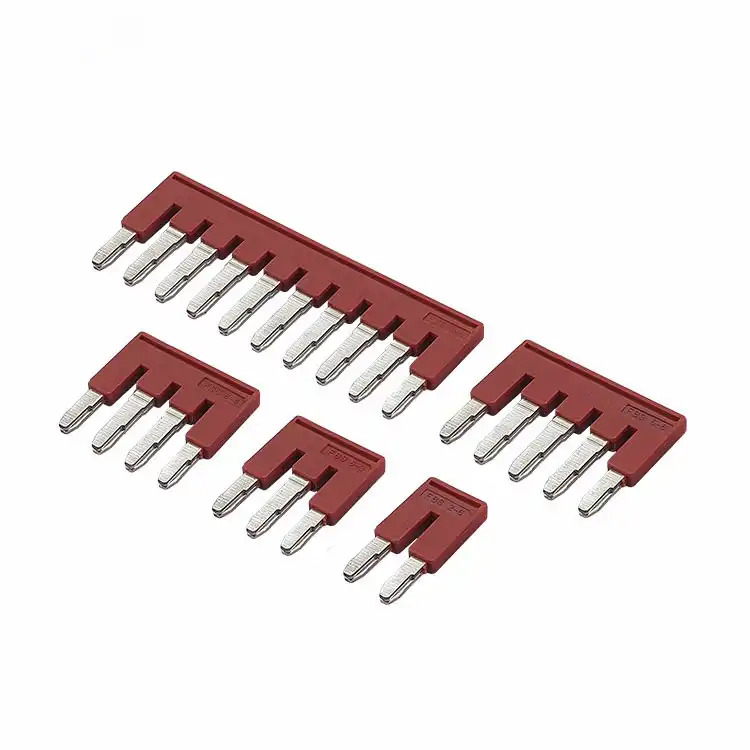
Jumpers and Bridging Accessories
Compatible jumpers electrically connect selected adjacent spring terminal blocks and distribute a common potential across multiple connection points.
- Connects selected terminal positions
- Distributes a common electrical potential
- Reduces repeated external wiring
- Available for different pole quantities
DIN Rails
DIN rails provide the mounting foundation for spring feed-through terminals, protective earth terminals, end brackets, and related cabinet components.
- Supports terminal block installation
- Available in different rail profiles
- Can be prepared to project length
- Must match the terminal mounting foot
Five Functions Required for a Complete Spring Terminal Strip
Each accessory performs a different role in the mechanical, electrical, insulation, or identification structure of the completed DIN rail terminal strip.
Select the Main Terminal Before Selecting Accessories
Confirm the Terminal Model
Identify the exact spring terminal series, model, connection function, and housing structure.
Check the Terminal Profile
Confirm width, height, side profile, bridge channel, marker slot, and mounting foot.
Define the Accessory Function
Determine whether the accessory is required for fixing, insulation, separation, marking, or bridging.
Confirm Compatibility
Verify the accessory model, quantity, installation position, and terminal-family compatibility.
Information to Confirm Before Ordering
Typical Items Included in a Spring Terminal Strip BOM
The exact quantity depends on the wiring diagram, terminal grouping, grounding positions, bridge layout, and marking requirements.
| Component | Typical Function | Information Required |
|---|---|---|
| Spring Terminal Blocks | Circuit connection, grounding, testing, or distribution | Model, function, wire size, and quantity |
| End Brackets | Secures the terminal group on the DIN rail | DIN rail type and number of terminal strips |
| End Plates | Closes exposed terminal sides | Terminal model and open-side positions |
| Partition Plates | Separates voltage levels or circuit functions | Separation positions and terminal profile |
| Jumpers and Bridges | Distributes a common electrical potential | Bridge pitch, pole quantity, and connected positions |
| Markers | Identifies terminal numbers and circuit functions | Marker format, text, numbering, and quantity |
| DIN Rail | Provides the mounting foundation | Rail profile, material, length, and quantity |
Similar-Looking Spring Terminal Accessories May Not Be Interchangeable
End plates, partitions, markers, jumpers, and end brackets can differ in terminal profile, mounting structure, bridge pitch, marker slot, height, width, and product-family compatibility. Select accessories according to the exact spring terminal series and model rather than appearance alone.
Spring Terminal Blocks for Industrial Applications
Spring terminal blocks are used in control panels, automation machinery, electrical cabinets, building systems, energy equipment, transportation infrastructure, and industrial production equipment. The correct terminal type should be selected according to the circuit function, conductor, installation density, maintenance method, and applicable project requirements.
Industrial Control Panels
Spring terminal blocks organize incoming power, control signals, relay circuits, PLC wiring, sensor connections, and protective grounding inside industrial control panels.
Automation Machinery
Automated machinery often contains repeated connections for sensors, actuators, motors, switches, valves, and control devices that must be clearly organized and accessible.
Electrical Cabinets
Electrical cabinets may require separate terminal groups for incoming circuits, control power, signal distribution, auxiliary wiring, grounding, and outgoing equipment connections.
Building Automation
Building-control cabinets connect heating, ventilation, lighting, access, monitoring, elevator, and energy-management devices through organized control and signal circuits.
Renewable Energy Systems
Spring terminal blocks can be used in control and auxiliary circuits within energy-storage cabinets, inverters, monitoring equipment, charging systems, and renewable-energy control units.
Transportation and Infrastructure
Transportation and infrastructure projects use terminal blocks in control cabinets, signaling equipment, monitoring systems, station equipment, roadside devices, and auxiliary circuits.
Common Terminal Functions Across Industrial Equipment
A single cabinet may use multiple spring terminal block types according to the electrical function of each circuit group.
Select the Terminal Direction According to the Wiring Scenario
| Application Scenario | Recommended Product Direction | Important Details to Confirm |
|---|---|---|
| PLC and relay control circuits | Spring feed-through terminal blocks | Wire size, conductor type, terminal width, marker system, and bridge requirements |
| High-volume machinery wiring | Push-in or efficient tool-operated spring terminals | Conductor preparation, direct-insertion capability, ferrules, and assembly procedure |
| Compact signal cabinets | Compact or double-level spring terminals | Total positions, terminal height, cabinet clearance, and marking access |
| Equipment protective grounding | Spring protective earth terminals | Grounding positions, conductor size, DIN rail compatibility, and terminal family |
| Shared control potential | Spring terminals with compatible jumpers | Bridge pitch, pole quantity, circuit positions, and separation requirements |
| Maintenance and test circuits | Disconnect or test spring terminal options | Required function, operating method, test access, and available model |
Application Information Required Before Product Selection
Industrial application names alone are not enough to select a terminal model. The actual wiring and project conditions should be reviewed before preparing the product list.
From Equipment Type to Complete Terminal Strip
Define the Equipment
Identify the cabinet, machine, system, or infrastructure application.
Separate Circuit Functions
Divide normal wiring, grounding, testing, and distribution circuits.
Confirm Conductors
Check wire sizes, conductor types, ferrules, and quantities.
Match Terminal Models
Select the connection type, dimensions, and DIN rail structure.
Complete the BOM
Add terminals, PE positions, markers, bridges, plates, and brackets.
Industry Name Alone Does Not Determine the Correct Terminal Model
Two machines in the same industry may use different conductor sizes, circuit functions, DIN rails, cabinet layouts, maintenance procedures, accessories, and project standards. Final spring terminal block selection should be based on the actual wiring requirements and product documentation.
SENTOP as Your Spring Terminal Block Manufacturer
SENTOP supports industrial customers with spring terminal blocks, protective earth terminals, multi-level terminals, matching DIN rail accessories, model identification, mixed-product BOM supply, OEM labeling, and project-based packaging. Product selection is organized according to the actual conductor, circuit function, terminal dimensions, DIN rail, and accessory requirements.
From Individual Models to Complete Spring Terminal Strip Kits
Customers may require one replacement model, several terminal sizes, or a complete DIN rail terminal-strip BOM. SENTOP can organize the product list according to the required functions, conductor sizes, grounding positions, bridge layouts, marking information, quantities, and packaging method.
Replacement matching should be confirmed according to the actual terminal function, conductor, electrical requirements, dimensions, DIN rail structure, and applicable project documentation.
Spring Terminal Block Supply for Different Project Requirements
Multiple Product Functions
Supply options can include spring feed-through terminals, protective earth terminals, multi-level terminals, and available functional terminal models.
Conductor-Based Matching
Product recommendations can be organized according to conductor size, conductor construction, ferrule use, and required insertion method.
Accessory System Support
Match end brackets, end plates, partitions, markers, jumpers, bridges, and rails to the selected terminal family.
OEM Labeling and Packaging
Support project-based product labels, customer item codes, quantity labels, grouped packing, and outer-carton information.
Sample and Bulk Orders
Support product evaluation, project samples, batch purchasing, mixed-model orders, and recurring supply plans.
Export Order Preparation
Organize model separation, quantity verification, accessory grouping, carton labeling, and shipment documentation according to the order.
Select the Supply Format That Matches Your Project
Customers can purchase individual products, mixed-model BOMs, accessory packages, or grouped terminal-strip kits according to the project installation and inventory method.
Individual Terminal Models
Separate spring terminal block models supplied according to the required product number and quantity.
Mixed-Model Project BOM
Multiple terminal types, sizes, colors, grounding models, and accessories organized within one order.
Terminal and Accessory Packages
Main terminal blocks supplied together with matching brackets, plates, markers, jumpers, and DIN rails.
Project-Grouped Kits
Products grouped according to cabinet number, machine, terminal strip, production batch, or customer item code.
From Product Information to Order Preparation
Clear product and project information helps reduce model mismatching and incomplete accessory lists.
Send Requirements
Provide models, photos, drawings, conductor sizes, quantities, specifications, or BOM files.
Review and Match
Compare terminal function, dimensions, wire range, DIN rail structure, and accessory system.
Confirm Product List
Finalize terminal models, accessory quantities, labels, packaging, and order requirements.
Prepare the Order
Organize production or supply, model separation, quantity checks, packing, and shipment preparation.
Looking for a Spring Terminal Block Manufacturer?
Send your existing model, product photos, conductor size, terminal function, DIN rail profile, accessory list, required quantity, and packaging requirements. SENTOP will help review the information and organize a suitable supply solution.
Quality Control for Spring Terminal Blocks
Spring terminal block quality control should cover the housing, spring-clamping mechanism, conductive components, conductor entry, operating structure, DIN rail mounting foot, terminal dimensions, accessory compatibility, product identification, quantity, and packaging information before shipment.
Verify the Terminal, Accessories and Order Information
Product inspection is not limited to checking the plastic housing. The spring mechanism, conductor entry, internal conductive parts, operating structure, rail mounting foot, terminal dimensions, model identification, and matched accessories should also be reviewed.
Inspection methods and acceptance requirements should be organized according to the selected product model, customer specification, project documentation, and order scope.
Key Areas to Inspect on Spring Terminal Blocks
Plastic Housing
Check the housing for cracks, deformation, abnormal color, incomplete molding, contamination, and visible damage.
Spring-Clamping Mechanism
Inspect the spring position, return movement, operating structure, conductor opening, and visible assembly condition.
Conductive Components
Review the position and visible condition of the internal conductive part and connection structure.
Conductor Entry
Check the wire-entry opening, conductor path, operating hole, push button, and connection-point identification.
Operating Structure
Confirm that the tool opening or push-button mechanism moves correctly and returns to the intended position.
DIN Rail Mounting Foot
Inspect the mounting profile, locking structure, housing condition, and compatibility with the intended rail.
Grounding Structure
For PE terminal models, check the grounding-foot structure, rail-contact area, housing identification, and product model.
Terminal Dimensions
Verify width, height, length, side profile, bridge pitch, marker position, and other model-related dimensions.
Accessory Compatibility
Check whether end plates, brackets, markers, jumpers, and partitions match the selected terminal family.
Model Identification
Confirm model number, product color, customer item code, label information, and packaging identification.
Quantity Verification
Compare product quantities, accessory quantities, mixed-model lists, and package counts with the order.
Packaging Information
Check product separation, inner labels, quantity labels, customer codes, carton information, and packing condition.
Typical Inspection Steps Before Shipment
The exact process may vary according to the terminal model, order quantity, customer requirements, accessory list, and packaging method.
Review Order Information
Confirm model numbers, colors, quantities, accessories, labels, and packaging requirements.
Inspect Product Appearance
Check housing condition, visible assembly, identification, and component completeness.
Verify Dimensions and Fit
Review product dimensions, rail mounting, accessory fit, and model-related profiles.
Check Connection Operation
Review the spring opening, conductor insertion, release movement, and final connection condition.
Verify Packing and Quantity
Check product separation, quantity, labels, accessory groups, cartons, and order completeness.
Product Area, Inspection Purpose and Verification Method
| Inspection Area | Main Purpose | Typical Verification Direction |
|---|---|---|
| Housing and Appearance | Identify visible damage, molding defects, contamination, or incorrect product color. | Visual inspection and comparison with the approved model or order information. |
| Spring and Operating Mechanism | Check the movement and visible condition of the conductor-clamping structure. | Operating check using the intended terminal opening or push-button method. |
| Conductor Entry | Confirm that the wire-entry position and connection path are complete and unobstructed. | Visual review and model-based conductor insertion check where required. |
| DIN Rail Mounting | Confirm the mounting foot matches the intended DIN rail profile and installation method. | Installation and removal check on a compatible rail. |
| Terminal Dimensions | Confirm the terminal matches the required model, panel space, and accessory system. | Dimensional measurement and comparison with the selected product data. |
| Accessories | Prevent mismatched end plates, brackets, markers, bridges, or partitions. | Physical fit review and terminal-family matching. |
| Model and Quantity | Confirm the correct products and quantities are prepared for the order. | Compare model labels, packing lists, quantities, and mixed-model BOMs. |
| Packaging | Protect the products and keep models, quantities, and project groups organized. | Check inner packing, labels, carton condition, and order separation. |
Verify Products and Accessories as One Complete Order
Inspection Requirements Should Match the Actual Product and Project
Different spring terminal block models may use different connection mechanisms, conductor ranges, terminal dimensions, DIN rail feet, grounding structures, accessories, and packaging methods. Inspection items should be confirmed according to the selected model, order specification, and customer requirements.
Organized Packaging for Spring Terminal Block Orders
Spring terminal block orders may include multiple terminal models, protective earth terminals, end brackets, end plates, partition plates, markers, jumpers, DIN rails, and customer-specific labels. SENTOP can organize products according to model, quantity, project, cabinet, machine, or terminal-strip requirements.
Packaging Arranged Around Your Purchasing and Assembly Process
Customers can purchase individual terminal models, mixed-model orders, matching accessories, or complete terminal-strip kits. Packaging can be arranged according to customer codes, product models, production batches, cabinet numbers, machine numbers, or specific BOM requirements.
Custom labels, barcodes, customer item codes, project kits, mixed-model packages, and special packing quantities should be confirmed before order preparation.
Packaging Options for Different Order Structures
Individual Model Packaging
One terminal or accessory model is packed according to the confirmed quantity and standard label information.
Mixed-Model Packaging
Multiple terminal sizes, functions, colors, and accessories are separated and identified within the same order.
Complete BOM Packaging
Main terminals, PE terminals, brackets, plates, markers, jumpers, and rails are prepared according to the BOM.
Cabinet or Machine Kits
Products are grouped according to cabinet, machine, terminal strip, installation area, or customer item code.
Typical Components Included in a Project Kit
The final kit content depends on the wiring diagram, conductor sizes, terminal quantities, grounding positions, bridge layout, separation points, marker system, and DIN rail requirements.
Identification That Can Be Added to Each Package
From Confirmed BOM to Shipment Preparation
Packaging is organized after the product list, quantities, labels, grouping method, and delivery requirements have been confirmed.
Review the Order List
Confirm models, quantities, colors, accessories, project groups, and packaging instructions.
Separate Product Models
Organize terminals and accessories according to model, function, color, and quantity.
Apply Package Labels
Add model, quantity, customer code, project, cabinet, or package identification.
Complete Inner Packing
Protect products and keep different models, accessories, and project groups separate.
Prepare Outer Cartons
Complete carton identification, quantity checking, packing review, and shipment preparation.
Match the Order Type with the Appropriate Supply Method
| Order Situation | Recommended Packaging Method | Information to Confirm |
|---|---|---|
| One standard terminal model | Standard model-based packaging | Model, color, quantity, package quantity, and label information |
| Multiple terminal models | Separate mixed-model packaging | Model list, quantity per model, colors, and separation requirements |
| Terminals and accessories | Complete BOM packaging | Terminal models, brackets, plates, markers, jumpers, DIN rails, and quantities |
| Multiple electrical cabinets | Cabinet-number grouping | Cabinet number, product list, quantities, labels, and package sequence |
| Machine production kits | Machine-based kit packaging | Machine number, BOM, batch quantity, customer codes, and assembly sequence |
| Customer inventory system | Customer-code labeling | Customer item codes, barcode format, quantity format, and label layout |
Packaging Checks Before Shipment
Confirm Special Packaging Requirements Before Order Preparation
Customer codes, custom labels, barcodes, project grouping, cabinet kits, package quantities, accessory sets, and recurring packaging formats should be confirmed before order preparation. Final packaging depends on the product list, order quantity, project structure, and shipment method.
Frequently Asked Questions About Spring Terminal Blocks
Find answers about spring terminal block operation, conductor compatibility, push-in wiring, DIN rail installation, protective earth terminals, accessories, model matching, mixed BOM orders, and project-based supply.
Confirm the Wiring Function, Conductor and Installation Structure
Similar-looking terminal blocks may use different conductor ranges, spring mechanisms, dimensions, DIN rail feet, bridge pitches, marker slots, and accessory systems. Final selection should be based on the exact model information and project requirements.
01 What is a spring terminal block?
A spring terminal block uses a spring-based clamping mechanism to hold the conductor against the conductive component. Depending on the product design, the connection may be operated with a tool, push button, or direct conductor insertion.
02 Are all spring terminal blocks push-in terminals?
No. Spring terminal blocks include several connection structures, such as spring-cage, push-button, tool-operated, and push-in designs. Direct insertion capability depends on the selected terminal model and conductor type.
03 What conductor types can be used?
Compatible conductors may include solid, stranded, flexible, or ferruled wires. The acceptable conductor construction and cross-section vary by terminal model. Check the product data before final installation.
04 Do flexible wires require ferrules?
Ferrule requirements depend on the conductor, terminal design, wiring procedure, and project specification. Flexible conductors may be used with ferrules where required, but the ferrule size and preparation should match the selected product documentation.
05 How do I select the correct wire size?
Confirm the conductor cross-section in AWG or mm², conductor construction, ferrule use, circuit function, and required electrical conditions. Then compare this information with the conductor range of the exact terminal model.
06 Can spring terminals be mounted on any DIN rail?
No. The terminal mounting foot must match the intended DIN rail profile and dimensions. Confirm the rail type, terminal foot, installation orientation, and available cabinet space before ordering.
07 What is a spring protective earth terminal?
A protective earth terminal connects the PE conductor to a compatible grounded DIN rail structure. The grounding foot, wire range, rail profile, terminal family, and required grounding positions should be confirmed.
08 Can jumpers connect several terminal positions?
Compatible jumpers can distribute a common potential across selected terminal positions. The jumper model, bridge pitch, pole quantity, terminal series, and connected positions must match the actual circuit layout.
09 Are accessories from different terminal series interchangeable?
Not necessarily. End plates, partitions, markers, jumpers, and brackets may differ in side profile, width, bridge pitch, marker slot, mounting structure, and terminal-family compatibility. Do not select accessories by appearance alone.
10 Can SENTOP help match an existing terminal model?
Model matching can be reviewed using the existing model number, brand, product photos, terminal dimensions, conductor size, circuit function, DIN rail profile, electrical requirements, and accessory information.
11 Can I order terminal blocks and accessories in one BOM?
Yes. A mixed BOM may include feed-through terminals, protective earth terminals, multi-level models, end brackets, end plates, partitions, markers, jumpers, and compatible DIN rails.
12 What information is required for a quotation?
Provide the product model or photos, circuit function, conductor size and type, required quantities, DIN rail profile, accessory list, electrical requirements, project standards, packaging instructions, and drawings or BOM files where available.
Details That Help Improve Product Matching
Check the Exact Product Data Before Final Installation
Conductor range, stripping length, connection method, electrical ratings, terminal dimensions, rail compatibility, accessories, and installation procedures vary by model. Final selection and installation should follow the applicable product documentation and project requirements.