
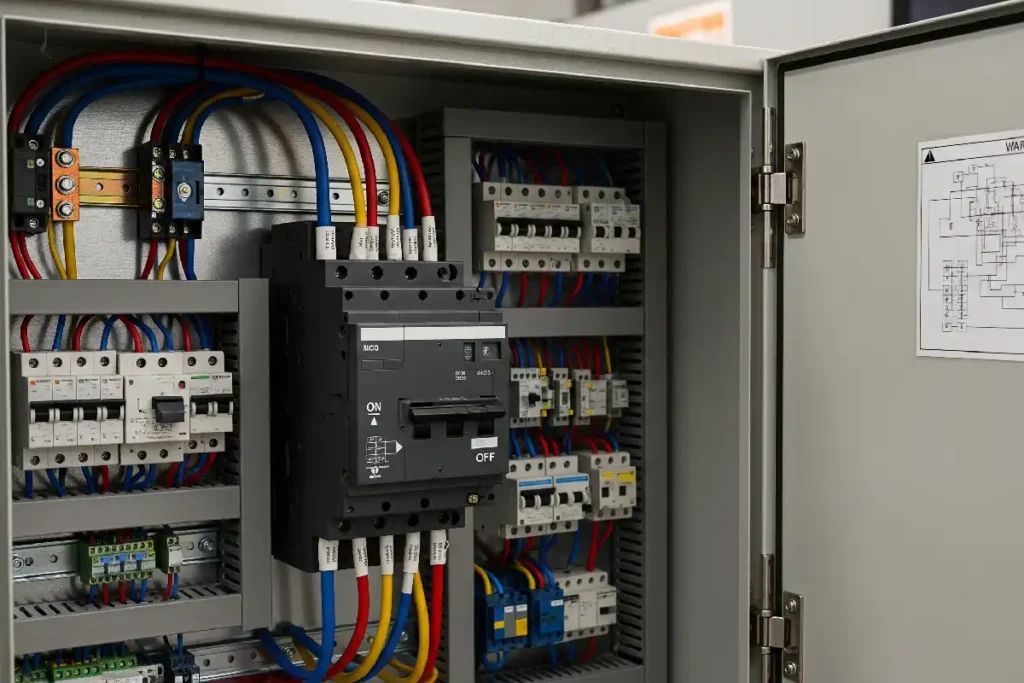
Choose Protection by Risk, Circuit Duty and System Data
Separate overload and short-circuit protection, residual-current protection, surge protection and isolation before comparing products. Then confirm voltage, conductors, fault level, load behavior, coordination, environment and target-market requirements.
No single protective device performs every safety function
A circuit breaker protects against specified overcurrent conditions. An RCCB or RCBO adds a residual-current function according to its design. An SPD limits transient overvoltage. A switch-disconnector provides isolation or switching within its declared duty.
The final arrangement can require several coordinated devices. Start from the risk and circuit, not the product name.
Overheating or cable damage
Review overload protection and conductor coordination.
Short-circuit energy
Calculate prospective fault current and breaking duty.
Earth leakage or shock
Define residual-current function, waveform and sensitivity.
Transient overvoltage
Review SPD type, voltage, location and coordination.
Match the device family to the problem it must solve
Choose the closest risk below. The result is a selection direction and enquiry checklist, not a final protection design.
Start with MCB, MCCB or ACB according to circuit position and duty
Coordinate the design current, conductor capacity, overload characteristic, load inrush and prospective short-circuit current. The breaker must interrupt the available fault current at the actual system voltage.
Choose RCCB or RCBO from the required function and connected load
An RCCB provides residual-current protection without integral overcurrent protection. An RCBO combines residual-current and overcurrent functions within its declared ratings. Waveform type, sensitivity and time behavior must suit the installation.
Build a coordinated SPD path from the exposure point to sensitive equipment
Choose the SPD from the AC or DC system, topology, maximum continuous operating voltage, exposure, installation location, protection level, surge-current duty, backup protection and coordination.
Use a declared switch-disconnector or isolating function for safe separation
Confirm whether the application requires isolation, emergency switching, load switching, local maintenance control or another defined function. Verify poles, AC/DC duty, utilization category, locking, accessibility and enclosure.
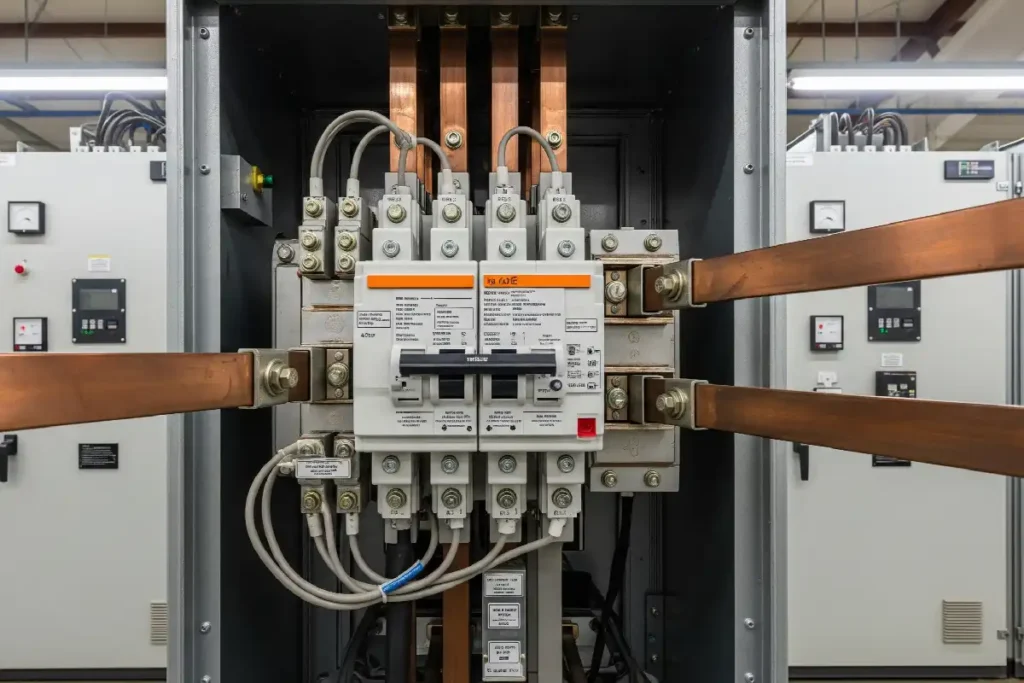
Choose the breaker from its position in the distribution system
MCB, MCCB and ACB categories can overlap in ratings. Circuit role, fault duty, protection settings, installation form and coordination usually provide a clearer starting direction than current alone.
Main incoming protection
Common starting direction: ACB or MCCB. Confirm source capacity, busbar rating, fault level, protection functions, settings and interlocking.
Submain and equipment feeders
Common starting direction: MCCB. Review conductor protection, adjustable trips, accessories, operating duty and downstream selectivity.
Final branch circuits
Common starting direction: MCB or RCBO. Match current, conductor, curve, inrush, fault rating, poles and any residual-current need.
Equipment-specific functions
Motors, power electronics, EV charging, PV, storage and sensitive equipment can require additional or specialized protection functions.
Complete the system checks before approving a model
Each gate can change the product family, rating or accessory package. Missing data should remain an open item, not an assumption.
Supply and earthing
AC or DC, nominal and maximum voltage, frequency, phases, neutral and TN, TT or IT arrangement.
Position and conductors
Main, feeder or final circuit; conductor material, cross-section, installation method and capacity.
Operating and inrush current
Design current, duty cycle, motor starting, transformer energization, LED drivers or capacitive input.
Prospective fault current
Calculate the short-circuit current at the device location and use the rating at the actual voltage.
Protection behavior
Overload pickup, delay, instantaneous response, residual-current sensitivity and time behavior.
Selectivity and backup
Use manufacturer curves and verified combinations where selectivity, cascading or backup protection is required.
Environment and fit
Temperature, altitude, enclosure, grouping, mounting, terminals, access, dimensions and IP requirements.
Standard and market
Exact model, certificate scope, standard edition, markings, target market, documents and approvals.
Know what each device does and does not do
The table describes common product directions. The exact model marking and documentation always take priority.
| Device family | Primary function | Key selection data | Do not assume |
|---|---|---|---|
| MCB | Overload and short-circuit protection for circuits within the exact product scope | Standard, voltage, current, poles, curve, Icn or applicable breaking data, conductor and environment | That every MCB suits industrial, DC, motor, isolation or residual-current duty |
| MCCB | Feeder, equipment or distribution protection with model-specific trip and accessory options | Frame, trip unit, Icu, Ics, settings, voltage, poles, accessories and coordination | That every MCCB is adjustable or suitable for every fault level and DC arrangement |
| ACB | Main or high-current switchboard protection with model-specific electronic protection and operating forms | Rated current, breaking data, trip functions, short-time withstand, fixed/draw-out form, interlocking and control power | That a large frame alone proves coordination, maintainability or project suitability |
| RCCB | Residual-current protection without integral overcurrent protection | Voltage, poles, rated current, Idelta n, waveform type, time behavior, standing leakage and upstream protection | That the RCCB protects the conductors against overload or short circuit by itself |
| RCBO | Residual-current and overcurrent protection in one declared product | All RCD data plus current, curve, breaking capacity, poles and conductor coordination | That any RCBO type is suitable for every electronic load or earthing system |
| SPD | Limits transient overvoltage and diverts surge current through a coordinated path | AC/DC, topology, type, Uc/Ucpv, Up, surge current, location, backup protection and conductor path | That an SPD provides conventional overload protection or can compensate for poor bonding |
| Switch-disconnector | Isolation and switching within the declared utilization duty | Voltage, current, AC/DC, poles, utilization category, locking, terminals, enclosure and accessibility | That it provides protection functions not stated in its product documentation |
Category names are starting points. Verify the product standard, exact ratings and certificate for the model being purchased. Similar housings can contain very different functions.
Residual-current and surge functions support the breaker system
These functions solve different risks and need their own selection data, installation rules and maintenance plan.
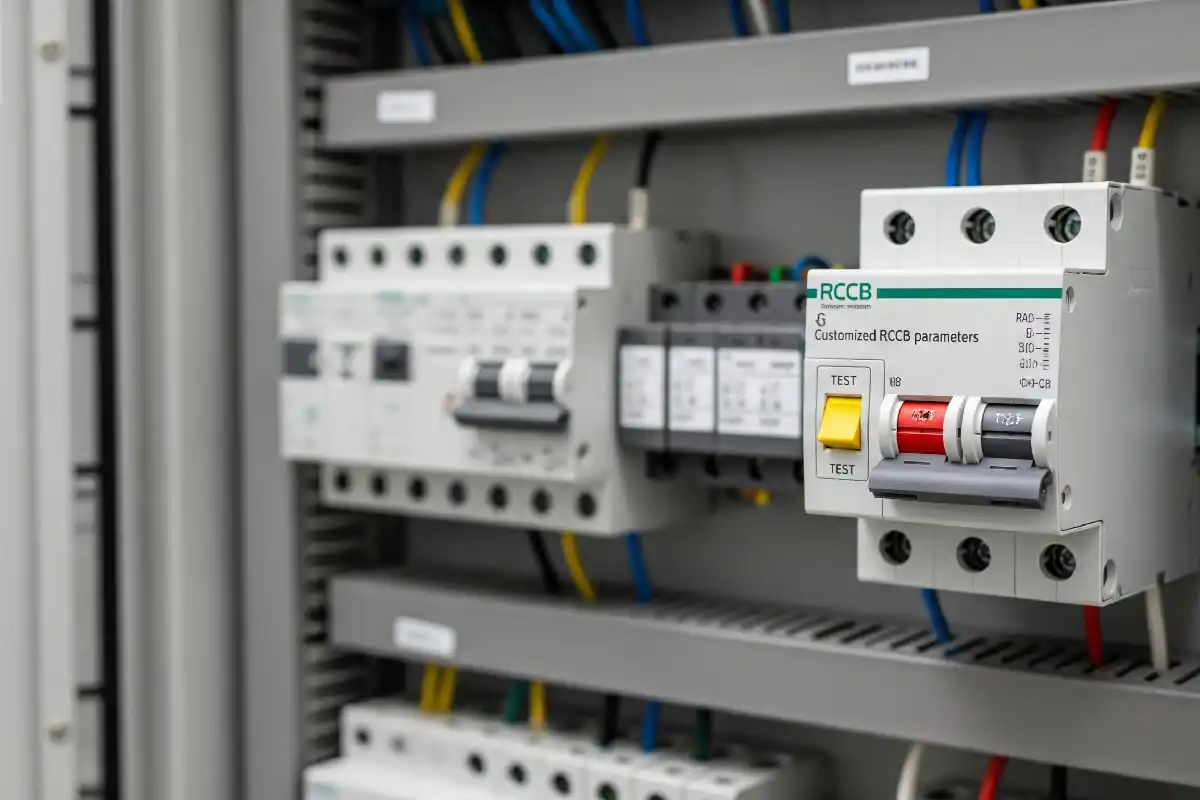
Match the RCD to the waveform and circuit
Define the required function, sensitivity, type, time behavior, poles, standing leakage, connected electronics and upstream overcurrent protection.
Review RCCB directions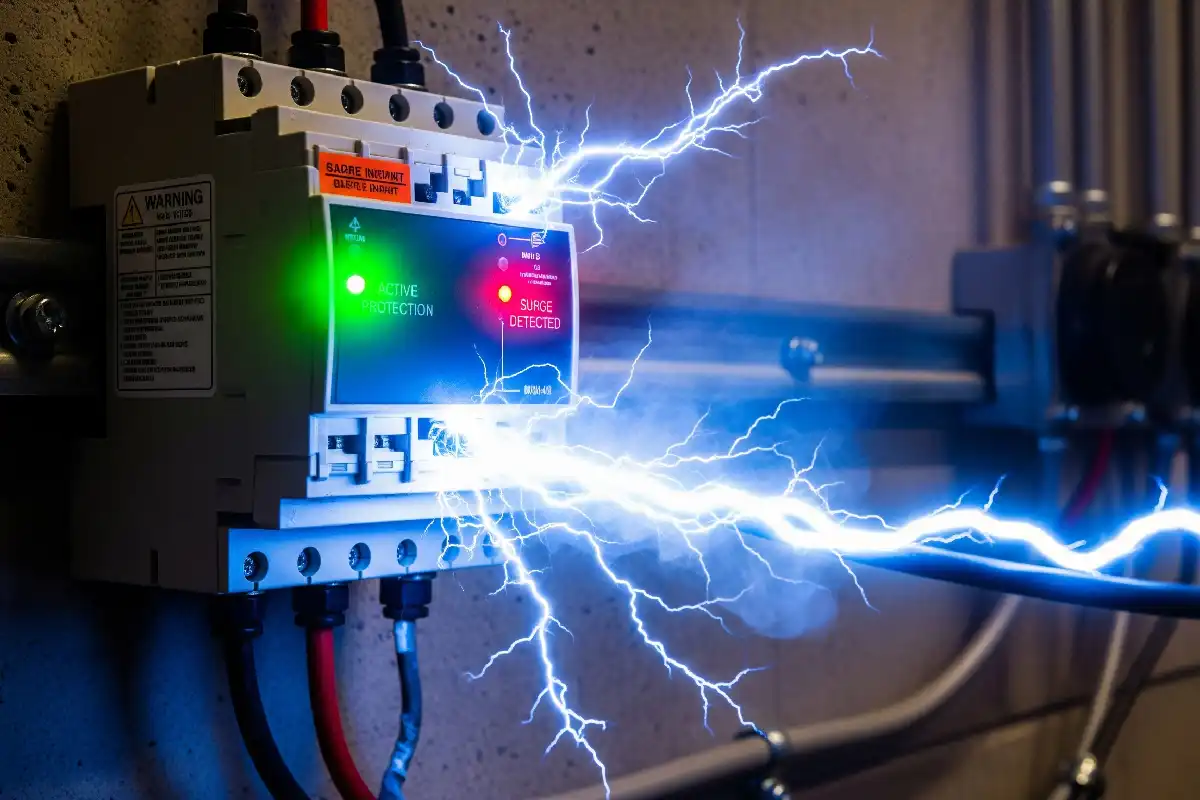
Coordinate SPDs from entry to load
Review exposure, topology, location, voltage protection level, surge-current duty, conductor length, bonding and backup disconnection.
Review SPD productsSix checks before comparing nameplates
A current value or kA marking has meaning only when read with its standard, voltage and declared rating definition.
Product scope and edition
Confirm the marked standard, edition used for certification, product class and whether the application falls within that scope.
AC/DC and voltage per pole
Check rated operational voltage, frequency, polarity, system maximum and any series-pole arrangement required for DC.
Rated current and reference conditions
Coordinate load and conductor data with ambient temperature, enclosure temperature, grouping and manufacturer derating.
Breaking or surge-current meaning
Distinguish Icn, Icu, Ics, Icw, In, Imax, Iimp and other model-specific ratings.
Trip, residual or SPD behavior
Review complete curves, settings, sensitivity, time delay, waveform type, voltage protection level and coordination data.
Certificate and target market
Match model reference, poles, accessories, ratings, certificate owner, required markings and destination-market acceptance.
Separate installation requirements from product testing
Installation standards define protection objectives and coordination. Product standards define requirements and tests for device families. Both must be applied with local rules and exact model documentation.
IEC 60364-4-43:2023
Addresses protection of conductors against the harmful effects of overcurrent and coordination of overcurrent protective measures.
Review IEC scopeIEC 60898-1:2015+A1:2019
Addresses AC circuit breakers for overcurrent protection in household and similar installations within its stated voltage, current and short-circuit scope.
Review IEC scopeIEC 60947-2:2024
Addresses low-voltage circuit breakers within its stated AC and DC voltage scope and installation by instructed or skilled persons.
Review IEC scopeIEC 61008-1:2024
Provides requirements and tests for RCCBs without integral overcurrent protection for household and similar uses within its scope.
Review IEC scopeIEC 61009-1:2024
Provides requirements and tests for RCBOs with integral overcurrent protection for household and similar uses within its scope.
Review IEC scopeIEC 61643-11:2025
Addresses requirements and test methods for SPDs connected to AC low-voltage power systems within its stated scope.
Review IEC scopeSend the circuit data, not only a product category
A one-line diagram, protection schedule or existing nameplate photo can shorten model matching and identify the missing engineering data.
Questions buyers ask before choosing protective devices
These answers explain category logic. Final selection still requires calculations and exact product data.
What is the first step in selecting electrical protection?
Identify the risk and required function first: overload and short circuit, residual current, transient overvoltage, isolation or an equipment-specific function. Then define the system, circuit, load, conductors and fault conditions.
Can one device provide every protection function?
Usually not. A project may need coordinated overcurrent, residual-current and surge protection plus a declared means of isolation. Verify which functions the exact product actually includes.
How do I choose between MCB, MCCB and ACB?
Use circuit position, current, conductor, prospective fault current, trip and coordination needs, installation form, accessories and applicable standard. MCB, MCCB and ACB rating ranges can overlap.
Is rated current enough to select a circuit breaker?
No. Also confirm voltage, AC/DC duty, poles, conductor capacity, load inrush, prospective short-circuit current, breaking rating, trip behavior, coordination, environment and approvals.
What is the difference between RCCB and RCBO?
An RCCB provides residual-current protection without integral overcurrent protection. An RCBO combines residual-current and overcurrent functions within its declared scope. Both still require correct selection for the circuit and load.
Does an RCCB protect against overload and short circuit?
An RCCB without integral overcurrent protection does not perform that function by itself. It requires coordinated overcurrent protection according to the installation design and exact product data.
Can an SPD replace a circuit breaker?
No. An SPD limits transient overvoltage and diverts surge current. It requires its own backup and short-circuit coordination but does not replace conventional conductor overcurrent protection.
Can a circuit breaker be used as an isolator?
Only when the exact breaker is declared suitable for isolation and the installation satisfies the applicable requirements. An OFF position alone is not sufficient evidence.
Why is prospective short-circuit current important?
The protective device must safely interrupt or withstand the fault duty at its installation point. Compare the calculated value with the exact product rating at the actual system voltage.
What should I send for a protection quotation?
Send the one-line diagram, voltage, phases, earthing system, load current, conductor, fault current, required functions, settings or curve, mounting, accessories, target market, quantity and destination.
Turn your one-line diagram into a clearer protection enquiry
Send the available circuit, load, fault, installation and commercial data. SENTOP can help organize the next product-matching step.