
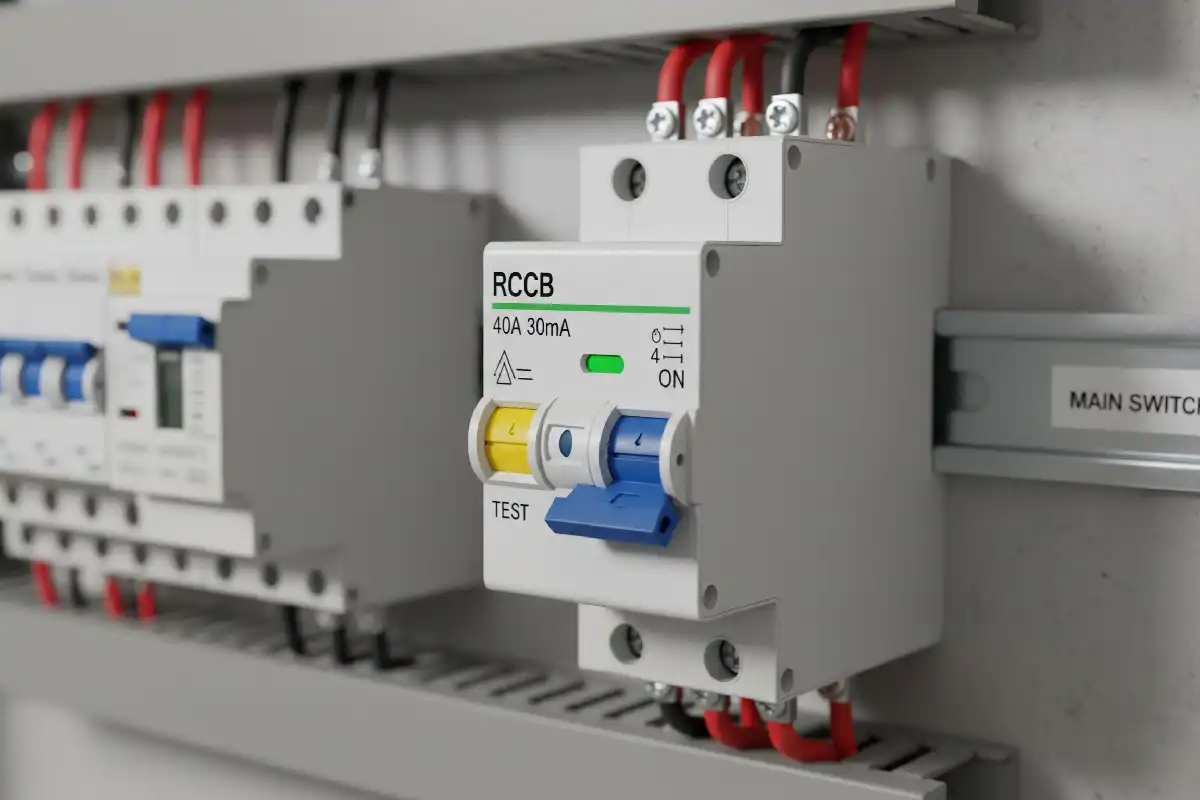
Residual Current Circuit Breaker Supplier
Residual Current Circuit Breakers for Leakage Protection That Fits the Load
Select an RCCB from the electrical system, residual-current waveform, rated residual operating current, poles and required time characteristic. SENTOP supports model matching, samples, OEM requirements and bulk supply for distribution boards, equipment and project applications.
What an RCCB Does
Disconnect when current leaves the intended circuit path
A residual current circuit breaker monitors the vector sum of current through the live conductors. When the residual current reaches the device's operating threshold under its specified conditions, the RCCB disconnects the circuit.
An RCCB does not normally include overload or short-circuit protection. It must be coordinated with a suitable fuse, MCB or other overcurrent protective device unless the selected product is an RCBO with integral overcurrent protection.
Residual-current detection
The RCCB compares the current passing through all monitored live conductors and responds to an imbalance within its declared characteristics.
Waveform compatibility
Electronic loads can produce sinusoidal AC, pulsating DC, mixed-frequency or smooth DC residual currents. The RCCB type must match the possible waveform.
Automatic disconnection
IΔn, operating time, earthing system and circuit conditions are coordinated to satisfy the applicable protection requirements.
Functional test
The test button checks the device's internal test circuit under the documented supply conditions; it does not replace installation verification.
RCCB Selection Process
Choose the RCCB from the load and protection objective
A correct request connects the circuit, possible residual-current waveform, sensitivity, time characteristic, poles, overcurrent coordination and destination requirements to one exact model.
System and destination
Confirm AC voltage, frequency, single- or three-phase supply, earthing arrangement, circuit role, installation rules and target-market approval.
RCCB or RCBO function
Decide whether residual-current protection alone is required or whether the device must also provide overload and short-circuit protection.
Residual-current waveform
Identify possible sinusoidal AC, pulsating DC, composite-frequency or smooth DC components from the connected equipment, then select Type AC, A, F or B accordingly.
IΔn and time characteristic
Select rated residual operating current and instantaneous or time-delayed behavior from the protection objective, coordination study and local installation rules.
Rated current and poles
Confirm In, 2P or 4P construction, neutral position, terminal arrangement, conductor size and whether every live conductor passes through the device.
Short-circuit coordination
Review conditional short-circuit current, backup protective device, prospective fault current and the exact coordination table because an RCCB has no integral overcurrent protection.
Supply behavior and test circuit
Confirm line/load orientation, functional dependence on line voltage where applicable, test-button supply path, ambient conditions, dimensions and certificates.
RCCB Product Directions
Start with the circuit and residual-current type
These product directions organize an enquiry. Final selection depends on the exact model's voltage, frequency, poles, In, IΔn, waveform type, time characteristic, conditional short-circuit rating and certificate scope.
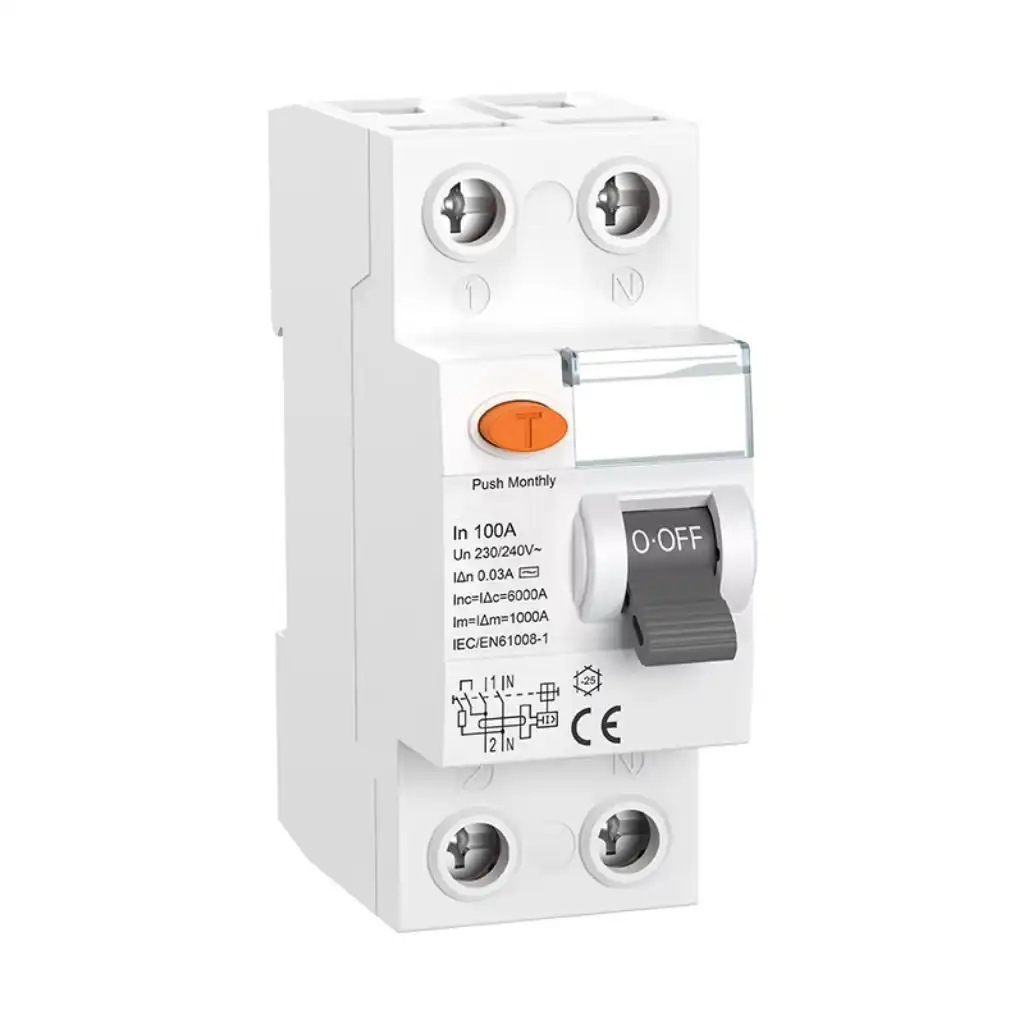
2-Pole RCCB
A compact direction for single-phase circuits where line and neutral must pass through and be disconnected by one residual-current protective device.
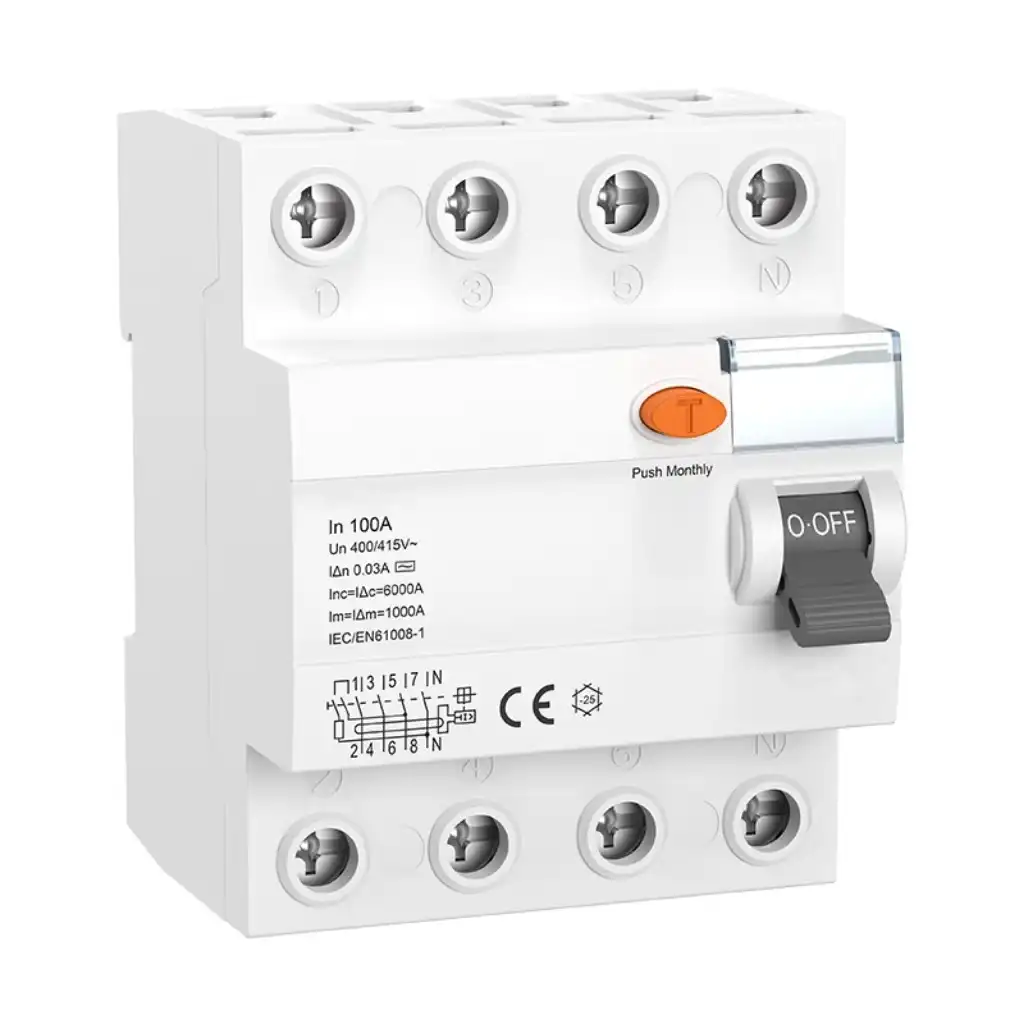
4-Pole RCCB
A direction for three-phase systems with a neutral where all live conductors are monitored and disconnected together according to the circuit design.
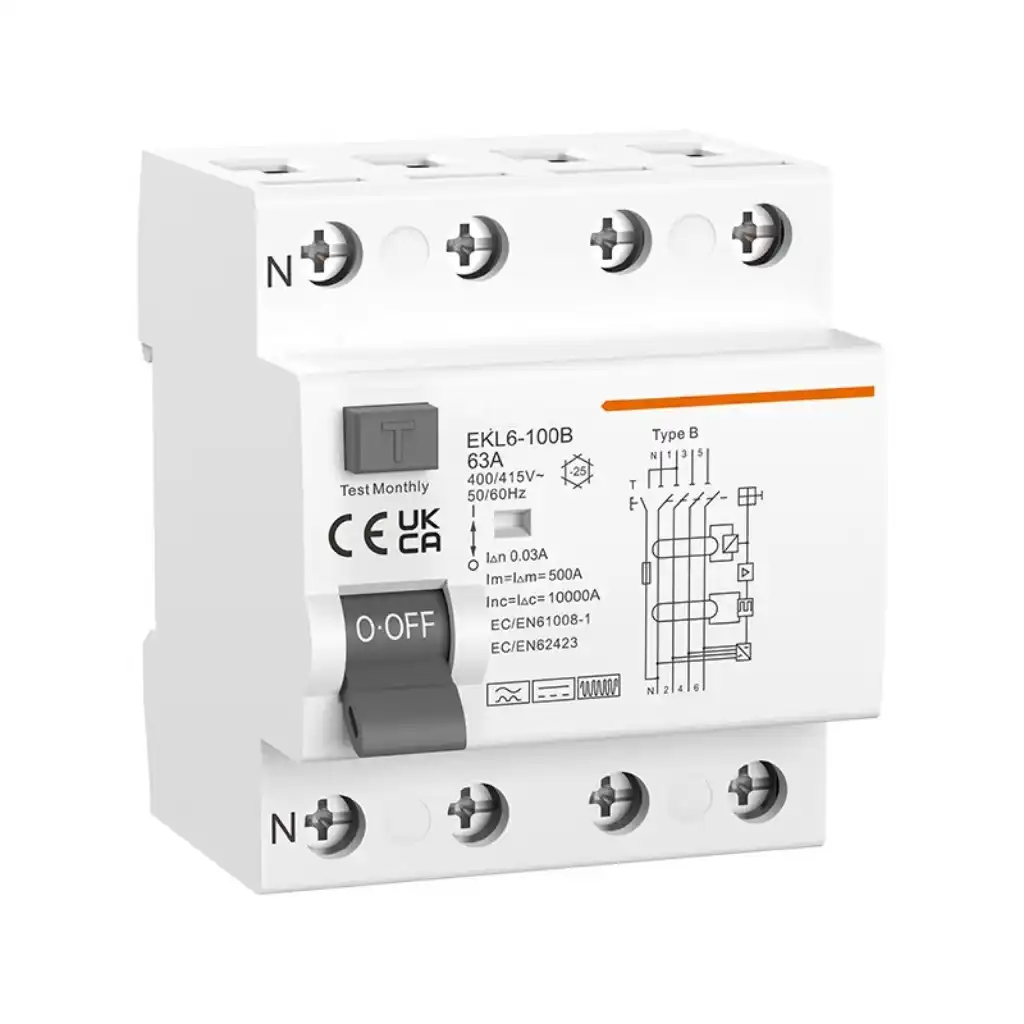
Type B RCCB
A residual-current direction for applications that can produce smooth DC and higher-frequency components within the selected device's declared capability.
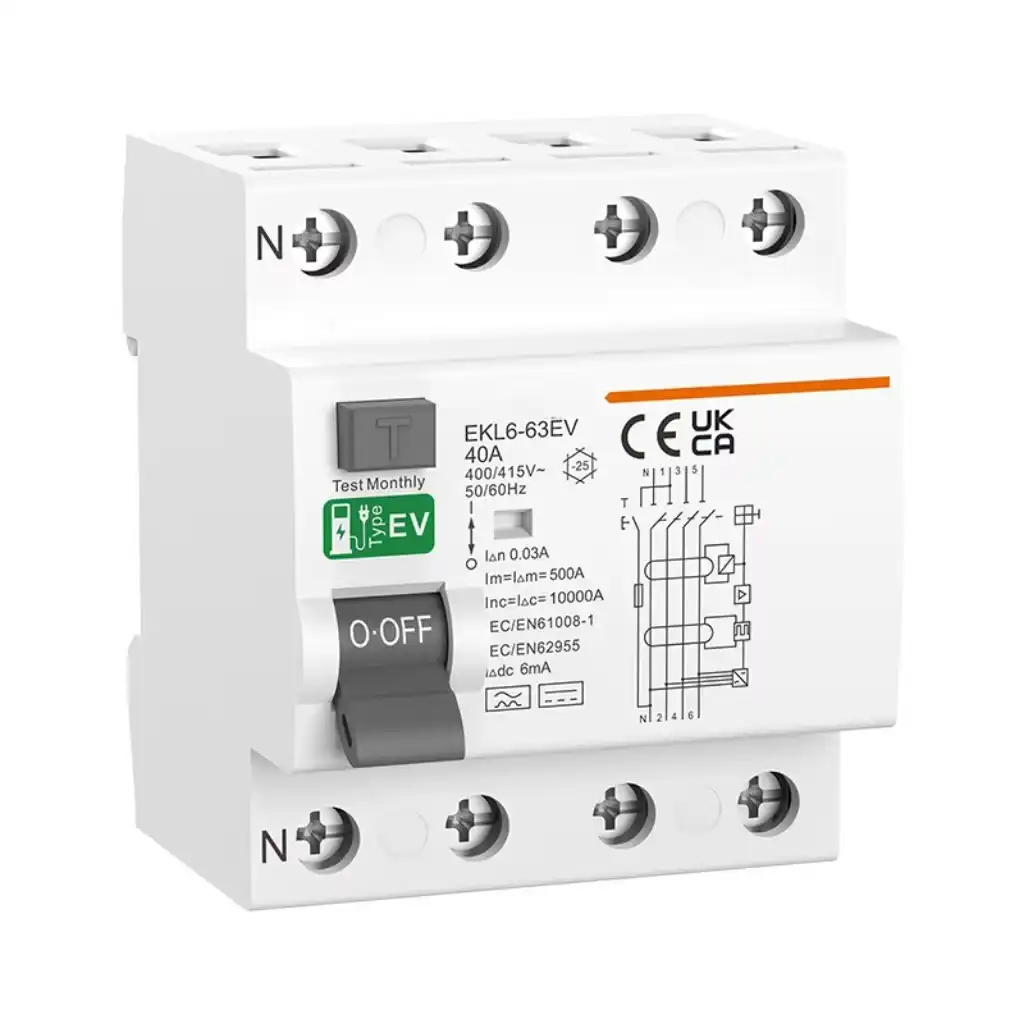
EV Residual Current Protection
A project direction for EV charging circuits where AC residual protection and DC residual-current detection must be coordinated with the charging equipment.
Replacement reminder: match more than rated current. Send the complete model, front and side photos, voltage, poles, In, IΔn, Type AC/A/F/B symbol, time-delay marking, conditional short-circuit data, terminals, dimensions and upstream protective device.
Residual Current Waveform Types
Match the RCCB type to the electronics behind the load
The type marking describes residual-current waveforms the device is designed to detect under its product standard. It is not the same as an MCB B, C or D tripping curve.
Type AC
Designed for residual sinusoidal alternating currents within the exact device's declared conditions.
Type A
Adds detection of pulsating DC residual currents to the Type AC capability under the applicable standard.
Type F
Extends Type A behavior for specified composite residual currents that may occur with selected single-phase frequency-controlled equipment.
Type B
Covers specified AC, pulsating DC, composite-frequency and smooth DC residual currents within its declared frequency range.
Do not select a waveform type by price or by the circuit name alone. Review the equipment's power-conversion topology, possible DC content, switching frequency, manufacturer instructions and local installation requirements.
RCCB Sensitivity and Product Standards
Read IΔn together with the complete circuit design
IEC 61008-1 covers RCCBs without integral overcurrent protection for household and similar uses within its stated scope. The protection objective, installation rules, product standard and exact certificate must all be verified.
10 mA
A high-sensitivity direction used only where the circuit, product documentation and installation requirements call for it. Review standing leakage and unwanted-tripping risk.
30 mA
A common additional-protection sensitivity for applicable final circuits. It does not make unsafe wiring or inadequate earthing acceptable.
100 mA
A project-specific direction that may support upstream or equipment protection objectives where permitted. It is not automatically a substitute for 30 mA additional protection.
300 mA
Often considered for selected upstream, equipment or fire-risk strategies, subject to the earthing system, leakage current, coordination and local rules.
Type S
A time-delayed selective RCCB direction for coordination with downstream RCDs. Verify the delay characteristic and selectivity tables, not only the S marking.
Sensitivity is not a stand-alone decision
Normal leakage from filters, drives, chargers and long cables can add together. Circuit grouping, RCD type, selectivity and expected standing leakage should be reviewed before choosing IΔn.
| Selection item | What to verify | Why it matters |
|---|---|---|
| IEC 61008-1 | RCCB without integral overcurrent protection, exact edition, model scope, voltage, current and certificate | It defines a different product function from an RCBO |
| IEC 61009-1 | Use when the requested product is an RCBO with integral overcurrent protection | RCCB and RCBO functions and markings must not be mixed |
| IEC 62423 | Additional requirements for Type F and Type B RCDs used with the applicable base standard | Waveform capability cannot be assumed from a generic RCD description |
| Ue, frequency and In | Operational voltage, 50/60 Hz data, rated current, poles, conductor and ambient conditions | The RCCB must carry normal load current without exceeding its declared conditions |
| IΔn and time | Rated residual operating current, instantaneous or delayed characteristic and operating-time data | Sensitivity and disconnection time determine the intended protection role |
| Conditional short circuit | Inc or declared short-circuit coordination and the specified backup protective device | An RCCB requires coordinated overcurrent and short-circuit protection |
| Approvals and marking | Certificate owner, model, RCD type symbol, test button, terminals, standards and destination market | Approval is confirmed per exact configuration, not by visual similarity |
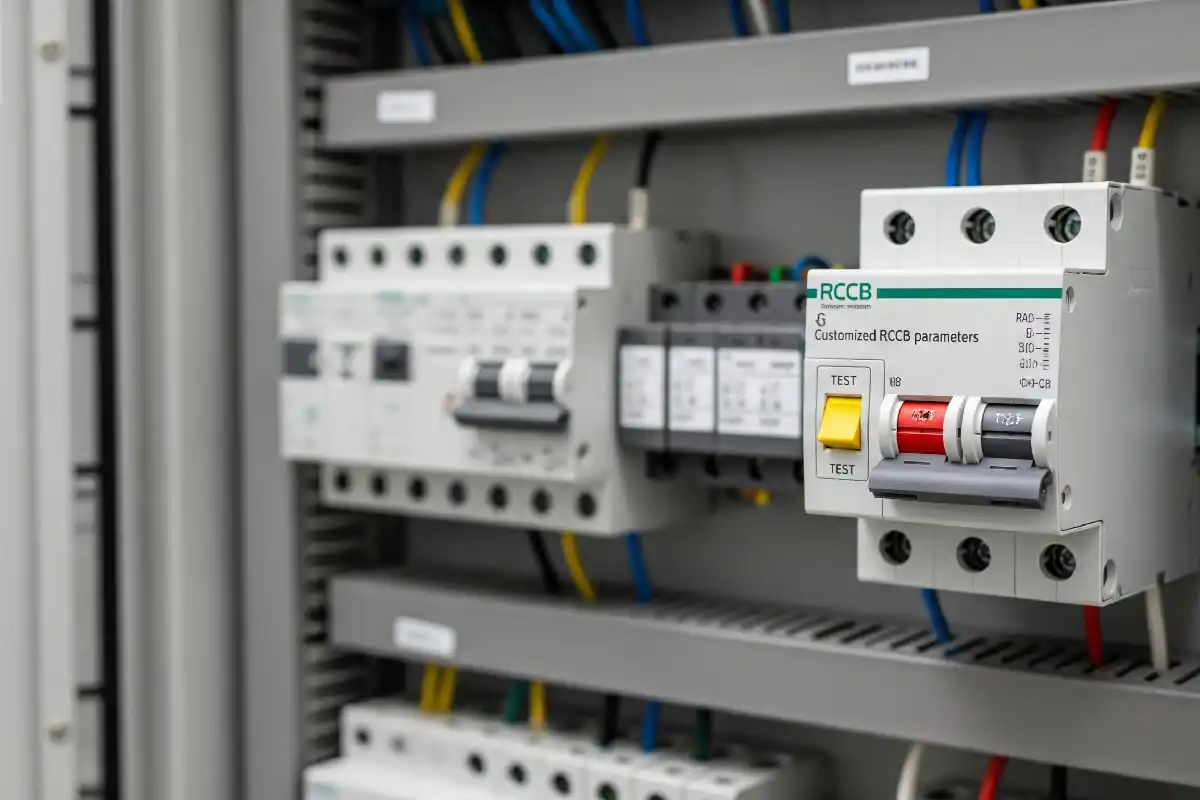
RCCB Applications
Define protection from the equipment behind the circuit
Two circuits with the same voltage and rated current can require different RCCB types. Power electronics, expected leakage, earthing, environmental conditions and local rules change the correct protection direction.
Residential and commercial final circuits
Confirm socket, lighting or equipment circuit rules, expected standing leakage, 30 mA requirements where applicable, waveform type and upstream MCB coordination.
Wet, outdoor and portable equipment
Review the environmental risk, applicable additional-protection rules, enclosure, earthing, disconnection time and qualified commissioning tests.
HVAC and frequency-controlled loads
Check the drive topology, single- or three-phase conversion, manufacturer-specified RCD type, leakage frequency spectrum and unwanted-tripping risk.
Solar, UPS and power converters
Identify smooth DC and higher-frequency residual components, transformer isolation, built-in monitoring and the inverter manufacturer's protection instructions.
Electric vehicle charging
Coordinate the RCD type with the charging mode, built-in DC residual-current detection, 6 mA RDC-DD function, circuit poles and destination requirements.
OEM distribution boards
Standardize the approved RCCB, upstream device, wiring diagram, neutral arrangement, test procedure, labels, certificates, packaging and repeat-order reference.
RCCB Quotation Checklist
Send the load and protection data for a faster quotation
You can begin with an existing model, nameplate photo, equipment manual, wiring diagram or basic circuit information. We will identify the remaining details that need confirmation.
Describe the circuit and load
Voltage, frequency, phase arrangement, earthing system, circuit purpose, equipment type, power-electronic topology and one-line diagram.
Define residual protection
RCCB or RCBO, 2P or 4P, In, IΔn, Type AC/A/F/B, instantaneous or Type S, neutral position and upstream protection.
Confirm the order
Existing model or sample, required standard, certificate, terminal capacity, dimensions, quantity, destination, OEM label, packaging and delivery schedule.
RCCB Installation and Verification
Install it as part of a coordinated protection system
Correct product selection is only one part of residual-current protection. Conductor routing, neutral separation, upstream protection, earthing and commissioning determine whether the installed system performs as intended.
RCCB Model Verification and Bulk Supply
Build repeat orders around an approved protection specification
For panel builders, equipment manufacturers and distributors, a stable RCCB order depends on configuration control. A similar housing does not confirm the same residual-current behavior or approval scope.
Related Low-Voltage Protection
Continue planning the complete distribution system
Residual Current Circuit Breaker FAQ
RCCB selection questions
Use these answers to prepare the technical information required for model matching, replacement and procurement.
How do I select the correct residual current circuit breaker?
Confirm AC voltage and frequency, earthing system, circuit and load type, rated current, 2P or 4P, IΔn, Type AC/A/F/B, instantaneous or delayed behavior, conditional short-circuit coordination, terminal capacity, standard and target-market approval.
What is the difference between an RCCB and an RCBO?
An RCCB provides residual-current protection without integral overcurrent protection. An RCBO combines residual-current protection with overload and short-circuit protection. Confirm the required function before comparing model size or price.
Does an RCCB protect against overload and short circuit?
Normally no. An RCCB must be coordinated with a suitable upstream or associated fuse, MCB or other overcurrent protective device according to the manufacturer's data. Use an RCBO when integral overcurrent protection is required.
What does 30 mA mean on an RCCB?
It is the rated residual operating current IΔn, not the normal load-current rating. A 30 mA RCCB is commonly used for additional protection in applicable circuits, but the installation must still satisfy earthing, disconnection and local wiring requirements.
What is the difference between Type AC and Type A RCCBs?
Type AC is designed for residual sinusoidal alternating currents. Type A also covers pulsating DC residual currents within its specified conditions and is often selected for many modern single-phase electronic loads. Follow the equipment and installation requirements.
When is a Type B RCCB considered?
Type B is considered when equipment can produce smooth DC or specified higher-frequency residual currents, such as selected drives, inverters or charging systems. Verify the equipment topology, IEC 62423 scope, frequency range and manufacturer instructions.
Should I select a 2-pole or 4-pole RCCB?
A 2-pole RCCB commonly monitors and disconnects line and neutral in a single-phase circuit. A 4-pole RCCB commonly serves a three-phase system with neutral. Every live conductor of the protected circuit must follow the exact wiring diagram.
Why does an RCCB trip repeatedly?
Possible causes include a real insulation fault, moisture, cumulative filter leakage, a shared or crossed neutral, a neutral-to-earth connection downstream, incorrect line/load wiring, an unsuitable RCD type or faulty equipment. Qualified personnel should isolate and test the circuits instead of repeatedly resetting the device.
How often should the RCCB test button be used?
Follow the interval printed on the device and stated in the manufacturer's instructions or local installation policy. The test button checks the internal test function under the required supply conditions; periodic instrument testing may also be required.
What information is needed to replace an existing RCCB?
Send the complete model, nameplate and clear photos, voltage, frequency, In, IΔn, 2P or 4P, Type AC/A/F/B symbol, S marking if present, short-circuit coordination, terminal layout, dimensions, upstream device and required quantity.
Can SENTOP support OEM and bulk RCCB orders?
Eligible RCCB configurations can be reviewed for samples, model matching, repeat supply, labels, packaging, documentation and other OEM requirements. Feasibility, approval scope, quantity and technical impact are confirmed for the requested model and destination.
RCCB Supply Support
Send your RCCB model, one-line diagram or panel requirements
SENTOP can review residual current circuit breaker requirements for new projects, replacements, samples, OEM switchboards, distributor ranges and bulk orders.