
Electrical Glossary for Clearer Product Selection
Search practical definitions for wiring, terminal blocks, circuit protection, transfer switches, panel meters, control panels and industrial communication. Each entry explains the term and the project data that still needs to be confirmed.
Alternating Current (AC)
Electric current whose direction and magnitude vary periodically. Most utility and industrial distribution systems use AC at a specified voltage and frequency.
Confirm: phases, frequency, line-to-line or line-to-neutral voltage and earthing arrangement.
Active Power (kW)
The portion of electrical power converted into useful work or heat. It is commonly expressed in watts or kilowatts.
Confirm: operating load, efficiency, power factor and whether the value is input or output power.
Apparent Power (kVA)
The product of RMS voltage and current in an AC system, without accounting for phase relationship. Equipment such as transformers and generators is often rated in kVA.
Confirm: phase system, voltage, current, power factor and load type.
Ambient Temperature
The temperature of the surrounding air under stated conditions. It affects conductor capacity, device ratings, enclosure heat rise and service life.
Confirm: minimum, maximum, altitude, ventilation, solar gain and grouping conditions.
Accuracy Class
A stated performance classification that limits measurement error under specified reference conditions. It does not describe accuracy under every installation condition.
Confirm: measured quantity, range, burden, temperature, input method and exact standard.
Automatic Transfer Switch (ATS)
A switching device or assembly that monitors power sources and automatically transfers a load according to defined logic and operating conditions.
Confirm: sources, poles, current, utilization duty, controller logic, transition type and protection.
Auxiliary Contact
A contact used for signalling, feedback, interlocking or control rather than carrying the main load current.
Confirm: NO/NC state, contact rating, isolation, mechanical relationship and required quantity.
Baud Rate
A signalling-rate setting used by serial communication devices. On a shared network, compatible devices must use matching communication parameters.
Confirm: baud rate, data bits, parity, stop bits, address and protocol.
Bill of Materials (BOM)
A controlled list of components, quantities and identifying information required to build or purchase an assembly.
Confirm: revision, exact model, accessories, alternatives, approvals and quantities.
Breaking Capacity
The fault current a protective switching device can interrupt under specified voltage, power-factor and test conditions.
Confirm: applicable value such as Icn, Icu or Ics, system voltage, fault level and standard.
Current Transformer (CT)
An instrument transformer that reproduces a scaled current for measurement or protection while providing isolation according to its design.
Confirm: primary/secondary ratio, accuracy class, burden, frequency, window size and safety procedure.
Current (A)
The rate of flow of electric charge, expressed in amperes. Selection uses more than the nominal load current because starting, fault and environmental conditions also matter.
Confirm: continuous load, inrush, duty cycle, conductor capacity and protection.
Cable Lug
A termination fitted to a conductor so it can be bolted or otherwise connected to compatible equipment.
Confirm: conductor material and size, stud size, palm geometry, plating, tooling and installation method.
Clearance Distance
The shortest distance through air between two conductive parts. Required clearance depends on voltage, transient conditions, environment and insulation coordination.
Confirm: working voltage, overvoltage category, pollution degree, altitude and applicable standard.
Coil Voltage
The specified supply voltage for operating the coil of a contactor, relay or solenoid. It is separate from the main circuit rating.
Confirm: AC/DC, voltage, frequency, tolerance, inrush and suppression method.
Commissioning
The controlled process of inspecting, testing, configuring and proving a system before it is placed into intended service.
Confirm: approved procedure, responsibilities, test evidence, settings, safety controls and handover records.
Contactor
An electrically operated switching device intended for frequent control of a main circuit under its specified utilization category.
Confirm: load type, operational current, poles, coil voltage, auxiliary contacts and duty.
Control Panel
An assembly containing electrical control, protection, power, terminal and communication components for a machine or process.
Confirm: governing standard, supply, load, fault rating, environment, enclosure and documentation.
Conductor Cross-Section
The nominal cross-sectional area of a conductor, commonly stated in mm²; AWG is another conductor-size system. Size alone does not establish ampacity.
Confirm: material, insulation, temperature, installation method, grouping and terminal range.
Creepage Distance
The shortest path along an insulating surface between conductive parts. It is influenced by voltage, material group and contamination conditions.
Confirm: working voltage, pollution degree, insulation material and applicable standard.
Direct Current (DC)
Electric current that flows with a consistent polarity. DC switching and protection ratings can differ significantly from AC ratings.
Confirm: voltage, polarity, grounded conductor, time constant and device DC rating.
DIN Rail
A standardized metal mounting rail used to organize terminal blocks, protective devices, relays, power supplies and other panel components.
Confirm: rail profile and material, mounting spacing, load, bonding and accessory compatibility.
Disconnect Terminal Block
A terminal block with a separable current path that supports circuit isolation or testing within its stated function.
Confirm: current, voltage, disconnection method, operating procedure, marking and accessories.
Digital Panel Meter
A panel-mounted instrument that converts an electrical input into a numerical display and may provide alarms, outputs or communication.
Confirm: measured quantity, input range, auxiliary supply, cutout, accuracy and outputs.
Derating
A reduction of a device or conductor rating when service conditions differ from the reference conditions used for its published rating.
Confirm: ambient temperature, altitude, enclosure, grouping, duty cycle and manufacturer curves.
Distribution Board
An assembly that divides an incoming electrical supply into outgoing circuits and normally contains switching and protective devices.
Confirm: system, incomer, outgoing circuits, fault rating, enclosure, neutral/PE arrangement and standard.
Dry Contact
A contact that does not supply its own voltage; it opens or closes an externally supplied circuit within its contact rating.
Confirm: contact rating, isolation, common reference, wetting current and NO/NC logic.
Earth Fault
An unintended conductive path between a live conductor and earth or exposed conductive parts. Fault magnitude depends on the system and fault-loop impedance.
Confirm: earthing system, protective conductor, fault path, disconnection time and protective device.
Electrical Energy (kWh)
Electrical power accumulated over time. Billing and energy-monitoring applications commonly express active energy in kilowatt-hours.
Confirm: import/export direction, tariff periods, CT/PT ratios, pulse constants and reset behavior.
Enclosure
A housing that supports and protects electrical equipment from defined external influences and limits access to hazardous parts.
Confirm: material, dimensions, IP or Type rating, heat, corrosion, cable entries and mounting.
Equipotential Bonding
Electrical connection of conductive parts intended to minimize hazardous potential differences under defined conditions.
Confirm: bonding path, conductor size, connection points, continuity test and governing installation rules.
Feed-Through Terminal Block
A terminal block that connects conductors across a single continuous current path, commonly used to organize field and panel wiring.
Confirm: conductor range, current, voltage, connection technology, rail and accessories.
Ferrule
A crimped sleeve used to prepare the end of a stranded conductor for a compatible terminal. It is not automatically required or permitted for every connection.
Confirm: conductor class and size, sleeve length, insulation collar, crimp tool and terminal approval.
Fuse
An overcurrent protective device that opens a circuit by melting an element when current exceeds its time-current capability.
Confirm: voltage, current, utilization category, breaking capacity, time-current curve and holder.
Frequency (Hz)
The number of AC cycles per second, expressed in hertz. Frequency affects motors, transformers, coils, meters and power supplies.
Confirm: 50/60 Hz or another value, device tolerance and variable-frequency operation.
Human-Machine Interface (HMI)
A device or software interface through which an operator views process information and interacts with a control system.
Confirm: display size, communication, tags, environment, user access and software compatibility.
Impedance (Ω)
The opposition a circuit presents to AC, combining resistance and reactance. Its magnitude and phase affect current and fault calculations.
Confirm: frequency, circuit configuration, conductor data and source/load characteristics.
Interlock
A mechanical, electrical or logical arrangement that prevents an unsafe or undesired operating combination.
Confirm: prohibited states, failure behavior, manual override, feedback and test procedure.
IP Rating
A classification describing enclosure protection against access to hazardous parts and ingress of solid objects and water under specified tests.
Confirm: required digits, installation orientation, cable entries, environmental exposure and certification evidence.
Jumper / Bridge
A terminal-block accessory used to electrically connect selected terminal positions and distribute a common potential.
Confirm: terminal family, pole count, current, spacing, insulation and removable/fixed design.
Line-to-Line Voltage
The voltage measured between two phase conductors. In a balanced wye system it differs from line-to-neutral voltage.
Confirm: system topology, nominal value, tolerances and which conductors a device connects across.
Line-to-Neutral Voltage
The voltage measured between a phase conductor and the system neutral. It must not be assumed from the line-to-line value without knowing the system.
Confirm: system configuration, neutral availability, earthing and voltage tolerance.
Manual Transfer Switch (MTS)
A transfer device operated by a person to connect a load to one of two or more sources while maintaining the required source separation.
Confirm: poles, current, utilization duty, handle arrangement, interlocking, enclosure and operating procedure.
Miniature Circuit Breaker (MCB)
A compact circuit breaker typically used for final or branch-circuit overcurrent protection within its stated standard and ratings.
Confirm: voltage, poles, current, trip curve, breaking capacity, installation and standard.
Molded Case Circuit Breaker (MCCB)
A circuit breaker in a molded insulating case, commonly used for higher-current distribution and available with fixed or adjustable protection.
Confirm: frame, trip unit, current, poles, Icu/Ics, accessories, settings and coordination.
Modbus RTU
A serial form of the Modbus application protocol commonly carried over RS485. The protocol and physical layer are related choices, not the same thing.
Confirm: RS485 wiring, baud/parity, device address, function codes and register map.
Modbus TCP
Modbus messaging carried over TCP/IP networks, generally using Ethernet infrastructure. Device data still depends on the manufacturer register model.
Confirm: IP settings, network architecture, unit identifier, register map and cybersecurity requirements.
Multifunction Meter
An instrument that measures several electrical quantities such as voltage, current, power, energy, frequency and power factor.
Confirm: system, CT/PT inputs, accuracy, display, auxiliary supply, outputs and communication.
Neutral Conductor (N)
A conductor connected to the neutral point of a system and capable of contributing to electrical energy distribution. It is not the protective conductor.
Confirm: system topology, switching/protection rules, harmonic current, identification and terminal rating.
One-Line Diagram
A simplified drawing that represents a multi-conductor power system with single lines and standardized symbols to show sources, distribution and protection.
Confirm: sources, voltages, ratings, protection, conductor data, earthing and revision.
Overcurrent
Current exceeding a specified value. It can result from overload, short circuit, earth fault or another abnormal condition.
Confirm: cause, duration, conductor capability, protective curve, fault level and coordination.
Overload
An operating condition in an electrically healthy circuit that causes current above the intended full-load value for a period of time.
Confirm: load profile, motor starting, thermal capacity, ambient condition and protection setting.
Open Transition
A transfer method that disconnects the load from one source before connecting it to another, creating a planned interruption.
Confirm: acceptable interruption, transfer timing, residual voltage, load type and source conditions.
Power Factor (PF)
The ratio of active power to apparent power under defined conditions. Low power factor increases current for the same useful power.
Confirm: displacement and total power factor, harmonics, operating load and measurement method.
Programmable Logic Controller (PLC)
An industrial digital controller that executes programmed logic to monitor inputs and control outputs for machines and processes.
Confirm: I/O types, supply, program platform, communication, environment and safety functions.
Protective Conductor (PE)
A conductor provided for protective earthing or bonding. It is part of the fault-protection path and is distinct from the neutral conductor.
Confirm: conductor size, continuity, connection method, identification, bonding path and test.
Prospective Short-Circuit Current (PSCC)
The current expected to flow at a point if a negligible-impedance short circuit occurred there, before protective interruption.
Confirm: source, transformer, conductor impedance, system voltage and calculation point.
RS485
A balanced serial electrical interface widely used for multi-device industrial communication. It defines electrical signalling, not the complete application protocol.
Confirm: topology, polarity, cable, termination, biasing, common reference and protocol.
Register
An addressed data location used by a device protocol to store or expose a value, status or setting. Register meaning is device-specific.
Confirm: register type, address convention, data type, word order, scaling and access rights.
Relay
An electrically operated device that changes one or more contacts in response to an input. Relays may serve control, interface, monitoring or protection functions.
Confirm: coil/input, contact arrangement and rating, isolation, timing and socket.
RCBO
A residual-current operated circuit breaker with integral overcurrent protection, combining residual-current and overcurrent functions in one device.
Confirm: poles, current, trip curve, residual-current type/sensitivity, breaking capacity and standard.
RCCB
A residual-current operated circuit breaker without integral overcurrent protection. Separate overcurrent protection is normally required as designed.
Confirm: rated current, poles, residual-current type/sensitivity, conditional protection and coordination.
Residual Current Device (RCD)
A general term for a device that responds when residual current reaches specified conditions. The exact product may be an RCCB, RCBO or another RCD type.
Confirm: device type, sensitivity, time delay, waveform type, system compatibility and overcurrent protection.
Reactive Power (kvar)
The oscillating component of AC power associated with energy stored and returned by inductive or capacitive elements.
Confirm: sign convention, load condition, harmonics, compensation and measurement method.
Resistance (Ω)
The opposition of a material or circuit element to current flow that converts electrical energy into heat under stated conditions.
Confirm: temperature, conductor length and area, material, connections and measurement method.
Scaling
The conversion that maps an input signal or transformer secondary value to the engineering value shown, transmitted or controlled.
Confirm: input endpoints, decimal position, CT/PT ratio, units, sign and output mapping.
Schematic Diagram
A functional drawing that uses symbols and connections to show how an electrical circuit operates, rather than its physical layout.
Confirm: reference designations, terminal numbers, cross-references, states, notes and revision.
Short-Circuit Current Rating (SCCR)
A marked current rating related to an equipment or assembly's ability to withstand a specified short-circuit condition under defined rules.
Confirm: complete assembly, voltage, protective device, component ratings, calculation/evaluation method and marking.
Short Circuit
An accidental or intentional conductive path of relatively low impedance between points that should normally be at different potentials.
Confirm: fault type and location, prospective current, disconnection time, equipment withstand and protection.
Selectivity / Discrimination
Coordination in which the protective device nearest a fault operates while upstream service is retained as intended, within proven limits.
Confirm: exact devices, settings, current range, manufacturer tables/curves and fault levels.
Shunt
A low-value precision resistor that creates a proportional voltage drop for current measurement, commonly in DC applications.
Confirm: current rating, millivolt output, accuracy, temperature, mounting, polarity and meter input.
Single-Phase System
An AC system using one phase relationship for supplying loads. Conductor and voltage arrangements vary by distribution system.
Confirm: voltage, line/neutral arrangement, frequency, earthing and load current.
Surge Protective Device (SPD)
A device intended to limit transient overvoltage and divert surge current according to its type, ratings and installation.
Confirm: AC/DC system, SPD type, Uc, Up, discharge current, backup protection, leads and earthing.
Switchgear
A general term for switching, controlling, protecting and isolating electrical circuits and equipment, either as devices or assemblies.
Confirm: voltage class, assembly type, fault rating, service conditions, standard and verification.
Spring-Clamp Terminal
A terminal connection that uses spring force to maintain conductor contact. Push-in and tool-operated designs are different implementations.
Confirm: conductor type/range, stripping length, ferrule use, actuation and accessory family.
Screw Terminal
A connection in which a screw-actuated clamping element secures the conductor. Correct preparation and tightening are essential.
Confirm: conductor range, torque, tool, number of conductors, inspection and retightening instructions.
Terminal Block
An insulating assembly of one or more terminals used to connect and organize conductors, often as part of a modular rail-mounted system.
Confirm: function, conductor, current/voltage, connection method, rail, spacing and accessories.
Test Terminal
A terminal designed to support defined testing, measurement or isolation operations using compatible plugs, links or disconnect elements.
Confirm: circuit function, sequence, touch protection, accessories, rating and operating procedure.
Three-Phase System
An AC system with three phase quantities displaced in time, widely used for generation, distribution and industrial loads.
Confirm: line and phase voltage, frequency, neutral, earthing, phase sequence and balance.
Tightening Torque
The turning moment specified for a screw or bolted connection. The correct value supports reliable clamping without damaging the connection.
Confirm: exact model, conductor, tool accuracy, units, access and manufacturer instruction.
Trip Curve
A time-current characteristic showing how a protective device responds to different current levels. A letter alone is not the complete curve.
Confirm: exact device, standard, thermal and instantaneous regions, ambient conditions and tolerances.
True RMS
A measurement method intended to determine the effective value of a waveform, including specified non-sinusoidal shapes within the instrument limits.
Confirm: bandwidth, crest factor, range, waveform, accuracy and input method.
Voltage (V)
The electric potential difference between two points. A voltage value is meaningful only when the reference points and system are known.
Confirm: AC/DC, phase relationship, nominal/maximum value, frequency, polarity and tolerance.
Voltage Transformer (VT / PT)
An instrument transformer that reproduces a scaled voltage for measurement or protection while providing isolation according to its design.
Confirm: primary/secondary voltage, ratio, accuracy, burden, connection, frequency and insulation level.
4–20 mA Current Loop
An analogue signal method in which the measured range is represented by current, commonly from 4 mA at the lower endpoint to 20 mA at the upper endpoint.
Confirm: loop power, active/passive devices, load resistance, polarity, isolation and scaling.
Similar words can describe different selection decisions
Use the distinction to frame the question, then check the exact standard and product documentation for the project.
kW, kVA and kvar
kW is active power, kVA is apparent power and kvar is reactive power. Power factor connects these quantities in AC systems.
MCB and MCCB
Both are circuit breakers. An MCB is generally compact and used for branch/final circuits; an MCCB covers broader current, fault and trip-unit options. The actual standard and ratings decide suitability.
RCD, RCCB and RCBO
RCD is the general family term. An RCCB provides residual-current protection without integral overcurrent protection; an RCBO includes overcurrent protection.
Contactor and transfer switch
A contactor frequently controls a load circuit within its utilization duty. A transfer switch selects between power sources and must maintain the required source separation and operating sequence.
RS485 and Modbus
RS485 describes an electrical serial interface. Modbus describes application messaging. Modbus RTU is often carried over RS485, but neither term alone defines the whole network.
CT ratio and meter range
The CT ratio describes primary-to-secondary current transformation. The meter range and settings determine how that secondary signal is interpreted and displayed.
Neutral and protective earth
Neutral can carry operating current as part of energy distribution. PE is provided for protective earthing or bonding. They are not interchangeable.
IP rating and product approval
An IP rating addresses defined ingress/access tests for an enclosure. It does not by itself confirm electrical performance, market approval or suitability of the complete installed assembly.

A familiar symbol does not confirm a complete product match
When reviewing an existing model or preparing an RFQ, record the full label and the circuit in which it operates. A single current or voltage value can refer to different duties.
Use the product function first, then confirm the electrical data
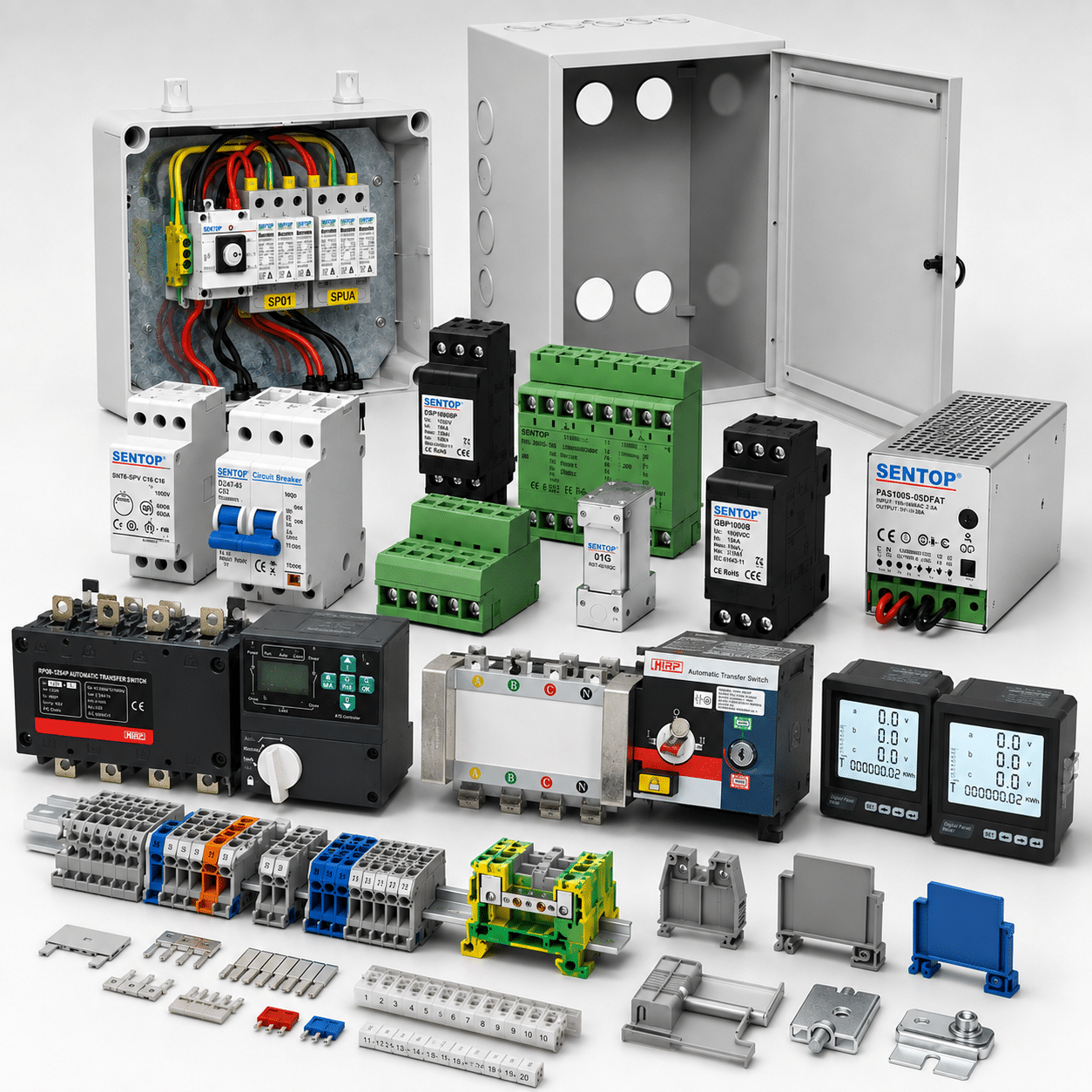
SENTOP's core supply ranges are terminal blocks and wiring accessories, automatic and manual transfer switches, and digital panel meters. Selected circuit protection, control and distribution products can also be reviewed as part of one BOM.
Use official vocabulary and specifications when precision matters
This glossary uses plain-language explanations for practical communication. For contracts, design, conformity assessment and safety decisions, refer to the current official publication and the exact product documentation.
IEC Electropedia
The online International Electrotechnical Vocabulary (IEC 60050) is the IEC's official source for standardized electrotechnical terms and definitions across many subject areas.
Search IEC ElectropediaIEC standards
Product and installation standards define terms together with scope, ratings, tests and conditions. Use the standard that applies to the exact equipment and market.
Review IEC publication guidanceModbus Organization
Official Modbus specifications separate application-protocol requirements from serial-line and TCP/IP implementation guidance.
View Modbus specificationsManufacturer documentation
Datasheets, installation instructions, trip curves, register maps, certificates and accessory tables establish model-specific conditions that a general glossary cannot replace.
Send the term together with the actual application
A product family name is a useful start. Add the circuit, ratings, installation and commercial requirements so SENTOP can review a practical direction.
Questions about technical terminology
These answers help use the glossary correctly when comparing products, reading labels and preparing specifications.
Is this electrical glossary a replacement for IEC standards or local electrical codes?
No. It is a practical orientation tool. Final design, installation, safety and conformity decisions must use the applicable current standard, local rules, manufacturer documentation and competent engineering review.
Why can the same electrical term have more than one meaning?
Meaning can change with product family, standard, country and technical context. For example, a current value may be a continuous rating, operational current, frame rating or short-circuit value. Always read the term together with its symbol, standard and conditions.
What is the difference between a product category and a model specification?
A category such as terminal block, transfer switch or panel meter identifies the general function. The model specification confirms conductor range, voltage, current, poles, inputs, dimensions, approvals, accessories and other exact conditions.
Which data should I send when asking for a replacement model?
Send clear front and side label photos, existing model, dimensions, wiring or one-line diagram, terminal arrangement, electrical ratings, application, target market and required quantity. A product photo alone may not show the critical rating or accessory configuration.
Does a higher current rating always mean a better electrical product?
No. The rating must match the duty, conductor, fault level, enclosure, temperature, standard and coordination. Oversizing can also create fit, protection, measurement or cost problems.
Are RS485 and Modbus RTU the same thing?
No. RS485 is an electrical serial interface, while Modbus RTU is an application messaging format commonly carried over serial networks. A working system also needs compatible wiring, settings, addresses and register maps.
Can I select a terminal block only by wire size?
No. Also confirm conductor material and class, current, voltage, connection technology, rail, circuit function, ambient conditions, marking, bridges, end accessories and applicable approvals.
What is the fastest way to clarify an unfamiliar abbreviation?
Record the complete abbreviation, nearby symbols, product model, manufacturer, standard marking and the circuit where it appears. Search the exact product documentation first, then compare it with an authoritative vocabulary such as IEC Electropedia.