27-Point ATS Maintenance Checklist (With Torque & Test Specs)
IEEE 493 field data attributes roughly 85% of automatic transfer switch failures to deferred maintenance — loose lugs, carbonized contacts, and uncalibrated timers that never

IEEE 493 field data attributes roughly 85% of automatic transfer switch failures to deferred maintenance — loose lugs, carbonized contacts, and uncalibrated timers that never

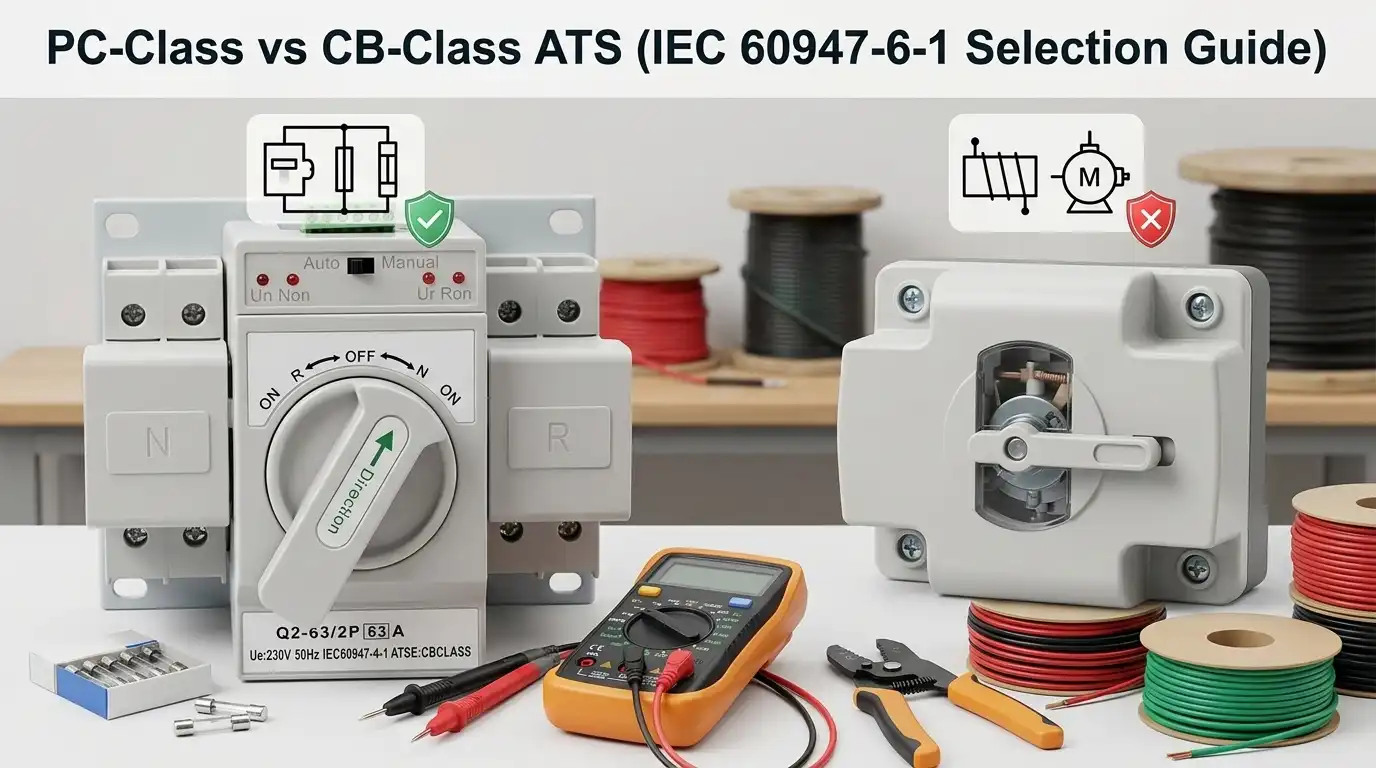
Roughly 80% of automatic transfer switch specifications outside North America reference the ATS IEC 60947-6-1 standard — yet most engineers can’t explain what separates a

Roughly 30 kA of fault current flowing for three cycles — that is the kind of stress a UL 1008 automatic transfer switch must survive

An automatic transfer switch reacts to a utility failure in roughly 6 to 12 cycles of AC power — about 100 to 200 milliseconds —

Roughly 68% of automatic transfer switch failures trace back to just three points: pitted contactor contacts, a burned transfer coil, or a dead control board

Roughly 70% of unplanned downtime in mission-critical facilities traces back to improper transfer switch behavior, not the generator itself — and that single statistic explains

Expect to pay between $1,800 and $4,200 for a typical residential automatic transfer switch installation, while manual switches run $400 to $1,300 installed — and the gap

The average automatic transfer switch price for a quality residential or light commercial unit sits between $280 and $485 — well under the $500 threshold

Hospitals lose an average of $636,000 per hour during unplanned power outages, according to Ponemon Institute downtime research — and most of those losses trace back to

Facility managers quoting an ATS retrofit upgrade cost 2026 are seeing wide swings — anywhere from $4,800 for a basic 200A controller swap to north

An ATS transfers load in 50 to 500 milliseconds using mechanical contactors, while an STS completes the same handoff in under 4 milliseconds via solid-state

Power outages cost U.S. businesses an estimated $150 billion annually, and roughly 70% of standby generator failures trace back to transfer switch issues — not

Roughly 70% of data center and hospital ATS specifications written in the past five years default to PC-class — yet nearly a third of those
![Complete ATS Transfer Time Specification Guide [With Codes]](https://6598bcb4.delivery.rocketcdn.me/wp-content/uploads/2026/05/qw.Complete-ATS-Transfer-Time-Specification-Guide-With-Codes.webp)
NFPA 110 Level 1 emergency systems demand a transfer to standby power within 10 seconds — yet most commercial ATS units operate in a 3 to 6

Roughly 70% of commercial ATS installations in North America still ship as 3-pole with a solid neutral, yet misapplying that default in a separately derived

Undersize your ATS by even 15% and you will trip the switch during the first real outage — a mistake that costs facility managers an

Nearly 30% of industrial control panel failures trace back to undersized or misrated terminal connections, according to field data from NFPA 79 incident reviews. Getting the terminal

Field data from a 2023 Rockwell Automation service report found that roughly 34% of unplanned PLC downtime traces back to the control panel — and terminal connections

Roughly 60% of UL 508A panel rejections I’ve reviewed trace back to a single cause: terminal blocks that look compliant but fail one of seven

Loose terminal screws cause an estimated 30% of low-voltage control panel failures, according to field data from UL and IEC 60947-7-1 commissioning reports — and
![9 Terminal Block Faults Explained [Symptoms, Causes, Fixes]](https://6598bcb4.delivery.rocketcdn.me/wp-content/uploads/2026/04/6.9-Terminal-Block-Faults-Explained-Symptoms-Causes-Fixes.webp)
Roughly 30% of unplanned control-panel downtime traces back to a single failure point most engineers underestimate: the humble screw terminal. Effective terminal block troubleshooting comes

A 20-amp terminal block strip 12 way 24 way provides 12 independent circuits across 24 screw contacts — two contacts per position, wired as input and output
![7 Proven Advantages of Push-In Terminal Blocks [Tested]](https://6598bcb4.delivery.rocketcdn.me/wp-content/uploads/2026/04/4.7-Proven-Advantages-of-Push-In-Terminal-Blocks-Tested.webp)
Bench testing by Phoenix Contact shows push-in terminations cut wiring time by up to 50% versus screw clamps — and that’s just the headline number. The real

A two-tier terminal block can cut DIN rail real estate by roughly 50% compared to single-level equivalents — which is why panel builders working in

Wrong terminal block selection accounts for roughly 30% of panel failures I’ve diagnosed on industrial retrofit jobs — usually from undersized current ratings or incompatible

Roughly 68% of control panels built to UL 508A in North America now standardize on DIN rail terminals, yet barrier strips still dominate marine, transportation,

Roughly 60% of unplanned downtime on low-voltage control panels traces back to a wiring component that costs less than $5 — the terminal block. The
SENTOP Team
Typically replies within minutes
Do you want to learn more about our products or services?
Contact Us
🟢 Online | Privacy policy
Contact Us