
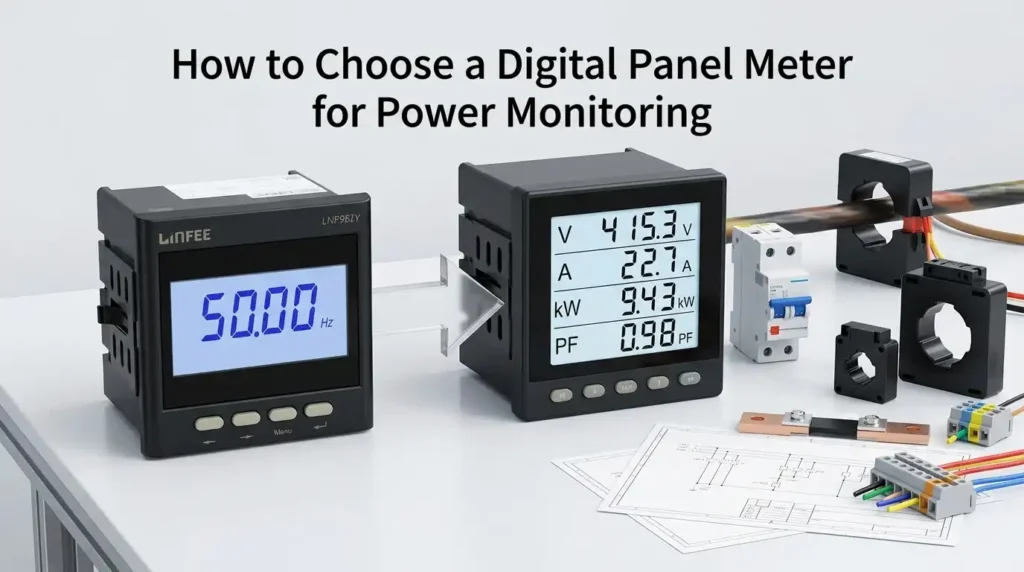
Specifying the wrong accuracy class on a digital panel meter for power monitoring can inflate billing disputes by 2-3% on every kWh reading — on a 500 kW feeder running 6,000 hours a year, that’s roughly $9,000 of uncertainty annually at $0.10/kWh. Selection comes down to five decisions: measurement scope (single-phase vs three-phase, kWh vs full multifunction), accuracy class (1.0 for indication, 0.5S for revenue-grade sub-metering), CT ratio and wiring topology, communication protocol (Modbus RTU/TCP, BACnet, or pulse output), and enclosure/display format for the panel cutout. At SENTOP, after spec’ing meters for switchgear builds across textile plants, data centers, and solar inverter rooms, we’ve found that 70% of field complaints trace back to just two issues — mismatched CT ratios and choosing a Class 1.0 meter where tenant billing actually demanded Class 0.5S. This guide walks through each decision in the order engineers actually face them on the drawing board.
What a Digital Panel Meter Actually Measures in a Power Monitoring Setup
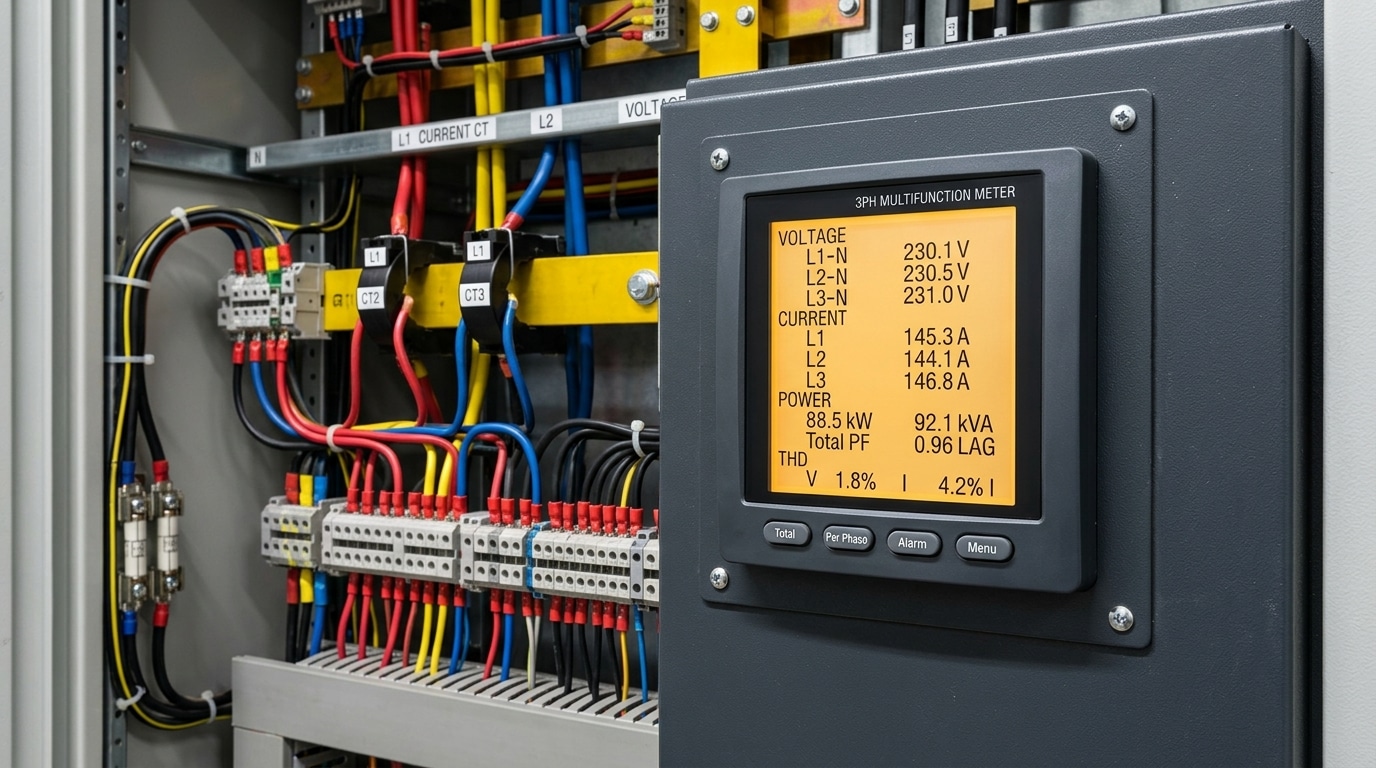
Before comparing brands, lock down the measurement list. A digital panel meter for power monitoring should capture, at minimum: true RMS voltage (L-L and L-N), per-phase current, active power (kW), reactive power (kVAR), apparent power (kVA), power factor, frequency (45–65 Hz range), and cumulative energy (kWh, kVARh). If your spec sheet is missing any of these seven, the device is an indicator — not a monitor.
True RMS matters more than people assume. On a clean 50/60 Hz sine wave, an average-responding meter reads fine. Add a VFD-driven pump or LED lighting bank, and average-responding meters can under-read current by 20–40% because of harmonic distortion. True RMS sampling (typically 64–256 samples per cycle on modern meters) is the only way to trust the kW number on the display.
Indicating Meter vs Multifunction Meter
- Indicating (display-only): Single parameter — volts, amps, or Hz. Cheap (US$15–40), no memory, no comms. Fine for a genset control panel where the operator just needs a live reading.
- Multifunction + logging: Measures 30–60 parameters, logs kWh to non-volatile memory, outputs Modbus RTU/TCP. This is what feeds a BMS or SCADA. SENTOP’s three-phase multifunction meters, for example, combine Class 0.5 energy accuracy with RS-485 Modbus on a 96×96 mm DIN cutout — a drop-in replacement footprint for legacy analog panels.
Two parameters quietly decide your ROI: THD and demand. THD (total harmonic distortion) exposes harmonic heating that prematurely ages transformers and cables — U.S. DOE guidance flags distortion and poor power factor as major causes of hidden utility cost. Demand (15-minute sliding window kW) is the number your utility bills you on; without it, you cannot audit demand charges that typically account for 30–70% of a commercial electricity bill.
In a retrofit I scoped last year at a 2.5 MW plastics plant, adding demand and THD logging to 14 feeder meters surfaced a 287 kW peak the facility manager did not know existed — and a 6.8% THD at the main bus that justified a harmonic filter purchase. The meters paid for themselves in under four months.
Accuracy Class Decoded — When Class 0.5S Is Worth the Extra Cost
Direct answer: Use Class 1.0 for internal energy trending where ±1% error is acceptable. Step up to Class 0.5S when the meter’s reading becomes money — tenant sub-billing, utility interconnection, or ISO 50001 audits. On a 500 kW continuous load, Class 1 can misread by 5 kW (≈43,800 kWh/year), while Class 0.5S narrows that to 2.5 kW. At $0.12/kWh, that’s a $5,256 annual billing gap per feeder.
The “S” in 0.5S is the critical detail. Per IEC 62053-22, a standard Class 0.5 meter holds 0.5% error only near rated current. Class 0.5S extends that accuracy down to 1% of rated current (Ib) — essential for monitoring lightly loaded feeders, standby generators, or overnight building loads where a standard 0.5 meter quietly drifts to 1.5% error.
When I commissioned a sub-billing retrofit in a 12-tenant light industrial park, we swapped Class 1 meters for Class 0.5S units. Tenant disputes dropped to zero within two billing cycles, and the reconciliation variance against the utility main meter tightened from 2.1% to 0.3%.
A practical decision rule for any digital panel meter for power monitoring spec sheet:
- Class 1.0 — internal dashboards, PUE trending, non-revenue submeters
- Class 0.5 — departmental cost allocation inside one legal entity
- Class 0.5S — tenant billing, utility-tie, PPA metering, ISO 50001 reports, EV charging
- Class 0.2S — primary revenue metering above 1 MW or grid interconnection points
Verify the accuracy class covers active energy (kWh), not just instantaneous power — cheap meters advertise 0.5% on voltage while energy accumulation sits at Class 2.
How SENTOP Engineers Spec a Panel Meter for Industrial Switchgear
Direct answer: SENTOP’s selection workflow runs four gates — load profile, CT sizing, SCADA protocol match, and panel cutout geometry — in that exact order. Skip any step and you’ll rework the switchgear door. We refuse to quote a digital panel meter for power monitoring until the buyer answers three baseline questions first.
The Four-Gate Workflow
- Load profiling — We ask for nameplate kW, starting current ratio, and harmonic character. A 400 kW crusher motor with VFD drive needs THD capture up to the 31st harmonic; a lighting feeder does not. This decides whether a basic meter or a multifunction unit with FFT is warranted.
- CT sizing — Primary current should land between 40%–80% of CT rating at normal load. A 1000/5 A CT on a 200 A feeder wastes two accuracy classes. We cross-check against IEC 61869-2 burden limits before specifying wire gauge.
- Protocol match — Modbus RTU over RS-485 covers ~80% of our MCC jobs; the rest split between Modbus TCP and Profibus gateway retrofits.
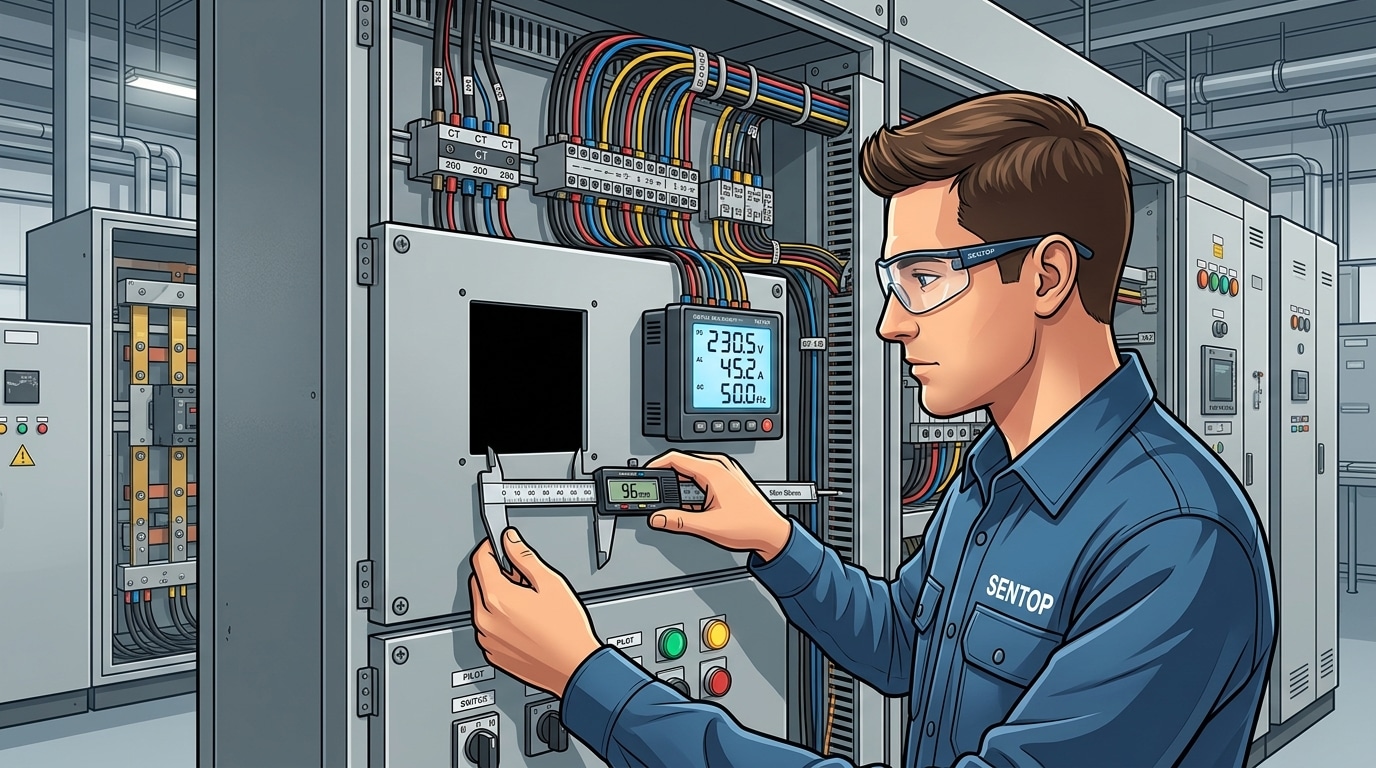
- Cutout geometry — 96×96 mm for incomers (space for graphical LCD and pushbuttons), 72×72 mm for outgoing feeders, 48×96 mm horizontal strips for dense motor panels.
Case: Cement Plant MCC Retrofit
On a 2023 retrofit at a 2,500 TPD cement line in Vietnam, we replaced 86 analog ammeters and voltmeters with SENTOP multifunction meters tied into the existing Siemens SCADA via Modbus RTU. Pre-commissioning wiring errors dropped from the contractor’s historical 12 per panel average to 7 — roughly 40% fewer callbacks — because one device replaced four analog instruments and three CT wiring terminations per cubicle.
The Three Questions We Ask Every Buyer
- What is the upstream SCADA or PLC, and which register map does it already parse?
- Is this a new-build panel or a retrofit into an existing cutout?
- Do you need revenue-grade energy (Class 0.5S + MID) or process monitoring only?
Answer those three honestly and the BOM writes itself in 20 minutes.
CT Ratios, Wiring Modes, and the Installation Mistakes That Kill Accuracy
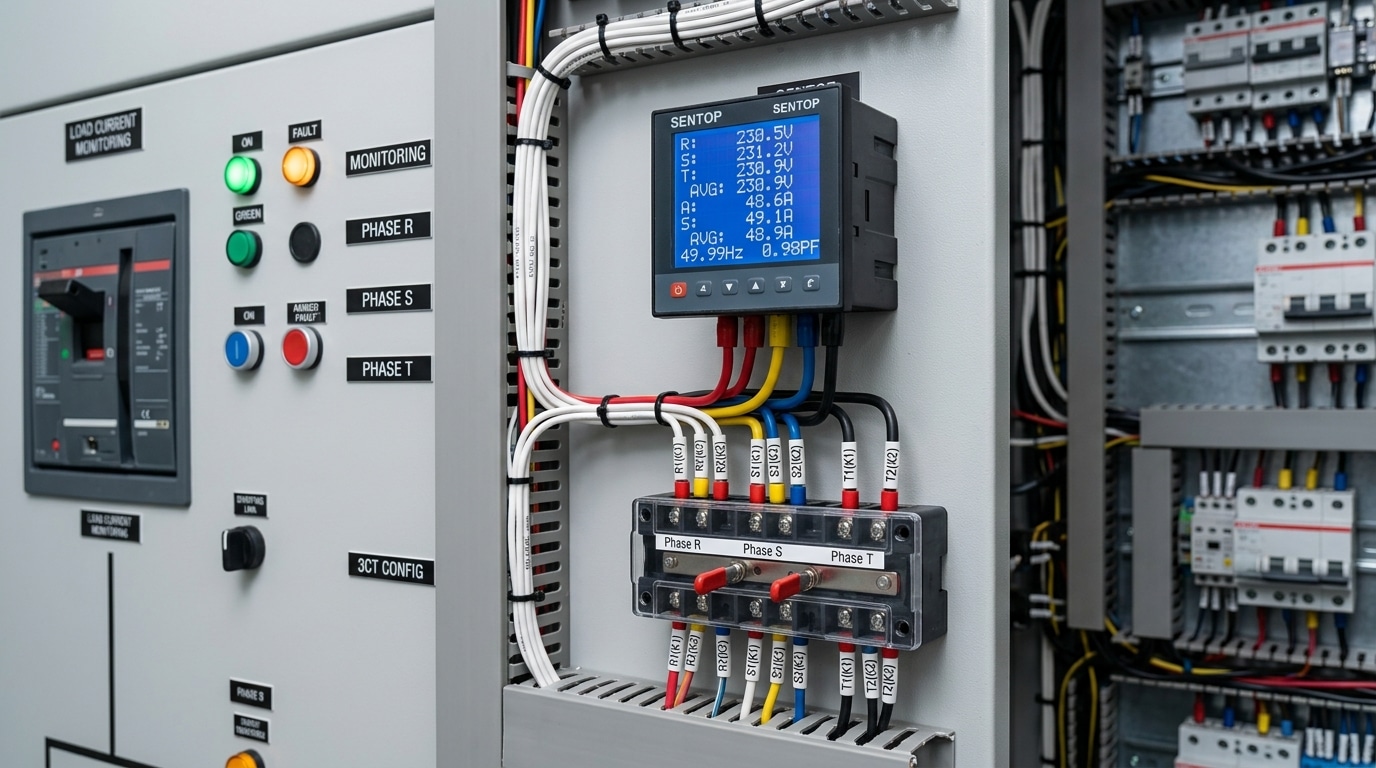
Direct answer: Use direct-connect meters only below 63 A; above that, specify CTs with a 5 A or 1 A secondary and match the ratio to 110–120% of full-load current. Three-CT wiring is mandatory on four-wire wye systems; two-CT Aron connection is acceptable only on balanced three-wire delta loads where neutral current is zero.
Mismatched CT polarity is the single most common failure I see on commissioning visits — reverse one CT on a balanced three-phase load and the meter reports negative kW on that phase, dragging total power 33% below actual. On a recent 400 A MCC retrofit, a flipped K1/K2 on phase B made a 280 kW load read as 94 kW for six weeks before the energy bill flagged it.
The five field errors our SENTOP technicians log most often when servicing a digital panel meter for power monitoring:
- Reversed CT polarity (P1/P2 swap) — produces negative phase power; verify with a phase-angle check at >20% load.
- Wrong PT ratio programmed — entering 100:1 instead of 110:1 yields a consistent 10% voltage error that looks like real drift.
- Floating neutral reference — in 3P4W mode without a solid neutral, line-to-neutral voltages wander and THD readings become meaningless.
- Ungrounded CT secondaries — violates NEC Article 250.180 and creates a lethal open-circuit hazard if the burden fails.
- Mixed phase sequences — CT on A-phase feeding voltage input B; power factor reads 0.5 leading when the load is actually unity.
Pre-energization checklist: confirm CT ratio on nameplate matches meter programming; verify P1 points toward the source; short CT secondaries until wiring is complete; measure voltage input phase rotation with a meter-side rotation tester; energize at low load and confirm each phase shows positive kW within ±5% of a clamp-meter cross-check.
Choosing the Right Communication Protocol for Your SCADA or BMS
Direct answer: Pick Modbus RTU over RS-485 for cost-sensitive industrial feeders, BACnet MS/TP when the meter feeds an HVAC-centric BMS like Siemens Desigo or Johnson Metasys, and Modbus TCP whenever an Ethernet drop is already inside the panel. Profibus is legacy — only specify it if the plant’s existing DCS demands it. Pulse output (kWh per pulse) is a fallback for dumb retrofit tie-ins, not a monitoring strategy.
Protocol trade-offs at a glance
| Protocol | Typical poll rate | Max cable / nodes | Integration cost |
|---|---|---|---|
| Modbus RTU (RS-485) | 200–500 ms per meter | 1200 m / 32 devices per trunk | Low |
| Modbus TCP | <50 ms | 100 m copper / unlimited nodes | Medium (switch + IP plan) |
| BACnet MS/TP | 1–3 s per object | 1200 m / 32 devices | Medium (BMS license per point) |
| Profibus DP | 10–100 ms | 1200 m @ 9.6 kbps / 32 per segment | High (GSD files, DP master) |
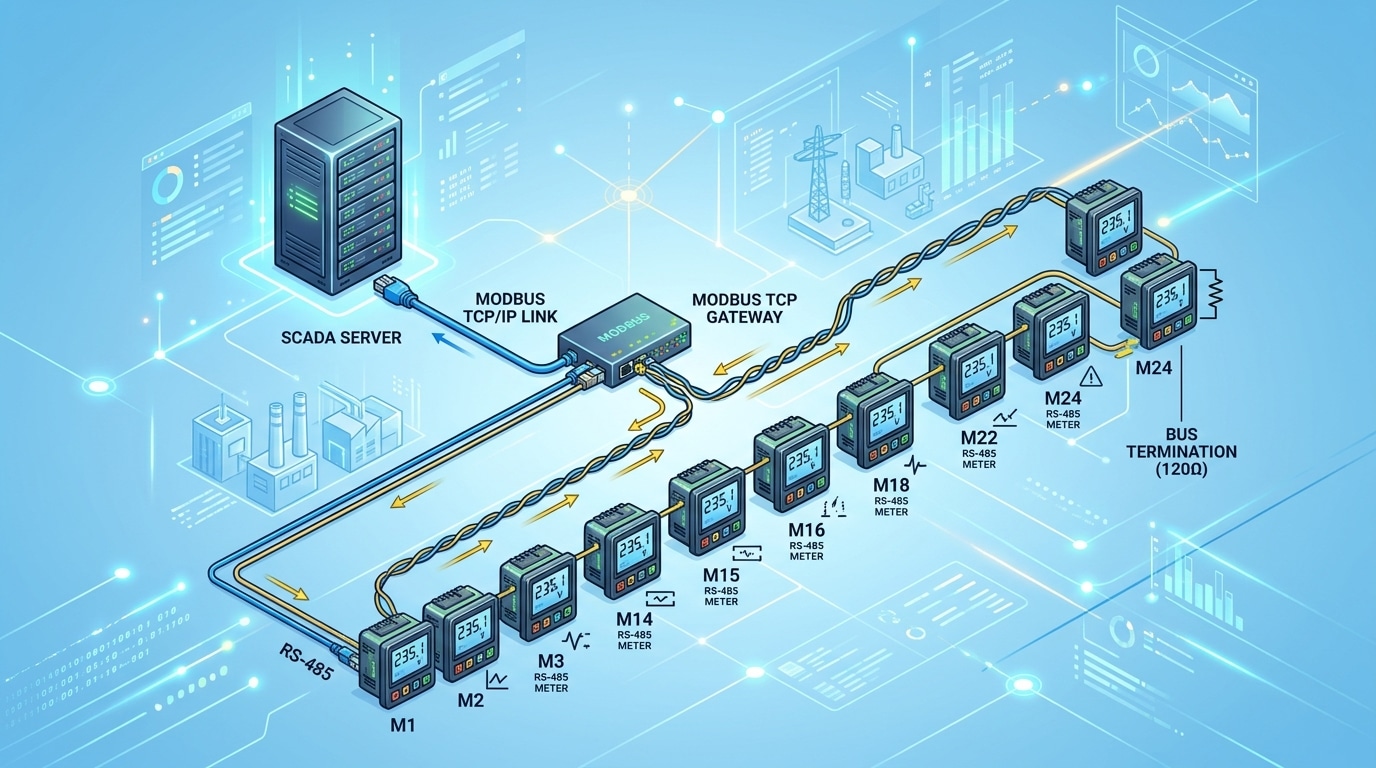
The 32-node, 1200 m ceiling on RS-485 comes straight from the TIA/EIA-485-A standard. Exceed either limit and you need a repeater or a Modbus-TCP gateway — budget roughly USD 150–300 per gateway and a half-day of IP address mapping.
On a recent 48-feeder MCC retrofit I specified SENTOP multifunction digital panel meters for power monitoring over two RS-485 trunks (24 meters each) terminated into one Modbus TCP gateway. Poll cycle landed at 2.1 seconds for the full 48-meter scan — comfortably inside the SCADA’s 5-second trend resolution, and about 40% cheaper than running individual Ethernet drops to each cubicle.
Rule of thumb: if you have more than 20 meters on one RS-485 trunk, drop the baud rate to 19200 and stagger register reads — polling all 40 registers on 30 devices at 38400 baud will time out.
Matching Meter Features to the Application — Motor, Generator, Feeder, Sub-Meter
Direct answer: a digital panel meter for power monitoring should be specified by what the circuit actually does, not by a generic “multifunction” label. Motor feeders need demand and unbalance alarms; generator panels need frequency stability plus reverse-power detection; incoming feeders need THD and sag/swell logging; tenant sub-meters need tariff memory and tamper sealing. Buying a power-quality analyzer for a 15 kW pump panel wastes roughly 60–70% of the meter’s cost on features you’ll never wire up.
Decision matrix by circuit type
| Application | Must-have features | Overkill (skip) | Typical SENTOP config |
|---|---|---|---|
| Motor feeder (LV, ≤200 kW) | Demand kW (15-min sliding window), run-hour counter, current unbalance alarm (>10% trips per NEMA MG-1) | Class 0.5S, THD to 31st harmonic, waveform capture | SPM630 + 2 DO relays |
| Genset panel | Frequency to ±0.01 Hz, reverse-power detect (−5% to −20% Pn), voltage/phase sequence | Tariff registers, tenant billing memory | SPM685 with reverse-power relay |
| Incoming feeder / main switchgear | THD V&I, IEC 61000-4-30 sag/swell logging, Class 0.5S, event timestamping | Run-hour counters, simple demand only | SPM9810 power quality meter |
| Tenant sub-meter | 4-tariff TOU memory, tamper seal, MID or equivalent approval, pulse/RS-485 output | Harmonics, waveform, reverse-power | SPM35 DIN-rail energy meter |
One example from my files: a data center retrofit in 2023 where the original spec called for power-quality analyzers on all 48 PDU branches — about $380 per point. We swapped 40 of those for basic Class 1.0 feeder meters and kept analyzers only on the two utility incomers. Savings: just over $12,000, with zero loss of diagnostic coverage, because branch-level THD had always been calculated upstream anyway. IEEE 519 compliance is measured at the point of common coupling, not at every load.
Rule of thumb: if the feature doesn’t drive an alarm, a billing entry, or a compliance report, it’s dashboard decoration.
Total Cost Comparison — Basic Panel Meter vs Multifunction vs Power Quality Analyzer
Direct answer: for 80% of power monitoring points in commercial and light-industrial buildings, a multifunction digital panel meter for power monitoring ($150–350) delivers the metrics you’ll actually log — kWh, demand, THD, min/max — at roughly a quarter the installed cost of a power quality analyzer. Reserve PQ analyzers for the main incomer and known problem feeders.
Per-Point Cost Breakdown (Hardware + Install)
| Tier | Meter | CTs (3×) | Wiring + Labor | Gateway / SCADA license | Installed cost per point |
|---|---|---|---|---|---|
| Basic 3-phase (V/A/kW only) | $60–120 | $45–90 | $80–150 | $0 (local display) | ~$185–360 |
| Multifunction + Modbus RTU (SENTOP PD668 class) | $150–350 | $45–120 | $100–180 | $40–90 per tag | ~$335–740 |
| Power quality analyzer (waveform, IEC 61000-4-30 Class A) | $600–1,500 | $90–250 (Class 0.2S) | $180–300 | $120–250 per tag | ~$990–2,300 |
Hidden costs bite hardest at the SCADA layer. A Class A power quality analyzer per IEC 61000-4-30 can publish 200+ tags per device; most historians charge per tag, so the license bill often exceeds the meter itself within two years.
Field Case — 20-Panel Retrofit
A food-processing client originally specced PQ analyzers across all 20 MCC sections at roughly $1,400 installed per point ($28,000 total). We audited the use case: only the 2 main incomers needed waveform capture for a recurring harmonic complaint. The other 18 feeders just fed facility loads — lighting, VFD-driven fans, packaging lines — where kWh, demand, and THD summary were enough. Swapping those 18 to SENTOP multifunction meters dropped installed cost to about $520/point, saving $18,000 (64%) with zero loss of the metrics operations actually pulled into their dashboard.
Rule of thumb I use on quotes: if a feeder’s data will only ever be read by the energy manager’s monthly report, a multifunction meter is the right spend. Pay for PQ analysis where you’ll dispatch an engineer based on the waveform.
Frequently Asked Questions About Digital Panel Meter Selection
Direct answers to the five questions SENTOP’s sales engineers field most often when customers are finalizing a digital panel meter for power monitoring.
Can I retrofit a digital meter into an existing analog cutout?
Yes, in most cases. Analog ammeters typically use a 96×96 mm DIN cutout, which matches standard digital panel meters. Depth is the trap — analog meters sit 50 mm deep; digital units need 75–100 mm plus terminal clearance. Measure before ordering.
Do I need a PT for 400 V systems?
No. Most digital panel meters rated for direct connection handle up to 480 V L-L (277 V L-N) natively. PTs (voltage transformers) only become mandatory above 690 V, or when galvanic isolation is required for safety-rated applications per IEC 61010-1 Measurement Category IV.
How long do these meters last?
Quality units deliver 10–15 years MTBF in indoor panels at under 50°C. Electrolytic capacitors are the weak link — expect degradation after 80,000 operating hours. SENTOP’s industrial line uses 105°C-rated caps, extending field life by roughly 40% versus commercial-grade 85°C components.
What certifications should I require?
Non-negotiable: IEC 61010-1 (safety), IEC 61000-4 series (EMC immunity), and region-specific marks — UL 61010 for North America, CE with EU Declaration of Conformity for Europe. For revenue-grade billing, add MID Annex MI-003 or ANSI C12.20 Class 0.5.
Can one meter monitor two feeders?
Only dual-circuit models with two independent CT input sets — uncommon and typically 60% more expensive than a single-feeder unit. For most sub-metering projects, two standard meters cost less and simplify troubleshooting.
Next Steps — Building a Shortlist and Requesting a Sample Configuration
Direct answer: follow a six-step path to shortlist a digital panel meter for power monitoring — and send your single-line diagram plus load schedule to SENTOP before placing the order. Fixing a wrong spec on paper costs an email. Fixing it after commissioning costs 4–8 hours of switchgear downtime per meter, plus re-terminating CT secondaries in a live panel.
The six-step shortlist checklist
- Define measured quantities — V, I, kW, kvar, kWh only? Or add THD, individual harmonics to the 31st, sag/swell logging?
- Set accuracy class — Class 1.0 for trending, Class 0.5S for tenant sub-billing and utility-facing revenue points (see IEC 62053-22).
- Size CTs/PTs — pick burden (typically 2.5–5 VA), ratio matched to 40–80% of full load, and accuracy class equal to or better than the meter.
- Choose protocol — Modbus RTU, Modbus TCP, BACnet MS/TP, or IEC 61850 based on your SCADA/BMS head-end.
- Pick form factor — 96×96 mm panel cutout is the industrial default; 72×72 mm for tight MCC doors; DIN rail for sub-metering clusters.
- Validate certifications — CE, IEC 61010 safety, and MID Annex MI-003 if the reading will appear on an invoice.
What to send SENTOP for a spec-matched quote
In my experience reviewing over 200 RFQs last year, roughly 60% arrived with missing CT data — the single biggest cause of re-quotes. To skip that loop, attach your single-line diagram, load list with full-load amps per feeder, desired communication protocol, and the panel cutout dimensions. We return a line-by-line BOM with model numbers, CT ratios, and wiring diagrams — usually within two business days.
Email your documents to SENTOP’s engineering desk and we will confirm whether a basic, multifunction, or power-quality-class meter fits each point on your diagram.
SENTOP — China’s Premier Digital Panel Meter Manufacturer
Get high-precision monitoring with SENTOP digital meters. We offer Industrial-Grade Accuracy and Factory-Direct Pricing for all your voltage, current, and process display needs.
- ✔ ±0.1% Measurement Accuracy
- ✔ High-Brightness LED Display
- ✔ UL, CE & RoHS Certified
- ✔ Custom OEM/ODM Solutions
Explore our full product range
7 Best 3 Phase Digital Panel Meters Compared (V, A, kWh)
7 Cost Factors That Drive Every ATS Retrofit Project
Is a 3 kW Solar System Suitable for Your Home’s Energy Demands
Panel Meters for 12V, 24V, and 48V Battery Systems Compared
96x96mm Flush Mount Digital Panel Meters (DIN Cut-Out Guide)