
A defined signal path
Direct voltage/current, shunt mV, CT secondary, 333 mV sensor, Rogowski coil, 4–20 mA, RTD and thermocouple are not interchangeable.
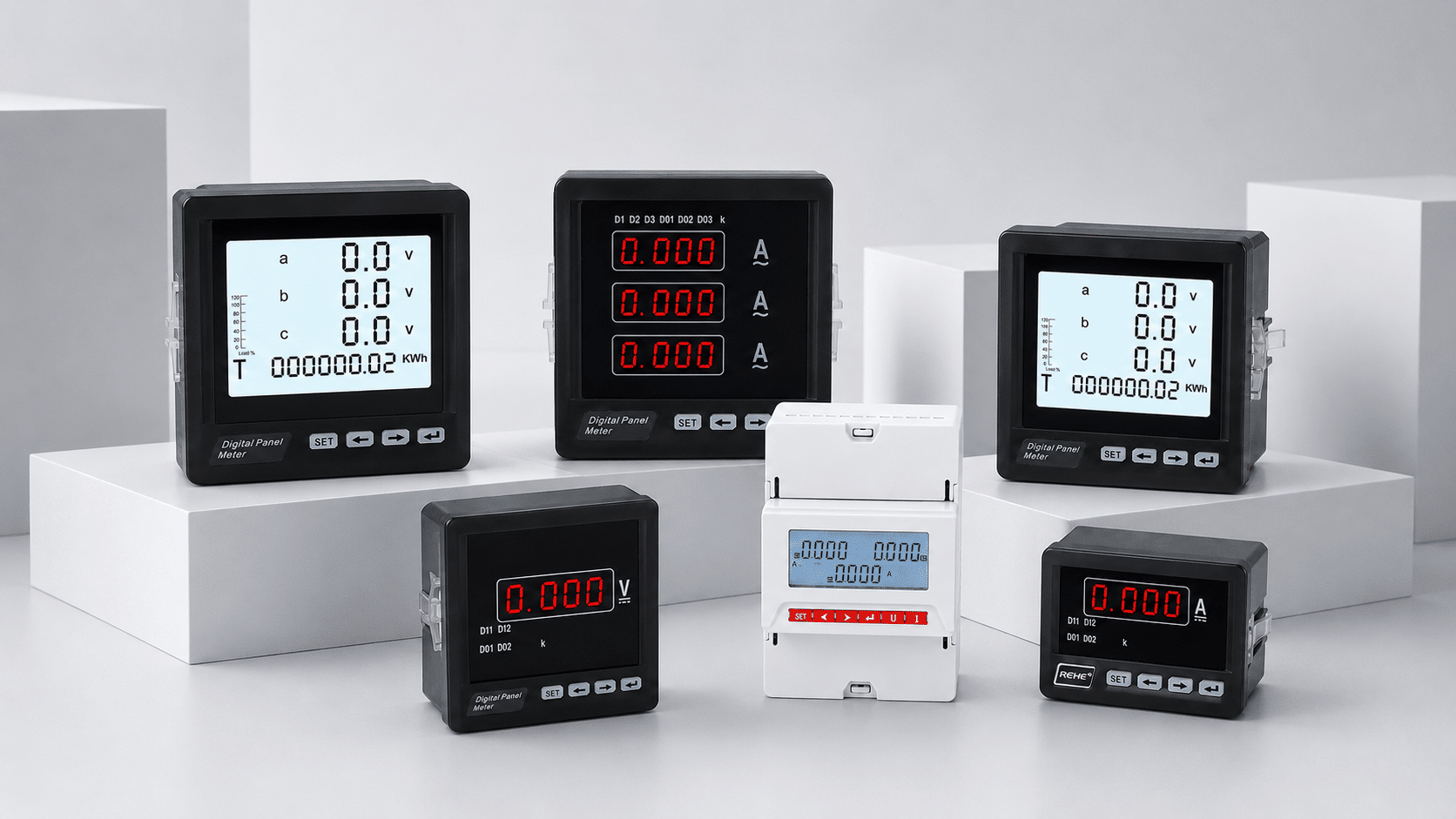
Seven public one-piece examples run from $7.95 to a $399 regular price, yet the front display explains little of the difference. Price moves with the input interface, signal conditioning, outputs, environmental evidence, lifecycle and the work required to make the meter part of a repeatable panel. Buy the least expensive exact model whose documentation proves every required interface—not the cheapest display that happens to fit the cutout.
SENTOP product-family illustration. The image does not establish that every pictured model has the same input, accuracy, protocol, certification, availability or price.
Usually more explicit measurement and integration scope—not simply more display digits. The useful question is whether the exact meter accepts the native signal, fits the power/reference arrangement, survives the environment and provides the outputs and evidence the project needs.
Direct voltage/current, shunt mV, CT secondary, 333 mV sensor, Rogowski coil, 4–20 mA, RTD and thermocouple are not interchangeable.
A separate supply, loop burden, reference scheme, relay, retransmission or communications port changes both the model and the surrounding BOM.
Character size, color, update behavior, gasket, front protection, temperature and terminal access matter only when documented for the selected variant.
Current data, approvals, lifecycle, configuration records, accessories, lead time and support can be worth more than an attractive headline specification.
A small DC readout, a loop-powered process indicator, a configurable universal meter and a multifunction energy meter can all carry the same generic label. Treating them as equivalent products with different prices is the first purchasing error.
| Meter category | Typical job | Not automatically included | First buying check |
|---|---|---|---|
| Basic DC display | Shows one defined low-voltage value inside a controlled product or enclosure. | Isolation, universal input, industrial front protection, approval or calibration evidence. | Input/supply range, reference scheme, scale, cutout and enclosure use. |
| DC multi-value monitor | Shows voltage, current, power or energy for a documented DC arrangement. | Permission to connect to any high-current conductor or power system. | Current-sensing path, supplied shunt, fault exposure and indoor/enclosure limits. |
| Process indicator | Displays a defined transmitter or process signal such as 4–20 mA. | Zero loop burden, HART transparency, alarms or broad sensor flexibility. | Loop drop, scaling, power/reference, decimal point and backlight condition. |
| Universal process meter | Accepts a named set of voltage, current, RTD, TC or resistance inputs. | Every family input, output, protocol or certification on every suffix. | Freeze the exact input, supply, output and option configuration. |
| Power or energy meter | Calculates quantities for a supported topology and sensor interface. | Revenue accuracy, power-quality analysis or protection function. | Topology, CT/PT/sensor type, ratios, accuracy basis, protocol and approvals. |
Digits are not accuracy. Resolution says what the display can show. Accuracy has stated conditions and can depend on range, signal level, temperature, filtering, sensor error and plus-count terms.
These editorial buckets were rebuilt around seven named public-price snapshots: approximately $8–$14, $15–$39, $40–$89, $90–$129, $130–$179, $180–$259 and $260–$400. They are not standardized market classes, a statistical survey or a quality ranking. “Capability” means only what the cited example documents.
A 3-digit 4.5–30 VDC display can be excellent for a deliberately narrow local indication. It does not prove isolation, industrial front protection or suitability for another signal.
Check the observed listing →The listing shows voltage, current, power and energy for a stated 6.5–100 VDC / up-to-20 A arrangement and says indoor use only. More displayed values do not remove its application limits.
Check the observed listing →A ±20 VDC, 3.5-digit backlit LCD model with a 5 VDC supply and PC-pin termination. DigiKey lists it as Last Time Buy, so price and electrical fit do not equal a long-term design-in decision.
Check price and lifecycle →A 4–20 mA process meter with a 7.5–32 VDC supply and screw terminals. DigiKey says the bezel is sold separately and lists the part as Last Time Buy—an immediate example of hidden BOM and lifecycle scope.
Check price and included parts →A 1/8 DIN meter with a named list of voltage, current, resistance, RTD, thermocouple and potentiometer inputs. Related output variants are separate configurations.
Check the exact configuration →The selected 5-digit tri-color model adds a 4–20 mA retransmission and two 8 A SPDT relays. Those are different interface jobs and should be named separately in the RFQ.
Check outputs and supply →The listing shows a 20 V AC TRMS configuration with a 9–32 VDC supply, a $297.26 sale price and $399 regular price. Promotion and lead time must be reconfirmed; TRMS scope, bandwidth, crest factor and AC-only versus AC+DC response must come from current model data.
Check current price and availability →An inexpensive module is not automatically poor engineering. It can be the most efficient choice when the source is already within its stated range, the power/reference relationship is known, the enclosure is benign and the value is only a convenience indication.
The false economy starts when the panel team asks the module to supply missing isolation, a different sensor interface, a protected front, a documented output or a lifecycle plan. These requirements do not appear merely because the display has enough digits.

The visible digits are the endpoint. The costly work often sits in the input circuit, output interface, housing, verification and support model.
4–20 mA, millivolts, direct voltage/current, RTD, TC, CT secondary and pulse inputs need different conditioning and protection.
Compare: type, range, impedance/burden, reference, isolation and fault limits.A headline percentage can change by range, low-signal level, temperature and attached sensor. Resolution and accuracy remain separate.
Compare: full accuracy statement, plus counts, temperature and sensor-chain error.A meter can need a separate supply, share a reference or consume loop voltage. Backlighting and output options may change the demand.
Compare: supply, isolation, loop drop, start-up and reference rules.Character height, contrast, color, viewing conditions, gasket, front protection and temperature affect field use.
Compare: exact installed-front statement, cutout, depth and terminal access.A relay, 4–20 mA retransmission and Modbus connection serve different receivers and need different commissioning evidence.
Compare: type, rating/range, isolation, protocol, map and receiving device.Approvals, software, support, PCNs, stock, warranty and approved alternates keep a repeated build supportable.
Compare: exact catalog number, document revision, status, quote and alternate process.
The middle and upper examples document process inputs, repeatable configuration, operator-facing displays or interfaces that can pass a value to another device. That added structure can reduce external components and troubleshooting—but only when the selected option actually matches the requirement. For higher-scope system planning, review the electrical panel monitoring solution separately.
A relay contact is not an analog output. Analog retransmission is not a network connection. A serial protocol is not useful without addressing, data-map and receiving-system work. Treat each as a separate RFQ line with a stated job. A standard panel-meter relay may serve an ordinary alarm or control-system input when its ratings and logic are engineered for that circuit; it is not a safety relay, protective device or safety function.
A $12 display can need extra signal conditioning, a custom mount and more verification. A $200 process meter can simplify the same panel—or add complexity through unused options. Count the actual approved assembly, not a generic savings percentage. Use the safe panel-meter installation workflow to identify installation and commissioning tasks without turning this pricing page into a field procedure.
A current display may accept direct current, a millivolt shunt, a conventional 1 A or 5 A CT secondary, a 333 mV sensor or a Rogowski-coil interface. These are different products and different safety/commissioning paths.
For a conventional CT system, record the primary/secondary ratio, accuracy and burden basis, lead contribution, polarity, topology, meter input and validation method. The sensor system—not the display price—defines whether the chain can produce the intended result.

The output is a frozen configuration description that procurement can quote without silently changing the measurement interface.
Voltage, current, transmitter output, temperature, pulse, frequency, power, energy or another derived value—and the decision that uses it.
Direct input, shunt mV, CT secondary, 333 mV sensor, Rogowski, 4–20 mA, 0–10 V, RTD, TC or pulse; include normal and credible exposure.
Specify units, decimal point, character size/color, update need, resolution and the complete performance condition independently.
Supply, common/reference rules, isolation, loop budget, power-up behavior and input/output relationships.
Alarm contact, analog retransmission, serial/fieldbus or discrete signal; add range/rating, protocol and receiving device.
Check panel-meter cutout sizes, depth, retention, terminal access, door clearance, front environment, temperature and service access.
Catalog number, option code, data revision, approvals, calibration, accessories, lifecycle, lead time, quote and approved alternates.
These are requirement examples, not universal product recommendations or installation instructions.
A regulated low-voltage bus needs a local convenience reading inside a benign enclosure. The source range and reference are known, and the number does not independently command machinery.
Likely start: the $7.95 or $17.50 pattern—only after input, power, mounting and enclosure assumptions are documented.A transmitter already feeds the process and maintenance needs a local engineering-unit display. Verify input, loop drop, scale, decimal point and brightness. Add alarms or retransmission only if a receiver needs them.
Likely start: the $94.33 process-indicator pattern; move upward when explicit outputs or broader configuration reduce the total BOM.Related machines use 0–10 V, RTD or thermocouple inputs, while operators need consistent local indication and the control system may need a contact or 4–20 mA retransmission.
Likely start: the $159–$249 configurable patterns, then compare one-family repeatability against specialized meters.The price column is a comparison starting point from the observed examples, not a budget rule or technical approval.
| Application condition | Minimum evidence | Observed starting reference | Escalate when |
|---|---|---|---|
| Low-voltage enclosed DC indication | Input/supply/reference, scale, physical fit and intended enclosure use. | $7.95–$48.09 examples. | The reading affects safety, quality or control, or needs isolation/front-environment proof. |
| Known 4–20 mA transmitter point | Input, loop drop, scale, decimal point, power/reference and readability. | $94.33 signal-specific example. | Alarm, retransmission, communication or future input flexibility is required. |
| OEM with several sensor types | Exact supported inputs, configuration record, supply, fit, lifecycle and output options. | $159–$249 configurable examples. | The field panel needs stronger environmental, data or approval evidence. |
| CT/PT/shunt current or energy chain | Sensor interface, ratio, burden, topology, polarity/direction, range and validation. | Do not select from price alone. | The use involves settlement, protection, power quality or multi-phase integration. |
| Specialty field-facing instrument | Exact input/supply, readability, environment, output, documentation, lifecycle and support. | $249–$399 examples. | The requirement exceeds the selected configuration—or the correct meter is above the article ceiling. |

A quote line that says “digital panel meter, four digits” leaves the measurement path open to substitution. Freeze the exact catalog number and suffix, native source, scale, supply/reference, output, cutout, environment and required evidence.
Preserve a settings/configuration record, drawing revision and approved-alternate rule. When a part becomes Last Time Buy, do not let a physically similar replacement change the input architecture without engineering review.
For repeated supply, SENTOP can review a model, photo, drawing or BOM and coordinate product matching, labels, grouping and order details. The responsible project parties retain final system engineering and approval.
A useful enquiry lets the supplier confirm one exact model and expose the missing accessories, constraints and evidence before price becomes the deciding number.
| Observed risk | Likely purchasing mistake | Evidence-based correction |
|---|---|---|
| Reading has an implausible scale | Input range, CT/shunt ratio or engineering scale was assumed. | Compare native source, range, ratio, scaling, decimal point and current configuration. |
| 4–20 mA loop loses range | Loop-powered indicator voltage drop was omitted. | Review supply, transmitter, every series device, meter drop/backlight condition and loop drawing. |
| Wrong current interface | Direct current, CT secondary, shunt mV, 333 mV and Rogowski inputs were merged. | Freeze the sensor output and matching meter input before part selection. |
| Replacement fits but fails electrically | Only the panel cutout was matched. | Check input, supply/reference, depth, terminals, outputs, environment, approval and settings backup. |
| Relay cannot feed the desired PLC signal | Relay, analog retransmission and communications were treated as one “output.” | Name the receiving interface, behavior, range/rating and isolation. |
| Delivered suffix lacks a brochure feature | An option or alternate variant was assumed standard. | Cross-check complete manufacturer part number, option list, data revision and quote description. |
| Low web price delays the build | Lifecycle, stock, tariffs, accessories and lead time were reviewed after release. | Obtain a current quote and approved alternatives before design freeze. |
An exact component claim is useful evidence; it does not certify the completed panel, sensor chain or end application.
Input, supply, outputs, environment, accuracy condition, cutout and option code for the quoted part.
CT, shunt, transmitter, RTD/TC or other sensor compatibility, ratio, burden and stated error contribution.
Protection, wiring space, isolation, environment, SCCR/fault context, markings and chosen panel standard.
Exact country/region, certificate or listing record, installation conditions and documentation revision.
Operator decision, machine/process risk, calibration need, billing/revenue purpose, acceptance criteria and AHJ/customer rules.
These answers explain the comparison boundary. Exact data and current quotes still control.
The phrase covers a broad display form factor, not one electrical interface. The $8 example is a constrained low-voltage readout, while the near-$400 example is a specialty AC-voltage configuration. Inputs, supply, outputs, environment, documentation and lifecycle—not the generic name—explain the useful difference.
No. They are seven observed public product-price anchors checked on August 24, 2026. They are not standardized classes, quality grades or guaranteed ranges. Recheck the exact price, stock, tariff, configuration and quote terms before buying.
No. Digit count and display resolution describe what the display can show. Accuracy is a stated performance condition that can depend on input range, signal level, temperature, filters, sensor-chain error and plus-count terms. Compare the complete accuracy statement for the intended range.
No. It draws operating energy from the loop and introduces a model-specific voltage drop. Check the complete loop budget, transmitter requirement, barriers or isolators, backlight condition and any HART or system constraints.
No. Confirm whether it accepts direct current, a shunt millivolt signal, a conventional CT secondary, a 333 mV sensor, a Rogowski-coil interface or another approved input. These interfaces are not interchangeable, and the applicable safety procedure is separate from the meter price.
No. A relay is a contact output with a stated rating and logic role. Analog retransmission sends a scaled signal. Modbus communicates digital data and needs addressing, a data map and system integration. Specify the receiving device and required interface.
No. The cutout is one mechanical check. Also review the input interface, supply/reference arrangement, depth, terminals, scale, outputs, environment, approvals, settings and sensor chain. Preserve the old configuration and approved drawing before replacement.
No. Verify the exact model, market, installation conditions and document revision. UL certification must match the certification record; CE marking is the manufacturer’s declaration that applicable EU requirements are met; and IP65 is an enclosure-protection classification, often limited to the correctly installed front. None should be copied from a family page to an unverified suffix or treated as certification of the completed panel.
No. Do not specify “revenue grade” from price, digit count or a general accuracy claim. Billing and settlement applications must meet the utility, legal-metrology and jurisdictional requirements that apply to the exact installation.
Price, inventory and product status can change without notice. Manufacturer documentation controls technical fit; distributor pages provide the dated price observations shown above.
Send the measurand, native input and range, supply/reference, required scale and accuracy basis, cutout, outputs, environment, target market, approvals, quantity and destination. SENTOP can review the product match and identify missing configuration, accessory or commercial fields; final system engineering and approval remain with the responsible project parties.


.jpg)
