
Can the exact part do the job?
Match conductor, current, voltage, temperature, poles, spacing, mounting, environment, accessories and end-use rules.
A broad catalog is not model approval.
Eight widely established manufacturers worth investigating are Phoenix Contact, WAGO, Weidmüller, TE Connectivity, Molex, ABB, Eaton, and Rockwell Automation. They are not interchangeable. Choose an exact family by circuit function, conductor, connection method, approvals, accessories, documentation, and regional support.
Phoenix Contact, WAGO, and Weidmüller are especially broad in modular DIN-rail systems. TE Connectivity and Molex add strong PCB, barrier-strip, and connector-oriented options. ABB brings SNK and hazardous-location depth; Eaton supports machinery-control and mixed connection methods; Rockwell Automation fits Allen-Bradley-centered industrial systems.
Match conductor, current, voltage, temperature, poles, spacing, mounting, environment, accessories and end-use rules.
A broad catalog is not model approval.Require a current datasheet, drawing, exact certification record, declaration where applicable and accessory list.
A logo alone is not evidence.Review traceability, inspection, calibrated tools, nonconformance handling, material controls and change notification.
Sample approval must connect to bulk supply.Compare MOQ, price, lead time, Incoterms, packaging, warranty and spares using dated written terms.
Website promises do not control a purchase order.A respected manufacturer name does not make every model suitable. Verify the exact catalog number, conductor range, current and voltage data, short-circuit conditions, insulation system, accessories, approvals, installation instructions, lifecycle status, and destination-market availability.
The numbers create a usable editorial list, not a laboratory reliability hierarchy. A lower-numbered company is not automatically better for your application, and a manufacturer outside this shortlist may be superior in a regional or specialized niche.
No universal score can compare every DIN-rail, PCB, barrier, high-current, thermocouple, or hazardous-location terminal. The shortlist uses official, checkable evidence to identify brands worth investigating.
Feed-through, PE, fuse, disconnect/test, multi-level, distribution, high-current, PCB, or barrier options as relevant.
Screw, spring, push-in, lever, IDC, bolt, stud, pluggable, or another documented method.
Bridges, end plates, markers, test parts, covers, tools, software data, and preassembly support.
Accessible data sheets, instructions, drawings, approvals, certificates, and application guidance.
Industrial, process, building, energy, transport, hazardous-area, electronics, or power-distribution use.
Distributor access, configuration tools, regional documents, lifecycle control, and project standardization.
Multiple functions can reduce cross-family variation when the project needs power, signal, testing, and field interfaces.
The brand makes it practical to move from a family page to exact part numbers and a defensible approved BOM.
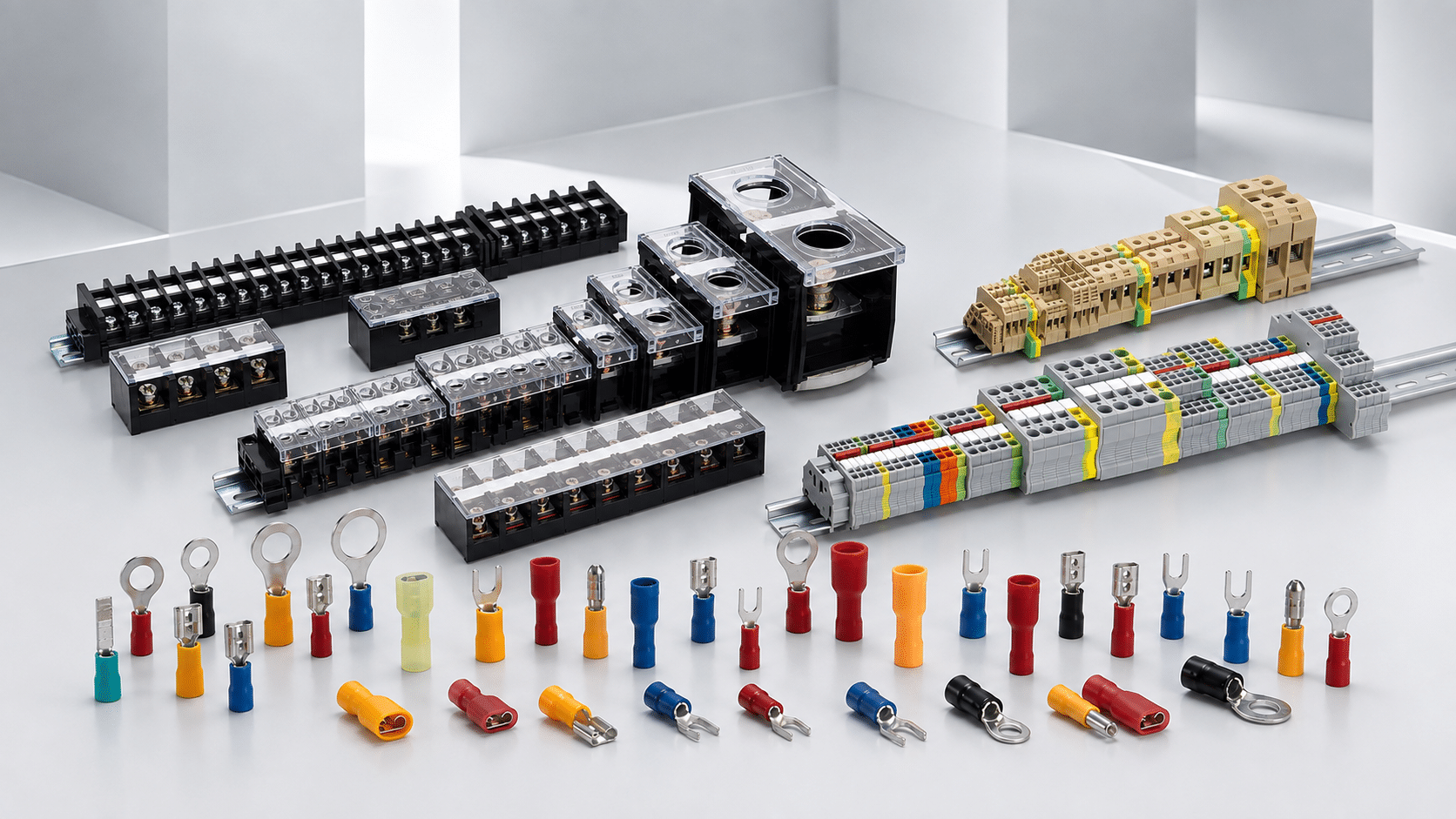
DIN-rail blocks, barrier strips, high-current interfaces, PCB terminals, and crimped wire ends solve different jobs. A brand shortlist becomes useful only after the circuit and conductor interface are defined.
Image: SENTOP terminal block and cold-pressed terminal families.Each profile identifies a defensible starting point and the evidence still required. The numbering improves navigation; it does not certify one brand as universally more reliable than another.
A strong first stop for deeply integrated DIN-rail terminal strips. CLIPLINE complete spans feed-through, multi-level, fuse, disconnect, high-current, hybrid, installation, sensor/actuator, and special-function blocks across Push-X, Push-in, screw, spring-cage, COMBI, and bolt technologies.
TOPJOB S combines lever, push-button, and operating-slot actuation with push-in termination for compatible conductors. The broader rail range includes functional blocks, installation terminals, X-COM pluggable systems, compact and multi-level designs, sensor/actuator wiring, and POWER CAGE CLAMP products.
Klippon Connect combines universal terminal blocks with application-specific solutions for power feed, control-voltage distribution, instrument-transformer wiring, signal marshalling, DCS, shielding, and building installation. Connection options include screw, tension clamp, PUSH IN, and SNAP IN.
TE's BUCHANAN portfolio is especially relevant when terminal blocks form part of an electronic assembly. It includes PCB terminal blocks, barrier strips, and one- or two-piece wire-to-board products using rising-cage screw clamps, push-in clamps, straight or right-angle headers, and pluggable interfaces.
Molex covers PCB terminal blocks and connectors, DIN-rail blocks, barrier strips, terminal strips, and high-current universal-clamp products. This breadth helps equipment manufacturers compare board, panel, and power connection points within a wider connectivity bill of materials.
ABB's SNK platform is notable for industrial, infrastructure, and hazardous-location projects. The official range includes screw, PI-Spring, and pluggable technologies, with qualifying SNK products carrying IECEx, ATEX, UL hazardous-location, and other regional certifications.
Eaton's active XB IEC range covers screw, spring-cage, insulation-displacement, and hybrid connection technologies, plus feed-through, multi-level, PE, fuse, disconnect, component, diode, and pluggable functions. The wider channel also includes North American barrier-style products.
Allen-Bradley Bulletin 1492 is well aligned with North American industrial automation. Current documentation covers 1492-P push-in, 1492-H finger-safe, 1492-J screw, 1492-L spring-clamp, power terminal blocks, and marking systems with numerous functional variants.
Use application fit to shorten the list, then qualify exact parts. A brand name cannot replace model-level ratings, accessories, approvals, availability, or end-equipment validation.
| Application priority | Strong starting candidates | Why they enter the shortlist | Qualification focus |
|---|---|---|---|
| Broad DIN-rail systems | Phoenix Contact, WAGO, Weidmüller | Deep feed-through, PE, function, distribution, accessory, and marking ecosystems. | Map every terminal-strip position, bridge, end plate, marker, test point, and tool to one compatible generation. |
| Fast push-in or spring wiring | WAGO, Phoenix Contact, Weidmüller | Several mature spring-based technologies and panel-oriented product families. | Check direct-insert conductor classes, ferrule policy, actuation method, pull-out behavior, and operator access. |
| Process and marshalling | Weidmüller, Phoenix Contact, Rockwell Automation | Application-specific functions for DCS, CT, signal, test, disconnect, thermocouple, and automation wiring. | Verify circuit topology, isolation, test sequence, shielding, documentation, and plant maintenance conventions. |
| PCB and wire-to-board | TE Connectivity, Molex | Broad fixed, pluggable, barrier, header, and board-interface options. | Confirm pitch, mating direction, solder process, retention, thermal limits per pole, and PCB drawing revision. |
| Hazardous locations | ABB, Weidmüller, WAGO, Phoenix Contact | Selected families are documented for demanding industrial and hazardous-location applications. | Match the exact certificate, zone or division, gas or dust group, temperature class, ambient, enclosure, and accessories. |
| North American machinery | Rockwell Automation, Eaton, Phoenix Contact, WAGO | Familiar automation channels, machinery-control functions, and regional documentation. | Keep IEC and North American rating columns separate; check SCCR method, plant standards, spares, and distributor access. |
| Barrier-style termination | TE Connectivity, Molex, Eaton | Established barrier and terminal-strip formats for equipment wiring and service access. | Check covers, barriers, stud or screw hardware, torque, lug geometry, spacing, and touch protection. |
| High-current distribution | Molex, WAGO, Phoenix Contact, Rockwell Automation, Weidmüller | Power-oriented families using universal clamps, cages, bolts, or dedicated power blocks. | Validate conductor material, cross-section, temperature, derating, short-time current, mounting, covers, and upstream protection. |
| ABB-centered projects | ABB | SNK can align terminal selection with an existing ABB low-voltage ecosystem and hazardous-area documentation path. | Confirm the exact active series, regional inventory, accessories, certificate scope, and long-term spares plan. |
Editorial boundary: this is an engineering shortlist, not a market-share ranking, a common laboratory reliability test, or a paid endorsement. Qualification remains specific to the part number and application.

A manufacturer earns a place in the BOM only when the exact product and its complete assembly can be documented. Ask every candidate for the same seven evidence categories.
Order code, revision, dimensions, materials, conductor range, strip length, torque or actuation, and rating conditions.
Approved wire preparation, ferrules, tools, mounting, bridging, testing, maintenance, and replacement procedure.
Official file or certificate number, covered part number, standard edition, ratings, conditions, factory where relevant, and current status.
Short-time withstand or SCCR information tied to conductor size, upstream protective device, installation, and applicable test method.
Temperature, vibration, corrosion, pollution degree, altitude, hazardous-location, ingress, and material data where required.
Bridges, end plates, partitions, covers, markers, test parts, end clamps, rail, and tools from compatible product generations.
Active status, approved source, traceability, revision control, alternates, notice periods, spares, and last-time-buy process.
Read every document for its own scope. An organization-level certificate, a legal declaration, a substance statement, and a model-specific product approval answer different questions.
| Evidence | What it tells you | What it does not prove | Buyer check |
|---|---|---|---|
| ISO 9001 | A quality management system standard for an organization. | It does not certify every terminal block or guarantee field reliability. | Verify certificate scope, site, issuer and current status; then review product evidence separately. |
| CE marking | The manufacturer's declaration that identified products meet applicable EU requirements. | It is not an EU approval or a universal third-party safety certificate. | Obtain the signed declaration, exact product identity, applicable laws and technical basis. |
| RoHS | Restricted-substance compliance for products within its scope. | It does not prove current capacity, insulation, connection reliability or panel suitability. | Ask for a dated, model- or material-specific declaration and scope. |
| UL / CSA / VDE / CQC | A scheme record may cover defined models, ratings, factories and conditions. | A logo or a record for a related series does not cover every product. | Match exact model, file or certificate number, standard, ratings, conditions and status in the official record. |
Use the same sequence for each candidate. A familiar brand or an attractive quote should not bypass a circuit, evidence, sample, or release gate.
Feed-through, PE, neutral, distribution, fuse, disconnect, test, shield, signal, PCB, barrier, or power.
Start with the circuit, not the brand.Material, cross-section, class, insulation, ferrule policy, conductors per point, strip length, and field-wiring status.
The wire must fit the rated conditions.Current, voltage, impulse, insulation, temperature, pollution, altitude, vibration, corrosion, and fault duty.
Keep IEC and regional ratings separate.Target markets, end-product standards, hazardous-area needs, exact files, declarations, reports, and traceability.
Do not accept a family logo as proof.Match function, connection method, footprint, documentation, availability, support, and installed cost.
Preserve a defensible alternate path.Add bridges, partitions, end plates, covers, markers, test parts, end clamps, rail, tools, and spares.
Accessories are system components.Engineering, production, quality, service, procurement, and compliance teams check the real installation.
Record deviations before release.Release order codes, revisions, approved channels, alternates, inspection points, spares, and change-notice rules.
Recheck the first production receipt.The risk is rarely the logo alone. It is an incomplete requirement, an invalid comparison, or a release process that lets the supplied construction drift away from the approved one.
It matches the required circuit, conductor, ratings, spacing, accessories, evidence, installation process, and supply controls. Similar color or dimensions are not an engineering equivalence.
A strong DIN-rail ecosystem may not be the best PCB, barrier, hazardous-area, or high-current answer.
Rated current or voltage can change with conductor, pole count, ambient, mounting, standard, and test conditions.
A block without its approved bridge, end plate, cover, marker, test part, and tool is not a complete terminal-strip solution.
Unclear origin, mixed lots, obsolete stock, or undocumented substitutions can invalidate the approved evidence and spares plan.
A physical fit does not prove the same conductor range, temperature rise, insulation system, retention, fault duty, or approvals.
Certificates and ratings belong to defined models, constructions, conditions, and sometimes factories—not every product carrying the logo.
The sample should represent the approved construction and the way your team will use it. Project standards and qualified engineering decide the required tests.

Use the real DIN rail or PCB, end plates, bridges, markers, conductor, ferrule policy, strip length and tool. Check access, labeling, full insertion, torque where specified, wire bend, rework and inspection. Then run the electrical and environmental checks required by the product and end equipment.
Photo: MTA Capital Construction Mega Projects / Wikimedia Commons, CC BY 2.0. Layout crop only.Check rail or PCB fit, wire entry, tool angle, bend radius, adjacent devices, covers, end plates, markers and service reach.
Confirm strip length, ferrule or contact, insertion or actuation, model-specific torque, visual checks and approved rework.
Use the applicable standard and end-product test plan for temperature rise, retention, dielectric, vibration, fault or environmental duty.
Seal the sample or record revision and lot. Define inspection, traceability, acceptable deviations and notice before any material or design change.
Example architecture: for an OEM serving North America and Europe with 24 VDC PLC I/O, 480 VAC motors, PE, fused sensors, thermocouples, and a high-current feeder, begin with Phoenix Contact, WAGO, or Weidmüller for the main DIN-rail system; consider Rockwell for an Allen-Bradley-centered plant and TE or Molex for PCB interfaces. Standardize one primary family and one controlled alternate for generic functions, with documented exceptions for specialized circuits.
Price, MOQ, lead time and freight change by model, quantity, region and date. Compare the same approved BOM and commercial scope across suppliers.
Blocks, PE positions, fuse or disconnect parts, bridges, end plates, partitions, covers, markers, end clamps and DIN rail.
Wire preparation, ferrules, torque or actuation tools, marking, assembly, inspection, test, correction and training.
MOQ, pack multiple, lead time, Incoterms, freight, duties, safety stock, spares, partial shipments and shelf management.
Requalification, engineering changes, mixed revisions, line stops, field replacement, warranty handling and unavailable accessories.
For product qualification after choosing a manufacturer family, use the terminal block selection guide. If the approved commercial route includes factory-direct purchasing, use SENTOP's factory-direct sourcing guide as a separate supply-control workflow.
A model, photo, drawing, sample, terminal plan, or BOM lets SENTOP review possible matches. Give every candidate the same technical, compliance, quality, and commercial inputs.
This page owns the global manufacturer comparison. Use the pages below for exact product selection, documentation, regional sourcing, samples, factory evidence, and project support.
Review screw terminal blocks and spring terminal blocks after the application is clear.
Use DIN rail terminal blocks or plug-in and PCB terminal blocks according to the equipment architecture.
Review terminal block accessories and the accessories guide.
Use these answers to build a defensible shortlist. The exact model, circuit, evidence, sample, approved source, and end equipment still decide release.
There is no single best manufacturer for every application. Phoenix Contact, WAGO, and Weidmüller are strong broad DIN-rail candidates; TE Connectivity and Molex are especially relevant for PCB interfaces; ABB has notable hazardous-location depth; Eaton and Rockwell Automation fit many machinery-control ecosystems. The best choice is the exact family that meets your circuit, evidence, assembly, service, and supply requirements.
Do not assume so. Products may differ in dimensions, conductor preparation, connection operation, bridges, end plates, markers, test parts, ratings, and approvals. Treat a cross-brand change as a controlled substitution and validate the complete terminal-strip assembly.
WAGO, Phoenix Contact, and Weidmüller are strong starting candidates because each publishes broad spring-based or push-in product families. Compare the exact actuation method, conductor classes, ferrule rules, insertion force, accessories, ratings, and application evidence before selecting a model.
TE Connectivity and Molex are strong starting points for fixed, pluggable, barrier, and wire-to-board interfaces. The final choice depends on pitch, poles, mating direction, solder process, retention, current per pole, temperature, PCB layout, and the exact compliance record.
An authorized or otherwise traceable channel can reduce counterfeit, obsolete-stock, mixed-lot, and undocumented-substitution risk. It may also improve access to current drawings, approvals, technical support, lifecycle notices, and regional inventory. Record the approved source in the released BOM when channel control matters.
Only after a documented equivalence review. Match circuit function, conductor data, ratings and conditions, spacing, materials, mounting, accessories, installation process, approvals, fault and environmental evidence, traceability, and lifecycle control. Similar color, pitch, or footprint is not enough.
No. IEC 60947-7-1 has a defined scope, and compliance claims apply to specific products and conditions. Some terminal blocks may use another applicable standard, and some products in a manufacturer's wider portfolio may be outside that scope. Verify the exact order code and current supporting record.
Use as few as practical without forcing unsuitable products into specialized circuits. Many OEMs benefit from one primary terminal-block system, one qualified alternate for generic functions, and documented exceptions for PCB, hazardous-area, high-current, automation-standard, or customer-mandated applications.
Send the function, ratings, conductor, connection method, mounting, dimensions, accessories, environment, target market, evidence needs, quantity, and delivery target. SENTOP can review cross-brand model matches and the controls required before release.