
How to Choose a Reliable Terminal Block Wholesaler for Bulk
Qualify the complete supply system, not the unit price. A reliable wholesaler identifies the exact terminal and accessory set, supports the claim with current evidence, keeps samples and production lots traceable, states real availability, and accepts written controls for substitutions and discrepancies.

Six controls separate a useful wholesaler from an uncontrolled buying channel
Begin with a released part specification and terminal-strip bill of materials (BOM). Then test whether the wholesaler can preserve that identity through quotation, sampling, the first bulk lot, replenishment, and problem resolution.
Exact product identity
The quote states manufacturer, complete order code, revision or version where applicable, color, pack unit, and every functional accessory.
Current source evidence
Data sheets, approval records, drawings, installation information, and accessory relationships match the exact quoted item.
Sample-to-lot continuity
Accepted samples, cartons, labels, lot information, and later shipments can be linked without relying on appearance alone.
Complete terminal system
Blocks, rail hardware, end stops, end plates, bridges, markers, separators, covers, test parts, and functional terminals are quoted together.
Written commercial controls
MOQ, pack quantity, stock basis, lead time, substitution approval, return route, warranty, and delivery terms are unambiguous.
Corrective-action support
A named contact can contain a suspect lot, identify affected orders, arrange disposition, and provide a documented response.
Bulk buying magnifies small identity and coordination errors
A change in bridge pitch, marker slot, housing height, conductor range, clamping method, plating, approval marking, or pack identity can stop assembly even when the basic block looks equivalent. Compare the business consequence and the control before comparing price.
| Risk area | Typical failure | Business consequence | Buyer control |
|---|---|---|---|
| Identity | A family-level quote hides a different order code, color, revision, or manufacturer. | Wrong fit, approval gap, or incompatible accessory set. | Released manufacturer order code, controlled drawing, and buyer-approved BOM. |
| Consistency | The sales sample differs from the replenishment lot or cartons contain mixed parts. | Assembly defects, quarantine, rework, and uncertain root cause. | Lot and pack traceability, first-lot inspection, and change notification. |
| Accessories | Blocks arrive without matching bridges, end plates, markers, covers, or rail hardware. | Line stoppage, emergency freight, and improvised assembly. | Quote and sample the complete terminal-strip BOM. |
| Evidence | A generic certificate or data sheet does not cover the received item or required use. | Inspection delays, requalification, or end-product conformity risk. | Verify current official records against the exact product identity and conditions. |
| Availability | “In stock” does not distinguish on-hand, allocated, regional, or forecast quantity. | Production delay and costly spot buying. | Record stock location, free quantity, allocation, replenishment source, and confirmed date. |
| Response | No technical escalation, containment, return, or corrective-action route exists. | Recurring defects and slow recovery. | Name contacts, response expectations, disposition rules, and commercial remedies. |
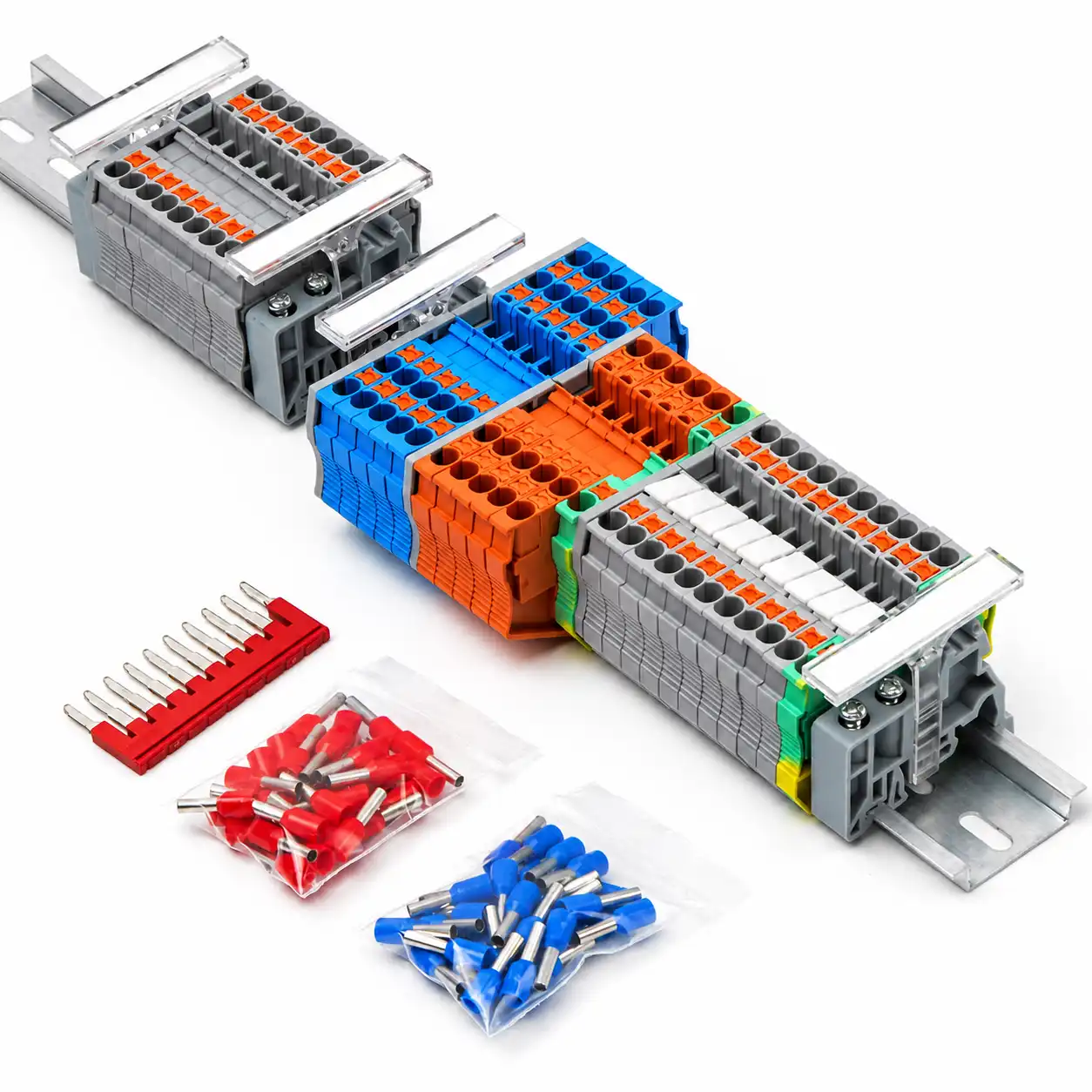
Make every supplier quote the same controlled system
A wholesaler cannot reliably quote an undefined component. “2.5 mm² terminal block” may refer to many functions, connection technologies, conductor constructions, rail interfaces, ratings, accessory families, and market approvals. Give every candidate the same controlled input.
- Identity: manufacturer part number, exact order code, description, color, revision status, unit of measure, and packaging multiple.
- Electrical duty: circuit function, current, voltage, fault or protective context, operating temperature, grouping, and any required derating data.
- Conductor interface: copper or another permitted material, size, strand class, number of conductors, ferrule rule, strip length, and tool or actuation method.
- Mechanical interface: rail profile, width, height, entry direction, end hardware, bridge pitch, markers, test access, and enclosure constraints.
- Functional set: feed-through, PE, neutral, fuse, disconnect/test, component, multi-level, distribution, shield, and spare positions as required.
- Evidence and market: destination, end-product route, component category, required official record, declarations, markings, and customer documentation.
Know who holds the stock, who owns the data, and who answers when something changes
A manufacturer, authorized distributor, independent wholesaler, and broker can each be useful in the right situation. Channel labels are not the decision. Traceability, technical competence, custody, warranty, and escalation determine whether the channel fits your program.
Where did this exact stock come from?
Record manufacturer, upstream channel, stock location, pack condition, acquisition basis, and who warrants authenticity and identity.
What does the claimed relationship cover?
When authorization matters, verify the entity, territory, product family, status, and warranty route rather than accepting a logo or screenshot.
Can the seller tie documents to the quote?
Current drawings, data sheets, certificates, database records, installation information, and accessory references must match the exact order code.
How are similar products kept separate?
Look for labeled locations, lot and carton control, receiving checks, sealed-pack policy, and rules for repacked or split quantities.
Can anything ship without buyer approval?
The answer should cover substitutions, manufacturer revisions, sites, materials, labels, packaging, lifecycle events, and alternative accessories.
Who can resolve a technical discrepancy?
Name commercial and technical contacts, response targets, return authorization, containment, replacement, and corrective-action routes.
A good sample matters only when it is connected to the bulk process
Use the sample as a controlled first article, not a showroom check. Compare it with the released requirement, assemble a representative terminal strip, connect permitted conductors under the approved work instruction, and retain enough evidence to recognize a later difference.
Confirm identity
Photograph the product, markings, inner pack, carton, labels, lot/date data, packing list, and exact quoted order code.
Build the strip
Check rail engagement, end hardware, width, end plates, bridges, markers, covers, test parts, and functional terminals.
Run the process
Use the documented wire preparation, permitted ferrule, tool, torque or actuation method, and inspection criteria.
Repeat on the lot
Apply the agreed receiving plan to the first bulk lot and increase control after a change, escape, or repeated discrepancy.
Do not invent one universal sample count. Part criticality, supplier history, lot size, failure consequence, and your end-product controls should drive the documented plan. ISO 2859-1:2026 is one current framework for attribute-based lot sampling, but the acceptance criteria and risk assumptions remain the buyer's responsibility.

Compare the landed, usable, approved terminal strip—not a headline unit price
A low quote may exclude pack multiples, accessories, labels, kitting, documentation, replacement freight, or availability commitments. An itemized quote turns these differences into visible purchase risk.
| Commercial term | Record in the quote or purchase order | Question it prevents |
|---|---|---|
| Part and unit | Manufacturer, exact order code, revision/status, unit of measure, currency, price break, and quote validity. | Are both suppliers pricing the same controlled item? |
| MOQ and pack | MOQ, order multiple, factory-sealed pack, split-carton policy, repacking label, and residual quantity. | Will the usable quantity and traceability match the production plan? |
| Accessories | Separate line items for blocks, bridges, end plates, markers, rail/end hardware, covers, separators, test parts, and spares. | Is the terminal strip complete when it reaches kitting? |
| Availability | On-hand free quantity, allocated quantity, location, replenishment source, confirmed date, and order cut-off. | Is the date firm stock or only a forecast? |
| Delivery | Named place, agreed Incoterms® 2020 rule where used, freight mode, packaging, insurance responsibility, and export/import documents. | Where do cost, delivery duty, and transit risk change hands? |
| Change control | Written buyer approval before substitution, revised item, site/source change, alternate accessory, label change, or split stock. | Can an “equivalent” arrive without engineering review? |
| Quality response | Inspection window, quarantine notice, return authorization, freight, replacement, containment, root cause, and corrective-action timing. | What happens when a pattern appears in the bulk lot? |
| Recurring supply | Forecast, blanket order/call-off rules, allocation, price review, lifecycle notice, safety stock, and cancellation terms. | Can the channel support the program after the first order? |
Score only candidates that already meet the non-negotiable technical gates
A total score must not conceal an unresolved identity, approval, substitution, or functional-accessory gap. Set pass/fail gates first; then weight the remaining factors to match your purchasing risk.
Exact order codes, data accuracy, accessory mapping, current documents, and written substitution rules.
Source, stock custody, lot/pack labels, sample-to-shipment linkage, receiving records, and recall reach.
Named specialist, response speed, evidence quality, deviation handling, and ability to interpret a terminal plan.
Stock transparency, replenishment, allocation, lead-time stability, lifecycle notice, and recovery planning.
Landed usable cost, MOQ, pack multiples, credit, kitting, warranty, returns, quote validity, and delivery terms.
Confirmed-date delivery, fill rate, document accuracy, discrepancy rate, return cycle, and corrective-action effectiveness.
Choose your own weights. A prototype buyer may favor low MOQ and fast technical response. A recurring OEM program may place more weight on evidence, traceability, change control, continuity, and corrective action.
Six red flags that justify pausing the purchase
No exact order code
The quote says “same specification,” “compatible,” or only a family name without a controlled engineering comparison.
Unrelated evidence
Certificates, database screenshots, and data sheets are generic, outdated, incomplete, or do not match the quoted model.
Mixed or unmarked stock
Samples or cartons lack source, part, pack, lot, or traceable links to the quotation and purchase order.
Accessories deferred
The seller quotes basic blocks now and promises “equivalent” bridges, labels, end plates, or functional terminals later.
Moving stock story
Free quantity, location, allocation, replenishment source, and confirmed delivery date change without explanation.
No written remedy
The seller refuses substitution approval, return terms, containment, replacement, or a quality-escalation commitment.
Keep the approved identity connected through receiving and replenishment
Qualification is not complete when the purchase order is issued. Verify carton and inner-pack labels against the released BOM, protect unopened pack identity, quarantine differences before kitting, and inspect the defined features from each lot or under the approved switching plan.
For multi-site programs, keep a central approved manufacturer identity while mapping qualified local supplier codes, pack multiples, documents, language needs, and delivery routes. A local alternate should follow the same technical review as a new source.
The numbers and suppliers are intentionally omitted. The point is to normalize scope before price.
Supplier A and Supplier B may not be quoting the same deliverable
A panel builder requests a recurring terminal strip. Supplier A quotes only the feed-through block and says matching accessories can be selected after order. Supplier B quotes the released blocks, PE terminals, rail/end hardware, end plates, bridge system, markers, spares, pack quantities, source documents, and a written substitution rule.
Supplier A's headline unit price looks lower. The comparison changes after missing end plates, incompatible bridges, small-order freight, repacking, extra kitting labor, and production delay are included. The correct baseline is landed, usable, approved terminal-strip cost and risk.
This does not mean the higher quote automatically wins. Ask Supplier A to quote the same BOM, evidence, packaging, availability, and quality terms. If both can meet the same controlled requirement, price and service are finally comparable.
Send enough information to receive a controlled quotation
A useful request for quotation gives the wholesaler one unambiguous basis for product, evidence, packaging, delivery, and problem response.
Move from supplier screening to a complete sourcing package
Bulk terminal block wholesaler questions
What is the first thing to check in a bulk terminal block quote?
Check the exact manufacturer order code and the complete accessory BOM. A feed-through block line alone may omit PE terminals, end stops, end plates, bridges, markers, covers, rail hardware, and functional terminals. Then verify current source evidence for the exact configuration before comparing prices.
Should I buy directly from a manufacturer or from a wholesaler?
Either route can work. Direct buying may suit high volume and close engineering coordination. A wholesaler may add regional stock, mixed-model supply, local service, kitting, credit, and multi-brand coverage. Compare traceability, technical support, fulfillment, commercial terms, warranty, and escalation rather than the channel label alone.
How many samples should I inspect?
Use a documented sampling plan that matches part criticality, supplier history, lot size, failure consequence, and your end-product controls. The first article should at least prove identity, mechanical fit, connection process, accessory compatibility, and document match. Increase control after changes or nonconformances.
Can a wholesaler substitute an equivalent terminal block?
Only after written engineering approval. Similar dimensions or nominal conductor size do not prove compatible bridges, markers, conductor behavior, approvals, or functional accessories. Treat an alternative as a new controlled terminal system and update the terminal plan, BOM, work instructions, and evidence file.
What documents should the wholesaler provide?
Request current manufacturer data, exact order code and revision status, applicable official approval or marking evidence, accessory compatibility information, installation or preparation instructions, packing and lot traceability where required, warranty and return terms, and a written substitution and change-notification policy.
How should I evaluate a terminal block lead-time claim?
Ask separately for free on-hand quantity, allocated quantity, stock location, upstream source, replenishment status, order cut-off, and the date basis for the delivery promise. Record the answer in the quote. Reliable suppliers distinguish firm available stock from a forecast or factory estimate.
Why do terminal block accessories matter so much in bulk orders?
Accessories turn basic blocks into a usable terminal strip. Rail hardware, end stops, end plates, bridges, labels, separators, covers, test parts, and functional terminals control assembly, potential distribution, identification, service access, and fit. Quote and sample them with the blocks.
What should happen after a bulk-lot defect is found?
Quarantine the suspect lot, identify affected orders and panels, document the nonconformance, and request disposition, replacement, containment, root cause, and corrective action under the agreed terms. Do not mix replacement stock into inventory until part identity and traceability are restored.
Verify the current rule and the exact product scope
These sources support the category, sampling, quality-system, and delivery concepts used in this guide. They do not approve a supplier or replace the current requirements for your destination, end product, and exact component.
- UL Solutions — Connector Certification Services: current terminal-block and connector category references, including UL 1059 and the ANSI/UL 60947-7 series.
- IEC 60947-7-1:2025: terminal blocks for copper conductors with screw-type or screwless clamping units within its stated scope.
- ISO 2859-1:2026: sampling schemes indexed by acceptance quality limit for lot-by-lot inspection by attributes.
- ISO — Certification and accreditation: explains what certification and accreditation mean and why the exact certification claim must be checked.
- ICC — Incoterms® 2020 rules for any mode of transport: official delivery, cost, and risk allocation context for commercial terms.
Send the full terminal-strip requirement and compare like with like
SENTOP can review a model, drawing, terminal plan, BOM, sample, or mixed-product requirement and coordinate product matching, accessories, documentation, packaging, quantity, and delivery. Final approval remains with the buyer's engineering, quality, and end-product process.
Application · exact model/BOM · conductor data · current/voltage · terminal functions · rail/accessories · destination market · annual volume · sample plan · documents · packaging/labels · required delivery date