
AC current
Repeated natural zero crossings
The breaker still needs the correct AC rating, but the current-zero points help the interruption process.
Circuit protection selection guide
AC and DC breakers may look alike, but the current type changes how the device must stop an arc. Select from the exact marked voltage, breaking capacity, pole connection and direction—not from amperes or case size alone.
Do not use an AC-only breaker on DC. Do not assume a DC breaker is approved for AC. Either use is acceptable only when the exact catalog number is marked and documented for that current type, voltage, fault duty and wiring arrangement.

The current rating is only one field. The breaker must also stop the worst fault expected at its installed voltage and under its approved connection method.
| Selection point | AC breaker context | DC breaker context |
|---|---|---|
| Arc interruption | AC current crosses zero every half-cycle. This can help a suitable breaker end the arc. | DC has no natural current-zero point. The breaker must force the arc to cool, lengthen or divide until current stops. |
| Voltage marking | Use the stated AC voltage, frequency and network arrangement. | Use the stated DC voltage with its required pole connection and system arrangement. |
| Breaking capacity | Must cover the available AC fault current at the marked voltage and test conditions. | Must cover the DC fault current at the installed point, voltage and stated circuit conditions. |
| Pole use | Poles serve phases or other conductors as the product and system design permit. | Two or more poles may need to be wired in series to achieve a stated DC voltage rating. |
| Polarity and direction | Many AC breakers are not directional, but line/load markings still control. | Some DC breakers are polarity-sensitive or approved for only one current direction. |
| System study | Review voltage, frequency, inrush, fault level, conductors and coordination. | Review all of those factors plus topology, current reversal and any stated L/R or time-constant condition. |
A breaker marked 400 V AC and 125 V DC is not rated 400 V DC. A 10 kA AC value is not automatically a 10 kA DC value. Read each rating as a complete set of conditions for the exact model.
When breaker contacts open under load or fault, current may keep flowing through an electrical arc. In AC, the current changes direction and crosses zero every half-cycle. That brief zero can help a correctly rated AC breaker put out the arc.
DC current does not cross zero in normal steady operation. A DC-rated breaker therefore needs an arc-control design that works at its stated DC voltage and fault duty. Depending on the product, it may use faster contact movement, arc runners, arc chutes, magnetic blowout or several contact gaps in series. Schneider Electric describes this zero-crossing difference in its AC/DC MCCB guidance.[1]
The breaker still needs the correct AC rating, but the current-zero points help the interruption process.
The device must force the arc to end. Its DC voltage, arc path and approved pole arrangement are linked.
This difference does not mean every DC breaker is physically larger or that every AC breaker has weak contacts. It means the rating must come from the product’s tested AC or DC configuration. Appearance cannot supply that evidence.
The two directions must be checked separately. A product can be dual-rated, but that approval belongs to a specific catalog number and a specific set of conditions.
The exact breaker must show or document the required DC operational voltage and DC breaking capacity. It must also permit the planned pole wiring, polarity, current direction and system topology.
UL’s marking guide notes that some three-pole breakers at or below 250 V DC use two poles to control the circuit. Above 250 V DC, breakers are generally intended to use poles in series and carry a wiring diagram.[4] This is a marking rule, not permission to connect any three-pole AC breaker to DC.
A DC-oriented frame may have different contacts, insulation, arc chambers and testing. It is not automatically suitable for an AC network.
For example, Schneider Electric says its ComPacT NSX DC frame is not recommended for AC use because that DC family is not tested and certified for the AC network.[8] Other dual-rated families exist, so the answer remains model-specific.
Use the marking on the exact device together with the matching data sheet, wiring diagram, installation manual and model-level certificate scope. A reseller title, a family brochure or a similar housing is not enough.
Start with the circuit, not the product list. Schneider Electric’s DC selection guidance highlights the system type, rated voltage, current and maximum short-circuit current at the installation point as core inputs.[6]
IEC 60947-2:2024 covers circuit breakers for instructed or skilled persons within its scope up to 1,000 V AC or 1,500 V DC.[2] IEC 60898-2:2016 adds requirements for certain single- and two-pole breakers suitable for both AC and DC in household and similar installations, within a smaller stated DC scope.[3] A standard name is a useful filter. It is not proof that every rating in a product family covers your system.
At higher DC voltage, a manufacturer may place two, three or more breaker poles in series. Each opening gap then shares part of the interruption task. The stated DC rating may exist only with that exact path.
Do not invent a series or parallel connection. A parallel link does not safely “double the amps” unless the manufacturer has tested and published that arrangement. Current sharing, contact timing and fault interruption can all change.
Some DC breakers use magnets to drive the arc into an arc chute. These products can be polarity-sensitive. Schneider’s C60H-DC is one model example: its plus/minus markings must be followed, and the company says it should not be used where current can briefly reverse.[7] Do not apply that example to every DC breaker; read the exact model documents.
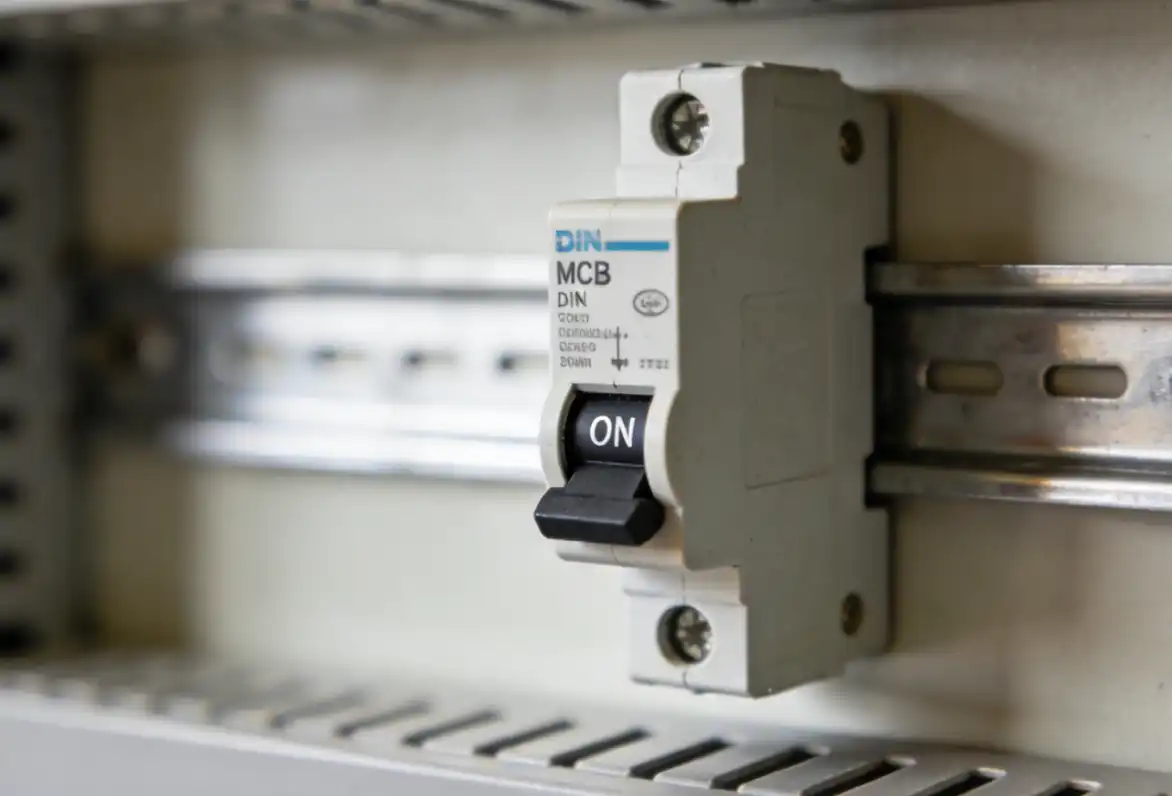
“Solar breaker,” “battery breaker” or “industrial breaker” is not a complete specification. Each application changes the source behavior, current direction, voltage range and fault path.
Confirm available AC fault current, conductor duty, load starting current, coordination and the breaker’s branch or feeder role.
Check the full battery voltage range, bus fault current, charge/discharge paths, polarity, topology and required service isolation.
Review string or combiner topology, temperature, possible reverse paths, enclosure conditions and PV-specific intended use.
Map rectifiers, battery backup, grounded or floating return, branch duty and current paths during normal and fault states.
Confirm whether the device is a branch breaker or only a supplementary protector inside approved equipment.
Include inverter, charger and regenerative states. A one-direction DC breaker cannot be assumed safe for both paths.
A switch-disconnector may provide switching or isolation without automatic overcurrent protection. In U.S. use, UL states that a supplementary protector is not intended to provide the branch-circuit protection required by the NEC.[5] Confirm each required function separately.

Use this process to prepare a design review or supplier enquiry. It does not replace a short-circuit study, coordination study or qualified installation work.
Record AC or DC, nominal and maximum voltage, AC frequency, source and load, grounding topology, and whether the device must protect, switch, isolate or combine those functions.
Include expected current, duty cycle, inrush, ambient and enclosure temperature, terminal limits, wire capacity and any adjustable trip setting.
Account for batteries, converters, transformers, conductors, upstream devices, fault path, system voltage and any stated L/R or time-constant condition.
Require marked voltage, current, breaking capacity, trip data, standard and intended use for the full catalog number. Do not rely on family-level claims.
Follow the approved diagram for series or parallel links, terminal sequence, line/load, plus/minus, common trip and bidirectional limits.
Review enclosure, clearance, altitude, temperature, terminals, accessories, target standard, certificate scope and local electrical rules.
Link the sample, data sheet, model code, wiring diagram, markings and order record. Reassess after changes to the source, battery, inverter, wiring, breaker or fault level.
For product-category planning, review SENTOP’s miniature circuit breaker range, molded case circuit breaker range and DC isolator switch range. The MCB vs MCCB guide helps separate device categories. Final suitability still depends on the exact model and complete system data.
These shortcuts hide the information that proves safe interruption. Ask for model-level evidence before accepting the offer.
A clear RFQ helps suppliers return a model that can be checked. Include the following information:
The main difference is arc interruption. AC current crosses zero every half-cycle, which can help end an arc. DC has no natural current-zero point, so the breaker must control and stop the arc under its stated DC voltage, fault current, pole arrangement and direction conditions.
Only when the exact breaker is marked and documented for the intended DC voltage, current, breaking capacity, pole connection and system arrangement. An AC-only rating is not enough. Some dual-rated products exist, but their DC conditions are model-specific.
Only when the exact breaker also has the required AC rating and approval for that network. A DC-oriented design does not prove AC test performance. Check the full part marking, data sheet, certificate scope and manufacturer instructions.
At higher DC voltage, the manufacturer may connect poles in series to create several opening gaps and achieve the stated interruption rating. The pole count, jumper path and terminal order are part of the approved configuration.
No. Some are polarity-sensitive, while others are approved for defined bidirectional use. If current can reverse during battery charging, regeneration or multi-source operation, confirm the exact model’s direction limits in writing.
Determine the greatest prospective short-circuit current at the breaker location under the real voltage and circuit conditions. Then choose a breaker whose stated DC breaking capacity covers that duty with the required pole and system arrangement.
Not always. A breaker provides overcurrent protection within its rating. A switch-disconnector may provide switching or isolation without automatic overcurrent protection. Confirm both the protection and isolation functions required by the system.
Not without a complete protection review. Fuses and breakers can differ in voltage rating, interruption behavior, time-current curve, coordination, connection and end-product approval. Do not substitute by amperes alone.
Engineering and safety notice: This guide supports comparison, specification and purchasing. It is not an installation instruction, wiring diagram or substitute for a short-circuit and protection-coordination study.
Final selection must follow the exact product marking, manufacturer documentation, system grounding arrangement, applicable code, end-product standard and work by qualified electrical personnel. Never alter pole links, polarity, terminals or breaker ratings based only on a generic online example.
Send SENTOP the system voltage range, current, prospective fault duty, topology, pole diagram, current direction, target market, model reference, quantity and destination. The review can then start from a complete requirement instead of a visual substitute.