
Manual off/on or test operation
Counts toward mechanical or electrical endurance under the stated test duty. It is not the same as clearing a fault.
Post-trip decision guide for homes, facilities and industrial systems
A trip is a protective action, not an automatic end-of-life signal. What matters most is why the breaker tripped, how much current it interrupted, whether it trips again and what condition it is in now.
One ordinary overload trip usually does not mean a correctly rated breaker is worn out. A suspected short circuit, repeated or instant re-tripping, unusual heat, smoke, odor, cracks, water exposure or a failed test function needs a qualified assessment—and may require replacement.[1][2]
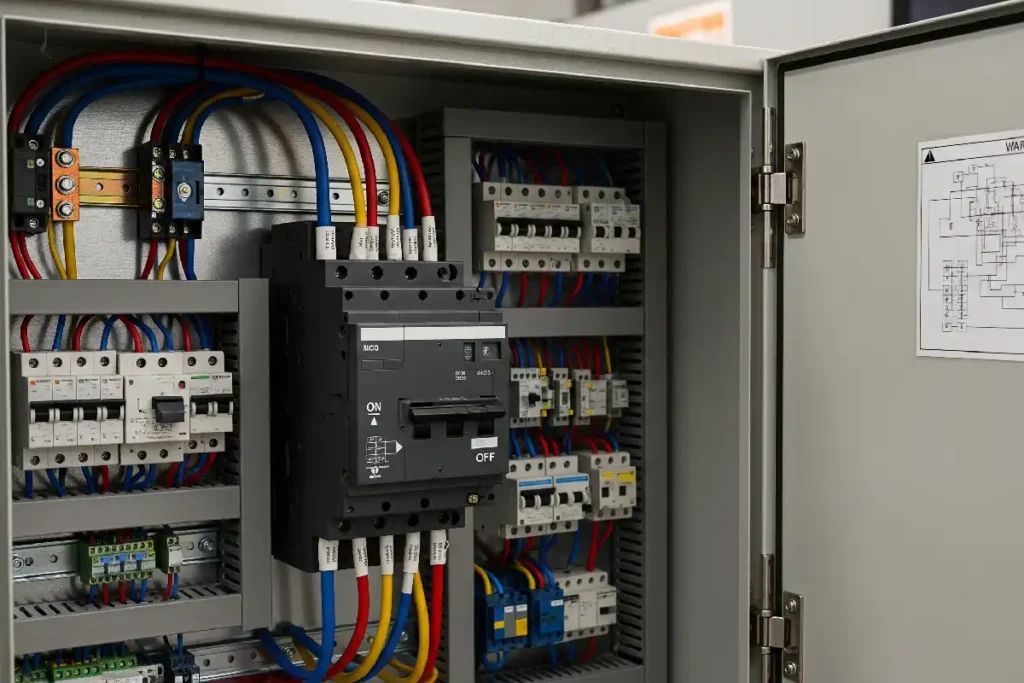
Trip severity changes the questionA moderate overload, an instantaneous short-circuit trip and repeated reclosing onto an uncleared fault are not equal life events.
Do not judge the breaker from its handle position alone. Identify the event, remove the cause and check for warning signs before any permitted reset.
This guide serves homeowners, electricians, maintenance teams, panel builders, facility engineers and technical buyers. It explains decisions and purchasing data; it does not authorize live work or replace the exact manufacturer's procedure.
Arc-flash, shock and stored-energy hazards can remain even when a breaker appears open. Follow the site electrical-safety program, isolation procedure, PPE requirements and local rules.
Technically, every loaded interruption uses some of the breaker's electrical endurance. In practical service, however, one moderate overload trip is normally a much smaller event than interrupting a high short-circuit current. A correctly applied breaker is designed to operate, trip and interrupt within its ratings.
Eaton notes that the number of overcurrents a molded-case circuit breaker can clear depends greatly on the magnitude of current interrupted.[2] That is why there is no trustworthy universal answer such as “a breaker is safe for ten trips.”
Counts toward mechanical or electrical endurance under the stated test duty. It is not the same as clearing a fault.
Thermal stress and loaded opening occur. Repeated overloads also heat conductors, terminals and the enclosure.
High current, arc energy and electrodynamic forces can affect contacts, arc paths, connections and nearby equipment.
The current may not look like an overload. Find and correct the leakage or arcing cause before restoring service.
Heating and cooling can expose load, conductor, termination, ambient-temperature or coordination problems.
It can repeat the dangerous event. Schneider states that the fault must be identified and cleared before reclosing.[1]
The event magnitude, breaker rating, available fault current, product category, environment and present condition carry more meaning than a raw trip count.
A data sheet may publish operating cycles, while a maintenance decision asks whether the installed breaker can still protect the real circuit. Keep these five measures separate.
Years alone do not show contact wear, fault history, corrosion, contamination or actual operating duty.
Open-close cycles under the manufacturer's stated mechanical test conditions.
Operations while making or breaking a defined current and voltage under a defined duty.
Short-circuit current, clearing sequence and the product's rated interrupting performance.
Inspection, test results, event data and manufacturer limits applied to the installed device.
IEEE 1458 provides a framework for selecting, field testing and determining remaining life for molded-case circuit breakers in industrial applications.[4] NEMA AB 4 addresses inspection and preventive maintenance for commercial and industrial MCCBs.[5] Neither turns a general cycle rating into a universal homeowner reset allowance.
Select the conditions you can identify without opening energized equipment. The result is conservative guidance, not permission to work on a panel or a model-specific return-to-service decision.
If facts are uncertain, leave the breaker off and use a qualified person. Always follow the exact breaker, panel and site instructions.
One reset is not a diagnostic method. Resetting without removing the cause can re-energize damaged wiring or equipment. Never keep trying a breaker that trips again.
These signs do not prove the breaker is the root cause, but they are strong reasons to stop restoring power and arrange a qualified evaluation.
For water exposure, NEMA warns that corrosion, foreign particles, loss of lubricant, affected contacts and reduced insulation performance can compromise protective equipment.[3]

The fault may remain, the mechanism may be damaged or the product may have a special reset sequence. Do not force the handle.
Repeated operation points to an unresolved circuit, load, wiring, temperature, setting or breaker problem.
Cracks, melting, deformation, soot, discoloration or a burnt smell require the equipment to remain out of service.
A loose, sticky, rough or inconsistent mechanism needs review against the manufacturer's instructions.
Follow the device's instructions for a failed RCD, GFCI, AFCI or electronic trip-unit test. Do not assume overcurrent protection alone is unaffected.
Record the event, estimated fault current and protective operation. Inspect the breaker, connections, enclosure and downstream equipment before return to service.
Dry appearance is not proof of safe insulation or mechanism condition. Use the manufacturer and industry recovery guidance.
Similar shape and current rating do not prove panel compatibility, fault rating, trip function, terminals or certification.
The scope depends on breaker type, energy level, manufacturer instructions and facility rules. These are assessment categories—not do-it-yourself test steps.
Record protective indication, trip-unit data, time, load state, alarms, operating sequence and any disturbance upstream or downstream.
Use the approved isolation, lockout/tagout, absence-of-voltage and stored-energy procedure for the site and equipment.
Check for cracks, soot, loose mounting, discoloration, abnormal terminals and damage to the switchboard or connected equipment.
Investigate insulation, wiring faults, current, inrush, phase balance, harmonics and the actual reason protection operated.
Product-appropriate work may include trip-time or primary-current injection, contact resistance, mechanical operation, trip-unit diagnostics and accessory checks.
Compare findings with manufacturer limits, fault rating, maintenance rules and the required reliability of the circuit.
Schneider's post-fault procedure requires identifying the trip cause, clearing the electrical fault, checking the load and inspecting the breaker and switchboard after a short circuit before reset and reclose.[1]
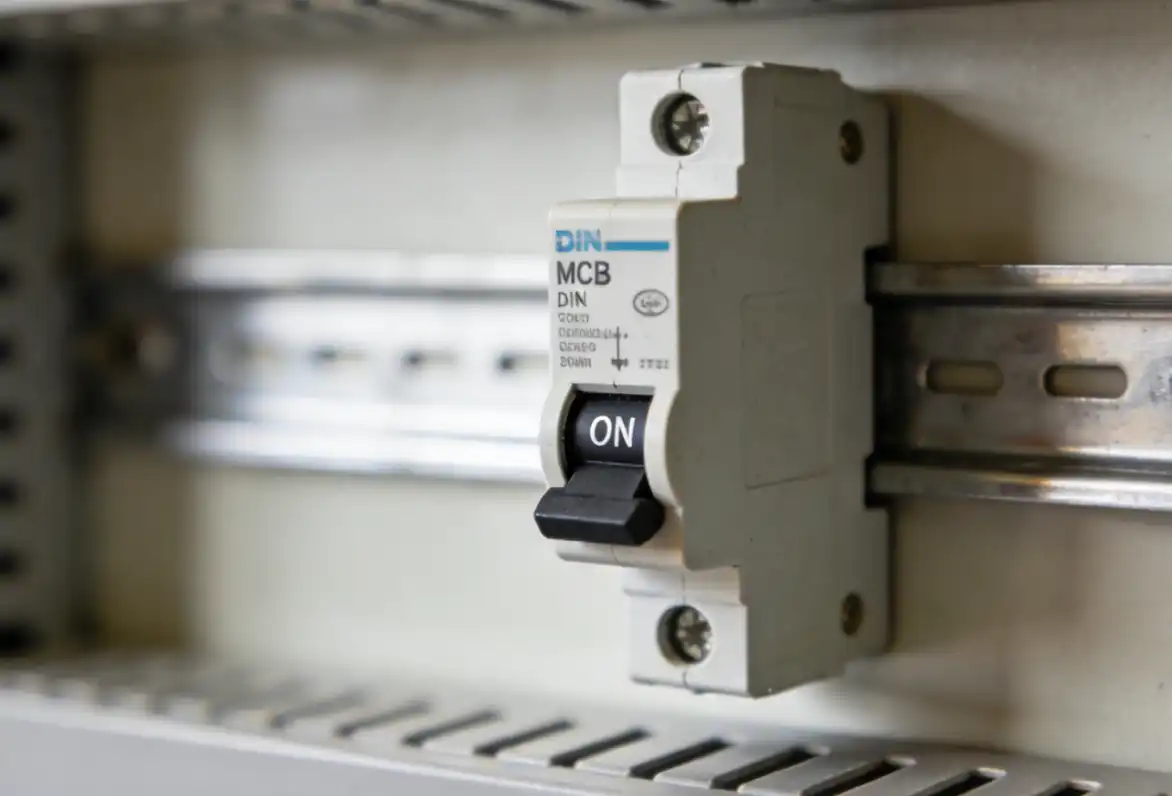
A sealed residential MCB and a drawout power breaker have different serviceability, diagnostics, maintenance programs and post-fault options.
Common in final circuits. Replacement is often more practical than internal repair. Match the exact panel, ratings and protection functions.
May have fixed, adjustable or electronic protection. Post-fault integrity depends on the exact frame, trip unit, fault level and manufacturer procedure.
May support inspection, testing, component maintenance and event diagnostics under a formal electrical maintenance program.
Requires trained personnel, defined maintenance intervals, mechanism and interrupter checks, and manufacturer-specific limits.
For current SENTOP product directions, review the MCB range, MCCB range and air circuit breaker range. Exact endurance, fault ratings, accessories and service instructions are confirmed by ordering code.
Cycle figures describe a defined test duty for a specific product. They are useful for selection and planned switching duty. They are not a promise that the breaker can interrupt that many unknown short circuits.
Check the exact model, standard, current, voltage, utilization category, operating sequence, temperature, maintenance condition and whether the number is typical, minimum or certified.
| Published product example | Mechanical endurance | Electrical endurance | Correct interpretation |
|---|---|---|---|
| Schneider Acti9 iC60H3/N3 RCBO | 20,000 cycles | 5,000 O-C cycles | Applies to the cited RCBO catalogue data and test conditions—not every Acti9 device or every fault interruption.[8] |
| ABB S200 MT MCB | 20,000 operations | AC: 20,000 below 32 A; 10,000 at 32 A and above. UL 1077 data is listed separately. | Different standards and AC/DC duties carry different figures. Keep each value with its stated product condition.[9] |
| Siemens 3VJ1, cited 63 A MCCB code | 15,000 typical operations | 5,000 operations at AC-1, 380/415 V | This is one exact ordering code and utilization condition, not a category-wide 3VJ1 or MCCB value.[10] |
Do not use this percentage to estimate remaining life after unknown faults, water exposure, contact damage, contamination, abnormal heat or operation outside the published conditions.
IEC 60898-1 covers AC circuit breakers for household and similar installations within its scope, while IEC 60947-2 covers low-voltage circuit breakers intended for instructed or skilled persons.[6][7] A cycle number must remain attached to the exact product standard and model.
Many failures develop around the installation, not from a single normal protective operation.
Available fault current, clearing time and repeated fault interruption raise stress on contacts, arc paths and connections.
Persistent heating can affect the breaker, conductor insulation, terminals, busbars and enclosure temperature.
Excess resistance creates local heat. Correct conductor preparation and product-specified torque matter.
High ambient temperature, salt, dust, chemicals, vibration and condensation can affect insulation and mechanisms.
A protection breaker should not be assumed to be a high-frequency control switch unless it is rated for that duty.
Incorrect fault capacity, trip curve, settings, panel compatibility or upstream/downstream coordination increases risk.
Measure load and inrush, correct wiring or termination problems, control enclosure temperature, keep the device within ratings and follow a condition-based maintenance plan.
A short event log is more useful than memory alone. It also gives a maintenance team evidence for the condition-based program covered by standards such as NFPA 70B.[11]
What equipment was starting, running, stopping or being tested?
Manufacturer, full model, rating, poles, trip unit, settings and panel position.
Long-time, short-time, instantaneous, ground-fault, arc-fault or unknown.
Measured current, inrush, phase balance, connected load and recent changes.
External heat, odor, marks, moisture, contamination, enclosure temperature or vibration.
Who investigated, what fault was corrected, tests completed and who authorized return to service.
Send clear front and side photos, the full code, panel information and trip history. Do not select a substitute from current and pole count alone. The MCB vs MCCB guide explains why the category and circuit duty matter.
A useful breaker enquiry connects the device to system voltage, available fault current, operating duty, environment and panel. It also asks what happens after a high-current interruption.
AC/DC, voltage, frequency, poles, load current, inrush, trip functions, fault level, Icn/Icu/Ics and coordination.
Expected operations, loaded switching duty, mechanical/electrical endurance, test sequence and maintenance assumptions.
Approved panel, terminals, torque, conductor, busbar, temperature, altitude, humidity, contamination and vibration.
Full code, standard, certificates, trip-unit data, accessories, after-fault procedure, warranty, traceability, quantity and destination.
A trip uses some operating life, but a correctly applied breaker is designed to trip. One moderate overload trip normally causes much less stress than interrupting a high-current short circuit. Judge the event by cause, current, product rating and present condition.
There is no universal safe trip count. Manufacturer cycle ratings use defined currents, voltages and test sequences. Fault magnitude, repeated overloads, environment, maintenance and condition all affect the decision.
Only when the cause is understood and corrected, no warning signs are present, the event was not repeated or a suspected short circuit, and the exact instructions permit a reset. Otherwise leave it off and use a qualified person.
The overload or fault may remain, the load may have excessive inrush, a connection or conductor may be overheating, the trip settings may be wrong or the breaker may be defective. Do not keep resetting it.
Not every correctly rated breaker is automatically replaced after every short circuit, but a serious fault requires the manufacturer's post-fault procedure and a qualified integrity assessment. Damage, failed tests or operation outside the interrupting rating can require replacement.
Yes. Internal contact damage, reduced insulation, contamination or a weakened mechanism may not be visible from outside. Event history, qualified testing and manufacturer guidance matter after severe faults or water exposure.
Water can introduce corrosion, particles, lubricant loss and insulation damage. Keep affected equipment de-energized and follow the manufacturer and recognized water-damage guidance; drying the outside is not enough to prove safe service.
Provide the manufacturer and full model, clear markings and photos, current, voltage, poles, trip curve or settings, fault rating, panel type, terminals, accessories, trip history, system fault level, target standard and required quantity.
Safety notice: This article is an educational decision guide. It does not replace the exact breaker and panel instructions, local electrical rules, a short-circuit and coordination study, or work by qualified electrical personnel.
When the cause is unknown, the breaker repeats the trip, or heat, smoke, damage, water, contamination or a serious fault is involved, keep the equipment out of service until the required assessment is complete.
Send the full model, markings, panel information, system voltage, load and inrush, fault level, trip history, visible condition, required standard, quantity and destination.