
Electricity bill calculation guide
Calculate Single-Phase and Three-Phase Electricity Bills
Single-phase and three-phase bills do not use a universal price multiplier. Start with measured or estimated real energy in kWh, then apply the account's actual energy rates, demand rules, fixed charges, taxes and adjustments.
Direct answer
Calculate real power, convert it to kWh, then follow every line of the tariff. For a real invoice check, billing-meter data and the approved rate schedule outrank a hand calculation.Planning calculator
Estimate single-phase or balanced three-phase electricity cost
Enter a steady-load estimate and simple tariff items. Use measured billing-period kWh and billing demand instead whenever they are available.
Your planning estimate
This is a steady-load calculation, not a utility invoice prediction.
Subtotal = energy charge + demand charge + fixed charge + adjustments. Rate blocks, minimums, ratchets, export treatment and other tariff rules are not modeled.
Read the invoice first
An electricity bill is more than kWh multiplied by one rate
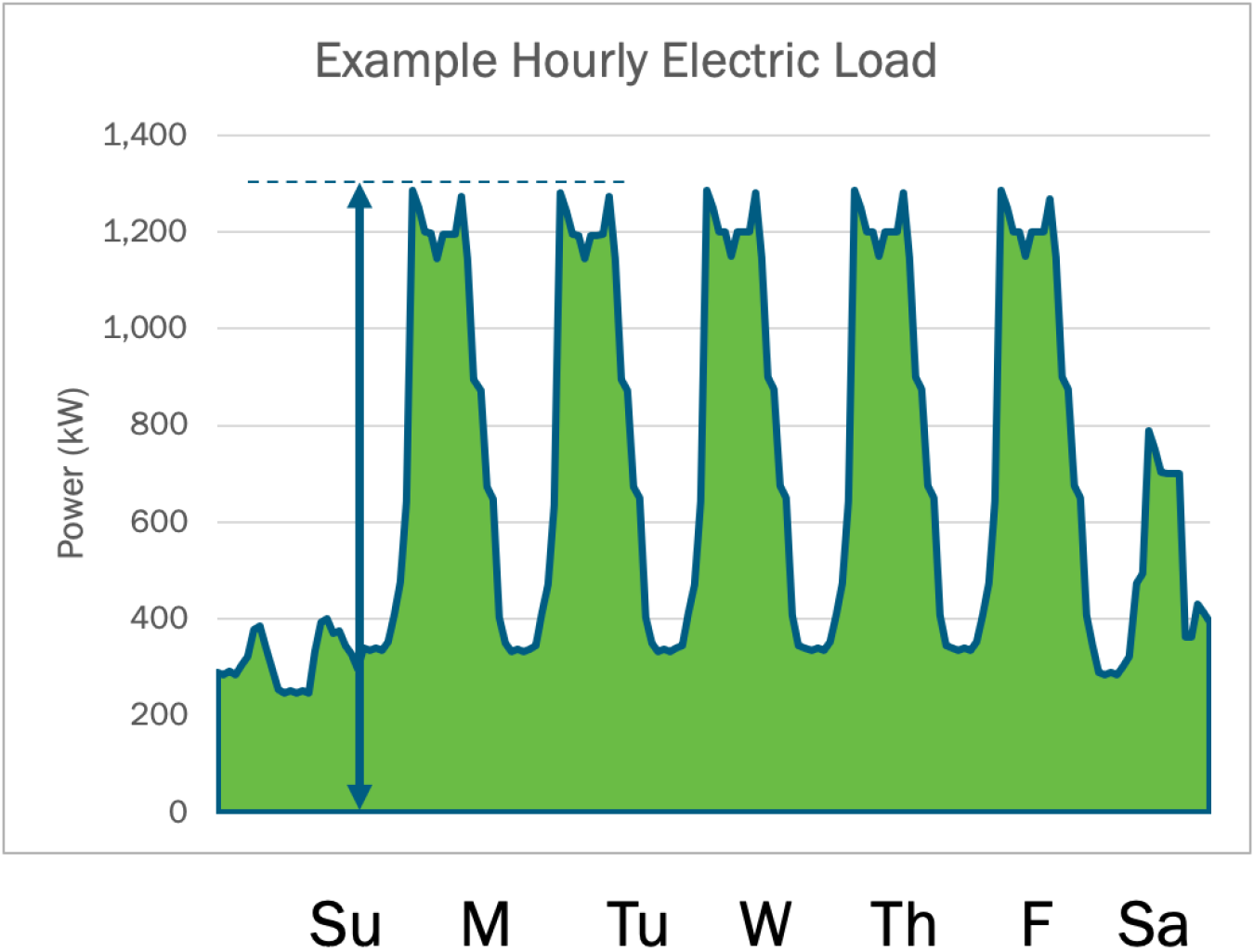
A phase formula estimates electrical power. The tariff decides how that measurement becomes money. The U.S. Department of Energy separates common utility costs into energy, demand and fixed components; many real tariffs add time periods, taxes, riders, credits or reactive-power terms.
Why phase count does not set the price
A small single-phase shop and a three-phase workshop may both buy energy in kWh. The workshop may have larger motors, a higher service voltage or a demand-billed commercial account, but those are load and tariff differences.
If both sites use 500 kWh under the same energy rate, the three-phase site is not automatically charged three times the energy price. Always identify the rate class, billing period and invoice line items before comparing costs.
Use the right unit
kW, kWh, kVA and power factor answer different questions
A panel display may show all of them, but the invoice may not charge each one. Compare like with like before calling a reading wrong.
| Quantity | Plain-language meaning | Where it belongs in a bill check |
|---|---|---|
| V and A | Voltage and current at a moment or over an interval. | Inputs to a power estimate. They are not an energy total. |
| kW | Real power: how fast useful electrical energy is being used. | May drive a kW demand charge and is the starting point for a kWh estimate. |
| kWh | Real energy accumulated over time. | Usually the main consumption quantity on the invoice. |
| kVA | Apparent power based on RMS voltage and current. | May matter for equipment capacity or a kVA demand tariff. |
| kVAR / kVARh | Reactive power or reactive energy. | Relevant only where the meter and agreement include it. |
| PF | Power factor: the relationship between real and apparent power in the measurement context. | Use a measured or documented value. A tariff may or may not attach a cost to it. |
Power formulas
Use different power formulas, but the same billing logic
Both calculations estimate real kW. Multiply average kW by operating hours to estimate kWh, then apply the actual tariff.
Use the relevant line-to-neutral voltage, operating current and power factor. Volts multiplied by amps alone gives VA, not necessarily real watts.
Use line-to-line voltage and line current. The formula already gives the three-phase total, so do not multiply the result by three again.
Formula reference: Schneider Electric PM2200 total-power calculation.
Transparent examples
Worked single-phase and balanced three-phase calculations
The example rate and fixed charge are arithmetic inputs, not market prices. Replace them with the exact tariff for the account.
230 V heater, 10 A, PF 1.00
The heater runs 6 hours per day for 30 days, or 180 hours.
- Power: 230 x 10 x 1.00 / 1,000 = 2.30 kW
- Energy: 2.30 x 180 = 414 kWh
- Energy charge: 414 x $0.18 = $74.52
- Illustrative subtotal: $74.52 + $12 fixed = $86.52 before other charges
400 V motor load, 12 A, PF 0.85
The load runs 8 hours per day for 22 working days, or 176 hours.
- Power: 1.732 x 400 x 12 x 0.85 / 1,000 = 7.07 kW
- Energy: 7.0666 x 176 = about 1,244 kWh
- Energy charge: unrounded energy x $0.18 = about $223.87
- Optional demand: 7.1 kW x $10/kW = $71 if the tariff bills this value
Important limit
Do not use one three-phase current when the load is unbalanced
The square-root-of-three shortcut assumes the phase voltages, currents and power factors are effectively equal. Mixed lighting, sockets, IT loads, VFDs and uneven single-phase circuits can break that assumption.
For an unbalanced system, measure or calculate phase A, B and C real power separately, then add them. If a meter reports 2.1 kW, 1.7 kW and 2.5 kW, the total is 6.3 kW.
A correctly configured polyphase meter is usually the better choice when loads change, waveform distortion is significant, or per-phase values differ. Confirm Wye or Delta topology, three-wire or four-wire connection, CT/PT ratios, phase association and direction before trusting totals.
Bill reconciliation
Why a hand calculation may not match the electricity bill
A hand formula describes one electrical condition. An invoice may integrate thousands of changing intervals and apply tariff rules that the formula does not include.
| Check | Evidence to collect | Common reason for a mismatch |
|---|---|---|
| Billing dates | Invoice start/end, interval timestamps and logger time zone. | A calendar month is compared with a different utility billing window. |
| Energy direction | Import and export registers plus generation configuration. | Export is netted even though the tariff keeps import and export separate. |
| Units and scaling | kWh, kW, kVA, kVARh, meter multiplier and CT/PT ratios. | A kW peak is treated as kWh, or a multiplier is missed. |
| Demand rule | Demand line, interval length, on-peak window and ratchet clause. | Total kWh is used to explain a charge created by the highest interval. |
| Load behavior | Trend data, run schedule, starts, VFD speed and production records. | One instantaneous current reading is multiplied by every operating hour. |
| Tariff layers | Rate blocks, TOU periods, fixed charges, taxes, riders, credits and minimums. | The calculation includes only one energy price. |
- Identify the account and periodRecord the meter number, tariff name, currency, invoice dates and every line item.
- Use billed registers firstCompare matching import kWh registers or the utility interval-data export. Keep import and export separate unless the tariff says otherwise.
- Verify measurement setupCheck topology, voltage inputs, CT/PT ratios, phase association, sign, direction and time settings through approved documentation or qualified personnel.
- Compare the same boundaryA whole-building utility meter will not equal one machine submeter. Define what each device includes.
- Explain the residual differenceInvestigate demand, TOU periods, meter losses, data gaps, taxes, riders and load variation before making a savings or procurement claim.
Power factor and demand
Power factor affects the bill only when the tariff recognizes it
Low power factor can increase current and apparent-power capacity for the same real kW. That does not create one global penalty rule.
Look for a kVA demand line, kVARh/reactive-energy charge, explicit PF adjustment or contract threshold. If the bill shows only kWh plus fixed charges, do not promise savings from power-factor correction without another tariff mechanism.
Before investing, collect measured kW, kVA, kVAR, PF, voltage, current and the time pattern of the load. Also review harmonics, load balance and equipment behavior with a qualified engineer. Correcting PF without understanding the system can create new technical problems.
Choose the evidence level
Use the strongest data source the decision requires
| Data source | Best use | Main limit |
|---|---|---|
| Utility bill and interval data | Checking the actual billed account, tariff periods and peaks. | May not isolate one machine or department. |
| Approved billing meter | Contractual or tenant billing where the device and process are legally accepted. | Approval, sealing, installation and data rules vary by market. |
| Panel submeter | Finding load drivers, comparing lines and supporting energy management. | Does not automatically replace the utility meter. |
| Portable power logger | Peak investigation, phase balance and short-term before/after evidence. | A short study can miss seasonal or production conditions. |
| Hand calculation | Fast planning estimate for a documented steady load. | Sensitive to voltage, current, PF, runtime and balance assumptions. |
A three-phase logger can record per-phase and total real power, apparent power, reactive power, PF and energy. See Fluke's 30-day load-study workflow.
Meter selection
Select a panel meter around the decision, not the display size
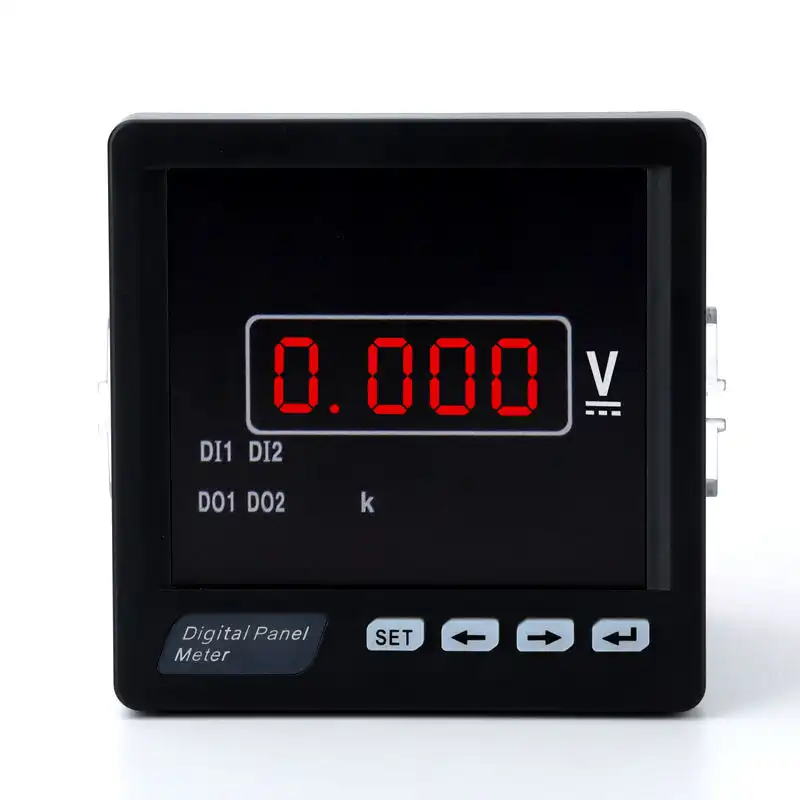
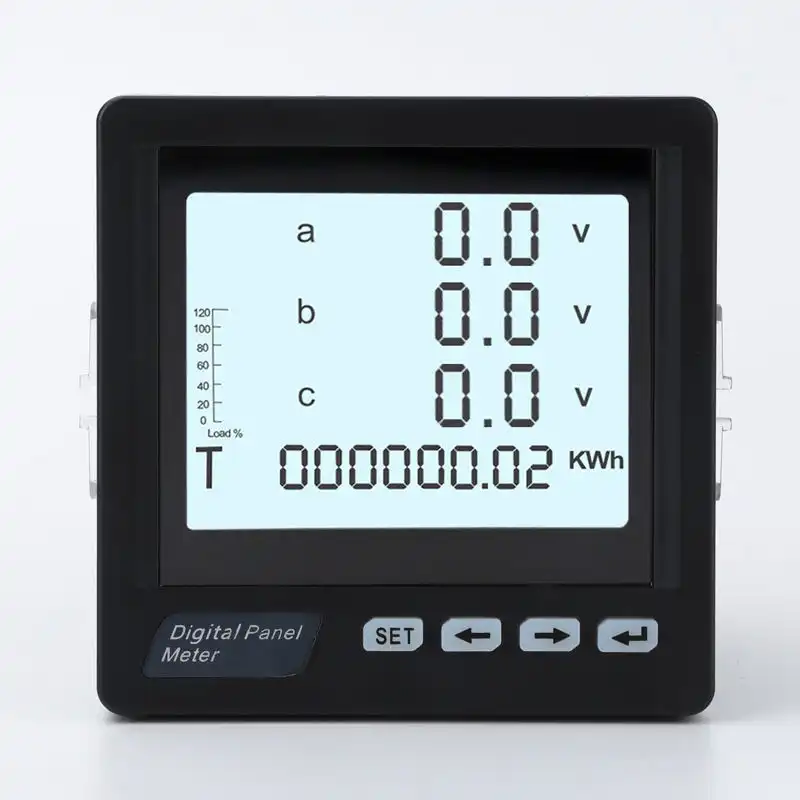
A meter used to find an energy driver needs different functions from a display-only voltmeter or ammeter. Define the measurement boundary and the required evidence before choosing a model.
| RFQ field | Why it changes the choice | Question to answer |
|---|---|---|
| Network topology | Single phase, three-phase 3-wire and three-phase 4-wire systems need different connection logic. | What supply system and nominal voltage will the meter see? |
| Measurement objective | A basic V/A display may not provide kWh, kW, kVA, kVAR, PF or demand. | Which total and per-phase values must be measured or logged? |
| Current sensing | Direct and CT-operated systems have different ranges, ratios and wiring risks. | What are normal/maximum current, CT ratio, class and conductor arrangement? |
| Accuracy and use | Operational monitoring, allocation and regulated billing require different evidence. | Is this for visibility, internal allocation, tenant billing or an approved billing point? |
| Data and time | TOU and demand analysis need timestamped intervals and correct clocks. | What interval, protocol, register, historian and report format are required? |
| Installation | Cutout, auxiliary supply, insulation, EMC, temperature and access affect suitability. | What panel, environment, standard and qualified installation process apply? |
Common calculation errors
Eight mistakes that can distort a bill estimate
Calling V x A real kW
For AC loads, it can be apparent power. Include measured PF or use measured real kW.
Mixing VLL and VLN
State the voltage basis and use the matching single- or three-phase formula.
Multiplying by three twice
The 1.732 x VLL formula already gives total balanced three-phase power.
Using breaker size as load
A protection rating is not the same as representative operating current.
Using motor output kW
Nameplate output, efficiency, PF, load factor and actual input power are different.
Ignoring demand
A short high interval can add cost that monthly kWh alone cannot explain.
Assuming balance
Mixed single-phase loads can make current and PF unequal across phases.
Treating a submeter as billable
Revenue or tenant billing may require approved equipment and local acceptance.
Using one universal rate
TOU periods, blocks, seasons, riders, taxes and credits may need separate calculations.
Prepare a useful meter enquiry
Need panel-level visibility for energy and demand?
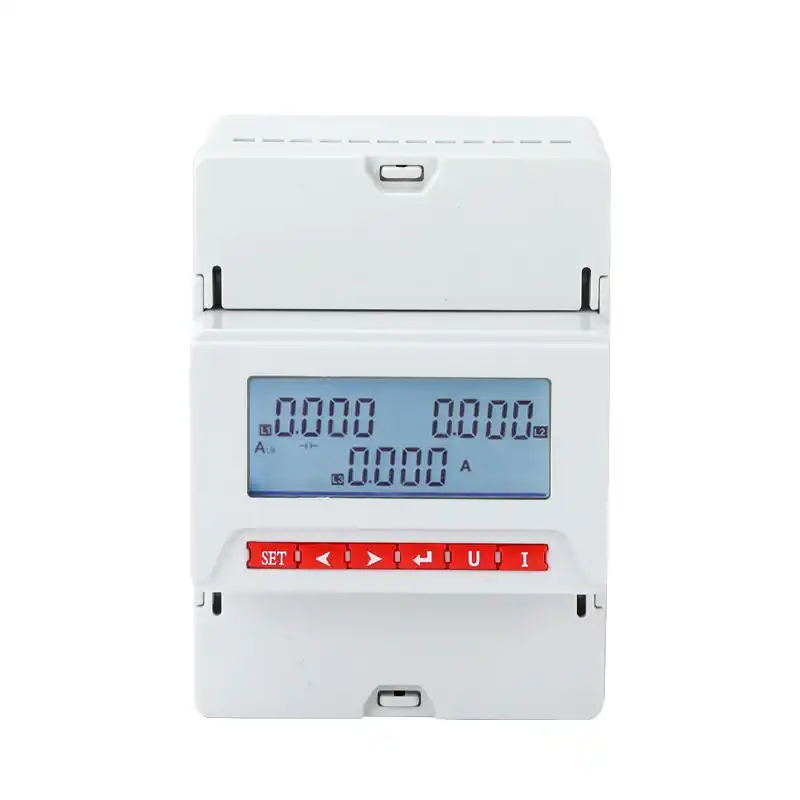
Send the electrical and data requirements that determine meter suitability. SENTOP can then discuss relevant product options without treating a generic display as a complete billing solution.
- Single phase or three phase
- 3-wire or 4-wire topology
- Nominal voltage and frequency
- Normal and maximum current
- Direct, CT or CT/PT input
- Required kWh, kW, kVA, PF or demand
- Per-phase and total values
- RS485, protocol and logging needs
- Panel cutout and auxiliary supply
- Monitoring or billing purpose
Frequently asked questions
Single-phase and three-phase electricity bill FAQs
Does three-phase electricity cost more than single phase?
Not automatically. The bill follows the rate schedule and measured use. A three-phase site may have a different service class, larger loads or demand charges, but phase count itself is not a universal price multiplier.
How do I calculate kWh for a single-phase load?
Estimate real kW as volts x amps x power factor / 1,000, then multiply by operating hours. Use the utility or approved meter's kWh register for an actual bill check whenever available.
How do I calculate kWh for a balanced three-phase load?
Estimate kW as 1.732 x line-to-line volts x line amps x power factor / 1,000, then multiply by hours. The formula assumes the phases are balanced and the values represent the operating condition.
Why is there a square root of three in the three-phase formula?
It comes from the 120-degree relationship among balanced three-phase voltages. It allows line-to-line voltage and line current to calculate total balanced three-phase real power.
Can I calculate an electricity bill from amps only?
No. You also need the correct voltage basis, real power factor or measured kW, operating time and the actual tariff. A changing load should be measured over a representative period.
What is the difference between kW and kWh on a bill?
kW is power at a point or over a demand interval. kWh is energy accumulated over time. A demand line may use kW or kVA, while the energy line typically uses kWh.
Will improving power factor always reduce the electricity bill?
No. It may help only if the tariff includes a kVA, reactive-energy or power-factor term, or if it resolves another capacity constraint. Check the tariff and measure the system first.
Can a digital panel meter replace the utility meter for billing?
Not automatically. A panel meter may suit monitoring or internal allocation, while legal billing can require approved accuracy, installation, sealing, data handling and contractual acceptance.
Why does my hand calculation not match the invoice?
Common causes include TOU prices, demand charges, a different billing window, taxes or riders, changing loads, PF assumptions, CT/PT multipliers, meter boundaries or incorrect topology and configuration.
Technical references
Sources and calculation limits
- U.S. Department of Energy: Evaluating Your Utility Rate Options - energy, demand, fixed-charge, TOU and rate-review framework.
- U.S. EIA: Demand Charge Glossary - demand charge as a rate-schedule billing component.
- U.S. EIA: Utility Rate, Tariff and Demand-Charge Data FAQ - reminder to obtain tariff details from the applicable source.
- Schneider Electric PM2200 total-power calculation - single-phase and balanced three-phase formula reference.
- Schneider Electric: Calculation of Electrical Powers in PMDs - active, reactive and apparent power in metering devices.
- Fluke: 30-Day Load Studies - per-phase and total power, PF, energy and interval-data practice.
- Texas Instruments three-phase electricity meter reference design - RMS values, active/reactive energy, PF and frequency measurement context.
- European Union Directive 2014/32/EU - market-specific conformity context for active electrical energy meters.