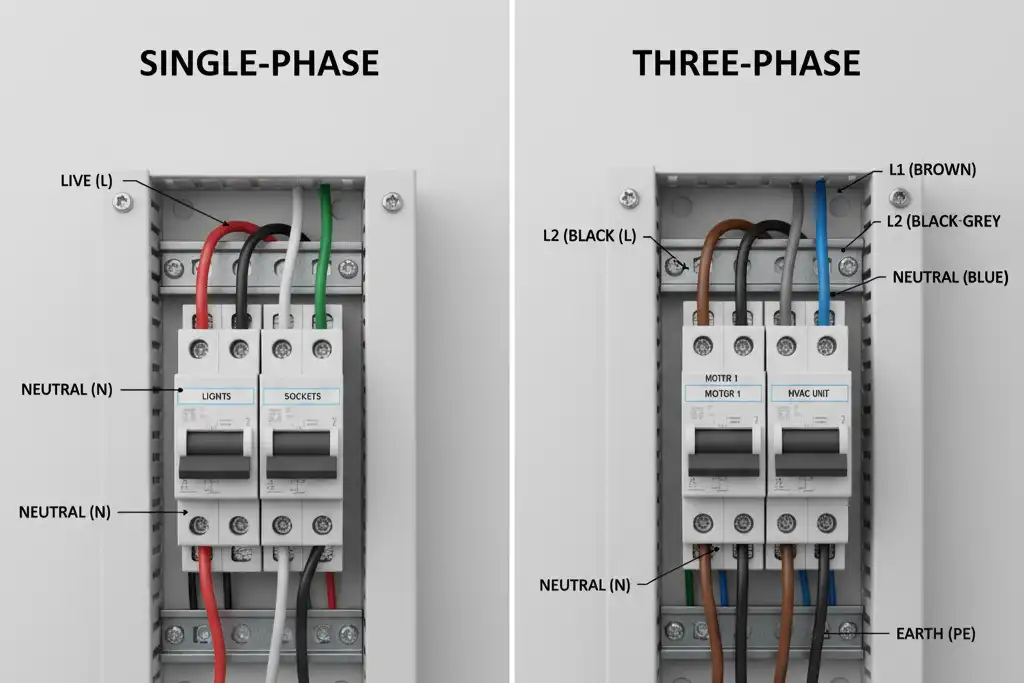
When you put in circuit breakers, it is important to know the difference between single-phase and three-phase circuits. These differences change how safe, efficient, and expensive things are. Most homes use single-phase systems. Three-phase systems are becoming more popular because they give steady power and save energy. You find single-phase and three-phase circuits in different places since each one works best for certain needs:
- Single-phase systems usually power homes and small shops.
- Three-phase systems give power to big buildings and factories.
Miniature Circuit Breakers keep people safe by stopping short circuits and overloads fast. Residual Current Circuit Breakers also protect you by turning off power during ground faults. This lowers the chance of getting shocked.
Key Takeaways
- Know the difference between single-phase and three-phase circuits. Single-phase is used in most homes. Three-phase is better for big buildings and factories.
- Pick the right circuit breaker for your needs. Use single-pole breakers for lights and outlets. Use double-pole breakers for big appliances like ovens.
- Follow safety rules when you install breakers. Always turn off the power first. Check all connections. Follow rules from groups like NEC and OSHA.
- Think about cost and how well your system works. Single-phase systems cost less to put in. Three-phase systems work better and waste less energy over time.
- Try smart circuit breakers for more safety and saving energy. These breakers can watch your system and warn you about problems.
Overview
Circuit Breaker Basics
Circuit breakers help protect your electrical system from harm. If too much current flows or a short circuit happens, the breaker shuts off the power fast. This keeps your home or building safe from fires and damage to equipment. You can find circuit breakers in both single-phase and three-phase circuits. Single-phase systems have two wires. Three-phase systems use three wires with a 120° phase difference. This makes three-phase systems harder to set up but also more steady.
New technology has made circuit breakers smarter. Digital circuit breakers can watch your system all the time. These smart breakers use sensors to find problems early and help save energy. Some breakers can even connect to the internet for better control and safety.
Main Components
Each circuit breaker has a few main parts that work together to keep you safe:
- Frame: This is the outside shell that holds all the parts.
- Contacts: These let electricity pass when the breaker is on. They open to stop the flow if there is a problem.
- Trip Unit: This part finds trouble, like too much current, and tells the contacts to open.
- Operating Mechanism: You use this part to turn the breaker on or off.
You can see some main differences between single-phase and three-phase circuits in the table below:
| Factor | Single-Phase | Three-Phase |
|---|---|---|
| Install cost | Lower for loads < 10 kW | Higher utility hookup |
| Motor efficiency | 72–85% | 85–94% |
| Starting torque | Moderate | Smooth & high |
| Voltage stability | Drops to zero twice each cycle | Constant |
| Best fit | Homes, small shops | Manufacturing, data centers |
Tip: Smart breakers with sensors can help you use less energy and make your system safer. This works for both single-phase and three-phase circuits.
Single-phase Circuit Breaker Installation

Wiring and Connections
When you put in a circuit breaker for a single-phase system, you use two wires. One wire is live, and the other is neutral. The live wire goes to the breaker. The breaker controls how electricity moves. The neutral wire finishes the path for electricity. This setup is easier than three-phase wiring. You often see this in homes and small shops. Make sure each wire is tight and safe. The breaker should fit well in the panel. Good connections stop wires from getting too hot or causing problems.
Breaker Types
There are different circuit breakers for single-phase systems. The most common are single-pole and double-pole breakers. Single-pole breakers protect one live wire and give 120 volts. Double-pole breakers protect two wires and give 120/240 volts or 240 volts. The table below shows what each type can handle:
| Type of Circuit Breaker | Description | Rated Capacity |
|---|---|---|
| Single-pole breakers | Protect one energized wire, supply 120V | 15- to 30-amps |
| Double-pole breakers | Protect two energized wires, supply 120V/240V or 240V | 15- to 200-amps |
Pick the breaker type based on what you want to protect. Use single-pole breakers for lights and outlets. Use double-pole breakers for big things like ovens and air conditioners.
Applications
Single-phase circuit breakers work best where you do not need much power. You see them in homes, small offices, and shops. They help you:
- Keep devices safe from too much current or short circuits.
- Stop fires by cutting power fast if there is a problem.
- Keep people safe from electric shock.
Single-phase and Three-phase Circuits have different uses. Use single-phase breakers for normal devices. Use three-phase breakers for big machines.
Safety
You must follow safety rules when you put in single-phase circuit breakers. Groups like the National Electrical Code (NEC), OSHA, and UL make these rules to keep you safe. The table below lists some important rules:
| Regulatory Agency | Safety Standards |
|---|---|
| National Electrical Code (NEC) | Guidelines for breaker sizing, conductor protection, and installation best practices. |
| Occupational Safety and Health Administration (OSHA) | Outlines workplace safety standards that intersect with electrical work practices. |
| Underwriters Laboratories (UL) | Certifies products to ensure they meet rigorous safety standards. |
Tip: Always check if your circuit breaker is on or off. The handle points up when it is on. If you use a breaker as a switch for 120-volt fluorescent lights, look for the ‘SWD’ mark.
Both single-phase and three-phase circuits need careful safety checks. You lower risks by following these rules and checking your work.
Three-phase Circuit Breaker Installation
Wiring and Connections
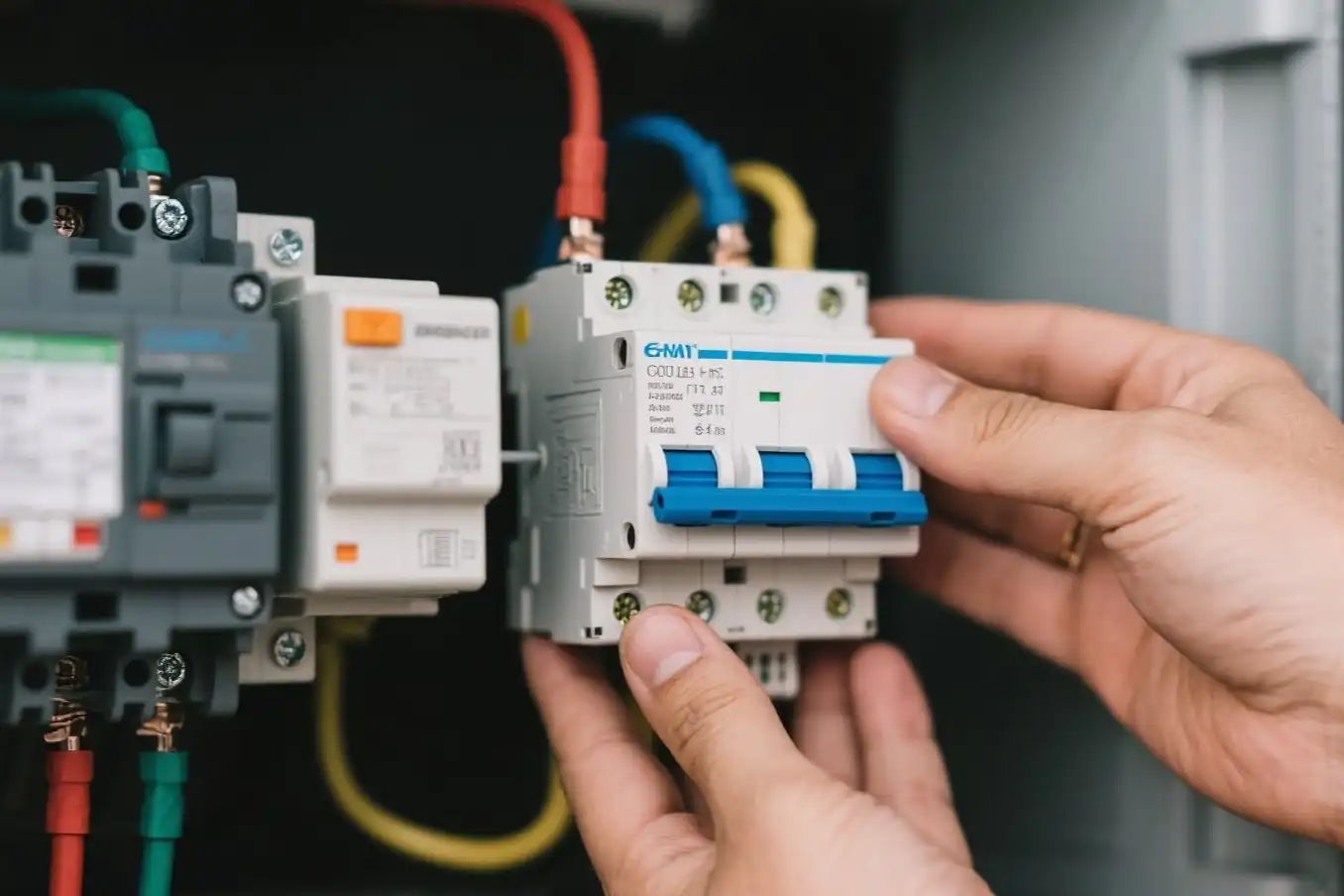
When you put in a three-phase circuit breaker, you use more wires than with single-phase. You connect three live wires. Each wire carries current at a different angle. You also need a neutral wire. A ground wire helps keep things safe. In factories, you use special parts to make sure everything works right. The table below shows what you need for a normal setup:
| Component Description | Quantity |
|---|---|
| Three Phase Energy meter | 1 No |
| Three Pole MCCB, 63A (100 or 250A in US) | 1 No |
| Double Pole, 63A, 30mA Trip Current (RCD/GFCI) | 3 No |
| Triple Pole MCBs, 63A (100-250A In US) | 3 Nos |
| Single Pole, 20A, MCB | 6 Nos |
| Single Pole, 16A (20A in US): MCB | 3 Nos |
| Single Pole, 10A (15A in US): MCB | 6 Nos |
| Distribution board cases | 3 Nos |
| Bus bar Link for Neutral Cable Connections | 1 No |
| Copper strips for MCB common connection | 3 Nos |
| Copper strip Busbar for Earth & Ground Link | 1 No |
Check every wire and connection. Tight wires help stop overheating and problems.
Breaker Types
Three-phase circuit breakers come in many kinds. You can pick from:
- SF6 gas-insulated
- Magnetic
- Spring operated
- Thermal
- Differential
- Air-operated
- Liquid bath
- Hydraulic-magnetic
Most three-phase breakers have three or four poles. You use them for power sharing, motor safety, network safety, and making power. Some breakers work by themselves. Others need you to turn them on or off. You find them inside and outside buildings. They work with high, medium, or low voltage. They protect against short circuits, too much current, and overloads.
Applications
Three-phase circuit breakers are used in many places. They protect big machines in factories. Data centers use them for computers and cooling. Hospitals need them for medical tools and emergency rooms. Warehouses use them for storing things and working safely. Farms use them for watering and machines. You also see them in power plants, tall buildings, and wind or solar farms. Three-phase breakers help control big loads and keep things working well. You can look at Single-phase and Three-phase Circuits to see which is best for you.
Safety
Safety is very important when you put in three-phase circuit breakers. You must follow lockout/tagout steps to make sure the power is off before you start. The table below lists key safety steps:
| Safety Consideration | Description |
|---|---|
| Lockout/Tagout Procedures | Make sure the panel is off using lockout/tagout steps. |
| Circuit Testing | Test wires with approved testers and check the tester works. |
| Arc Flash Boundaries | Set arc flash boundaries using energy calculations. |
| Equipment Lockout | Lock out all equipment at more than one spot. |
| Documentation | Write down that you checked the power is off and sign it. |
| Warning Signs | Put up warning signs and barriers around your work area. |
Wear the right safety gear for each voltage. For low voltage, wear safety glasses and special clothes. For high voltage, use arc suits, face shields, and gloves. Most electrical accidents happen when installing or fixing things. You lower risks by following these steps and teaching your team. Lockout/tagout rules must follow OSHA and NFPA standards. Each worker uses their own lock. A trained person checks that the power is off. Always compare Single-phase and Three-phase Circuits for safety needs.
Single-phase and Three-phase Circuits: Key Differences
Wiring
Single-phase wiring uses two wires. One is live, and one is neutral. This makes it easy to install. You see this in homes and small shops. Three-phase wiring uses three live wires and a neutral wire. Each live wire carries current at a different angle. This setup is harder to install. You must connect each wire carefully. Three-phase wiring is used in factories and big buildings. It can move more power over long distances. It also loses less energy.
Tip: Three-phase wiring can use thinner wires. This helps save money on materials for large projects.
Poles
Poles show how many wires a circuit breaker can control. Single-phase systems need one or two poles. One pole protects one live wire. Two poles protect both live wires in a 240V system. Three-phase systems always need three poles. Each pole connects to one phase. This lets you turn off all phases at once if there is trouble. You get better protection from electrical faults.
- Three-phase systems use 3-pole breakers in big buildings and factories.
- Each pole matches one phase. You can stop electricity in all phases at the same time.
Load Balancing
Load balancing means spreading power across wires. Single-phase systems cannot balance loads well. Too many devices can overload the system. Three-phase systems balance the load across three wires. This keeps things steady and stops overheating. Machines run smoother and power drops are rare. Good load balancing helps machines last longer.
Efficiency
Three-phase systems work better than single-phase systems. They are best for big machines and lots of equipment. You can move the same power with less wire. This saves money. Three-phase systems give steady electricity. Machines run without stops or jumps in power. You get about 1.7 times more power with three-phase systems. Voltage stays stable, so less energy is lost as heat.
- Three-phase systems use thinner, lighter wires for the same power.
- You get better voltage control and less energy loss over long distances.
- Machines last longer because the load is shared evenly.
Cost
Single-phase systems cost less to put in and keep up. The wiring is simple and needs fewer parts. This is good for homes and small businesses. Three-phase systems cost more at first. You need more wires, bigger panels, and special breakers. Maintenance costs more because the system is harder. But three-phase systems save money later for big buildings or factories. They use less wire for the same power and lower energy bills.
- Circuit breaker installation can cost $100 to $600, depending on the job.
- You may need to upgrade your system if you add more equipment or if safety rules change.
Safety
Safety matters when working with electricity. Single-phase systems are easier to install and check. There are fewer wires and connections. This means fewer mistakes. Three-phase systems need more care. You must check every wire and breaker. Each phase has its own pole for protection. This stops problems from spreading. You must follow strict safety steps like lockout/tagout.
| Aspect | Single-Phase | Three-Phase |
|---|---|---|
| Power Distribution | Short distances | Long distances (lower copper losses) |
| Power Losses | Higher | Lower |
| Economic Efficiency | Less economical | More economical (4 wires vs 6) |
| Application | Home appliances and office equipment | Heavy loads in industries |
| Load Accommodation | Typical loads (lighting/heating) | Higher loads (large electric motors) |
| Power Delivery | Unsteady | Steady and constant |
Note: Single-phase and Three-phase Circuits have different strengths. Pick the one that fits your needs. Always think about safety and efficiency.
Choosing the Right Breaker
Selection Criteria
You need to choose the right circuit breaker. This keeps your electrical system safe and working well. The best breaker depends on a few important things. Use the table below to help you pick:
| Factor | Description |
|---|---|
| Voltage Rating | Make sure the breaker matches your circuit’s voltage. If the rating is wrong, it might not work or trip when needed. |
| Current Rating | Pick a breaker that can handle the highest current. It should not trip during normal use. |
| Trip Characteristics | Check how the breaker reacts to too much current. Some trip slowly for small overloads. Others trip fast for short circuits. |
| Environmental Conditions | Think about where you will put the breaker. Dust, heat, or water can change how it works. |
| Mounting and Installation | See if the breaker fits in your panel. It should be easy and safe to mount. |
| Brand and Quality | Choose a brand you trust. Good breakers last longer and work better. |
| Cost | Compare the price with what you need. Sometimes a better breaker saves money by needing fewer repairs. |
Tip: Always check the voltage and current ratings before you buy. This helps stop damage and keeps your system safe.
Mistakes to Avoid
People sometimes make mistakes when picking circuit breakers. You can avoid problems by watching out for these common errors:
- Picking the wrong breaker type for your system.
- Using a breaker that does not protect enough. This can put your equipment at risk.
- Choosing a breaker that is too strong. It may trip too often and waste money.
You should know when to call a professional. Licensed electricians have special training. They know how to spot dangers and follow safety rules. They can help you:
- Make sure your setup follows local rules.
- Fix hard electrical problems.
- Keep your system safe and working right.
Note: For tough jobs, always ask a licensed electrician for help. This keeps you safe and makes sure your system follows all codes.
You have learned that single-phase wiring is easier and cheaper. Three-phase systems can handle more power but are harder to set up. Think about how much power you need, safety, and local rules before picking a breaker. To install breakers safely, follow these tips:
- Turn off the power and check the wires first.
- Pick the right breaker size for what you need.
- Make sure all wires are tight and safe.
- Follow what the manufacturer says.
Keep safe by fixing old wires, grounding your system, and calling a licensed electrician for hard jobs.
FAQ
What is the main difference between single-phase and three-phase circuit breakers?
Single-phase breakers protect one or two wires. Three-phase breakers protect three wires at once. You use single-phase for homes. You use three-phase for factories or big buildings.
Can you install a three-phase breaker in a home?
You should not install a three-phase breaker in a home. Homes use single-phase power. Three-phase breakers work best for places with heavy machines or large equipment.
How do you know which breaker size to choose?
You check the voltage and current your devices need. Look at the labels on your equipment. Pick a breaker that matches or is slightly higher than the highest current.
Do three-phase systems save money over time?
Yes, three-phase systems use less wire for the same power. You get steady electricity and lower energy loss. This helps you save money on big projects or buildings.
See also
Single vs Three Phase MCCB: Key Differences
What You Need to Know About Three-Phase Solar Inverters
Single Phase vs Three Phase Electricity: Which is Best for You?
Comparing Single Phase Voltage and Three Phase Voltage
Choosing Between Single-Phase and Three-Phase Solar Inverters