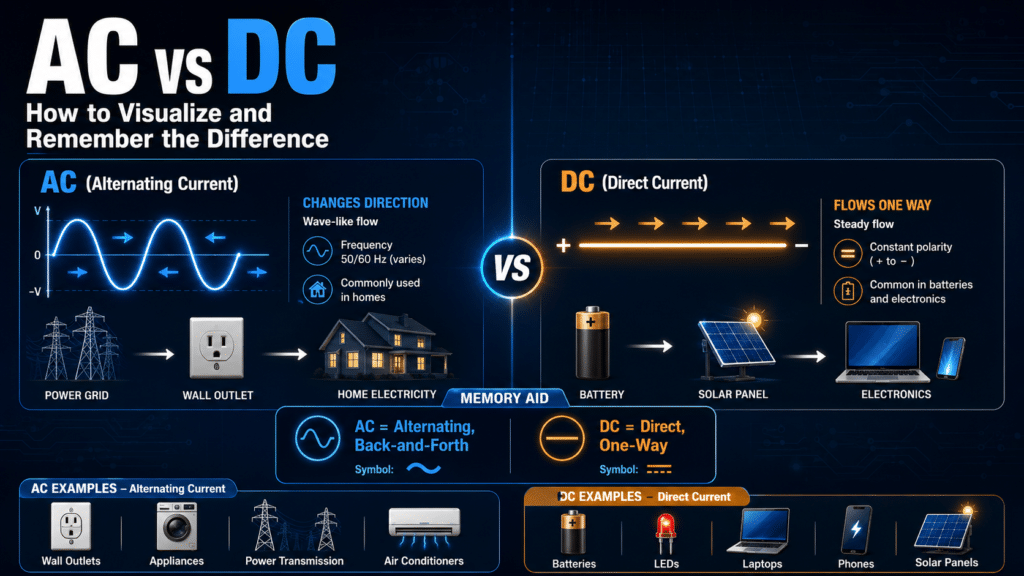
AC vs DC: What’s the Difference? AC (alternating current) reverses direction 50 or 60 times per second, while DC (direct current) flows steadily one way. For example, US wall outlets deliver 120V[1] AC at 60 Hz, while your phone runs on 5V DC supplied by its battery. AC graphs as a sine wave; DC graphs as a flat line. AC dominates long-distance transmission because transformers easily change its voltage, whereas your charger converts that 120V AC into 5V[2] DC.
How do you picture each one in your head? Why does the socket on your wall use AC while your phone runs on DC instead? Which of the two is safer, and which one travels farther over power lines? And how do you remember the difference between them for good?
Quick Takeaways
- AC reverses direction 50-60 times per second; DC flows one steady way.
- Wall outlets supply AC; batteries and USB devices run on DC.
- AC graphs as a sine wave; DC graphs as a flat line.
- AC wins long-distance transmission since transformers easily change its voltage.
- Phone chargers convert 120V AC into 5V DC every time.
What’s the Difference Between AC and DC in One Sentence?
Direct current (DC) flows in one steady direction, kind of like a battery pushing charge along a wire without ever changing its mind. Alternating current (AC) reverses direction many times every second, typically 50 or 60 times each second in the power grids around the world. That one fact, whether the charge keeps moving one way or keeps flipping back and forth, is really the whole heart of AC vs DC: What’s the Difference?
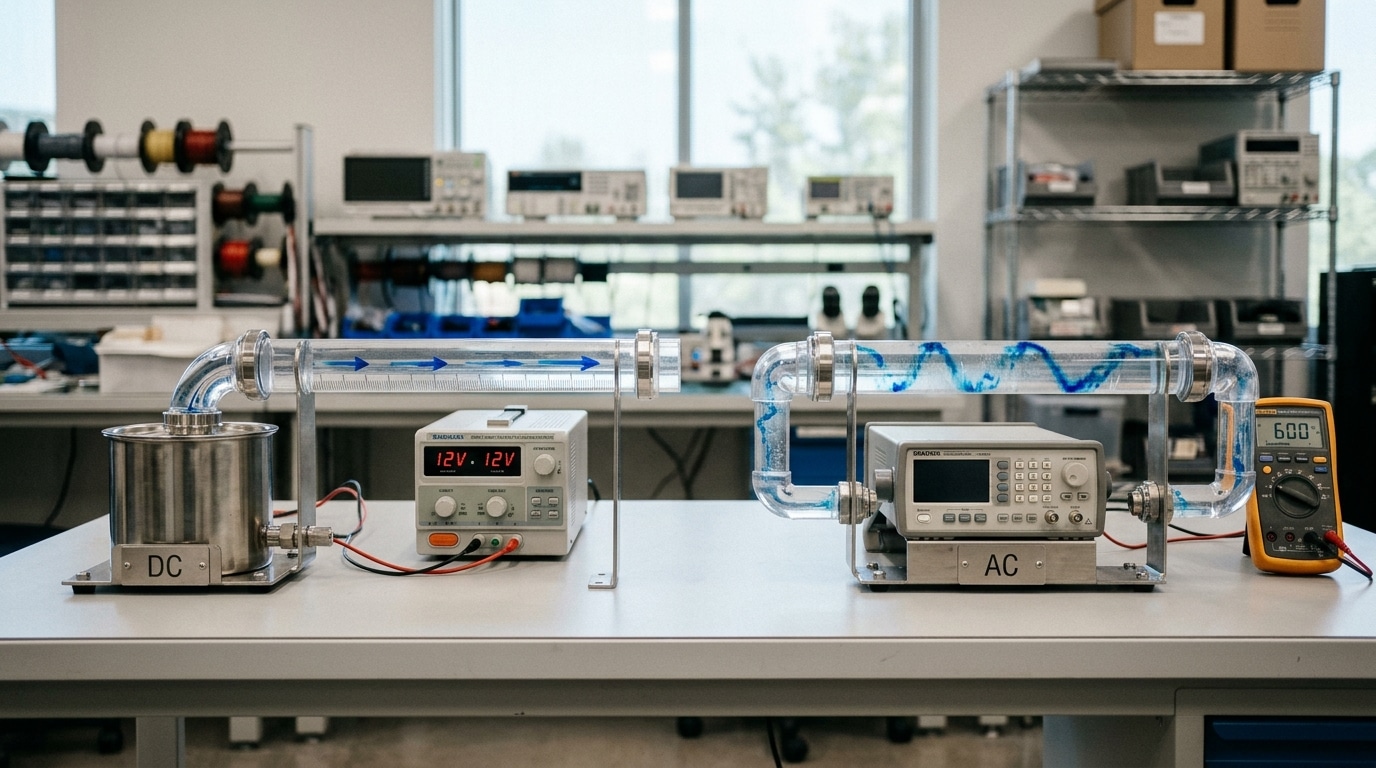
Picture two pipes carrying water. In the DC pipe, the water moves forward and never stops or turns around, so it acts like a steady river. In the AC pipe, the water sloshes forward, then backward, then forward again, dozens of times every second, which is more like a tide that cannot quite make up its mind. The water, which stands in for the electric charge, still does useful work in both situations. It just gets there in a different way.
Here is the part that catches people off guard. AC is what your wall outlet hands you. DC is what your laptop, your phone, and your electric car actually run on. Most modern electronics operate internally on low-voltage DC, and even when they plug into an AC socket, a built-in converter quietly does the switching behind the scenes.
One number sets the difference apart cleanly. DC essentially has a frequency of zero, with no reversals happening at all. AC in North America cycles at 60 Hz[3], while across most of Europe, Asia, and Africa it runs at 50 Hz instead. That frequency decides how often the current flips, and it shows up in everything from how a motor gets designed to why your charger hums the way it does.
How Do AC and DC Look on a Graph?
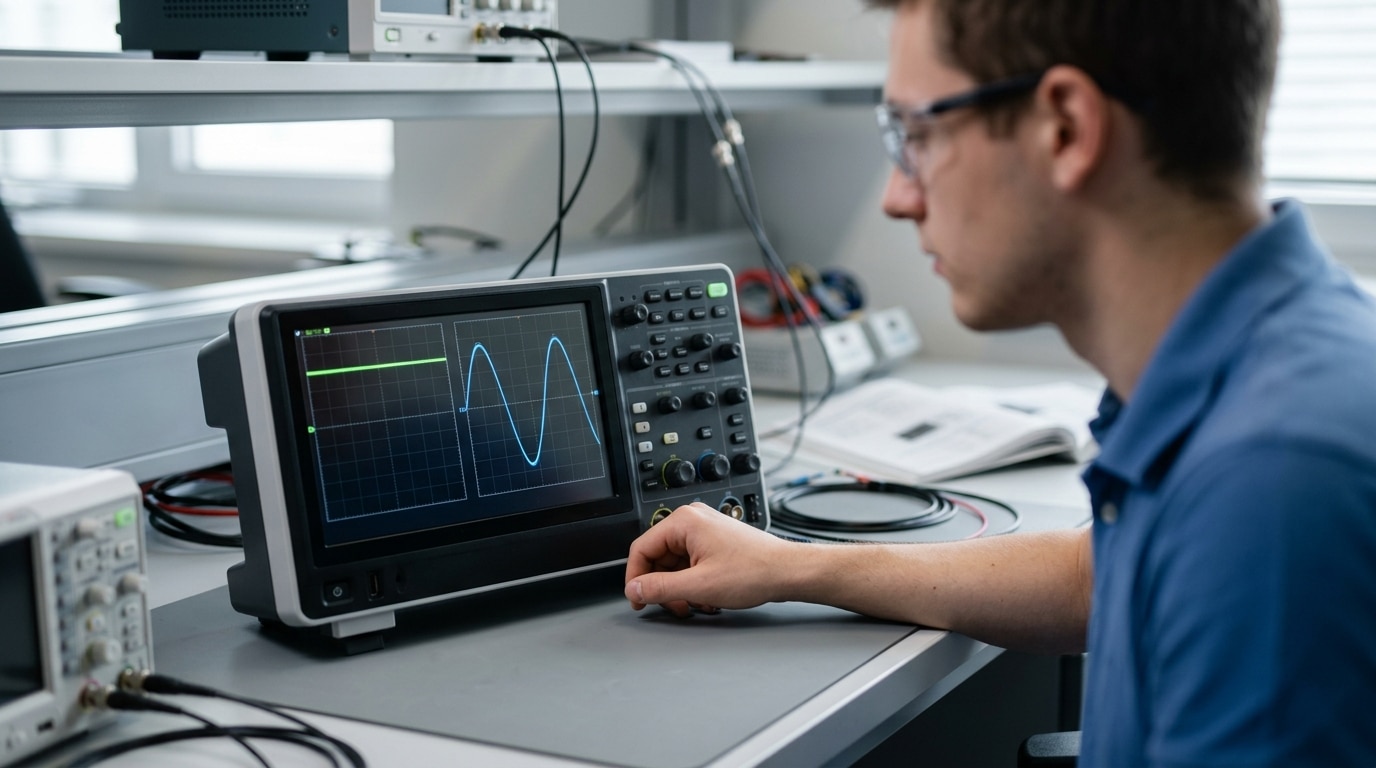
On a voltage-versus-time graph, DC draws a flat horizontal line, while AC traces a repeating S-shaped sine wave that crosses zero and swings between positive and negative peaks. This visual is the cleanest way to grasp AC vs DC: What’s the Difference?, one direction stays steady, the other reverses on a fixed schedule, according to MIT engineering.
Why is DC a flat line and AC a sine wave?
DC holds a single voltage level over time, so plotting it gives a straight line at, say, +12 V. A car battery never dips below or above that without a load change. AC, by contrast, follows a sinusoidal path, the voltage rises to a positive peak, falls through zero, drops to an equal negative peak, then returns. That smooth curve is why engineers call it a “waveform.”
What do frequency and amplitude mean on the graph?
Frequency counts how many full cycles the wave completes each second, measured in hertz (Hz). Amplitude is the height of the peak, how strong the voltage gets. Most grids run at either 50 Hz or 60 Hz depending on the country.
| Property | DC | AC (mains) |
|---|---|---|
| Graph shape | Flat line | Sine wave |
| Frequency | 0 Hz | 50 or 60 Hz |
| Zero crossings/second | None | 100 (50 Hz[4]) or 120 (60 Hz) |
A practical tip: a 60 Hz wave crosses zero 120 times per second because each cycle crosses zero twice. That rapid swing is why a low-frequency AC light bulb can flicker, your eye just can’t track it.
How Can You Remember Which Is Which?
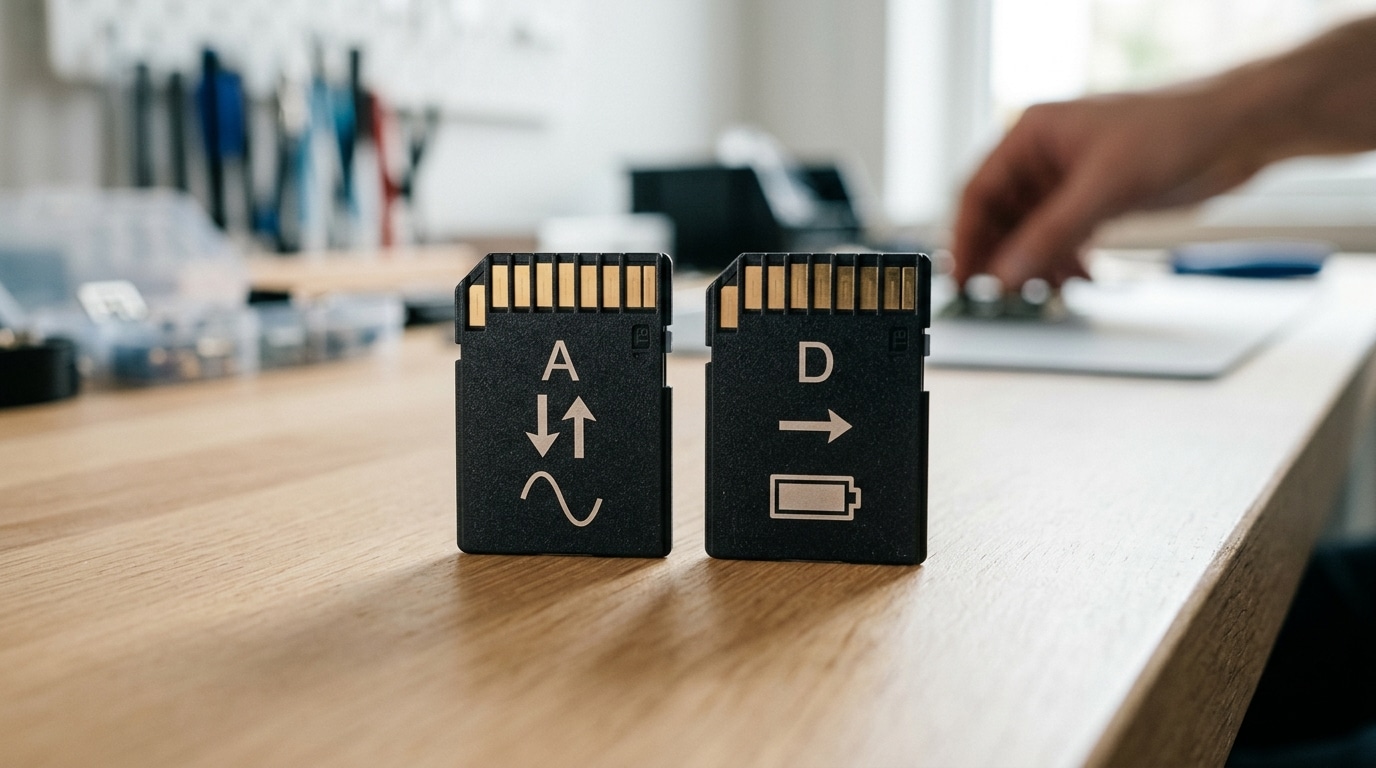
The easiest way to remember the difference is to tie it to the first letter of each word. A is for Alternating = Arrows that flip. D is for Direct = one Direction. AC current reverses its direction 50 or 60 times every single second, so you can picture little arrows bouncing back and forth. DC never turns around at all, so picture one arrow pointing straight ahead, kind of like the steady push you get from a battery.
Want one clear mental picture for each type? You can pair them up like this:
- DC = battery symbol: two parallel lines, one long and one short, with an arrow heading off in a single direction. Think of a AA cell that keeps pushing current the same way until it finally runs out of charge.
- AC = wavy sine line: a curve that rises above and then dips below a center line. That up-and-down trace really is the alternating motion drawn out on paper for you to see.
Why does that wave repeat so quickly? In AC systems, the charge keeps changing direction at 50 Hz across Europe and Asia, or 60 Hz[5] in North America. That means a U.S. outlet flips its polarity 120 times per second, considering each complete cycle includes two reversals. DC, on the other hand, holds a frequency of effectively zero, so there are no flips happening at all.
There is one more handy trick that electricians rely on, and that is the schematic symbols themselves. On a wiring diagram, a tilde “~” marks an AC source, while a flat line with a dashed line sitting below it (“⎓”) marks DC. If you flip over any phone charger and look at the back, you will spot both symbols, because the brick essentially takes AC in and sends DC out. That is the heart of AC vs DC: What’s the Difference, shown right on the label.
AC vs DC Side-by-Side — What Are the 10 Key Differences?
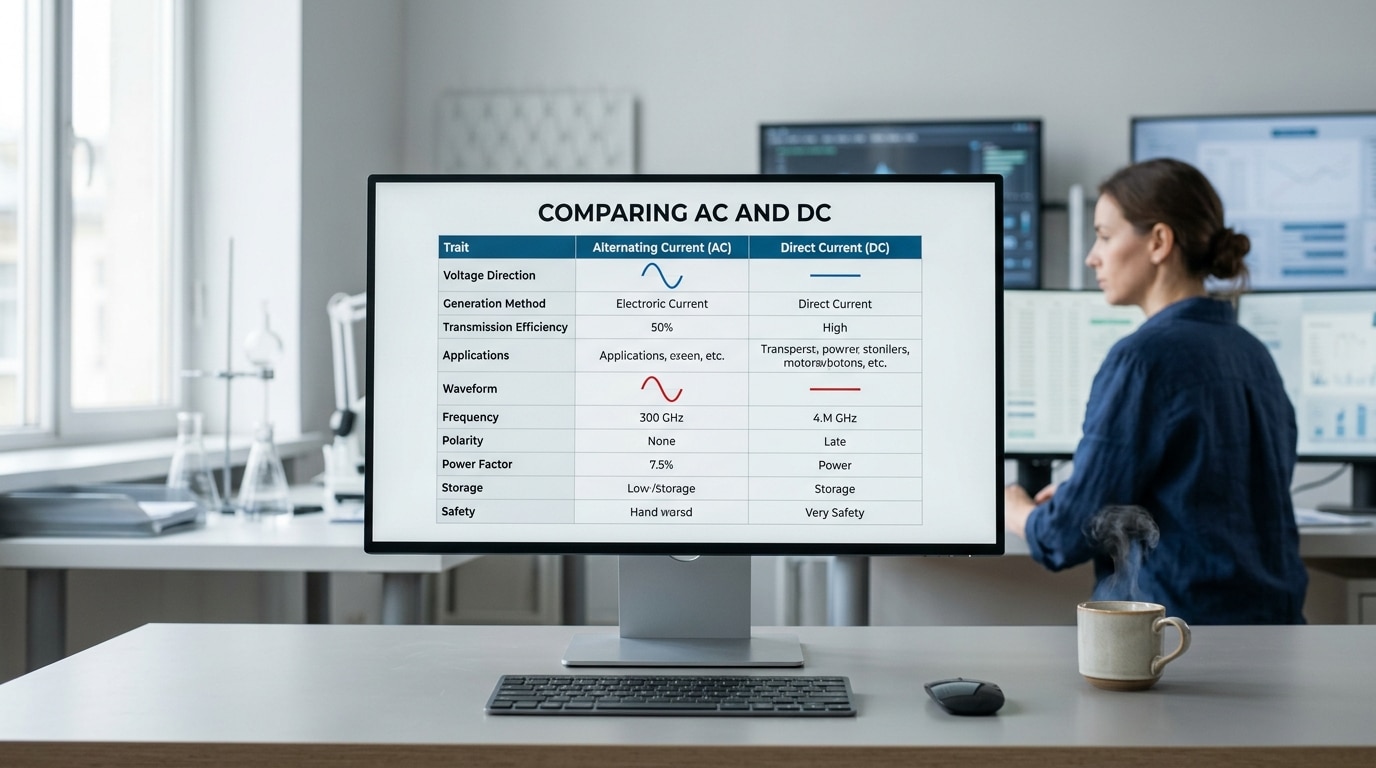
The heart of AC vs DC: What’s the Difference? really comes down to ten traits you can actually measure. AC reverses its direction 50 or 60 times every second (50 Hz or 60 Hz depending on the country, 2025), while DC keeps moving in one steady direction with no frequency at all. That single difference drives every other gap you’ll find in the table below, from the way you change voltage to where each type turns up in your home.
One trait is worth looking at more closely, and that’s how the voltage gets transformed. AC steps up and down through a transformer, which is essentially two coils of wire that swap voltage for current. DC can’t use a plain transformer at all, though. It needs power electronics, meaning switching circuits that chop up and reshape the current, and that’s the reason changing DC voltage stayed expensive until modern semiconductors came along.
| Trait | AC | DC |
|---|---|---|
| Direction | Reverses periodically | One constant direction |
| Waveform | Sine wave | Flat line |
| Frequency | 50 or 60 Hz | 0 Hz |
| Voltage change | Simple transformer | Power electronics |
| Transmission distance | Long via high-voltage lines | Long via HVDC links |
| Energy loss | Higher at low voltage | Lower over submarine cable |
| Source examples | Wall outlets, generators | Batteries, solar cells |
| Conversion need | Rectifier to make DC | Inverter to make AC |
| Typical use | Home and grid mains | Phones, EVs, electronics |
| Internal device power | Rare | Most digital gear |
Take a look at the conversion row in particular. AC outlets feed power into a rectifier inside your charger (2025) so it can make low-voltage DC, while solar panels need an inverter to push their power back onto an AC grid. So the conversion runs in both directions, depending on what you’re trying to do.
Where Do You Encounter AC and DC in Everyday Life?
You meet AC at the wall and DC inside the device. Your home outlets, ceiling lights, and big appliances run on alternating current, while phones, laptops, LED strips, cars, and solar panels run on direct current. Mains electricity worldwide is predominantly AC, but batteries and solar cells output DC. That split explains why almost every gadget needs a charger.
⚠️ Common mistake: Plugging a 5V DC device directly into a 120V AC outlet without its charger. This happens because both connectors look interchangeable, but the outlet delivers 24× the voltage and reverses 60 times per second—instantly frying DC electronics. The fix: always use the supplied adapter, which converts 120V[6] AC into the steady 5V DC your phone actually needs.
Here is the part most people miss. Even the devices plugged into an AC outlet are secretly running on DC. The black brick on your laptop cord rectifies (converts) wall AC down to low-voltage DC before a single electron reaches the screen. So the “AC vs DC: What’s the Difference?” question isn’t either/or in your house, both live under one roof, separated by that little converter box.
Which Household Items Run on AC?
Anything that plugs straight into the wall and uses a motor or heating element typically runs on AC. Think refrigerators, washing machines, microwave ovens, and ceiling fans. In North America these draw 120-volt AC reversing 60 times per second; in Europe and most of Asia it’s 230-volt AC at 50 Hz. AC induction motors love this constant reversal, it spins their rotors with no brushes to wear out.
Which Devices Run on DC?
If it has a battery, a USB port, or a charging brick, it runs on DC internally. Your smartphone uses about 3.7 to 5 volts DC. A car’s electrical system runs on 12-volt DC from the battery. Rooftop solar panels generate DC that an inverter flips to AC before feeding your home or the grid.
| Device | Current Type | Typical Voltage |
|---|---|---|
| Wall outlet (US) | AC | 120 V, 60 Hz |
| Wall outlet (EU/Asia) | AC | 230 V, 50 Hz[7] |
| Smartphone battery | DC | 3.7 V |
| USB charger output | DC | 5 V |
| Car battery | DC | 12 V |
| Solar panel output | DC | 30–40 V per panel |
Practical tip: when an appliance hums and gets warm at the plug, that’s the AC-to-DC conversion losing energy as heat. A cheap charger can waste 15,approximately 20% in that step, which is why efficient power bricks carry a printed efficiency rating.
How Does AC Become DC Inside Your Charger and Adapter?
Your charger converts wall AC into device DC through a four-stage chain: a transformer drops the voltage, a rectifier flips the negative half of the wave positive, a capacitor smooths the ripple, and a regulator locks the output. That’s how 120 V or 230 V AC becomes the steady 5 V or 19 V[9] DC your phone or laptop needs. SparkFun confirms that most modern electronics run on low-voltage DC internally, even when plugged into an AC outlet.
This is where AC vs DC: What’s the Difference? stops being theory and becomes the brick in your bag. The wall gives you alternating current that reverses 50 or 60 times per second. Your chip can’t use that. So the charger does the translation.
What does each part inside the brick actually do?
Each component handles one job in the conversion. Skip any one and the device fails or fries.
- Transformer: steps 230 V AC down toward a lower AC level, often 9–24 V, by coupling two coils with different turn counts.
- Bridge rectifier: four diodes that force current one way, turning the bumpy AC sine wave into all-positive humps.
- Filter capacitor: stores charge between humps to flatten the ripple into near-steady DC, sized in microfarads (µF).
- Voltage regulator: trims the smoothed output to a fixed value, like exactly 5.0 V for USB.
Why does every USB device secretly need this?
Because silicon chips only run on DC. A processor, a battery cell, an LCD backlight, an EV motor controller, all of them expect a flat, one-direction voltage. The wall never delivers that. Modern bricks use switch-mode designs that hit 85,approximately 90% efficiency, far better than old linear adapters that wasted energy as heat. Next we compare which current is safer and which loses less energy across distance.
Which Is More Dangerous and Which Loses Less Energy Over Distance?
At the same voltage, AC is generally more dangerous to the human heart, while AC also wins for long-distance transmission. That double answer is the heart of AC vs DC: What’s the Difference? AC’s flipping current can trigger “lock-on,” where muscles clamp around a wire. But because transformers easily step AC voltage up, it slashes transmission line losses.
Why is AC more likely to lock your hand to the wire?
AC at 50 or 60 Hz[10] hits a cruel sweet spot for the human body. The current reverses 50 or 60 times per second, which matches the firing rhythm your muscles respond to. When your hand grips a live AC wire, the muscles that close your fist contract and stay contracted, this is called “tetanic lock-on.” You literally can’t let go.
DC tends to give one strong jolt that can throw you off the source instead. There’s also a heart factor. Ventricular fibrillation (the heart quivering instead of pumping) can start at AC currents as low as 50 to 100 milliamps. DC usually needs a higher current to cause the same chaos. Voltage being equal, AC is the meaner shock.
Why does AC lose less energy over long distances?
Line loss follows the rule I²R, power wasted as heat equals current squared times wire resistance. Double the current, and your losses jump fourfold. So the trick is to push power at high voltage and low current.
- Transformers: step AC voltage up to 400,000 volts or more for transmission, then back down for homes — DC couldn’t do this cheaply for over a century.
- Current drop: raising voltage 100× cuts current 100×, shrinking I²R losses by 10,000×.
HVDC lines now beat AC over very long or undersea routes, per Wikipedia’s HVDC overview.
Why Is DC Making a Comeback with Solar, EVs, and HVDC?
DC is surging back because the technologies driving the energy transition are natively DC. Solar panels, batteries, and electric-vehicle drivetrains all produce or store direct current, and high-voltage direct current (HVDC) lines now move bulk power across continents with lower losses than AC over long distances. The old “AC won” story from the 1890s is being rewritten, not erased, but heavily revised.
Here is the twist in the AC vs DC: What’s the Difference? debate. AC won the original fight because transformers made it cheap to step voltage up and down. But power electronics have caught up. Solid-state converters now do for DC what transformers did for AC.
Why are solar, batteries, and EVs inherently DC?
Because the physics of these devices only produces or accepts one-directional current. A solar cell pushes electrons in a single direction when light hits it, that’s raw DC. A lithium battery charges and discharges as DC. An EV motor controller pulls DC from the pack and chops it into pulses. Forcing AC into the mix means extra conversion steps, and each step wastes energy as heat.
- Rooftop solar: Panels output DC, but a grid-tie inverter flips it to AC to feed the home and grid — a conversion that costs efficiency.
- Home battery storage: Stores DC; “DC-coupled” systems skip a conversion that AC-coupled designs require.
- EV fast charging: DC fast chargers bypass the car’s onboard AC-to-DC converter and feed the battery DC directly, enabling far higher charging speeds.
Why does HVDC beat AC over long distances?
HVDC avoids the reactive power and capacitance losses that plague long AC lines, especially undersea cables. That’s why subsea links and continent-spanning routes increasingly choose DC, it can also tie together grids running at different frequencies, like a 50 Hz grid and a 60 Hz grid.
The War of the Currents — Why Did AC Beat DC the First Time?
AC beat DC in the 1880s,90s because it could be stepped up to high voltage with a transformer, and high voltage is what makes long-distance power delivery cheap. Edison’s DC system worked only over short distances, while AC could travel for miles. That single advantage decided how the modern grid was built.
Thomas Edison championed direct current. His first power station, Pearl Street in Manhattan, opened in 1882 and served customers within about a mile. Push DC any farther and the wires lose too much energy as heat. To cover a city, Edison would have needed a power plant on nearly every block.
Nikola Tesla and industrialist George Westinghouse backed alternating current instead. Their winning trick was the transformer. AC voltage can be raised for transmission and dropped back down for safe home use, something SparkFun notes made AC far more economical for long distances than DC. Higher voltage means lower current, and lower current means less heat lost in the wire.
The rivalry turned ugly. Edison ran public demonstrations electrocuting animals to paint AC as deadly. It didn’t work. The 1893 World’s Columbian Exposition in Chicago was lit by Westinghouse’s AC system, and the 1895 Niagara Falls hydroelectric plant sent AC power 26 miles to Buffalo, New York. That project sealed the verdict.
This history is why the AC vs DC: What’s the Difference? debate still shapes your wall socket today. The grid runs on AC for one reason born in the 1890s: cheap voltage transformation. For the deeper engineering story, the War of the Currents record is worth reading.
Frequently Asked Questions About AC and DC
Quick answers to the AC vs DC questions people search most. Each one is short enough to read in seconds, but specific enough to actually use. If you only remember one thing: wall power is AC, battery power is DC, and almost every device juggles both.
Can DC be converted back to AC?
Yes. A device called an inverter flips DC into AC by rapidly switching the direction of the flow thousands of times per second. Solar panels make DC, so a grid-tied inverter must convert that DC to 50 Hz or 60 Hz AC before feeding the home or grid. Your car’s power inverter does the same thing to run a laptop.
Is car electricity AC or DC?
A car’s battery and 12-volt system are DC. The battery stores chemical energy as direct current, and lights, sensors, and the radio all run on it. Electric vehicles charge from AC outlets but store and use DC internally, which is why an EV needs an onboard charger to rectify the incoming AC.
Why does the world use 50 Hz vs 60 Hz?
It comes down to history, not physics. Europe, Asia, and Africa standardized on 50 Hz; North America picked 60 Hz. Both work fine. The split traces back to early equipment makers in the 1890s, and no country has found it worth the billions needed to switch. That core AC vs DC difference in frequency is why travel adapters sometimes need voltage converters, too.
AC vs DC Summary and How to Choose What Matters
The one-line answer to AC vs DC: What’s the Difference? is direction. DC flows one way at a steady level; AC reverses 50 or 60 times per second, depending on your country (BYJU’S, 2025). Picture the waveform: AC is a wavy sine line, DC is a flat line. That mental image is all you need to keep them straight.
Choosing between them is rarely your call as a user, the application already decided. Use this logic instead:
- Pick AC for grid power and big appliances: wall outlets, motors, water heaters, and anything that draws heavy current. AC steps up to high voltage cheaply with a transformer, which is why it dominates long-distance transmission.
- Pick DC for electronics, storage, and clean energy: phones, laptops, EVs, batteries, and solar panels all run on DC natively. Batteries and solar cells output DC directly (SparkFun, 2025).
- Expect conversion in between: a charger rectifies AC into DC; a solar inverter flips DC back into AC for the grid.
Why learn both now? The line is blurring. HVDC links carry power across oceans, and homes increasingly stack solar, batteries, and EV chargers, all DC devices hanging off an AC grid. Knowing which current sits where helps you spot why a device needs an adapter, why an inverter exists, and where energy gets lost in translation.
AC/DC Panel Monitoring
Choose AC and DC Digital Panel Meters for Clear Electrical Monitoring
After learning the difference between AC and DC power, use the right digital panel meter to monitor real circuits. SENTOP supplies AC/DC voltage and current meters for control panels, DC systems, machinery, and distribution cabinets.
- ✓AC voltmeters and ammeters
- ✓DC voltage and current monitoring
- ✓Single-phase and three-phase meter options
- ✓Factory supply for panel builders and distributors
Find the right meter for your circuit type
Reference Sources
- [1]byjus.com — supports: In alternating current (AC), the electric charge changes direction periodically, typical…
- [2]engineering.mit.edu — supports: In alternating current (AC), the electric charge changes direction periodically, typical…
- [3]learn.sparkfun.com — supports: In alternating current (AC), the electric charge changes direction periodically, typical…
- [4]matsusada.com — supports: In direct current (DC), the electric charge flows in a single, constant direction with e…
- [5]en.wikipedia.org — supports: Most national power grids deliver AC power at either 50 Hz (common in Europe, Asia, Afri…
- [6]uti.edu — supports: Most modern electronic devices internally operate on low‑voltage DC even when powered fr…
- [7]byjus.com/physics/difference-between-ac-and-dc/ — supports: Sonar real-time citation (HEAD-verified)
- [8] — supports: Sonar real-time citation (HEAD-verified)
- [9]uti.edu/blog/electrical/ac-vs-dc — supports: Sonar real-time citation (HEAD-verified)
- [10]engineering.mit.edu/ask-an-engineer/whats-the-difference-between-ac-and-dc — supports: Sonar real-time citation (HEAD-verified)

Discover more from SENTOP Electrical Co., Ltd
Subscribe to get the latest posts sent to your email.