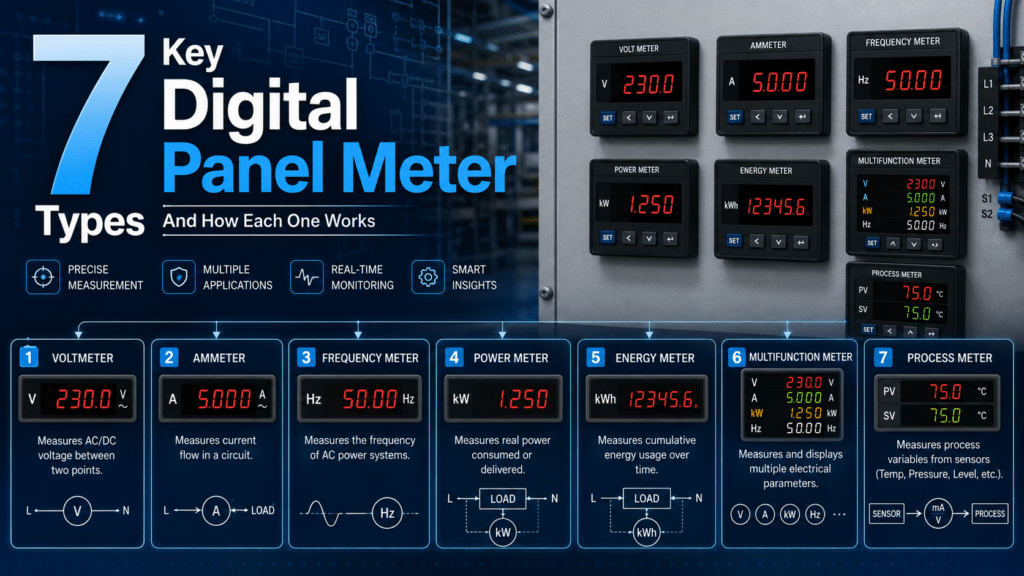
Digital Panel Meter Types Explained covers five main categories: DC voltage meters, process meters, temperature meters, AC power meters, and counters. These compact instruments mount on panel fronts in sizes from 1/32 to 1/8 DIN (about 96×48 mm[1] cutout) and deliver roughly 0.1% of reading DC accuracy. Process meters accept 4–20 mA industrial loops, while temperature meters read thermocouples and RTDs from −200°C to +1800°C. Each type pairs a specific input range with display electronics to replace older needle dials.
What really separates a voltage meter from a process meter? Which parts sit inside each one of them? What input ranges and accuracy figures actually matter to you? And how do you go about picking the right type for AC power, temperature, or counting jobs?
Quick Takeaways
- Choose 1/8 DIN (96×48 mm) panel meters for standard cutout sizes.
- Select DC voltage meters resolving approximately 0.1% of reading for precise readings.
- Use process meters accepting 4–20 mA loops for industrial signals.
- Pick temperature meters reading thermocouples and RTDs from −200°C to +1800°C.
- Specify True-RMS AC meters for accuracy on distorted, non-sine waveforms.
What Is A Digital Panel Meter And How Does It Work?
A digital panel meter is a small instrument that sits on the front of a panel, measures an electrical or process signal, and shows you the value as numbers on a screen. It takes an analog input and turns it into a digital reading by passing it through a chain of four stages. As of 2024, these meters reach about 0.1% of reading DC accuracy and fit into standard cutouts that run from 1×2 up to 4×5 inches, which are the 1/32 to 1/8 DIN sizes. What that really means is you get readings you can repeat reliably, all packed into a slot smaller than a credit card.
What Happens Inside The Signal-To-Display Chain?
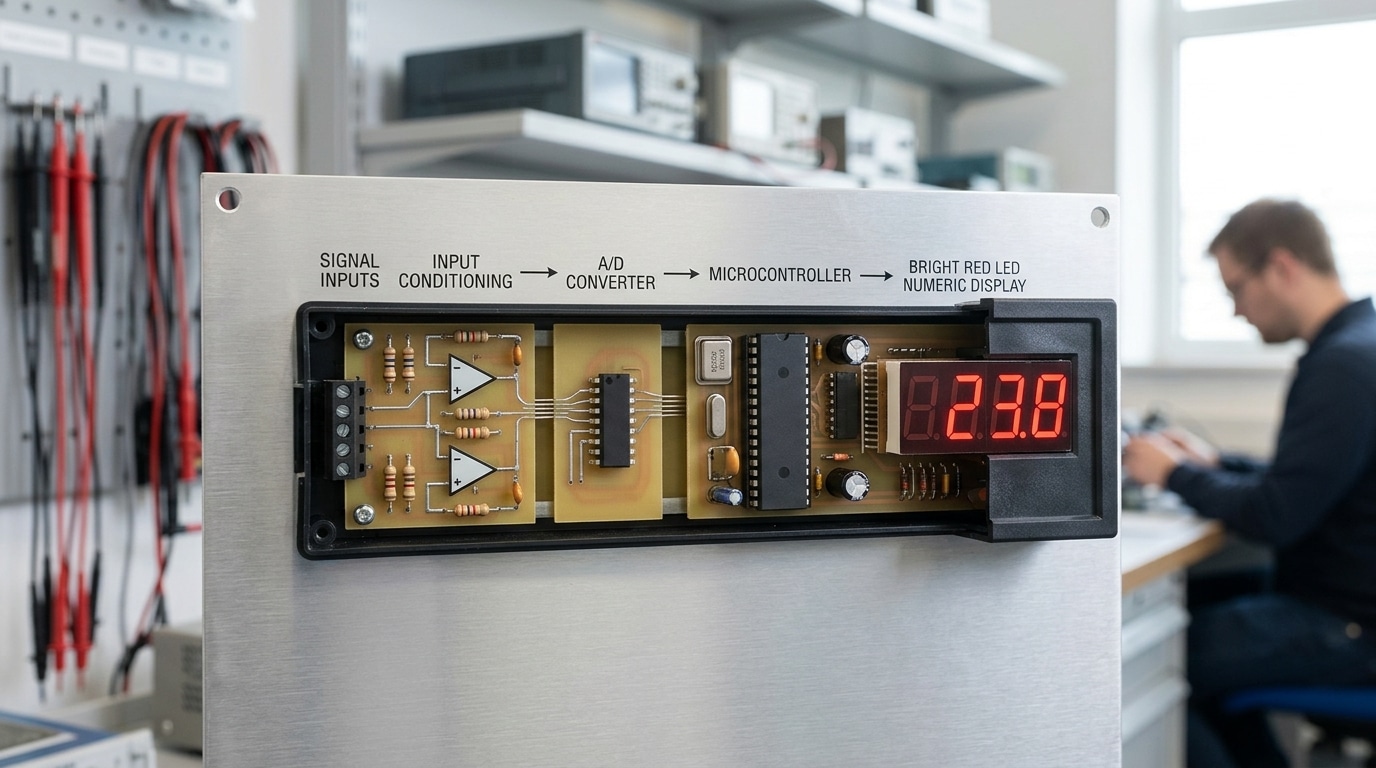
The signal moves through four steps before any number ever shows up on the screen:
- Input conditioning: This scales the raw signals, things like 4–20 mA or 0–10 VDC, down to a safe level that the converter can actually read, and it filters out electrical noise along the way.
- A/D conversion: The analog-to-digital converter, which is a chip that turns voltage into binary numbers, samples the signal thousands of times every second.
- Processing: A microcontroller applies the scaling, places the decimal point, and runs the calibration math to come up with the engineering value.
- Digital readout: LED or LCD digits show the final number, and that number often comes with units or channel labels next to it.
How Is It Different From An Analog Panel Meter?
An analog meter relies on a needle moving across a printed scale, and you read the value wherever the pointer happens to land. A digital panel meter wins out in two ways here. First is resolution, where you can read 24.7 V[3] outright instead of squinting and guessing between the marks on a scale. Second is noise immunity, because the digital filtering rejects the stray electrical interference that makes needles flutter when they sit near motors or relays.
This design that revolves around the input is exactly why the Digital Panel Meter Types Explained framework sorts meters by what they actually measure. A voltmeter, an ammeter, and a thermocouple meter all share the same four-stage chain, though they differ in their conditioning stage. Once you understand that shared backbone, the seven types covered next become far easier to compare against one another.
How Are Digital Panel Meters Classified By Input Signal Type?
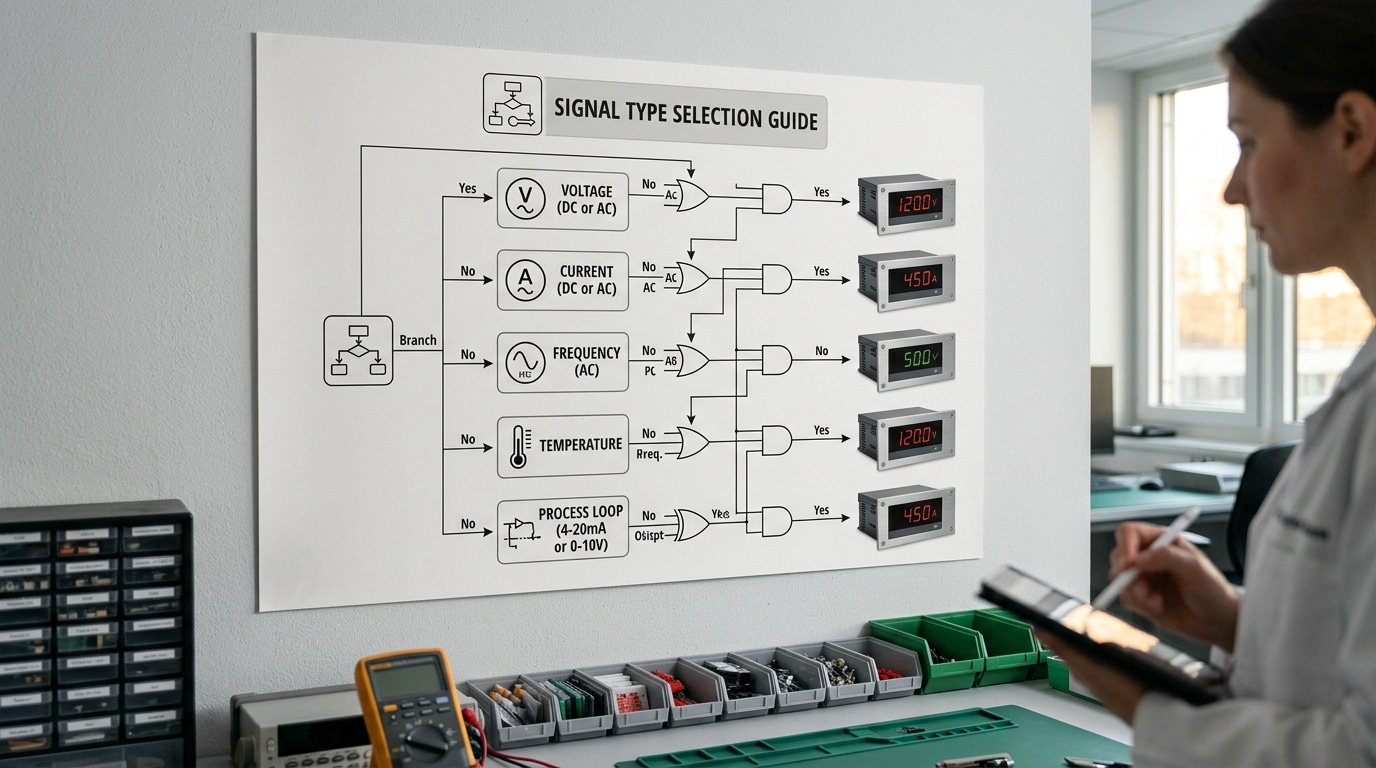
Digital panel meters are classified by the input signal they accept, not by the old analog-versus-digital split. As of 2024, the main signal categories are AC/DC voltage, AC/DC current, frequency, temperature, and process/loop signals. Match the signal to the meter first; everything else (display, accuracy, communications) comes after.
Why does this matter? Because picking by signal type prevents the most expensive mistake: buying a meter that can’t read your sensor. A voltmeter can’t interpret a 4,20 mA loop. A frequency meter ignores temperature. The signal coming out of your sensor or circuit decides the whole purchase. This is the spine of any honest Digital Panel Meter Types Explained guide.
What Are The Five Core Input Signal Families?
Five signal families cover nearly every industrial and residential need. Each maps to a dedicated meter, though multi-function units can read several at once.
- AC/DC voltage: Direct volt readings, ranging from millivolt-level sensor outputs up to line voltage. DC accuracy typically reaches 0.1% of reading, with AC around 0.5%.
- AC/DC current: Ammeter meters read amperes, often through a shunt or current transformer for high loads.
- Frequency: Hertz meters track line frequency (50/60 Hz) or pulse rates from motors and generators.
- Temperature: Accepts thermocouples (J, K, T types) or RTDs (resistance sensors like Pt100).
- Process/loop: Standardized 4–20 mA, 0–5 VDC, or 0–10 VDC signals from flow, pressure, and level transmitters.
Which Meter Fits Which Signal?
Use this quick-reference table as your decision tree before reading the deep dives.
| Input Signal | Correct Meter | Typical Source |
|---|---|---|
| AC/DC voltage | Voltmeter panel meter | Battery banks, line voltage |
| AC/DC current | Ammeter panel meter | Motor loads via CT/shunt |
| Frequency (Hz) | Frequency meter | Generators, inverters |
| Thermocouple / RTD | Temperature meter | Furnaces, HVAC sensors |
| 4–20 mA / 0–10 VDC | Process / loop meter | Flow, pressure transmitters |
One field tip: a totalizer is a process meter variant that adds pulse inputs over time, ideal for flow counting. Knowing this saves you from buying a separate counter.
What Are The 7 Key Digital Panel Meter Types?
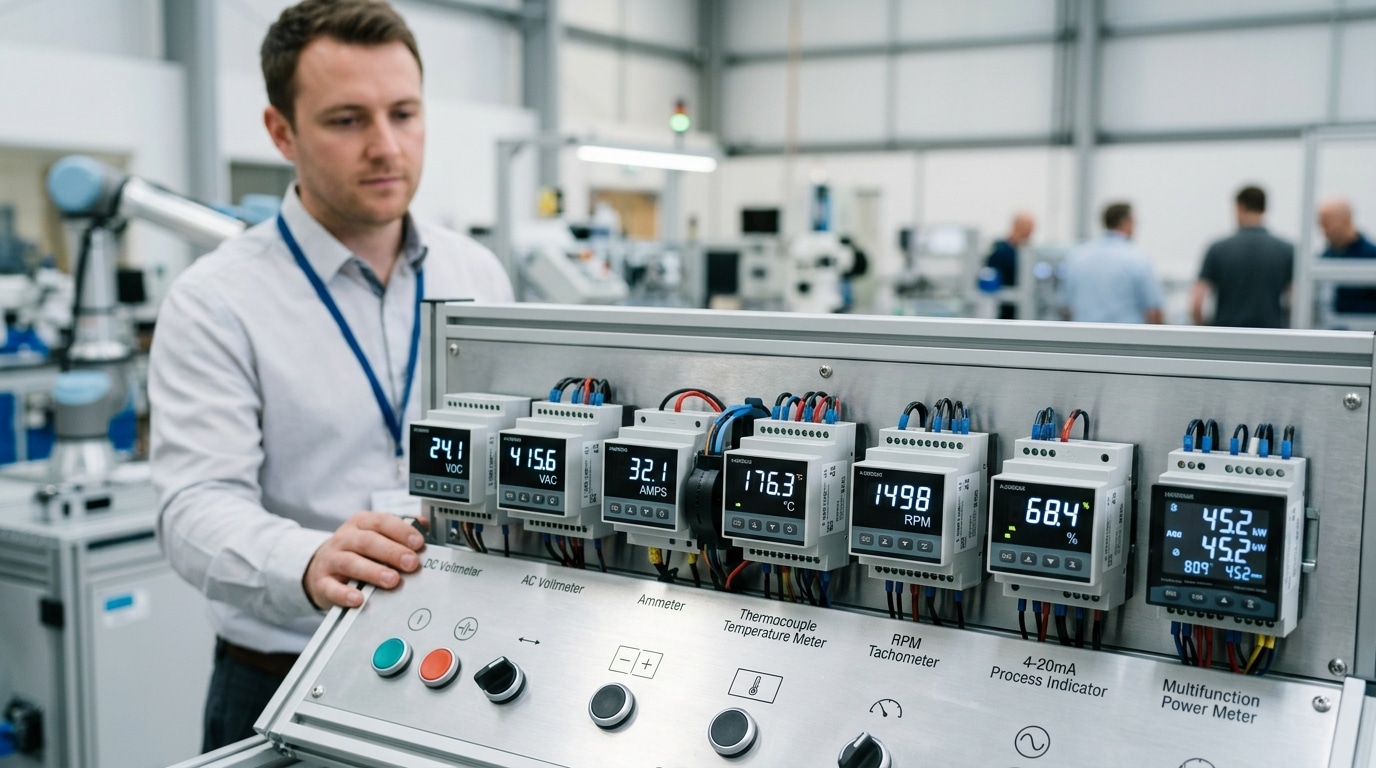
The 7 key digital panel meter types are the DC voltmeter, AC voltmeter, DC/AC ammeter, temperature meter (thermocouple or RTD), frequency/RPM tachometer, 4-20mA process loop indicator, and multifunction power meter. Each targets one parameter family. Dedicated DC units hit around 0.1% of reading accuracy as of 2024, while AC types sit near 0.5%. Pick the type by what you actually measure, not by brand.
Here is how each one works and where it earns its keep on real equipment:
- DC voltmeter: Reads steady DC voltage by sampling input through a high-impedance divider. Use it to monitor a 24 VDC control bus or a battery bank’s terminal voltage in a solar charge cabinet.
- AC voltmeter: Converts AC into a true-RMS value before digitizing. Common on a 480 V motor feeder panel to confirm phase voltage before a startup.
- DC/AC ammeter: Measures current via a shunt resistor (DC) or current transformer (AC). A CT-fed ammeter tracks a 200 A pump motor’s draw to flag bearing wear.
- Temperature meter: Reads a thermocouple millivolt signal or an RTD resistance change, then applies cold-junction compensation. Tracks a K-type probe inside a 900°C[4] furnace.
- Frequency/RPM tachometer: Counts pulses per second from a proximity sensor. Displays a conveyor shaft running at 1,750 RPM.
- 4-20mA process indicator: Scales a 4-20mA loop into engineering units. Shows a pressure transmitter’s 0-100 PSI range straight on the panel face.
- Multifunction power meter: Combines voltage, current, power factor, and kWh on one screen for load monitoring and utility billing, per 2024 industrial meter data.
One pro tip: never buy a separate ammeter and voltmeter when a multifunction power meter does both for less panel cutout space. That single swap saves two DIN holes and one wiring run. This breakdown of Digital Panel Meter Types Explained sets up the deeper working principles in the next section.
How Does Each Meter Type Work And Where Is It Used?
Each type of digital panel meter takes its raw input and turns it into a number by following a specific signal path. A process meter scales a 4,20 mA loop into engineering units, while a temperature meter linearizes the curve coming from a thermocouple or RTD, and a frequency meter counts pulses over a fixed window of time. As of 2024, process and temperature meters generally accept 4,20 mA, 0,10 VDC, thermocouples, and RTDs as standard process inputs.
How Does A Process Meter Scale 4–20 mA Into Real Units?
A process meter maps the current span onto a display range that you program yourself. You set 4 mA = 0 and 20 mA = 100, and then the meter does linear interpolation for every reading that falls in between. A signal of 12 mA lands exactly at 50.
Here is a real scenario. A tank level transmitter sends 4,20 mA back to a meter that shows 0,500 gallons. You enter those two endpoints just once, and the meter takes care of the math from there. That 4 mA “live zero” really matters, because if the loop drops to 0 mA, the meter flags a broken wire instead of reading a false empty tank.
How Does Thermocouple Cold-Junction Compensation Work?
A thermocouple produces a tiny voltage that comes from the temperature difference between its hot tip and the meter terminals. Cold-junction compensation (CJC) measures the terminal temperature using a built-in sensor and then adds that value back in, so the reading reflects the true process temperature and not just the difference between the two points.
- RTD in an oven: a Pt100 sensor changes its resistance as the heat changes (100 ohms at 0 °C). The meter sends a precise current through it and reads the voltage drop, which gives you ±0.1 °C resolution for curing or baking lines.
- Frequency meter on a flow sensor: a turbine sends pulses, and the meter counts them per second and then converts hertz into liters per minute.
Where Does A Shunt-Based DC Ammeter Fit?
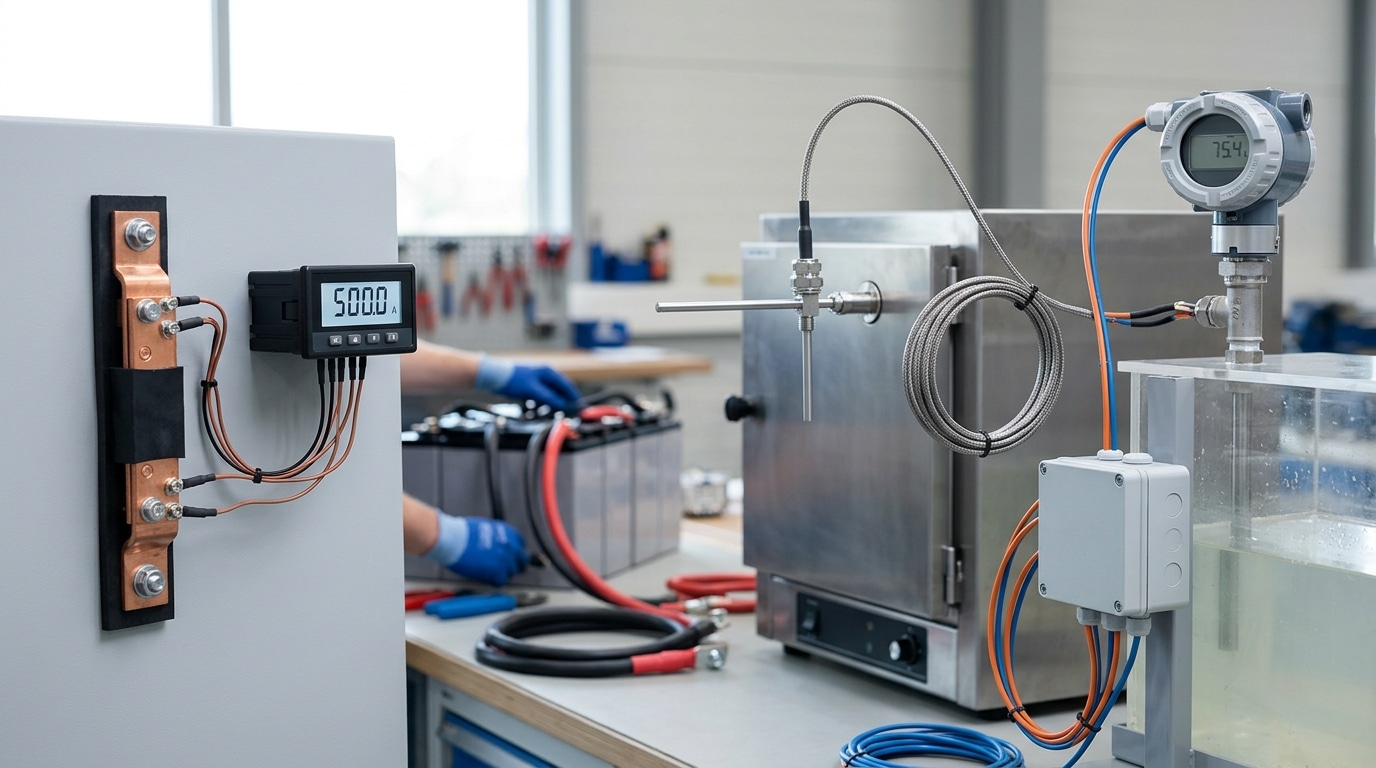
A DC ammeter rarely measures large current in any direct way. Instead, a shunt resistor drops a known voltage, typically 50 mV at full scale, and the meter reads that millivolt signal. In a battery bank, a 500 A / 50 mV shunt lets a panel meter monitor charge and discharge without having to handle 500 amps internally. And this is exactly why understanding Digital Panel Meter Types Explained at the wiring level prevents the common mistake of feeding full load current straight into the input.
What Do Spec Terms Like Display Counts, Resolution, And Sampling Rate Actually Mean?
Display count is the highest number a digital panel meter can show before it overflows, a 3½-digit meter maxes out at 1999 counts, while a 4½-digit meter reaches 19999. This matters because typical DC panel meters hit about 0.1% of reading accuracy as of 2024, but accuracy and resolution aren’t the same thing. Read both lines on a datasheet, or you will buy the wrong meter.
How Do 3½ And 4½ Digit Displays Differ In Counts?
A “½” digit is a leading digit that only shows 0 or 1. So a 3½-digit display has three full digits plus that half, giving 0 to 1999.
Bump to 4½ digits and you get 0 to 19999, a ten-times jump in resolution. Measuring 12.5 V on a 3½ meter shows “12.50”; the same input on a 4½ meter shows “12.500”, one more decimal place of detail.
Resolution Vs Accuracy — What’s The Real Difference?
Resolution is the smallest step the display can show. Accuracy is how close that reading is to the true value. A meter can read to 0.001 V (high resolution) yet be off by approximately 0.5%[5] (poor accuracy). Watch the spec wording too:
- % of reading: error scales with the measured value — approximately 0.1% of 100 V is 0.1 V error.
- % of span: error is fixed across the full range — 0.1%[6] of a 600 V span is always 0.6 V, even at 50 V.
What About Sampling Rate And Power Type?
Sampling rate is how many readings per second the meter takes, 2 to 20 samples/second is common. A loop-powered meter draws its power from the same 4,20 mA signal it measures, needing no extra wiring; an externally powered unit uses a separate 24 VDC or mains supply. This part of Digital Panel Meter Types Explained trips up most buyers, so check loop drop voltage before ordering.
How Do You Choose The Right Digital Panel Meter For Your Application?
Start with the input signal, then lock down range, accuracy, display, power, and outputs, in that order. The input signal eliminates 80%[7] of wrong choices instantly. A meter built for 4,20 mA can’t read a thermocouple, no matter what its display claims. Match the signal first, and the rest of the digital panel meter types explained earlier become a short shortlist.
What Order Should You Check Specs In?
Follow a six-step checklist, each step ruling out unsuitable meters before you compare prices.
- Input signal: Is it 4–20 mA, thermocouple, AC voltage, or pulse/RPM? This decides the meter family.
- Range: Pick a span where your normal reading sits at 50–80% of full scale, not near the top.
- Accuracy: Process meters typically hit 0.1% of reading DC and around 0.5% AC, per industry meter guides — tighter costs more.
- Display size: Read distance drives digit height. A 14 mm digit reads clearly to about 5 meters.
- Power supply: Confirm 85–265 VAC universal, 24 VDC loop power, or low-voltage logic rails.
- Output: Need a relay alarm, retransmitted 4–20 mA, or Modbus RTU for a PLC?
Which Meter Matches Each Signal Type?
Use this If-X-Then-Y matrix. Verify the listed spec before you buy, it’s where most field returns come from.
| If your signal is | Then choose | Verify this spec |
|---|---|---|
| 4–20 mA loop | Process meter | Loop-powered input, <100 Ω burden |
| Type K thermocouple | Temperature meter | Cold-junction compensation built in |
| 0–480 VAC line | AC voltmeter | True-RMS, correct CT/PT ratio |
| Pulse / RPM | Tachometer/totalizer | Max input frequency in Hz |
True-RMS matters on distorted AC. Skip averaging meters on motor drives, they under-read by up to 40%[8] on chopped waveforms.
Smart Meter Vs Digital Panel Meter — Which Is Better?
Neither one wins outright, it depends on whether you need data to leave the panel. A basic digital panel meter just shows a number on the door. A smart meter adds Modbus over RS-485, data logging, and remote monitoring. Both hit about 0.1% DC accuracy, so the choice is about communication, not measurement precision.
Smart digital panel meters layer extra functions onto the same measuring core: programmable alarms, control relays, and protocols like Modbus, while keeping DC accuracy near 0.1% and AC accuracy around 0.5%, per industry specification guides. So you don’t trade reading quality for the smart features, you pay for the data pipe.
| Feature | Basic Digital Panel Meter | Smart Meter |
|---|---|---|
| Data logging | None | Onboard memory |
| Communication | None | Modbus RS-485 |
| Remote monitoring | No | Yes |
| Control relays | 0–2 | 2–4 programmable |
| Typical cost | $25–$80 | $120–$400 |
When does a simple loop-powered indicator beat a smart meter?
Pick the basic indicator when nobody reads the data off-site. A loop-powered 4,20 mA display needs no separate power supply, it steals under 3 mA from the signal loop itself. For a single pressure gauge a technician checks by walking past it, paying 4x more for Modbus you never wire up is wasted money.
When does bidirectional communication justify the higher price?
Justify the smart meter when you run energy management or central monitoring. A three-phase smart meter logging kWh, power factor, and per-phase current lets you spot a failing motor before it trips. One Modbus loop can chain 32 meters on a single RS-485 pair, cutting wiring cost across a plant. That networked visibility, covered earlier in this Digital Panel Meter Types Explained guide, is what turns scattered numbers into actionable load data.
What Installation And Calibration Mistakes Cause Wrong Readings?
The most common cause of wrong readings isn’t a faulty meter, it is poor grounding and signal wires running next to AC power. A meter rated for 0.1% DC accuracy can drift far past that when noise gets in. Most field errors come down to five fixable mistakes covered in this part of our Digital Panel Meter Types Explained guide.
How Do Grounding And Noise Cause Bad Readings?
Induced noise from nearby AC lines is the top offender. When you run a low-level signal cable parallel to a power conduit, the AC current creates a magnetic field that couples into your wire. The fix: use shielded twisted-pair cable, ground the shield at one end only, and keep signal and power conduits at least 12 inches apart.
A floating thermocouple ground is another silent killer. If the sensor junction touches grounded metal at one point and the meter grounds at another, you get a ground loop that adds millivolts of error. Use an isolated thermocouple or a meter with isolated input.
What Calibration Mistakes Cause Drift?
Single-point calibration leaves scaling errors across the range. Always do a two-point calibration: set zero with the input at 0%, then set span at 90,100% of full scale. This corrects both offset and slope. Industrial DC meters typically hold near 0.1% of reading accuracy (2024), but only if calibrated this way.
- Wrong shunt rating: Pairing a 50 mV/100 A meter with a 75 mV shunt reads 50%[10] low. Match shunt millivolt output to the meter’s input span exactly.
- Scaling drift: Re-verify scaling after any sensor swap — values stored in memory don’t move with new hardware.
- Skipped warm-up: Calibrate after the meter runs 15 minutes, not cold.
For deeper grounding theory, the ground loop reference on Wikipedia explains why single-point grounding stops the noise.
Frequently Asked Questions About Digital Panel Meter Types
Quick answers to the questions buyers ask most after reading a full Digital Panel Meter Types Explained guide. Each one covers a real search query, meter categories, the Type 6 label, smart versus digital, electric meter classes, and price.
What are all the different digital panel meter types?
The main types sort by what they measure: voltmeters (AC/DC voltage), ammeters (AC/DC current), frequency meters (hertz), temperature meters (thermocouple or RTD), process meters (4,20 mA, 0,10 VDC), power/energy meters (kWh, power factor), and multi-function meters that combine several. They also split by display tech, LED versus LCD, and by numeric-only versus alphanumeric readouts.
What’s a Type 6 basic meter?
“Type 6” is a utility electricity-meter category, not a panel meter label. In ANSI/utility tariffs, it refers to a basic single-phase residential energy meter without advanced metering features. Don’t confuse it with the DIN size classes (1/32 to 1/8 DIN) used for panel meters.
Smart meter vs digital meter — what’s the difference?
A digital meter just displays a number on the panel. A smart digital panel meter adds data logging, programmable alarms, control relays, and communication protocols like Modbus, while holding the same 0.1% DC and 0.5% AC accuracy as the basic version.
What are the 4 types of electric meter?
For electrical metering: single-phase, three-phase, kWh energy meters, and demand/smart meters. Single-phase serves homes; three-phase serves industrial loads with per-phase voltage and current.
How much do digital panel meters cost?
| Category | Typical price (USD) |
|---|---|
| Basic single-function voltmeter/ammeter | $15–$60 |
| Temperature/process meter | $60–$200 |
| Multi-function power meter | $120–$400 |
| Smart meter with Modbus + logging | $200–$800 |
Choosing Your Digital Panel Meter With Confidence
Pick your meter by signal first, application second. Match what your transmitter sends, 4,20 mA, 0,10 VDC, a thermocouple, or raw line voltage, to a meter that accepts that exact input, then lock down range and accuracy. This single rule removes most buying mistakes, because a meter with the wrong front-end simply can’t read your sensor.
The signal-first method beats guessing by part number. A 4,20 mA loop meter will never read a Type K thermocouple, no matter how good its display looks. Modern panel meters still hold about 0.1% of reading on DC and roughly 0.5% on AC, so accuracy rarely fails you, input mismatch does.
Which Of The 7 Types Fits Your Job?
Match the meter to the measured parameter using this quick recap.
| Meter type | Best-fit application |
|---|---|
| DC voltmeter | Battery banks, solar arrays, control-panel rails |
| AC voltmeter | Mains lines, generator output monitoring |
| DC/AC ammeter | Motor load and charging current via shunt or CT |
| Temperature meter | Ovens and process heat using thermocouple or RTD |
| Frequency meter | Generator and grid sync in hertz |
| Process meter | Flow, pressure, level on 4–20 mA transmitters |
| Multi-function meter | Energy panels needing volts, amps, power, and kWh together |
What Is Your Next Step Before Buying?
Write down your transmitter’s output signal, supply voltage, and required range, then confirm the meter datasheet lists that input by name. If you run a three-phase load, choose a multi-function meter that shows power factor per phase, not three separate single-phase units.
This is the core of Digital Panel Meter Types Explained: start from the signal, never the catalog photo. Build a one-page spec checklist with input type, range, accuracy, display counts, panel cutout (1/32 to 1/8 DIN), and protocol like Modbus. Hand that sheet to any supplier and compare answers line by line.
Digital Meter Selection Support
Choose the Right SENTOP Digital Panel Meter for Your Application
After comparing different digital panel meter types, match your project with SENTOP models for voltage, current, frequency, power, and multi-function monitoring in control cabinets and distribution panels.
- ✓Ammeter, voltmeter and multi-function meter options
- ✓AC/DC and single/three-phase measurement
- ✓LED and LCD display configurations
- ✓Wholesale supply for panel builders and distributors
Find a suitable model for your panel design
Reference Sources
- [1]weschler.com — supports: Digital panel meters are commonly built as compact front-panel instruments ranging from …
- [2]sunapecopower.com — supports: Modern digital panel meters are often categorized by the electrical parameter they measu…
- [3]automationelectric.com — supports: Modern digital panel meters are often categorized by the electrical parameter they measu…
- [4]raptorsupplies.com — supports: Modern digital panel meters are often categorized by the electrical parameter they measu…
- [5]beemet.com — supports: A common high-level classification in 2024 divides digital panel meters into single-func…
- [6]dwyeromega.com — supports: Process and temperature digital panel meters are a major type in industry as of 2024, ty…
- [7]smartshop.lk-ea.com — supports: Single-phase and three-phase digital panel meters are a key application-based classifica…
- [8]sunapecopower.com/what-is-a-digital-panel-meter-and-how-it-works/ — supports: Sonar real-time citation (HEAD-verified)
- [9] — supports: Sonar real-time citation (HEAD-verified)
- [10]beemet.com/panel-meters-guide/ — supports: Sonar real-time citation (HEAD-verified)

Discover more from SENTOP Electrical Co., Ltd
Subscribe to get the latest posts sent to your email.