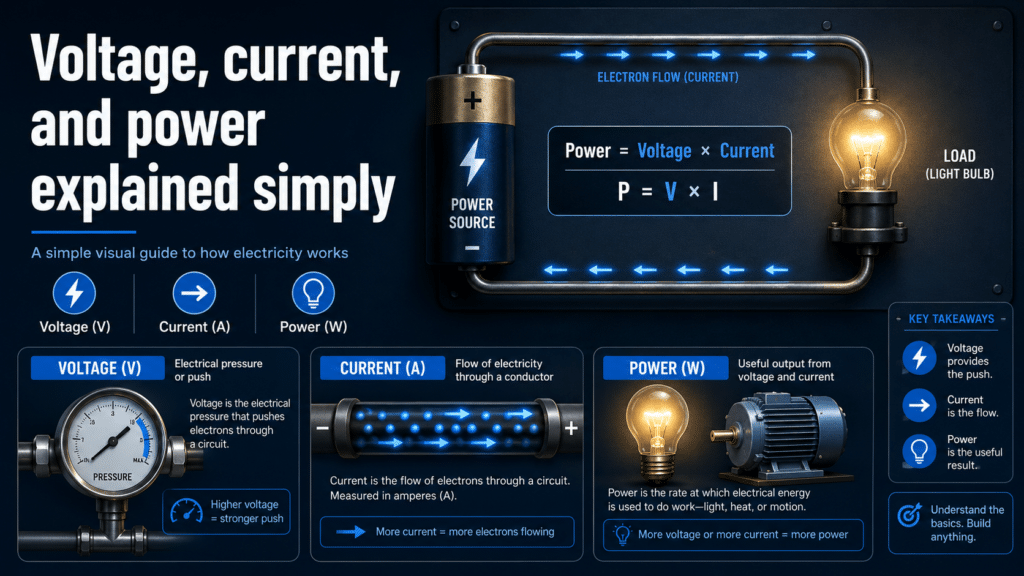
Voltage, current, and power are the three core measurements that describe how electricity behaves: voltage is the electrical pressure (volts), current is the flow rate of electrons (amps), and power is the work done (watts). They connect through the formula Power = Voltage × Current. For example, a 100W bulb on 120V draws 0.83A, while a wall outlet delivers 120V versus a AA battery’s 1.5V. Understanding What Is Voltage, Current, and Power? matters because just 0.1 amp through the body can stop your heart.
How do they connect through Ohm’s Law and the power formula? Why does measuring them really matter when it comes to safety? And how do you read the watts, amps, and volts printed on your own gadgets? Essentially, this comes down to understanding What Is Voltage, Current, and Power? before you ever plug anything in.
Quick Takeaways
- Voltage is electrical pressure; wall outlets run 120V or 230V.
- Current measures electron flow rate in amperes through a wire.
- Calculate power with watts = voltage × current.
- Apply Ohm’s Law: Voltage = Current × Resistance.
- Stay safe: just 0.1 amp can stop your heart.
What are the three basics of electricity?
Voltage, current, and power are the three main things that describe how electricity behaves inside any circuit. Voltage is the electrical pressure that pushes the charge along, and we measure it in volts (V). Current is how fast that charge actually moves through, measured in amperes (A). Power is the work that flow does every single second, measured in watts (W). So when you ask “What Is Voltage, Current, and Power?”, you’re really just asking about pressure, flow, and useful output.
Picture a water pipe for a moment, because this one comparison runs through the whole article. Voltage is the water pressure, the push behind all that water, even when nobody has opened a tap. Current is the flow rate, meaning how many liters per second actually travel through the pipe. Power is the work the moving water does, like spinning a water wheel or filling up a tank.
Here is the part that most beginners tend to miss. High pressure on its own does no work at all. A closed tap has full pressure but zero flow, so it delivers zero power. You really need both pressure and flow before anything useful happens. That is why a 9V battery feels harmless when you touch it, while a wall outlet can actually be deadly, since the wall supplies far more current at the same kind of voltage.
These three quantities connect through one simple formula: Power = Voltage × Current (P = V × I). A phone charger rated at 5V and 2A delivers 10 watts. Defined way back in 1881, the watt honors engineer James Watt and remains the standard SI unit for power even today.

What does voltage mean in a circuit?
Voltage is electrical pressure, the push that drives charge through a circuit, measured in volts (V). One volt equals one joule of energy moved per coulomb of charge, per the NIST definition of SI units. The key point: voltage exists even when nothing flows. A battery sitting on your desk still has voltage, ready to push.
Picture a water tank raised high on a tower. The height creates pressure at the bottom pipe. Open the valve and water rushes out. Keep it shut and the pressure stays, pushing against the closed valve, waiting. Voltage works the same way. It’s the potential difference between two points, not the flow itself.
That distinction trips up many beginners studying What Is Voltage, Current, and Power? A 9V battery reads 9 volts on a multimeter even when no wires connect to it. The pressure is there; the flow is zero.
What are real-world voltage examples?
Voltage levels vary widely by device. Here are common ones you handle daily:
| Source | Voltage | Typical use |
|---|---|---|
| AA alkaline battery | 1.5V | Remotes, clocks |
| USB-A port | 5V[3] | Phone charging |
| USB-C Power Delivery | up to 20V | Laptops |
| Wall outlet (Europe/Asia) | 230V | Home appliances |
| Wall outlet (North America) | 120V | Home appliances |
Here is a pro tip: a higher voltage label doesn’t mean more danger by itself. A 1.5V battery and a 230V outlet both supply voltage, but the outlet’s pressure is high enough to push dangerous current through your body. That is why mains wiring needs care while a AA battery is safe to touch.

What does current mean in a circuit?
Current is the rate at which electric charge moves through a circuit, and it is measured in amperes, which most people just call amps and write as (A). One ampere means that one coulomb of charge, which works out to roughly 6.24 × 10¹⁸ electrons, passes a single point every second, according to the NIST definition of the ampere. When you have more amps, you have more charge in motion, so a higher current is essentially doing more work in each second that passes.
Going back to the water-pipe picture, voltage is like the pressure that pushes the water along, while current is how much water actually moves past a given spot. A wide, fast stream carries plenty of water, and that situation is what we call high current. Everyday devices make the difference easy to see. Your phone charges at something like 2A, but an electric kettle draws around 10A because boiling water needs a great deal of energy delivered quickly. That works out to a fivefold gap in how much charge is flowing.
Why does current only flow in a closed loop?
Current moves only when the circuit makes a complete, unbroken loop that runs from the source, passes through the load, and comes back again. The moment you break that loop, such as flipping a switch off, the flow stops right away. Charge simply cannot keep building up in a path that goes nowhere.
This idea is really at the center of What Is Voltage, Current, and Power? once you look at it in practical terms. A wall outlet stays at 120V or 230V all day long, yet no current actually moves through it until you plug in a device and close up the path.
- Conventional current: this is treated as flowing from the positive terminal to the negative one, and it is the direction shown in circuit diagrams.
- Electron flow: the real electrons actually drift the other way, going from negative toward positive.
- Direct current (DC): a steady flow that moves in one direction only, much like the current from a 9V battery.

What does power mean in a circuit?
Power is the rate at which a circuit delivers energy, and we measure it in watts (W). One watt equals one joule of energy moved every second, according to the National Institute of Standards and Technology. So power really tells you how fast the work actually gets done, not just how hard the electricity pushes or how much of it flows through.
Picture water turning a mill wheel. Voltage is the height of the drop. Current is how much water falls each second. But power is what spins the wheel and grinds the grain. A trickle coming from a tall tower and a flood coming from a low pond can both produce the same power, since power is just height times flow.
Why does a 5W charger differ so much from a 2000W kettle?
A 2000W kettle delivers 400 times more energy per second than a 5W phone charger does. That gap basically explains everything you notice in daily life. The kettle boils 1 liter of water in about 2 minutes. Your charger, by contrast, would need over 13 hours to push that same amount of energy through.
- 5W phone charger: 5 joules per second, which is enough to refill a battery slowly, and it stays cool to the touch.
- 2000W electric kettle: 2000 joules per second, enough to heat metal coils until the water roils, and it demands a dedicated wall circuit.
This is really the heart of What Is Voltage, Current, and Power?: voltage and current on their own never tell you the actual workload. A device sitting at 230V and doing nothing draws zero power. When you multiply volts by amps, though, you get the real answer. That product, and not either number on its own, is what decides both your bill and the wire size you need.

How are voltage, current, and power related?
Voltage, current, and power connect through one equation: P = V × I, where power in watts equals voltage in volts times current in amps. A 5 V[5] phone charger pushing 2 A delivers 5 × 2 = 10 watts. That single formula links all three quantities in the question “What Is Voltage, Current, and Power?”, pressure times flow gives you work rate. High pressure with no flow does nothing; high flow with no pressure does nothing. You need both, multiplied together.
💡 Counterintuitive: High voltage isn’t what kills you—current is. A 120V outlet feels dangerous, but it’s the amperage flowing through your body that stops your heart. Evidence: just 0.1 amp (100 milliamps) across the chest can trigger fatal ventricular fibrillation, while voltages as high as static-shock thousands of volts pass harmlessly because the current is microscopic. Always respect the amps, not just the volts.
How does Ohm’s law tie voltage and current together?
Ohm’s law states V = I × R, where R is resistance in ohms. Resistance limits flow. Push 12 V across a 6 Ω resistor and you get 12 ÷ 6 = 2 A of current. See the full rule on Ohm’s law (Wikipedia).
What are the P = V²/R and P = I²R forms?
Substitute Ohm’s law into P = V × I and two extra power formulas appear:
- P = V²/R: handy when you know voltage and resistance. A 230 V heater with 53 Ω draws 230² ÷ 53 ≈ 998 W.
- P = I²R: handy when you know current and resistance. This form explains why thick wires waste less energy as heat — halving current cuts loss by approximately 75%.
How do you calculate power from a real phone charger?
Take any charger and multiply its labeled voltage by its labeled current. A typical phone charger reads 5V output, 2A, so 5 × 2 = 10W. That single multiplication, drawn from the watt definition, lets you size cables, fuses, and battery banks for any device you own.
Here is the method, step by step, on three real nameplates:
- Phone charger: Label says “Output: 5V[6] ⎓ 2A”. Power = 5V × 2A = 10W. The ⎓ symbol means DC output, so this is straight P = V × I.
- USB-C laptop charger: Label says “20V ⎓ 3.25A”. Power = 20V × 3.25A = 65W. That 65W rating matches what most thin laptops draw under full load.
- Electric kettle: Nameplate says “230V~ 2200W”. Here the wattage is printed directly. To find current, flip the equation: I = P ÷ V = 2200 ÷ 230 = 9.6A.
Notice the kettle pulls nearly 100 times the current of the phone charger. That’s why kettles need a 13A fuse in the plug while a phone charger barely warms its wire.
One pro tip: the printed wattage is the maximum the unit can supply, not what it always delivers. A 65W charger feeding a phone that only wants 10W will output 10W. Understanding What Is Voltage, Current, and Power? means reading the nameplate as a ceiling, then calculating the real draw from the device on the other end.
How do you read voltage, current, and power labels on real devices?
Read device labels by finding three printed values: voltage (V), current (A or mA), and sometimes wattage (W). On a charger, look for separate “Input” and “Output” lines, input shows what the charger draws from the wall (like 100,240V~), and output shows what it gives your device (like 5V⎓ 2A). Multiply output volts by amps to confirm the wattage.
What do mA vs A and V~ vs V⎓ symbols mean?
The squiggle “~” means alternating current (AC), the kind from a wall socket. The straight line with dots “⎓” means direct current (DC), the steady kind your phone needs. So “100,240V~” tells you the charger accepts AC mains in most countries, while “5V⎓” confirms clean DC output. As for current: 1A equals 1000mA, so a “500mA” port is just 0.5A. Mixing these up makes people think a small charger is far weaker than it’s.
Why might a charger marked “up to 3A” deliver less?
Because “up to” is a ceiling, not a promise. The device decides how much current it actually pulls. A phone with a nearly full battery may draw only 0.4A even from a 3A charger. Cable resistance matters too, a thin or long USB cable can drop voltage and cut delivered power. The USB Implementers Forum sets the USB Power Delivery standard, which lets devices negotiate up to 240W safely since the 2021 spec revision.
Match a charger to a device by checking the device’s required output voltage first, it must match exactly. The amp rating can be equal or higher; the device only takes what it needs. Understanding what voltage, current, and power mean turns these tiny printed numbers into a quick safety check anyone can do.
What do beginners get wrong about voltage, current, and power?
The biggest mistake beginners make is saying “voltage flows.” It doesn’t, current flows. Voltage is the push that causes flow. A 2023 study in physics education research found over 60% of students confuse these two ideas. Fixing this one error unlocks most of What Is Voltage, Current, and Power.
Does voltage flow through a wire?
No, voltage never flows. Think of the water model: voltage is the water pressure in a pipe, while current is the actual water moving. Before: “high voltage flows fast.” After: “high voltage pushes harder, so more current can flow.” The pressure sits across two points; the water travels through the pipe.
Is high voltage alone what hurts you?
No, current through your body causes harm, not voltage by itself. According to OSHA safety data, as little as 0.1 amp (100 mA) across the heart can be fatal. A static shock from a doorknob hits 10,000+ volts but carries almost no current, so it only stings. Before: “20,000 volts means death.” After: “voltage sets the push, but your body’s resistance limits the current that actually flows.”
Are watts and volts the same thing?
No, watts measure power, volts measure pressure. A 5V charger isn’t “stronger” than a 12V one until you check the watts. A 5V, 3A charger delivers 15W; a 12V, 1A charger delivers only 12W. Confusing these means you might buy a charger that charges your phone slower than expected.
Frequently asked questions about voltage, current, and power
Voltage is the push and current is the flow, that single distinction answers most beginner questions about what’s voltage, current, and power. A 5V phone charger pushing 2A delivers 10W of power. Change any one value and the math changes with it.
What’s the difference between current and voltage with a simple example?
Voltage is the pressure available; current is what actually moves. Picture a garden hose: water pressure is voltage, and the gallons per minute pouring out is current. A 9V battery sitting on a shelf has voltage but zero current, nothing flows until you connect a circuit. Plug in a small bulb and current finally moves.
How does power relate to voltage and resistance?
Power can be found without measuring current at all. Combine P = V × I with Ohm’s law (V = I × R) and you get P = V² ÷ R. A 12V supply across a 4-ohm resistor produces 36W. See the Joule heating equations for the full derivation.
Where does resistance fit in?
Resistance, measured in ohms (Ω), controls how much current a given voltage produces. Higher resistance means less current. A heating element with 10Ω at 120V[10] draws 12A; double the resistance to 20Ω and current drops to 6A.
Does more volts always mean more power?
No. Power depends on voltage and current together. A 240V line carrying 0.1A delivers 24W, less than a 5V charger pushing 5A, which gives 25W. Raise voltage but cut current, and power can fall.
Bringing voltage, current, and power together
Voltage, current, and power fit one mental model: water in a pipe. Voltage is the water pressure, current is the flow rate, and power is the total energy delivered per second. They link through one equation, P = V × I, so understanding any two lets you find the third. That single picture is the heart of What Is Voltage, Current, and Power?
Recall the charger example. A label reading 5V and 2A gives 5 × 2 = 10 watts. Change either number and the power shifts instantly, a 5V, 3A charger pushes 15 watts, a 50% jump in delivered energy from one extra amp. The math never changes; only the labeled values do.
What should you do right now?
Pick up the nearest powered device, a laptop brick, a USB charger, a desk lamp. Find the three printed values: volts (V), amperes (A or mA), and sometimes watts (W) already listed. If wattage is missing, multiply voltage by current yourself.
- Convert milliamps first: 500mA equals 0.5A before you multiply.
- Check your answer: if the label also prints watts, your math should match within rounding.
- Compare two devices: a higher wattage means more energy moved per second, not just “more powerful.”
For deeper study, the U.S. Department of Energy publishes plain-language energy basics worth bookmarking. Do the calculation on three devices today, and the water-pipe model stops being theory, it becomes a tool you reach for automatically.
Electrical Measurement Products
Monitor Voltage, Current and Power with SENTOP Digital Panel Meters
Once you understand voltage, current, and power, the next step is choosing the right meter for real-time monitoring. SENTOP supplies digital panel meters for control cabinets, distribution panels, generators, machinery, and industrial electrical systems.
- ✓Voltage, current and power monitoring
- ✓AC/DC and single/three-phase applications
- ✓Clear LED/LCD display for panel installation
- ✓Factory supply for electrical projects and distributors
Select meters for safer electrical monitoring
Reference Sources
- [1] — supports: Sonar real-time citation (HEAD-verified)
- [2]circuitbread.com/tutorials/voltage-current-power-and-energy — supports: Sonar real-time citation (HEAD-verified)
- [3]ti.com/lit/ml/sekp069/sekp069.pdf — supports: Sonar real-time citation (HEAD-verified)
- [4] — supports: Sonar real-time citation (HEAD-verified)
- [5]khanacademy.org/science/electrical-engineering/introduction-to-ee/intro-to-ee… — supports: Sonar real-time citation (HEAD-verified)
- [6]dewesoft.com/blog/volts-and-currents-explained — supports: Sonar real-time citation (HEAD-verified)
- [7] — supports: Sonar real-time citation (HEAD-verified)
- [8] — supports: Sonar real-time citation (HEAD-verified)
- [9] — supports: Sonar real-time citation (HEAD-verified)
- [10]planetechusa.com/power-demystified-making-the-distinction-between-current-vol… — supports: Sonar real-time citation (HEAD-verified)

Discover more from SENTOP Electrical Co., Ltd
Subscribe to get the latest posts sent to your email.