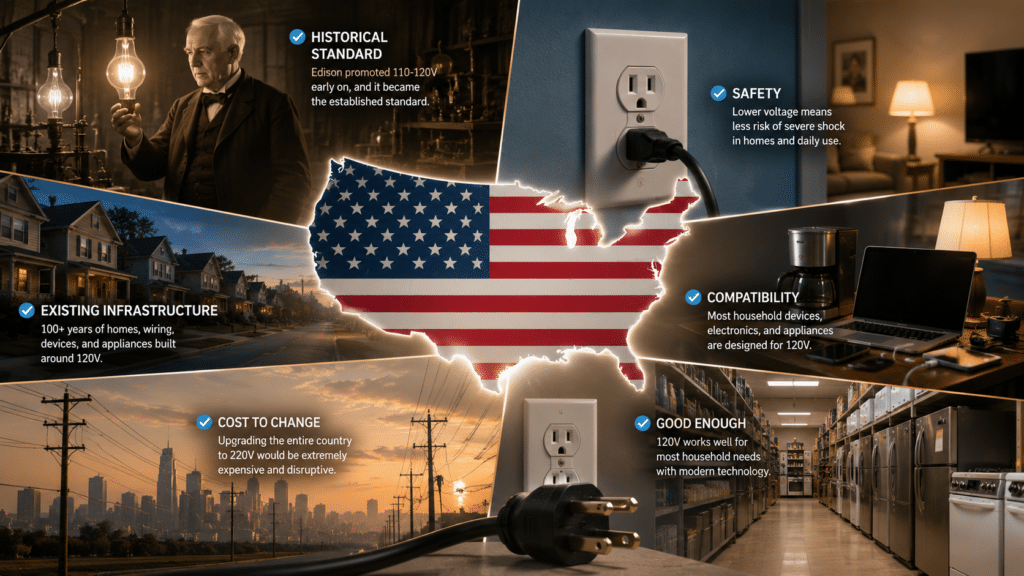
Why does the United States use 120V[1] instead of 220V? The answer is historical lock-in: Thomas Edison’s 1882 direct-current systems ran at about 110V to power carbon-filament bulbs, and once millions of homes and appliances were wired around that level, switching became too expensive to justify. U.S. nominal household voltage rose from 110V to 115V and reached roughly 120V by the mid-20th century, while 240V still quietly powers dryers, ovens, and AC units.
This article answers five things readers ask most: what historical decision set the standard, why safety played a role, how the US actually does use 240V, what 120V costs in efficiency, and whether the US will ever switch.
Quick Takeaways
- Edison’s 1882 DC systems locked early US wiring near 110 volts.
- Lower 120V reduces shock severity at standard household outlets.
- US homes still use 240V for dryers, ovens, and AC.
- V requires thicker copper wire, raising material costs and line losses.
- Rewiring every outlet and appliance to 240V would cost billions.
Why Does The US Use 120V Instead Of 220V — The Short Answer
The United States uses 120V instead of 220V mainly because of historical lock-in, meaning the country got stuck with a choice made long ago. Thomas Edison’s late-1800s direct-current systems ran at about 110V to power carbon-filament light bulbs, and once millions of homes and appliances had been wired around that level, switching to 220,240V was considered too costly and disruptive to justify. So the country kept 120V and added 240V only for the big, power-hungry loads.
Here are the five reasons in one tight package, ranked by how much they mattered:
- Edison’s DC head start: His carbon-filament lamps ran best at 100–110V, so the early distribution networks were built around that range before alternating current, the kind that switches direction, took over.
- Installed-base cost: By the 1920s and 1930s, US utilities had settled on service near 110–120V[2], and rewiring every wall outlet, meter, and motor to 240V meant replacing infrastructure that was already in place.
- Appliance compatibility: Raising the voltage toward 120V kept existing lighting and motors working, so utilities nudged the standard up gradually instead of forcing a clean break.
- Perceived shock safety: Lower voltage means a less severe shock when you touch something live, and that fit the wiring practices already common in American homes.
- The split-phase workaround: US homes already receive 240V at the panel as split-phase power, so high-draw devices like dryers get their 240V without anyone abandoning the 120V outlets.
The timing really matters here. Europe made its big voltage decision later than America did. When many European grids were rebuilt or expanded after World War II, planners standardized on 220,240V for better efficiency, since they were essentially building from a cleaner slate. America had already sunk decades of investment into 120V hardware by that point.
One detail that most explanations skip is this. The 120V figure is the utilization voltage at your outlet, not the only voltage reaching your house. Your service panel actually gets a 240V split-phase feed, which is two 120V legs plus a neutral. That single design choice is why the “why didn’t they just switch?” question has a practical answer. They partly did switch, just quietly, for the loads that genuinely needed it.
How Did Edison’s 110V DC System Become The US Baseline?
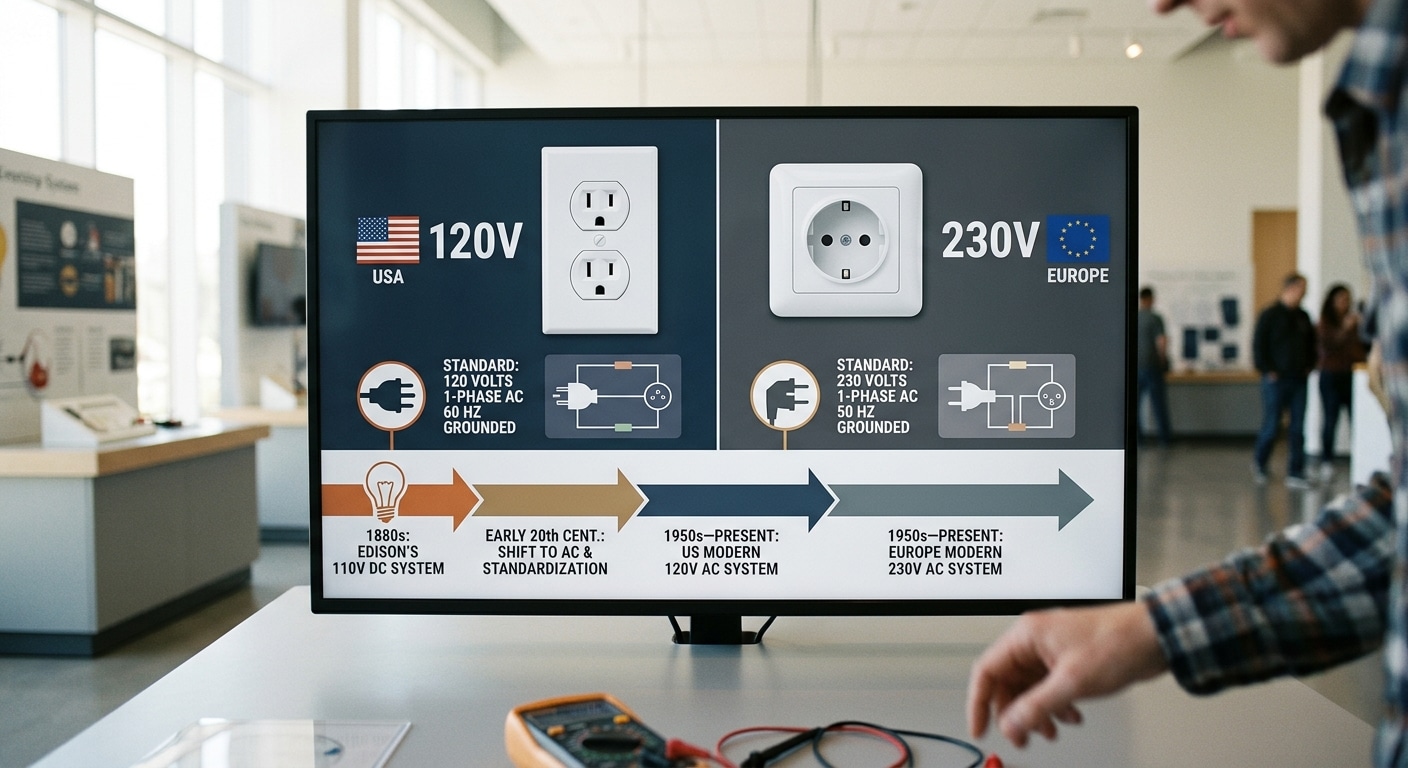
Edison’s 110V DC system became the US baseline because his Pearl Street Station in Manhattan, switched on September 4, 1882, powered carbon-filament lamps that worked best at roughly 110 volts. Early incandescent bulbs had practical operating voltages in the 100,110V range, so Edison built his whole grid around that number. Every later choice inherited it.
Why 110V and not higher? The voltage was set by the lamp, not the wire. Carbon filaments (thin carbon threads that glow when current passes through them) burned out fast at higher voltage. Push more volts and the filament overheats, sags, and snaps. Edison tuned his bulbs to last around 600 hours at this level, a real selling point in 1882.
Lower voltage also meant less shock danger inside homes full of new, untested wiring. That mattered when insurance companies were nervous about electric lighting causing fires and injuries.
Why didn’t Westinghouse and Tesla’s AC system reset the voltage?
Because the lightbulbs were already in millions of sockets. When George Westinghouse and Nikola Tesla pushed alternating current in the late 1880s, they needed it to power the same Edison-style lamps people already owned. So AC systems were set near 110V to stay compatible with the installed base of bulbs and fixtures.
This is the core of why the United States uses 120V instead of 220V, the standard froze before any cheaper or safer alternative could prove itself. Once factories tooled up to make 110V bulbs, sockets, and meters, switching meant scrapping all of it.
- Lamp compatibility: AC had to match existing 110V[3] Edison bulbs or lose customers instantly.
- Manufacturing lock-in: Bulb factories, sockets, and switches were all built for ~110V by the 1890s.
- Utility billing gear: Early meters were calibrated to the 110V service level.
By the 1890s, the number was no longer an engineering decision. It was an installed-base decision, and the installed base won.

Why Did North America Bump 110V Up To 120V Instead Of Switching To 220V?
North America pushed 110V up to 120V because that small bump in voltage cost almost nothing, while jumping all the way to 220V would have ruined every lamp, motor, and appliance already sitting in people’s homes. Utilities raised the standard level from roughly 110V to 115V, then 120V by the mid-20th century, basically to fight off the voltage that gets lost across bigger grids, not to start over with a brand new system.
Here is the math behind that slow climb. As power lines reached farther away from the substations that distribute electricity, the natural resistance in the wires used up some of the voltage before it ever got to the wall. That lost voltage is what people call voltage drop. By raising the supply voltage by a few points, utilities made sure the lamp sitting at the far end of the line still received something close to its rated 110V. The fix was invisible to homeowners, since the bulbs and motors already in use handled the slight increase just fine.
What Is The ANSI C84.1 Voltage Range That Allows This?
ANSI C84.1 sets the legal voltage window for electrical service in the United States. It calls for a standard 120V with an allowed range running from 114V to 126V at the spot where you actually use the power. That ±5% band is really the key part. It means a “120V” outlet can legally measure anywhere inside that span without breaking any rule at all.
- Service voltage (Range A): 114V–126V, which is what the utility company delivers to your meter.
- Utilization voltage: 110V–125V, which is what your device actually receives after some power is lost moving through the wiring inside the home.
- Nominal target: 120V, which is the label number that everything gets designed around.
Old 110V bulbs ran happily inside this whole range. A switch to 220V[4] would have offered no such forgiveness, because doubling the voltage means a 110V filament burns out the moment you turn it on.
Why Was The Nudge Cheap But A 220V Switch Ruinous?
The voltage nudge needed only tap changes on the distribution transformers, which is essentially a setting adjustment rather than new hardware. A full conversion to 220V would have left millions of already installed appliances useless all at once. That contrast is the real answer to why the United States uses 120V instead of 220V, because small step-by-step change was free though a complete overhaul certainly was not.

120V vs 220–240V For Home Wiring — Which Is Actually Better?
When it comes to raw efficiency, 240V comes out ahead, but for protection against shocks and staying compatible with older equipment, 120V still earns its place. At the same wattage, 240V draws half the current that 120V does, which reduces the heat lost in the wires (these are called I²R losses) by roughly 75%, according to electrical engineering analysis. That translates into wire that can be thinner and cheaper. So the answer to why does the United States use 120V instead of 220V really isn’t about one being better engineering, it’s a trade-off that the US decided to stick with.
Here’s the math that most competitors tend to skip over. A 1,800-watt space heater running on 120V pulls 15 amps. That exact same heater on 240V pulls only 7.5 amps. Cutting the current in half is essentially the whole point.
| Factor (1,800W load) | 120V system | 240V system |
|---|---|---|
| Current draw | 15 A | 7.5 A |
| Minimum copper wire gauge | 14 AWG | 16–18 AWG capable |
| I²R conductor loss | Baseline (4× higher) | ~25% of 120V[5] loss |
| Voltage drop over 100 ft | Larger (higher current) | Half the drop |
| Breaker size needed | 15–20 A | 10 A or less |
Why does 120V need thicker, more expensive wire?
120V needs thicker wire because it’s the current, not the voltage, that heats up a conductor. The gauge of a wire is chosen so it can carry the amps safely. Since 120V circuits push double the amps for the same wattage, they require a heavier copper core to keep from overheating. And copper is what really drives the cost here.
Picture two garden hoses for a moment. You push the same amount of water through a skinny hose and a fat hose. The skinny one strains and gets hot. That’s basically what a 120V wire carrying high current is doing.
Does the voltage drop difference actually matter in a real house?
Yes, on long runs it genuinely does. The voltage drop scales up with both the current and the distance. A 120V circuit feeding a detached garage 100 feet away can sag below the 5% drop limit set by the National Electrical Code, which forces electricians to use larger wire. A 240V feed cuts that drop in half, so it holds the voltage steady with cheaper conductors over that same distance.

Is 120V Actually Safer Than 220V? What The Electrocution Data Shows
120V is somewhat safer per shock incident, but it doesn’t produce lower national electrocution rates. Countries on 230V like Australia and the UK report fewer fatal shocks than the US, not more. Engineering analysis notes 120V reduces typical shock severity versus 230V contact, yet outcomes hinge on protective devices, not voltage alone.
Here is the counterintuitive part. The physics favors 120V. Lower voltage pushes less current through your body for a given skin resistance. Current is what stops the heart, roughly 100 to 200 milliamps across the chest can trigger ventricular fibrillation (the heart quivering instead of pumping). So a single 120V contact is statistically less likely to be lethal than a 230V one.
Why Don’t The Death Rates Match The Voltage Logic?
Because the protective device beats the voltage every time. The real safety driver is the ground-fault interrupter, called a GFCI in the US and an RCD (residual current device) in Europe and Australia. These trip the circuit in 25 to 40 milliseconds when they detect current leaking to ground, far faster than a heart can fibrillate.
Australia mandated whole-home RCD protection on circuits years ahead of US-wide adoption. The result? Australia records one of the lowest electrocution rates among industrialized nations despite running 230V. The US protects only specific 120V locations, bathrooms, kitchens, garages, outdoors, under the National Electrical Code (NFPA 70), not the whole house.
What Does This Mean For The 120V Safety Claim?
The “120V is safer” argument oversells one factor. Voltage sets the worst-case severity; the breaker sets whether you survive at all. This reframes the question of why does the United States use 120V[6] instead of 220V on safety grounds, the answer is mostly historical, with safety as a convenient after-the-fact justification rather than the original cause.
- Voltage severity: 120V lowers single-contact lethality versus 230V — real but modest.
- GFCI/RCD coverage: Whole-home tripping cuts fatalities regardless of voltage.
- Trip speed: A 30mA device clearing in under 40ms saves lives at both voltages.
Skip the voltage debate. Install GFCIs everywhere, including bedrooms.
How Do US Homes Already Use 240V For Dryers, Ovens, And EV Chargers?
US homes already run on 240V for big appliances because the system is technically a 240V split-phase supply, not pure 120V. Your panel gets two 120V hot legs plus a neutral. Measure between one hot and neutral and you get 120V. Measure across both hots and you get 240V. So Americans have both voltages at once.
The question “why does the United States use 120V instead of 220V” assumes it’s an either-or choice. It isn’t. The transformer outside your house splits a single high-voltage line into two opposing 120V waveforms. When those two peak in opposite directions, the difference between them doubles to 240V.
Why do dryers, ovens, and EV chargers need 240V?
High-draw appliances use 240V to cut the current in half for the same power. A 5,000-watt dryer on 120V would pull about 42 amps,too much for standard household wiring. On 240V, that same dryer draws only 21 amps. Lower current means thinner, cheaper wire and less heat in the cable.
- Electric dryers: Run on a 30-amp circuit through a NEMA 14-30 receptacle—two hots, a neutral, and a ground.
- Electric ovens and ranges: Use a 50-amp circuit with a NEMA 14-50 receptacle, the four-prong outlet you see behind the stove.
- EV chargers (Level 2): Plug into that same NEMA 14-50 outlet, drawing up to 40 amps continuous for roughly 9.6 kW of charging power.
Why does this hybrid setup matter?
This split-phase design is the part both 120V critics and 220V fans tend to skip. The US never gave up 240V[7],it just kept it off the lighting and small-outlet side of the house. Your lamps, phone chargers, and TVs stay on safer 120V. Your heavy loads quietly run at 240V right next to them.
One practical tip: if you install an EV charger, hardwire it instead of using the 14-50 plug. The National Electrical Code (NEC 625.42) lets you set a hardwired charger above 48 amps, and a continuous load on a plug-in connection ages the receptacle contacts faster.
What Would It Actually Cost To Convert The US To 240V Today?
Converting the US to a 240V-only standard would cost trillions of dollars and take decades. With roughly 140 million housing units to rewire, replace transformers for, and re-equip with new appliances, even a conservative estimate of approximately $20,000,$40,000 per home pushes the bill past approximately $3 trillion before you count commercial buildings. That math is exactly why the United States uses 120V instead of 220V today.
This is textbook path dependence. A sensible choice from the 1880s became an asset base too expensive to unwind. Once the grid and appliance market were widely built around ~120V by the mid-20th century, the conversion cost was already considered prohibitive.
What Hardware Would Actually Need Replacing?
Almost everything between the street and your wall outlets. The switch isn’t just swapping plugs.
- Distribution transformers: utilities operate millions of pole-top and pad-mount units. New ratios and re-tapping would be required across the network.
- Receptacles and devices: every 120V outlet, light switch, and dimmer (often 50–100+ per home) would need replacement to meet 240V insulation and clearance rules.
- 120V appliances: small kitchen gear, lamps, electronics, and motors rated for 120V would either need internal redesign or full replacement.
Why Can’t We Just Phase It In Slowly?
Because the grid must serve old and new devices at the same time during any transition, which means running two standards in parallel for years. That dual-system overhead is the real killer. The US Department of Energy instead pushes higher-voltage upgrades only where they pay off, like 240V EV charging circuits, rather than ripping out the whole base.
The honest takeaway: a 120V system that loses a bit of conductor efficiency is far cheaper to keep than a continent-wide rebuild. The money is frozen in place, not because 120V is best, but because change costs more than the gain.
Can You Use 220V Appliances In The US, And What Goes Wrong If You Don’t?
Sometimes yes, sometimes you fry the device. A 220V appliance works in the US only through a step-up transformer, a dual-voltage rating, or a dedicated 240V outlet. Plug a 220V-only device straight into a standard 120V receptacle and it gets half the voltage it needs. Plug a 120V[8] device into a 240V outlet and you double its voltage, often destroying it instantly.
The trickier problem is frequency. The US grid runs at 60Hz, while the 220,240V grids in Europe and most of Asia run at 50Hz. Voltage you can convert with a transformer. Frequency you usually can’t, not without expensive electronics.
When does plugging in actually work?
Three setups are safe. Check the label first.
- Dual-voltage devices: laptops, phone chargers, and many travel hair tools read “100–240V, 50/60Hz.” These handle both grids with just a plug adapter. No transformer needed.
- Step-up transformer: a 1000–2000W unit boosts 120V to 220V for resistive loads like a foreign space heater or kettle. Expect to spend approximately $40–$150.
- Dedicated 240V outlet: the NEMA 14-30 or 6-50 receptacle behind your dryer or range supplies true 240V for high-draw imports.
What does the 50Hz vs 60Hz mismatch break?
Frequency mainly hurts motors and clocks. An AC induction motor’s speed ties directly to grid frequency. Run a 50Hz European motor on US 60Hz and it spins approximately 20% faster, drawing more current and overheating. A 50Hz washing machine or fan motor can burn out in minutes. Old-style synchronous clocks count grid cycles, so a 50Hz clock runs fast on 60Hz, gaining about 17 minutes every hour.
This frequency split is partly why grid standards diverged after World War II, and it explains why the question of why the United States uses 120V[9] instead of 220V never has a simple “just buy an adapter” answer for motorized gear.
Skip the transformer for anything with a 50Hz motor. Buy the US version instead.
Frequently Asked Questions
Why doesn’t North America use 240V?
North America doesn’t switch to 240V because its entire grid and appliance base were built around 120V by the early 1900s, making a full conversion prohibitively expensive. The choice traces to Edison’s late-1800s direct-current systems running near 110V. Rewiring every home and replacing every device would cost trillions for marginal gains.
Is US voltage 110 or 120?
US household voltage is 120V nominal, not 110V. Utilities supplied around 110V in the early 1900s, raised it to 115V, then settled near 120V by the mid-20th century to offset voltage drop and power more motor loads. “110V” is just an outdated nickname people still use today.
Why do some countries use 110V and others 220V?
The split comes down to timing. Countries that built grids early, like the US, locked into Edison’s ~110V level. Many nations that rebuilt or expanded after World War II standardized on 220,240V to cut conductor size and I²R losses (energy wasted as heat in wires). Later development meant fewer legacy devices to protect.
Can I plug 220V into a US outlet?
No,a standard US 120V receptacle delivers half the voltage a 220V device needs, so the appliance will run weakly, overheat, or fail. Standard outlets also can’t physically accept most foreign plugs. For 220,240V gear, you need a transformer rated above the device’s wattage or a dedicated 240V circuit on a two-pole breaker.
So why does the United States use 120V instead of 220V at the wall?
Because flipping the standard never paid off. The US runs a 240V split-phase supply but taps 120V between one hot leg and neutral for outlets. Why does the United States use 120V instead of 220V[10] here? Historical lock-in plus a shock-safety edge kept the lower voltage at the receptacle.
The Bottom Line On Why The US Kept 120V
The United States stuck with 120V because of five linked reasons, not one mistake. Edison’s late-1800s systems locked in 110V, lamps were built for it, and by the 1930s utilities had nudged service toward 120V while keeping old equipment compatible, per electrical-engineering history. Switching later would cost trillions for little gain.
Look at the chain of logic and the question stops being “Why does the United States use 120V instead of 220V?” and becomes “Why would anyone rip it out?” Each decision made sense in its decade. Edison’s 110V matched carbon-filament lamps.
The push to 120V cost almost nothing and ran more appliances. Safety data favored lower voltage at the outlet. And the grid was already too big to change cheaply.
Here is the part most people miss: American homes already run on 240V where it counts. The service entering your house is a 240V split-phase feed, two 120V hot legs plus a neutral, as detailed by electronics engineers. Your dryer, oven, and EV charger pull the full 240V. Your lamps and phone chargers tap one 120V leg. You get both, automatically.
So the system isn’t backward. It’s a hybrid that delivers high-current safety for small loads and high-voltage efficiency for big ones. The “120V country” label only tells half the story.
Your takeaway, check your own panel:
- Open your breaker panel: single-width breakers feed 120V circuits; double-width (two-pole) breakers feed 240V loads like the dryer or range.
- Read your outlets: a standard NEMA 5-15 outlet is 120V; a NEMA 14-30 or 14-50 (dryer, EV charger) is 240V.
- Before buying imported gear: confirm the nameplate says 100–240V dual-voltage, or you’ll need a step-up transformer rated above the device wattage.
The decision was rational for its era. Don’t fight it, read your panel, match your plugs, and use the 240V you already have.
Voltage Monitoring Components
Monitor 120V, 220V and Industrial Power Systems with SENTOP Panel Meters
Different regions use different voltage standards, but every electrical panel needs clear monitoring. SENTOP supplies digital voltage meters and multi-function panel meters for 120V, 220V, single-phase, and three-phase electrical systems.
- ✓AC voltage monitoring for panels
- ✓Single-phase and three-phase meter options
- ✓LED/LCD display for quick voltage checks
- ✓Bulk supply for distributors and panel builders
Find panel meters for your voltage system
Reference Sources
- [1]electricaltechnology.org — supports: The modern U.S. nominal household voltage standard is about 120 V AC; utilities historic…
- [2]en.wikipedia.org — supports: The modern U.S. nominal household voltage standard is about 120 V AC; utilities historic…
- [3]viox.com — supports: North America’s use of approximately 120 V traces back to Thomas Edison’s late‑1800s dir…
- [4]electronics360.globalspec.com — supports: When many European countries rebuilt or expanded their grids after World War II, they st…
- [5]edn.com — supports: Once the U.S. grid and appliance base were widely built around ~120 V by the early to mi…
- [6]ieee.org — supports: Historical and technical standards background on AC power, voltage levels, and grid evol…
- [7]nist.gov — supports: U.S. standards and measurement context, including electrical quantities and nominal serv…
- [8]energy.gov — supports: U.S. Department of Energy information on the electric grid, residential power delivery, …
- [9]nfpa.org — supports: Publishes the National Electrical Code (NEC), which governs safe use of 120/240 V system…
- [10]iec.ch — supports: International Electrotechnical Commission standards explaining global voltage and freque…

Discover more from SENTOP Electrical Co., Ltd
Subscribe to get the latest posts sent to your email.