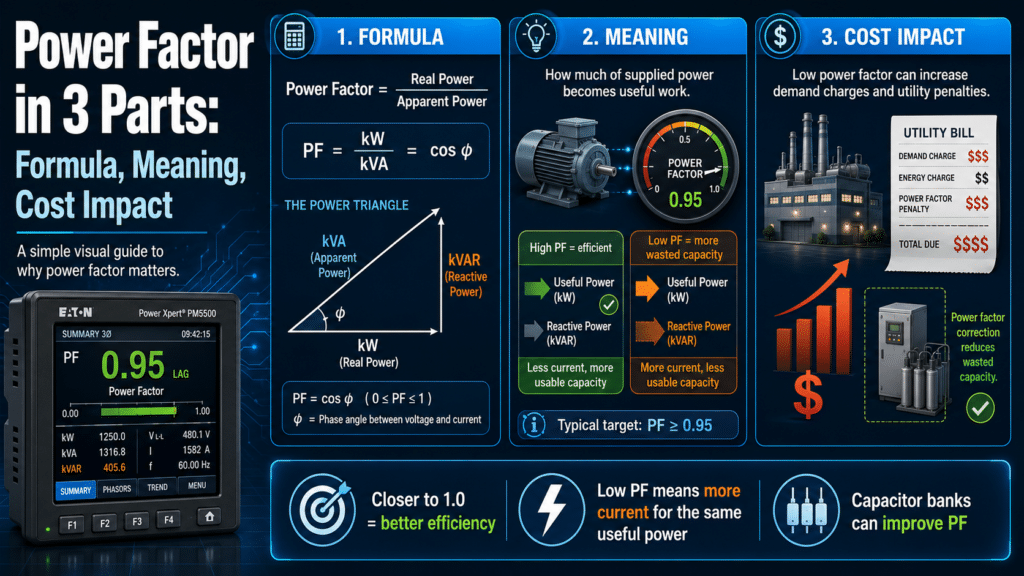
In AC power systems, power factor is defined as the ratio of real power to apparent power, usually written as PF = P/S (2025), where P is active power in watts and S is apparent power in volt-amperes. So What Is Power Factor? It’s a number between 0 and 1 that tells you how much of the electricity you draw actually does useful work. A PF of 1.0 means every amp pulls its weight; a PF of 0.7 means roughly a third of the current is wasted moving energy back and forth without doing a job.
This guide answers the questions people actually ask: What does the PF = P/S formula really measure? What do real, reactive, and apparent power each mean? And how does a poor power factor show up as extra cost on your electric bill, sometimes as a penalty charge from the utility?
Quick Takeaways
- Power factor = real power ÷ apparent power, always between 0 and 1.
- A PF of 1.0 is perfect; most industrial sites run 0.7–0.95.
- Reactive power (in VAR) does no work but still loads your wires.
- Many utilities bill penalties when PF drops below 0.90.
- Capacitor banks can lift PF and cut demand charges fast.
What Is Power Factor in Simple Terms?
Power factor is the ratio of real power (the energy that actually does work) to apparent power (the total energy your equipment pulls from the grid). It’s a dimensionless number between 0 and 1, with no SI unit. A value closer to 1 means your system wastes less electricity. So a 0.95 power factor is far better than 0.70.
Picture ordering a beer. The liquid you can drink is real power. The foam on top is wasted space, that’s reactive power. The full glass, beer plus foam, is apparent power. Power factor tells you how much of the glass is actual beer. Less foam, better deal.
What does power factor actually measure?
Power factor measures how efficiently an AC circuit turns supplied power into useful work. Real power is rated in kilowatts (kW). Apparent power is rated in kilovolt-amperes (kVA). In practice, engineers calculate PF as kW divided by kVA.
Why split the same electricity into two numbers? Because motors, transformers, and fluorescent ballasts pull extra current to build magnetic fields. That current never does work, but the utility still has to deliver it through wires and transformers.
What counts as good power factor?
A purely resistive load, like an electric heater, runs at unity power factor (1.0). All supplied power becomes heat. Add inductive equipment and the number drops. Most factories run between 0.70 and 0.85 before correction.
Utilities often want 0.90 or higher and penalize anything below.
- 0.95–1.0: Excellent — minimal wasted current, no penalty risk
- 0.85–0.95: Acceptable for most commercial sites
- Below 0.85: Likely surcharges and oversized wiring

What Is the Power Factor Formula and How Do You Calculate It?
The power factor formula is PF = kW ÷ kVA, or equivalently PF = cos(φ), where φ is the phase angle between voltage and current. Power factor is a dimensionless number between 0 and 1, and a value closer to 1 means your equipment turns more supplied power into useful work. To calculate it, divide real power (kW) by apparent power (kVA).
How Do You Calculate Power Factor in a Single-Phase Circuit?
For single-phase systems, multiply voltage by current to get apparent power in volt-amperes (VA), then divide real power by that figure. Say a small workshop runs at 230 V[1] and draws 20 A, giving 4,600 VA (4.6 kVA). If a wattmeter reads 3.68 kW of real power, then:
- Apparent power (S): 230 V × 20 A = 4,600 VA = 4.6 kVA
- Real power (P): 3,680 W = 3.68 kW[2] (measured)
- Power factor: 3.68 ÷ 4.6 = 0.80
That 0.80 also equals cos(φ). Work backward and the phase angle φ is 36.87°. According to Fluke’s power quality guidance, in sinusoidal AC circuits power factor always equals the cosine of this voltage-to-current phase angle.
How Does the Three-Phase Formula Differ?
Three-phase calculations add the factor 1.732 (the square root of 3). Apparent power becomes kVA = (√3 × V × I) ÷ 1,000 for line-to-line voltage. Take a 400 V, 50 A three-phase motor:
| Step | Calculation | Result |
|---|---|---|
| Apparent power (kVA) | 1.732 × 400 × 50 ÷ 1,000 | 34.64 kVA |
| Real power (kW) | 1.732 × 400 × 50 × 0.85 ÷ 1,000 | 29.44 kW |
| Power factor | 29.44 ÷ 34.64 | 0.85 |
Field tip: never measure current on just one phase and assume balance. Phase imbalance above approximately 5% skews your kVA reading and makes the calculated PF misleading. Clamp all three lines and average them before you plug numbers into the formula.

Real Power vs Apparent Power vs Reactive Power — What’s the Difference?
Real power (kW) does the actual work, reactive power (kVAR) sustains magnetic fields in motors and transformers, and apparent power (kVA) is the total the grid must deliver. They link through the power triangle: kVA² = kW² + kVAR². Understanding this trio is the core of What Is Power Factor?, because power factor equals kW divided by kVA.
Picture a glass of beer. The liquid is real power, what you pay for and actually drink. The foam is reactive power, it takes up space but does no useful work. The full glass, foam plus liquid, is apparent power. A high power factor means less foam.
What’s real power and why is it the only part that does work?
Real power, measured in kilowatts (kW), is the energy converted into motion, heat, or light. A 10 kW motor shaft turning a pump uses real power. Your utility meter records kWh, and this is the number tied directly to your energy bill.
What’s reactive power and which loads create it?
Reactive power, measured in kilovolt-amperes reactive (kVAR), builds the magnetic fields that inductive equipment needs to run. It bounces back and forth between source and load, doing zero net work, yet the grid still has to carry it. Loads that create reactive power include:
- Induction motors: the biggest source in factories, often pulling power factor down to 0.7–0.85 at partial load
- Transformers: draw magnetizing current even when lightly loaded
- Fluorescent and HID lighting ballasts: magnetic ballasts add lagging kVAR
- Welding machines and arc furnaces: highly variable reactive demand
How do the three types of power compare?
Each type has its own unit, role, and meter behavior. The table below separates them clearly.
| Type | Unit | What it does | Created by |
|---|---|---|---|
| Real power | kW | Performs useful work (torque, heat, light) | Resistive loads — heaters, incandescent lamps |
| Reactive power | kVAR | Sustains magnetic/electric fields, no net work | Inductive loads — motors, transformers, ballasts |
| Apparent power | kVA | Total power the grid must supply and size cables for | The vector sum of kW and kVAR |
Here is the practical lesson engineers learn fast: cables, breakers, and transformers must be sized for kVA, not kW. A facility drawing 800 kW[3] at 0.7 power factor needs 1,143 kVA of capacity, approximately 43% more equipment than the 800 kVA it would need at unity. That extra headroom is wasted on foam.

What Does 80% Power Factor Mean?
A power factor of 0.80 means approximately 80% of the supplied power does real work, while the other approximately 20% is reactive power that does no useful job. To deliver the same real load, the system must push 25% more current through the wires. That extra current is why utilities flag 0.80 as a warning line and start adding penalties below it.
Run the numbers. A facility needing 800 kW[4] of real power at 0.80 PF draws 1,000 kVA of apparent power (800 ÷ 0.80).
Fix the power factor to 0.95, and the same 800 kW needs only 842 kVA. That’s 158 kVA of capacity freed up, transformer headroom you no longer pay to reserve.
Why Does 80% Power Factor Require 25% More Current?
Current scales with apparent power, not real power. At 0.80 PF, apparent power is 1.25 times the real power, so amperage rises by the same 25%. Higher current means more heat in cables and transformers. Since power loss in a wire equals current squared times resistance (I²R), a 25% current jump raises line losses by roughly 56%.
This is the core of what’s power factor doing to your wiring: the same useful work, but fatter current and hotter conductors. Plant engineers often discover undersized cables and tripping breakers traced straight back to a sagging power factor.
Why Do Utilities Penalize Power Factor Below 0.90?
Utilities bill industrial and commercial sites partly on kVA demand, not just kWh. Low power factor forces them to build oversized transformers and feeders to carry reactive current that earns no energy revenue. Many tariffs impose penalties when average power factor falls below roughly 0.90,0.95, charging for the wasted capacity.
| Power Factor | kVA for 800 kW[5] load | Current vs unity |
|---|---|---|
| 1.00 | 800 kVA | baseline |
| 0.90 | 889 kVA | +11% |
| 0.80 | 1,000 kVA | +25% |
| 0.70 | 1,143 kVA | +43% |
Practical tip: if your monthly bill shows a “PF adjustment” or kVA demand charge, a meter reading near 0.80 is costing you in two ways, penalty fees plus wasted transformer capacity you can’t use for new equipment.

Leading vs Lagging Power Factor — Which Devices Cause Each?
Lagging power factor comes from inductive loads like motors and transformers, where current trails voltage; leading power factor comes from capacitive loads like capacitor banks, where current runs ahead of voltage. In a non-resistive AC circuit, the current waveform leads or lags the voltage, pushing the phase angle off zero and the power factor below 1.0. Knowing which type you’ve decides whether you add or remove capacitance.
What devices cause lagging power factor?
Inductive equipment causes lagging power factor, it stores energy in magnetic fields, so current arrives late behind voltage. These loads dominate most factories and commercial buildings.
- Induction motors: a lightly loaded motor can sag to 0.5–0.7 PF; at full load it climbs near 0.85.
- Transformers: magnetizing current keeps PF low even with little real load attached.
- Variable frequency drives (VFDs): the front-end rectifier draws non-sinusoidal current, hurting true power factor with harmonics.
- Fluorescent ballasts: older magnetic ballasts often run at 0.5 PF, a reason many sites switched to electronic versions.
What devices cause leading power factor?
Capacitive loads cause leading power factor, they store energy in electric fields, pulling current ahead of voltage. The classic example is a capacitor bank installed for correction.
- Capacitor banks: deliberately add capacitance to cancel motor lag.
- Lightly loaded long cables: cable capacitance dominates when little equipment is running, common during night shifts.
- Some LED drivers: certain switched-mode designs read slightly leading at low load.
Why does over-correction create a leading penalty too?
Add too much capacitance and you swing past unity into leading territory, and many utility tariffs penalize that just as hard as lagging. A bank sized for full production keeps running when motors shut off after hours, so PF overshoots to 0.85 leading. The fix: switched or automatic capacitor banks that drop steps as load falls, holding PF inside the 0.95,1.0 window utilities reward.
How Does Power Factor Appear on Your Utility Bill?
Power factor shows up on commercial bills in three places: a kVA demand charge, a measured PF percentage, and a power-factor penalty when your PF drops below a set threshold. Most utilities trigger the penalty when average PF falls below 0.90, because low power factor raises current and grid losses they must recover.
What are the exact line items to look for?
Scan your bill for these three entries. They tell you whether you’re paying for wasted reactive power.
- kVA demand charge: A monthly fee based on your peak apparent power in kilovolt-amperes, often $8–$20 per kVA. Since kVA = kW ÷ PF, a poor power factor inflates this number.
- Measured PF percentage: A reported figure like “PF: 0.82” averaged over the billing period. This is the same ratio explained in our power factor formula section.
- Power-factor penalty or surcharge: An extra charge that kicks in below the threshold, listed as “PF adjustment” or “low power factor surcharge.”
Do utilities bill on kVA or adjust the kW charge?
Two billing methods exist, and knowing yours decides your correction strategy.
| Method | How it charges | Best fix |
|---|---|---|
| kVA demand billing | Bills directly on peak kVA | Raise PF to shrink kVA |
| kW + PF adjustment | Adds a multiplier to kW when PF < target | Clear the threshold to drop the multiplier |
Pull three months of bills and find your average PF. If it sits below 0.90 under either method, you’re paying a penalty you can erase.
What Does Poor Power Factor Actually Cost? A Real Billing Case Study
A mid-size facility running at 0.75 power factor pays a real penalty. Take a plant drawing 300 kW of real power.
At 0.75 PF, its apparent power is 300 ÷ 0.75 = 400 kVA. Utilities bill on that 400 kVA, not the 300 kW doing work, so 100 kVA of capacity gets paid for while producing nothing useful.
Many tariffs charge a kVA demand fee on this inflated number. At a typical $12 per kVA demand rate, 400 kVA costs $4,800[7] per month. That same plant corrected to 0.95 PF needs only 316 kVA, dropping the bill to $3,792, a $1,008 monthly saving, or $12,096 a year.
Why does the extra current heat your cables?
Apparent power moves through wires as current. At 0.75 PF, the plant pulls roughly 26% more amps than it would at 0.95 for the same real work. Since cable heating rises with the square of current (I²R losses), that 26%[8] extra current means about 59% more heat wasted in your feeders. Utilities penalize low power factor partly because this increased current raises losses across the distribution network.
What does the before-and-after bill look like?
| Metric | At 0.75 PF | At 0.95 PF |
|---|---|---|
| Real power | 300 kW | 300 kW |
| Apparent power | 400 kVA | 316 kVA |
| kVA demand charge | $4,800/mo | $3,792[9]/mo |
| Annual cost | $57,600 | $45,504 |
That $12,096 yearly gap is pure physics turned into cash. Understanding what power factor is becomes a budget line, not a textbook idea.
How Do You Improve Power Factor and What’s the Payback?
You improve power factor by adding equipment that supplies reactive power locally, so the utility doesn’t have to. The three main tools are capacitor banks, synchronous condensers, and active harmonic filters. For most facilities, capacitor banks pay back in 6 to 24 months. Industry guidance recommends raising power factor to between 0.9 and 1.0 to cut kVA demand on the grid, per ABB power quality references.
Which Correction Method Fits Your Load?
Pick based on your loads and whether you’ve harmonics. Capacitor banks suit clean inductive loads. Synchronous condensers fit huge, swinging demands. Active filters are the only choice when variable-speed drives distort the waveform.
| Method | Cost range | Best use case | Harmonic handling | Typical payback |
|---|---|---|---|---|
| Capacitor bank | $30–$60 per kVAR | Steady motor and transformer loads | None (can worsen) | 6–24 months |
| Synchronous condenser | $200[10]+ per kVAR | Large, fluctuating industrial demand | Moderate | 3–7 years |
| Active harmonic filter | $150–$300 per kVAR | Drives, rectifiers, distorted current | Excellent | 2–5 years |
How Do You Size Correction Without Over-Correcting?
Size the kVAR needed to move from your present power factor to a target, usually 0.95, not 1.0. The formula: required kVAR = kW × (tan φ₁ − tan φ₂).
A 500 kW load going from 0.75 to 0.95 needs about 277 kVAR.
Stop at 0.95. Push past unity and you create a leading power factor, which trips utility penalties and can cause voltage rise that damages equipment. Use automatic switched banks that add capacitors in steps, so correction tracks load instead of dumping fixed kVAR onto a half-idle plant.
One warning: never bolt plain capacitors onto a line full of harmonics. They form a resonant circuit that amplifies distortion and burns out. That’s where an active harmonic filter earns its higher price.
Frequently Asked Questions About Power Factor
Power factor answers in short: it has no unit, a “good” value sits at 0.95 or higher, it cannot exceed 1.0, most homes never see it on a bill, and it isn’t the same as efficiency. Below, each question gets a precise answer you can act on.
Is power factor measured in any unit?
No. Power factor is a dimensionless number between 0 and 1. Real power uses kilowatts (kW) and apparent power uses kilovolt-amperes (kVA), but when you divide kW by kVA, the units cancel. So you write 0.92 or 92%, never “0.92 watts.”
What’s a good power factor?
A good power factor is 0.95 or above. Most industrial tariffs set the penalty threshold at 0.90 to 0.95.
Below that line, utilities add a surcharge. At unity (1.0), every volt-ampere supplied does real work, the ideal you correct toward but rarely hit in a motor-heavy plant.
Can power factor exceed 1?
No. By definition, real power can never be larger than apparent power, so the ratio caps at 1.0. If your meter reads above 1, the instrument is faulty or wired wrong. A reading of “1.05” is physically impossible and signals a metering error worth flagging.
Does power factor affect residential bills?
Rarely. Home meters bill on kWh (real energy) only, so a poor power factor costs you nothing directly. Utilities reserve power factor penalties for commercial and industrial customers with kVA demand charges. Your air conditioner draws reactive power, but the grid absorbs it without charging you.
What’s the difference between power factor and efficiency?
Efficiency measures output power versus input power, how much energy a device wastes as heat. Power factor measures how much of the supplied current does useful work versus circulating uselessly. A 95%-efficient motor can still run at 0.75 power factor. They’re separate numbers, often confused, never interchangeable.
Key Takeaways and Next Steps for Lowering Your Power Bill
Power factor is the ratio of real power (kW) to apparent power (kVA), expressed as PF = P/S, a dimensionless number between 0 and 1. A value below 0.95 usually triggers a utility penalty. To cut your bill, pull last month’s invoice, find the PF line, and price a capacitor bank against the surcharge it erases.
Here is the whole topic in one breath. The formula gives you a number. That number tells you how much of your supplied power does real work. The gap between the number and 1.0 costs you money through demand charges and direct penalties.
What should you remember about each part?
Three ideas carry the rest. First, the math: divide working power by total power. Second, the meaning: a PF of 0.80 wastes a fifth of your supplied capacity on reactive current that spins meters but turns no shafts. Third, the cost: utilities bill for that waste because low PF forces more current through their wires, raising losses across the distribution network.
One thing to know that most guides skip, your billed PF is an average, not a snapshot. A facility that runs clean all day but trips a big motor at startup can still record a poor monthly average. Check whether your tariff uses peak-interval PF or monthly average; the fix changes accordingly.
What’s your action checklist this week?
Skip the theory and run these steps in order:
- Pull your last bill: Find the kVA demand and the measured PF percentage, usually printed near the demand charge line.
- Calculate the gap: If PF reads 0.82 and your tariff wants 0.95, you’re paying for the difference in kVA. Multiply your kW load by (1/0.82 − 1/0.95) to size the missing reactive power in kVAR.
- Estimate the penalty: Sum any explicit PF surcharge plus the inflated kVA demand charge over 12 months. This is your annual loss.
- Request a correction quote: Send the kW, current PF, and target PF to a licensed electrical contractor. Ask for a capacitor bank or active filter spec with installed cost and projected kVAR.
- Confirm payback: Divide installed cost by annual savings. A figure under two years means do it now.
What mistake should you avoid before installing?
Don’t order capacitors before checking for harmonics. If your plant runs variable-frequency drives or LED banks, plain capacitors can resonate and overheat, blowing fuses within months. In those cases you need detuned capacitor banks or active filters instead, since true power factor (including harmonic currents) differs from the simple displacement power factor on your bill.
Understanding what power factor is gives you use in the quote conversation. Ask the contractor whether the correction targets displacement PF or true PF, the answer reveals whether they actually walked your load profile or just read the meter.
Start with the bill today. The number is already printed. Your savings are sitting in the gap between it and 0.95.
Power Quality Monitoring
Track Power Factor and Electrical Load with SENTOP Digital Panel Meters
Understanding power factor is useful, but real savings start with measurement. SENTOP supplies digital panel meters and multi-function power meters for monitoring voltage, current, power, and load conditions in industrial panels and distribution systems.
- ✓Power, voltage and current monitoring
- ✓Single-phase and three-phase meter options
- ✓Useful for distribution panels and control cabinets
- ✓Factory supply for OEM projects and distributors
Monitor electrical load and power quality
Reference Sources
- [1]en.wikipedia.org — supports: In AC power systems, power factor is defined as the ratio of real power to apparent powe…
- [2]fluke.com — supports: In AC power systems, power factor is defined as the ratio of real power to apparent powe…
- [3]keysight.com — supports: In AC power systems, power factor is defined as the ratio of real power to apparent powe…
- [4]byjus.com — supports: Power factor in sinusoidal AC circuits is equal to the cosine of the phase angle φ betwe…
- [5]testbook.com — supports: Power factor is a dimensionless number between 0 and 1 in magnitude, where values closer…
- [6]vfds.com — supports: Power factor is a dimensionless number between 0 and 1 in magnitude, where values closer…
- [7]pqcomponents.com — supports: Real (active) power associated with power factor is measured in kilowatts (kW), while ap…
- [8]woodstockpower.com — supports: Real (active) power associated with power factor is measured in kilowatts (kW), while ap…
- [9]abb.com — supports: In many industrial and commercial tariffs, utilities may impose additional charges or pe…
- [10]laurenselectric.com — supports: In many industrial and commercial tariffs, utilities may impose additional charges or pe…

Discover more from SENTOP Electrical Co., Ltd
Subscribe to get the latest posts sent to your email.