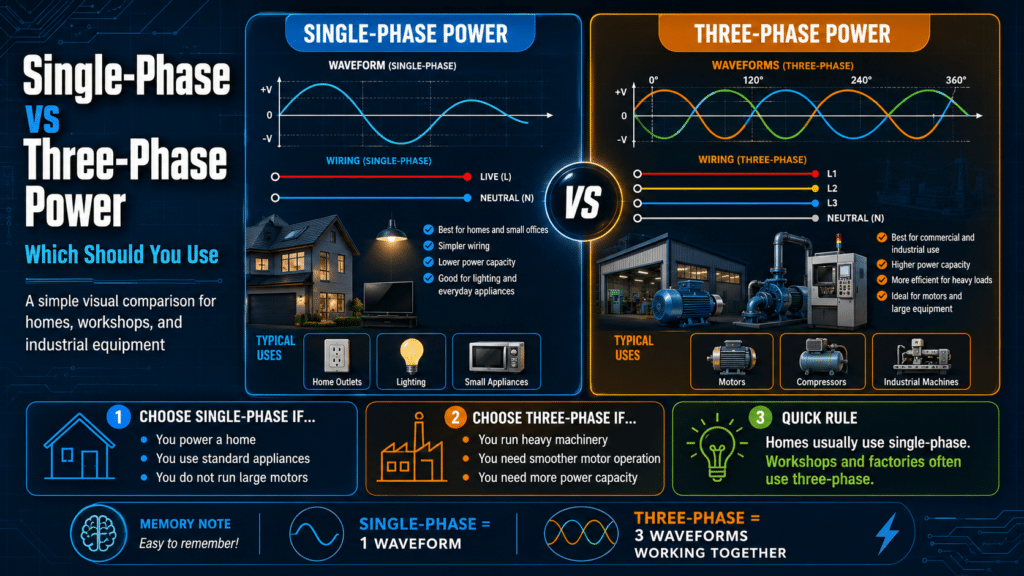
The main difference in Single-Phase vs Three-Phase Power is that single-phase uses 2 wires and suits homes and lighter loads under roughly 7.5 kW[1], while three-phase uses 3 or 4 wires and powers motors, large HVAC systems, and heavy equipment. In North America, single-phase residential service delivers 120/240 V at 60 Hz, whereas three-phase supplies 120/208 V or 277/480 V. Three-phase also delivers constant power and cuts copper wire needs by about 25% for the same load.
What kinds of loads genuinely need three-phase power? Which one is cheaper to install and to run over time? And how do you go about deciding which one is the right fit for your building?
Quick Takeaways
- Choose single-phase for homes and loads under roughly 7.5 kW.
- Switch to three-phase for motors, HVAC, and shop equipment above 7.5 kW.
- Three-phase moves triple the power using just one extra wire.
- Let actual motor work, not total wattage, drive your decision.
- Three-phase motors run smaller, cooler, more efficient, and vibrate less.
Single-Phase vs Three-Phase Power Which Should You Use
Use single-phase power for homes and lighter loads that sit under about 7.5 kW. Then switch over to three-phase once you are dealing with motors, heating and cooling systems, and shop equipment above that point. Three-phase moves roughly three times more power with just one extra wire (2024), so the heavy loads end up running cheaper, cooler, and a lot smoother on it.
Need the fast answer? Here it is. If your biggest load happens to be lighting, outlets, a 240 V dryer, and a central AC, then you should stay single-phase. If you are running a 5-horsepower motor, a CNC machine, or a commercial compressor, you really want three-phase. The dividing line is actual motor work, not the total wattage all by itself.
What tips the decision toward three-phase?
The motors are what decide it. A three-phase motor of the same rating turns out smaller, more efficient, and it vibrates less because its electromagnetic torque never drops to zero (2024). Single-phase motors pulse instead, which means more heat and shorter bearing life when you put them on big loads.
Here is a quick way to read your own situation:
| Your load | Best fit | Why |
|---|---|---|
| Home, outlets, dryer, AC | Single-phase | Loads stay under about 7.5 kW |
| 3–10 hp motors, compressors | Three-phase | Smoother torque, with less heat |
| Data center, large HVAC | Three-phase | Constant power flow, smaller cable |
One pro tip worth keeping in mind. Do not buy a phase converter just to dodge a real three-phase service if you are planning to grow. Rotary converters lose around 5 to approximately 10% efficiency and they derate your motors. When you are deciding Single-Phase vs Three-Phase Power, weigh out your next five years of equipment, not only today’s panel. The next sections break down voltage, wiring, and conversion cost in more detail.
What Is Single-Phase Power And Where Is It Used
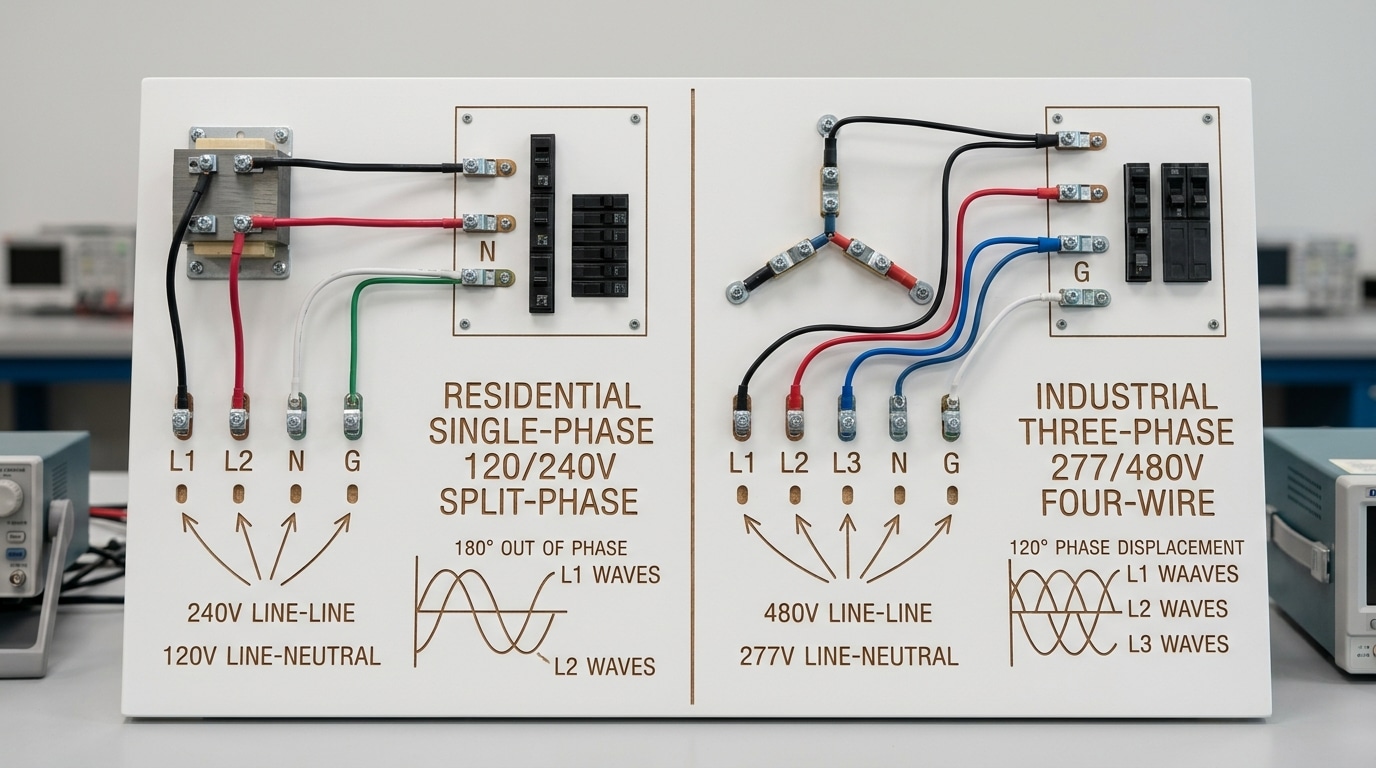
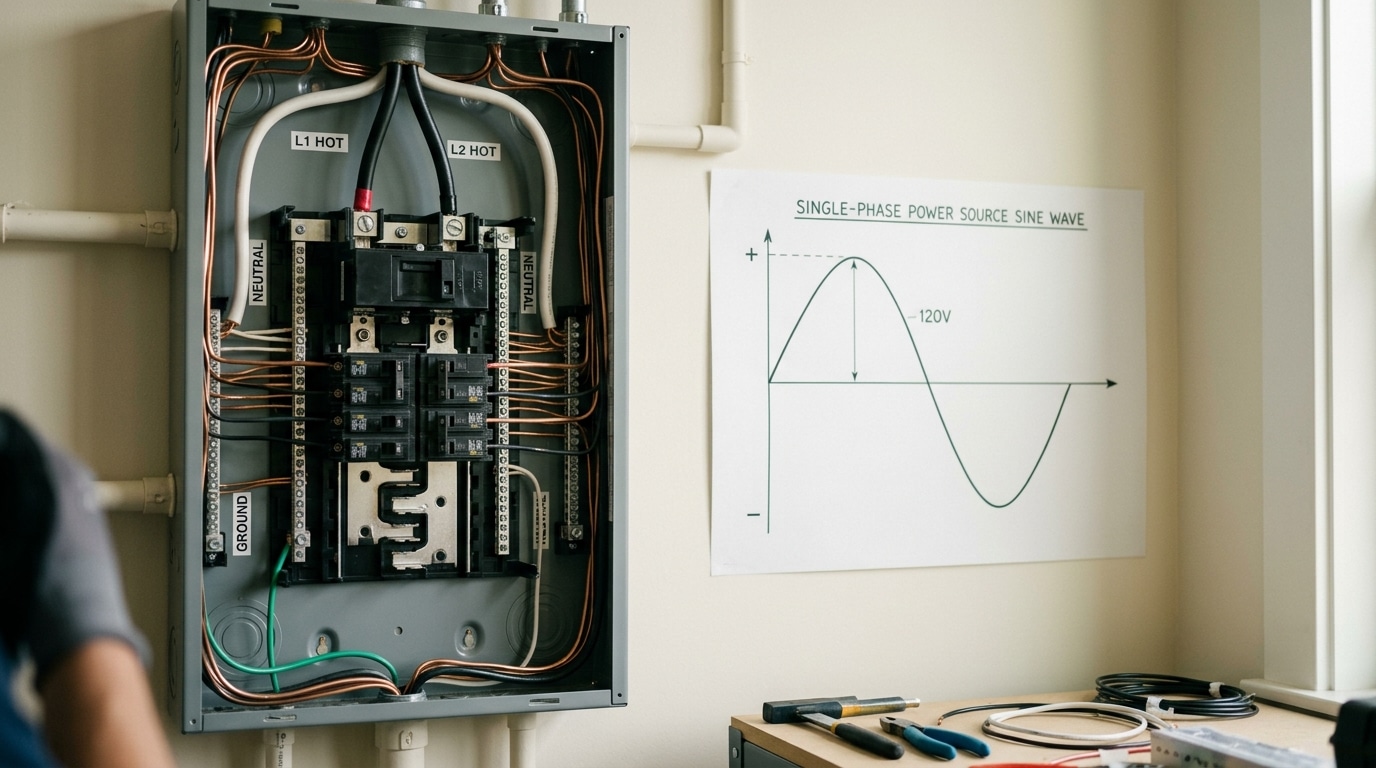
Single-phase power delivers electricity through one alternating voltage waveform that rises and falls 60 times per second in North America (50 times in Europe). In the single-phase vs three-phase power comparison, single-phase serves homes and light loads under about 7.5 kW. It uses two wires,one hot, one neutral,which makes wiring cheap and simple.
The waveform matters. With one sine wave, power drops to zero twice per cycle. That causes more vibration in motors, which is why single-phase struggles with heavy machinery. For a toaster or a lamp, nobody notices.
How Does US Split-Phase Differ From European Single-Phase?
US homes use split-phase service, not true single-phase. A center-tapped transformer splits one phase into two 120 V legs. Standard receptacle circuits run at 120 V line-to-neutral, while combining both legs gives 240 V line-to-line for big appliances.
Europe, India, and Australia skip the split. They run a flat 230 V single-phase connection on 50 Hz systems. One hot, one neutral, 230 V,done. This is why a US hair dryer pulls double the current of a European one at the same wattage. Higher voltage means lower current for the same power.
What Loads Does Single-Phase Power Serve Well?
Single-phase handles every common household and small-business load:
- 120 V[3] branch circuits: lighting, wall outlets, TVs, phone chargers—loads under 1.8 kW per 15 A circuit.
- 240 V split-phase circuits: electric ranges, clothes dryers, central air conditioners, electric water heaters—pulling 30 to 50 A.
- Small motors and tools: garage compressors, well pumps, and bench grinders up to about 5 kW.
The practical ceiling sits near 7.5 kW. Push past it and starting currents on single-phase motors get ugly,voltage sags, lights flicker, and breakers trip. That’s the signal to upgrade.
What Is Three-Phase Power And What Loads Need It
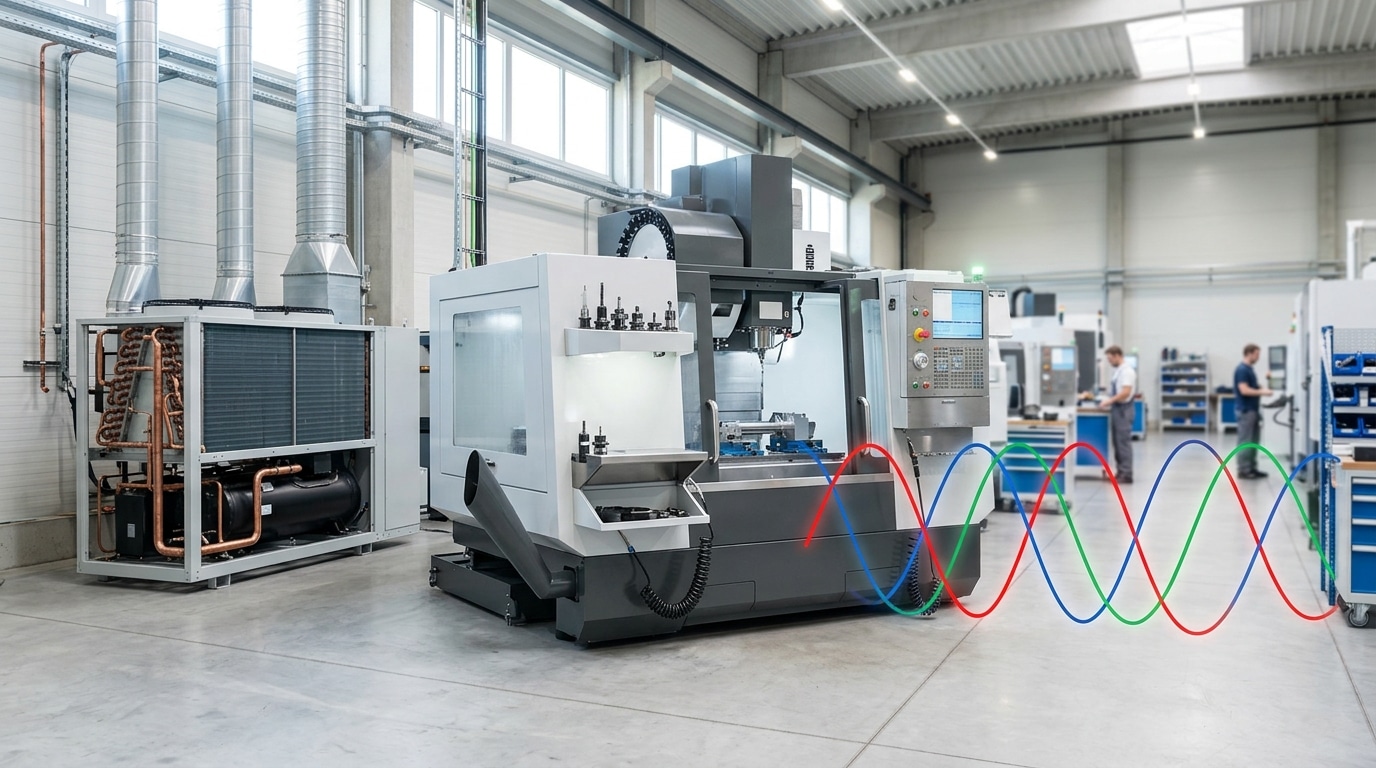
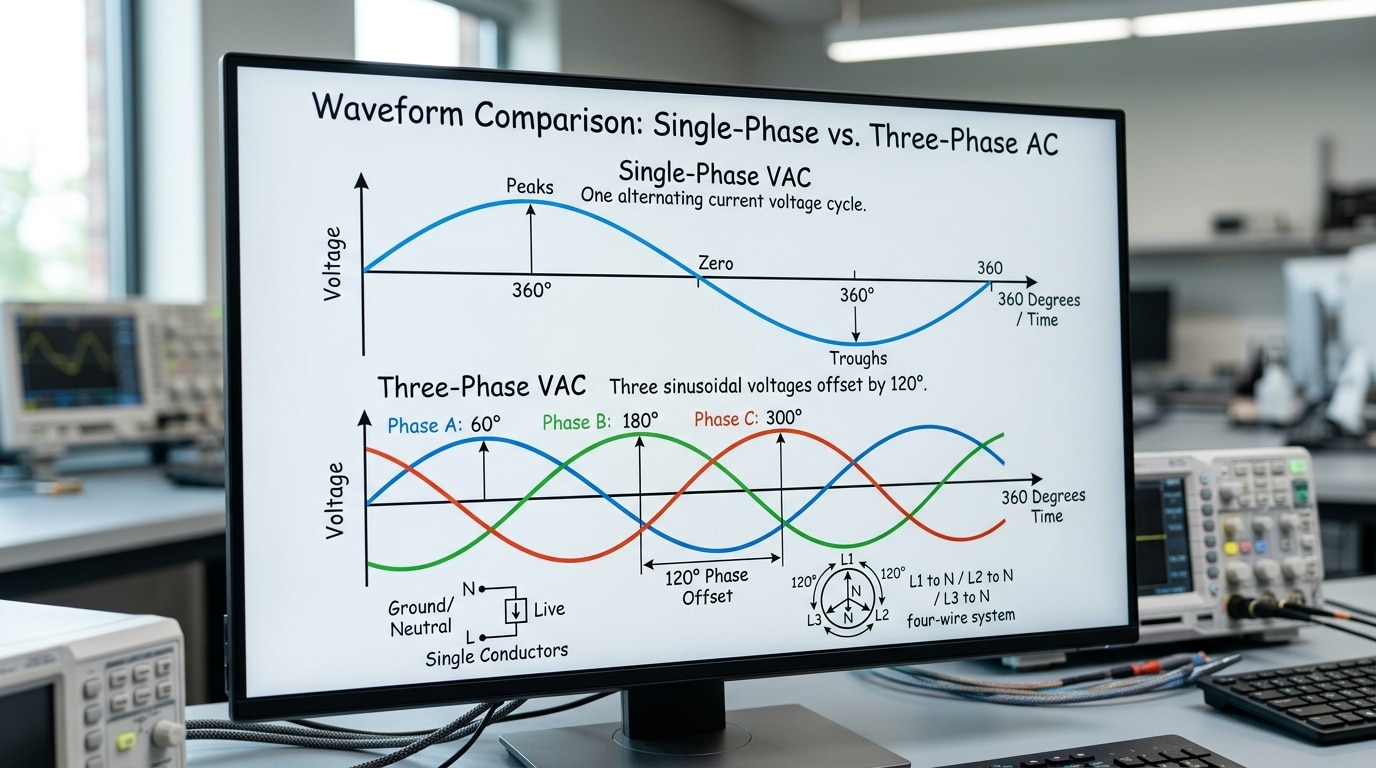
Three-phase power sends electricity along three separate alternating voltage waves, and each one is shifted from the others by 120 electrical degrees. Since the three waves reach their high points at different times, the total output they create together stays almost steady rather than rising and falling. This is the heart of any Single-Phase vs Three-Phase Power comparison. In a balanced three-phase system, the total amount of power being delivered never falls all the way to zero, while single-phase power drops to zero twice during every cycle, according to Fluke’s measurement guide.
So why does that smooth delivery actually matter? Motors are the equipment that benefits most. A three-phase motor creates a steady twisting force because the magnetic field inside it rotates evenly, which means it runs with less shaking and stays cooler while it works. Per Wikipedia’s three-phase electric power overview, three-phase motors with the same power rating are usually smaller and waste less energy than their single-phase counterparts.
Which Loads Actually Require Three-Phase Power?
Pretty much any motor larger than around 5 HP, along with any equipment that needs a constant twisting force to do its job, belongs on three-phase power. A single-phase motor of that size has a hard time getting moving when it is already carrying a load, and it burns through extra energy doing so. The most obvious candidates are these:
- CNC machines: the spindle motors need a vibration-free twisting force so they can hold very tight measurements, meaning within about plus or minus 0.01 mm on metal parts.
- Large HVAC compressors: rooftop units rated above 10 tons rely on three-phase power so they can manage the heavy surge of current at startup without dimming the lights in the building.
- Elevators: the traction motors that pull the cabs need a smooth twisting force so the car speeds up safely without sudden jerks.
- EV fast chargers: the direct current units rated at 50 kW and higher draw their power from a 480 V three-phase supply.
- Industrial pumps and conveyors: motors built to run continuously and rated above 5 HP only work efficiently when fed by three phases.
Here is a practical tip worth keeping in mind. You should never call for a single-phase motor above 7.5 HP if three-phase power is an option on site. The starting capacitors on those motors fail fairly often, and paying for replacements again and again over the life of the motor ends up costing more than simply upgrading the electrical panel would have. Data centers also choose three-phase service by default because it feeds their tightly packed racks of servers. The math behind voltage and efficiency comes up next.
How Do Single-Phase And Three-Phase Differ In Voltage Current And Efficiency
Single-Phase vs Three-Phase Power differ in three ways you can actually measure: the voltage levels, the current carried in each conductor, and how efficiently the copper is used. Three-phase carries roughly three times the power that single-phase does, and it manages this with just one additional wire, according to Fluke’s 2024 analysis. What that translates to is about 25 to approximately 30% less copper needed for the same load, which is a direct reduction in your wiring cost.
What Voltage Levels Does Each System Use?
The voltages tend to split along regional lines. In North America, single-phase homes are supplied with 120 V[4] line-to-neutral and 240 V line-to-line at 60 Hz, while three-phase services run at either 120/208 V or 277/480 V, according to Wikipedia’s 2025 mains data. Europe, India, and Australia, by contrast, use 230 V for single-phase and 400 V for three-phase, all at 50 Hz.
| Region / System | Single-Phase | Three-Phase | Frequency |
|---|---|---|---|
| North America (residential) | 120 V / 240 V | 120/208 V | 60 Hz[5] |
| North America (commercial) | 277 V | 277/480 V | 60 Hz |
| Europe / India / Australia | 230 V | 400 V | 50 Hz |
Why Does The √3 Factor Matter?
The √3 factor, which works out to about 1.732, is what links the phase-to-neutral voltage with the phase-to-phase voltage. So a value of 120 V to neutral becomes roughly 208 V when measured between phases. This same factor shows up in the power formula itself: P = √3 × V × I × power factor. And because three live wires are sharing the load between them, each one carries less current.
Lower current means you can use thinner conductors and you get a smaller voltage drop over long distances, which is really the reason factories choose three-phase for motors rated above 7.5 kW.
How Do You Know If You Have Single-Phase Or Three-Phase Power
Count the conductors entering your panel. Two or three incoming wires (plus ground) means single-phase; four wires, three “hots” plus a neutral, means three-phase. You can confirm by measuring voltage between legs: in North America, single-phase service reads 120 V line-to-neutral and 240 V line-to-line, while three-phase reads 208 V or 480 V[6] between any two legs.
Don’t trust the conductor count alone. A meter check seals it. Set your multimeter to AC volts and probe between the main breaker terminals.
What Do US Panels Show For Each System?
US single-phase service uses split-phase wiring: two 120 V hot legs and one neutral. Measure leg-to-leg and you get 240 V; leg-to-neutral gives 120 V. Your main breaker is a two-pole double-wide switch.
- Single-phase signature: two-pole main breaker, two hot bus bars, 120/240 V split-phase, three service conductors.
- Three-phase signature: three-pole main breaker, three hot bus bars, 120/208 V or 277/480 V, four service conductors.
The meter label helps too. Utility meters stamped “3Ø” or “120/208” confirm three-phase. A form 2S meter is single-phase; a form 9S or 16S meter is three-phase. The U.S. National Electrical Code (NFPA 70) requires this labeling on the equipment.
What Do EU Panels Show For Each System?
EU single-phase connections supply 230 V line-to-neutral at 50 Hz, while three-phase reads 400 V between phases. The simplest tell: count the main breaker poles. A single-pole or two-pole isolator means single-phase; a four-pole isolator means three-phase.
European panels label phases L1, L2, L3, plus N (neutral) and PE (protective earth). Spot three brown/black/grey conductors feeding the busbar and you’ve three-phase. Knowing the difference between Single-Phase vs Three-Phase Power at your panel decides which equipment you can legally connect, a critical step before any upgrade quote.
One pitfall: a home may have three-phase at the meter but only single-phase wired to some circuits. Always verify at the actual outlet, not just the main board.
Single-Phase Vs Three-Phase Which Should You Choose For Your Load
Pick single-phase for total loads under 7.5 kW with no motor over 3 horsepower. Choose three-phase the moment any single motor exceeds 5 horsepower or your total demand passes about 15 kW[7]. Three-phase motors of the same rating run smaller, cooler, and more efficiently, with smoother torque that never drops to zero. That difference decides most borderline cases.
What does the if-X-then-Y decision matrix look like?
Match your dominant load to the right service. Read the table top to bottom and stop at your worst-case load, the biggest motor or the highest total kW wins.
| If your load is… | Total demand | Largest motor | Then use |
|---|---|---|---|
| Home, office, small retail | Under 7.5 kW | Under 2 HP | Single-phase |
| Workshop, light machinery | 7.5–15 kW | 2–5 HP | Gray zone |
| HVAC, compressors, CNC | 15–50 kW | Over 5 HP | Three-phase |
| Industrial, data center | Over 50 kW | Any large motor | Three-phase |
What tips the choice in the gray zone?
Between 7.5 and 15 kW, either service can technically work, so three factors break the tie. First, motor starting current: single-phase motors above 5 HP draw heavy inrush that dims lights and trips breakers, while three-phase motors start gently. Second, future expansion. If you might add equipment within five years, three-phase saves a costly second upgrade.
Third, utility cost. Some power companies charge demand penalties on large single-phase loads to protect grid balance.
A practical rule: count your motor horsepower. Three or more motors, or any one over 5 HP, and the single-phase vs three-phase power question answers itself, go three-phase. The smaller motors and lower wire amperage usually offset the higher panel cost within a few years of energy savings.
What Does It Cost To Convert Single-Phase To Three-Phase
Converting single-phase to three-phase costs between $400 for a small rotary phase converter and $30,000+ for a new utility three-phase service drop. Most small shops spend approximately $1,500,$3,000 on a converter that runs a single 5-horsepower machine. The right choice depends on how many three-phase motors you run and how long they run each day.
The cheapest path is a phase converter, a device that fakes a third leg of power from your existing single-phase supply. You skip the utility entirely.
How Much Do Phase Converters And Transformers Cost?
Rotary phase converters cost the least upfront for real motor loads. Digital and VFD units cost more but run cleaner. Step-up transformers only raise voltage, they can’t create a missing phase, so they pair with another converter.
| Method | Typical Price | Best For | Catch |
|---|---|---|---|
| Rotary phase converter | $400–$2,500 | Multiple motors, hard starts | ~3% standby power waste |
| Digital/VFD converter | $300–$1,800 | One motor, speed control | One machine per unit |
| Step-up transformer | $200–$1,200 | Raising 208V to 480V | Adds no phase |
| Utility three-phase service | $2,000[8]–approximately $30,000+ | Heavy daily production | Trenching, permits, delay |
When Does Utility Service Pay Back?
Utility three-phase pays back fastest when you run motors many hours daily. A three-phase motor of the same rating is smaller, more efficient, and runs smoother than a single-phase one. A shop drawing 15 kW for 8 hours daily saves roughly 5% in motor energy versus phase-converted power, meaningful at industrial rates near $0.12/kWh, per U.S. EIA data.
The Single-Phase vs Three-Phase Power math is simple: light intermittent use favors a $1,000 converter; full-time production favors paying the utility once.
What Power Quality Problems Are Unique To Each System
Three-phase systems suffer most from phase imbalance and neutral overload, while single-phase service mainly battles voltage flicker and motor-starting sag. Both share one modern enemy: harmonics from variable frequency drives (VFDs). In a balanced three-phase system, the three voltages sit 120 electrical degrees apart, so any uneven load between phases breaks that balance and overloads the neutral wire.
Why Does Phase Imbalance Hurt Three-Phase Users Most?
Phase imbalance means one or two of the three legs carry more current than the others. A 2% voltage imbalance can raise a motor’s operating temperature enough to cut its lifespan by 25% or more, because the motor windings overheat. The fix is simple but often ignored: spread single-phase loads evenly across all three phases. Check this with a clamp meter on each leg during peak hours.
Neutral overload is the sneaky one. When non-linear loads like LED drivers and computers run on three-phase four-wire systems, third-harmonic currents add up in the shared neutral instead of canceling out. The neutral can carry more current than the phase wires. Specify a neutral conductor sized at 200% of the phase conductor for heavy electronic loads, many older installs used 100% and now run hot.
What Power Quality Faults Plague Single-Phase Setups?
Voltage flicker and motor-starting sag dominate single-phase. When a single-phase motor starts, it pulls 5 to 7 times its running current for a second or two. On a weak service this drops voltage enough to dim lights and reset electronics. This is exactly why the Single-Phase vs Three-Phase Power debate tilts toward three-phase for big motors, three-phase starts smoother because torque never drops to zero.
| Problem | Affects | Main Cause | Mitigation |
|---|---|---|---|
| Phase imbalance | Three-phase | Uneven leg loading | Redistribute loads across phases |
| Neutral overload | Three-phase, 4-wire | Third-harmonic addition | Oversize neutral to 200% |
| Motor-starting sag | Single-phase | 5-7x inrush current | Soft starter or capacitor start |
| Voltage flicker | Single-phase | Sudden load swings | Dedicated branch circuit |
| Harmonics | Both | VFDs and converters | Line reactors, harmonic filters |
How Do VFD Harmonics Affect Both Systems?
VFDs and rectifiers chop the smooth sine wave into pieces, creating harmonic distortion that flows back into the supply. The 5th and 7th harmonics are the usual culprits. The IEEE 519 standard recommends keeping total harmonic distortion below 5%[9] at the point of common coupling for most installations.
Harmonics waste energy as heat and can trip breakers on phantom currents. Install a 3% or 5% line reactor ahead of each VFD, this cheap coil smooths the current draw. For data centers running many converters, an active harmonic filter handles the load that simple reactors can’t.
Match the cure to the patient. Homes need surge protection and clean motor circuits. Factories need balanced phases and harmonic filters. Skip the generic UPS pitch, size protection to the actual fault your system faces.
Common Mistakes When Specifying Or Upgrading Power Service
The costliest power-service mistakes come from oversizing three-phase service you never load, running large motors without soft-start, ignoring open-delta capacity limits, and treating a phase converter as equal to utility three-phase. Each one wastes money or trips equipment. A three-phase system can move about three times the power of a single-phase system with just one extra conductor, per Fluke, but only if you actually load all three phases.
Why does oversizing three-phase service waste money?
Buying 200 A of three-phase service for a 40 A actual load means you pay demand charges and panel costs for capacity you never touch. Utilities bill three-phase commercial accounts partly on contracted demand. Size to your real connected load plus 25% growth headroom, not a round number that “feels safe.”
What happens when you start big motors on single-phase?
A motor over 3 horsepower drawing locked-rotor current can pull 6,8 times its running amps at startup. On single-phase service, that inrush sags voltage, dims lights, and trips breakers. Skip the bare across-the-line start. Add a soft-starter or variable frequency drive (VFD), which ramps voltage up over 5,10 seconds and cuts inrush by half or more.
Why are open-delta systems and phase converters not true three-phase?
An open-delta connection uses two transformers instead of three to make three-phase power. It works, but it caps usable capacity at roughly 57.7% of a full closed-delta bank, so a “150 kVA” open-delta setup safely carries about 86 kVA of balanced load.
Phase converters carry a different trap. A rotary or static converter generates a “manufactured” leg that’s electrically rougher than utility power. The voltage on that third leg can drift 5,10% off balance under load, which shortens motor life and confuses sensitive electronics. For CNC machines, servo drives, or any control with phase-monitoring relays, a converter often fails inspection. Treat the choice between Single-Phase vs Three-Phase Power as a load study, not a guess, get a clamp meter reading on each phase before signing off. Verify your panel against the NFPA 70 (National Electrical Code) sizing tables for the final spec.
Frequently Asked Questions
Short answers to the questions people ask most about the difference between single-phase and three-phase power. Each one targets a specific situation, from why your house came with two wires to what “two-phase” even means.
Why don’t most homes use three-phase power?
Homes don’t use three-phase power because residential loads almost never need it. A typical house draws under 7.5 kW for lights, outlets, and appliances, and that runs fine on single-phase service. In North American homes, most receptacle circuits are 120 V single-phase, while ranges and dryers use 240 V split-phase, per standard residential wiring practice.
Utilities also save money. Running one fewer conductor to millions of homes cuts copper and pole costs. Three-phase is reserved for streets feeding factories or large commercial buildings.
How much more does three-phase electricity cost than single-phase?
The electricity itself costs the same per kilowatt-hour. You pay for energy used, not the number of phases. The cost difference comes from infrastructure and demand charges.
Three-phase commercial accounts often carry monthly demand charges based on peak kW pulled, which single-phase residential plans usually skip. Installing a three-phase service drop where none exists can run several thousand dollars in utility transformer and meter work alone.
Does a house benefit from three-phase power?
Most houses gain nothing from three-phase. The exception is a home with heavy continuous loads: a workshop with large machine tools, a 7.5 kW+ electric vehicle charger bank, multiple HVAC compressors, or a pool with big pumps.
Three-phase motors at the same rating run smoother and more efficiently than single-phase ones, because their torque never drops to zero, a documented advantage of balanced three-phase systems. If you don’t own such equipment, the upgrade is wasted money.
How does two-phase differ from three-phase power?
Two-phase power uses two voltage waveforms offset by 90 degrees, while three-phase uses three offset by 120 degrees. Two-phase was an early 1890s grid design and is now obsolete, replaced almost everywhere by three-phase.
Don’t confuse it with the 240 V “split-phase” service in U.S. homes. Split-phase is single-phase power split into two 120 V[10] halves, not true two-phase.
| System | Phase offset | Status today |
|---|---|---|
| Single-phase | One waveform | Standard for homes |
| Split-phase (240 V) | Two 120 V halves | Standard for U.S. dryers, ranges |
| Two-phase | 90 degrees | Obsolete since early 1900s |
| Three-phase | 120 degrees | Standard for industry |
Choosing The Right Power Service For Your Situation
Match your power service to your largest motor and your total connected load, not to future “what ifs.” Homeowners stay single-phase. Small shops decide at the 7.5 kW line. Industrial sites with motors above 10 horsepower need three-phase. The deciding factor between Single-Phase vs Three-Phase Power is almost never the building type, it’s the motor.
What Should A Homeowner Do?
Keep your existing single-phase service. Standard U.S. homes run 120/240 V split-phase, which handles ranges, dryers, and central air on 240 V circuits without any upgrade, per Wikipedia’s residential wiring data (2025). The only common trigger for more capacity is an EV charger plus a heat pump. Even then, you usually upsize the single-phase panel from 100 A to 200 A, not switch phases.
What About A Small Shop Or Workshop?
Run the numbers on your biggest machine. A single 5 HP compressor or CNC spindle can justify three-phase, because three-phase motors of the same rating run smaller, cooler, and with smoother torque. If you’ve just one such machine, a rotary phase converter (a spinning motor that fakes a third phase) often beats a utility upgrade. Three or more three-phase machines? Call the utility.
Industrial Facility Action Checklist
- Load audit: Sum every motor in kW, then add 25% headroom — not 100%.
- Voltage choice: Pick 480 V three-phase over 208 V for loads above 100 kW to cut conductor cost.
- Utility timeline: New three-phase service drops can take 8 to 16 weeks — file early.
- Power quality plan: Specify balanced phase loading from day one to avoid neutral overload.
Before any change, get two confirmations. First, a licensed electrician validates panel capacity and code compliance. Second, your utility confirms three-phase is even available at your street, many residential blocks only carry single-phase on the pole. Skip these calls, and you risk paying for transformers the utility won’t energize.
Single-Phase & Three-Phase Monitoring
Monitor Single-Phase and Three-Phase Power with SENTOP Panel Meters
Whether your project uses single-phase or three-phase power, reliable measurement helps protect equipment and improve panel visibility. SENTOP supplies digital panel meters for voltage, current, and multi-function power monitoring in distribution and control systems.
- ✓Single-phase voltage and current meters
- ✓Three-phase digital ammeter and voltmeter options
- ✓Power monitoring for panels, machinery and generators
- ✓Wholesale supply for electrical distributors
Select meters for single-phase or three-phase panels
Reference Sources
- [1]en.wikipedia.org — supports: In North America, typical single‑phase residential service supplies 120 V line‑to‑neutra…
- [2]fluke.com — supports: A three‑phase power system can transmit about three times as much power as a single‑phas…
- [3]eaton.com — supports: Single‑phase power commonly uses two conductors (one active or ‘hot’ and one neutral), w…
- [4]wikipedia.org — supports: Reference‑level overviews of single‑phase, three‑phase, and electric power distribution …
- [5]chintglobal.com — supports: Industry explanations comparing residential single‑phase and industrial three‑phase appl…
- [6]uti.edu — supports: Educational content on practical differences and use cases of single‑phase vs three‑phas…
- [7]fluke.com/en-us/learn/blog/power-quality/single-phase-vs-three-phase-power — supports: Sonar real-time citation (HEAD-verified)
- [8]uti.edu/blog/electrical/single-vs-three-phase-power — supports: Sonar real-time citation (HEAD-verified)
- [9]otterbine.com/resource-center/articles-and-press/single-phase-vs-three-phase-… — supports: Sonar real-time citation (HEAD-verified)
- [10]chintglobal.com/global/en/about-us/news-center/blog/single-phase-vs-three-pha… — supports: Sonar real-time citation (HEAD-verified)

Discover more from SENTOP Electrical Co., Ltd
Subscribe to get the latest posts sent to your email.