
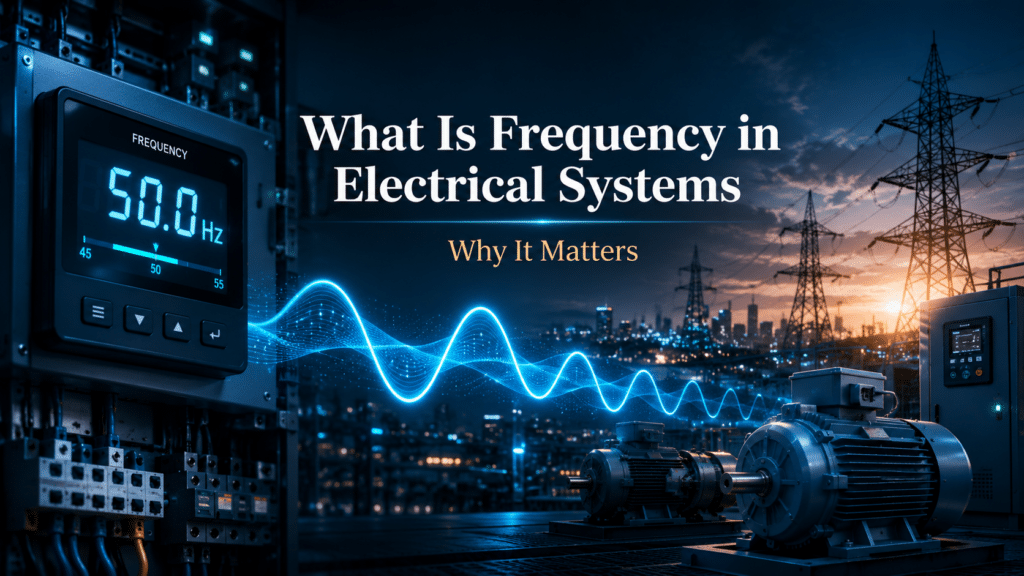
Frequency in electrical systems is the number of complete alternating current (AC) cycles that occur each second, measured in hertz (Hz). Understanding “What Is Frequency in Electrical Systems?” comes down to recognizing how fast the current changes direction: a 50 Hz[1] supply flips back and forth 50 times per second, while a 60 Hz supply does so 60 times. Europe and most of Asia run on 50 Hz, whereas North America uses 60 Hz, spinning motors about 20% faster.
Which parts of a power grid actually control it? And why is it that some countries run on 50 Hz while others use 60 Hz? It also covers what happens when frequency starts to drift away from its target, along with the specifications engineers should generally check when they’re choosing equipment.
Quick Takeaways
- Frequency counts AC cycles per second, measured in hertz (Hz).
- Europe and most of Asia run 50 Hz; North America runs 60 Hz.
- Grid frequency must stay within about ±0.5 Hz of target.
- Frequency sets motor speed; 60 Hz spins motors approximately 20%[2] faster than 50 Hz.
- A drop below 49 Hz can trigger automatic load shedding to protect the grid.
What Is Frequency in Electrical Systems?
Frequency in electrical systems is essentially the number of complete alternating current (AC) cycles that happen every second, and it gets measured in hertz (Hz). Put plainly, it tells you how fast the electric current flips its direction. One hertz equals one full cycle per second, so a 60 Hz supply actually reverses its polarity 60 times every single second. You can picture it as the heartbeat of the grid, where every generator spins in time with this rhythm, and frequency is the live signal that confirms they are all moving together in step.
Here is the part that most tutorials tend to skip over: frequency is tied straight to generator rotation speed. When a coal turbine or a hydro unit spins faster, the waveform repeats faster too, and the frequency goes up. Slow that spinning down, and the frequency drops. That mechanical connection is exactly why operators keep an eye on frequency the way a doctor watches a pulse.
One detail that catches newcomers off guard is this: direct current (DC) has no frequency, or 0 Hz. DC, like the power coming from a battery, flows in just one direction and never reverses itself, so there are no cycles at all to count. Frequency is really an AC concept and nothing else.
So what does all of this actually mean for you? If the frequency drifts even a tiny fraction away from its target, it signals that the electricity supply and the demand have fallen out of balance across the whole network. That one number, which gets sampled many times every second, drives the automatic systems that keep your lights steady and your motors running at the proper speed.
How Is Frequency Measured in Hertz and How Do AC Cycles Work?
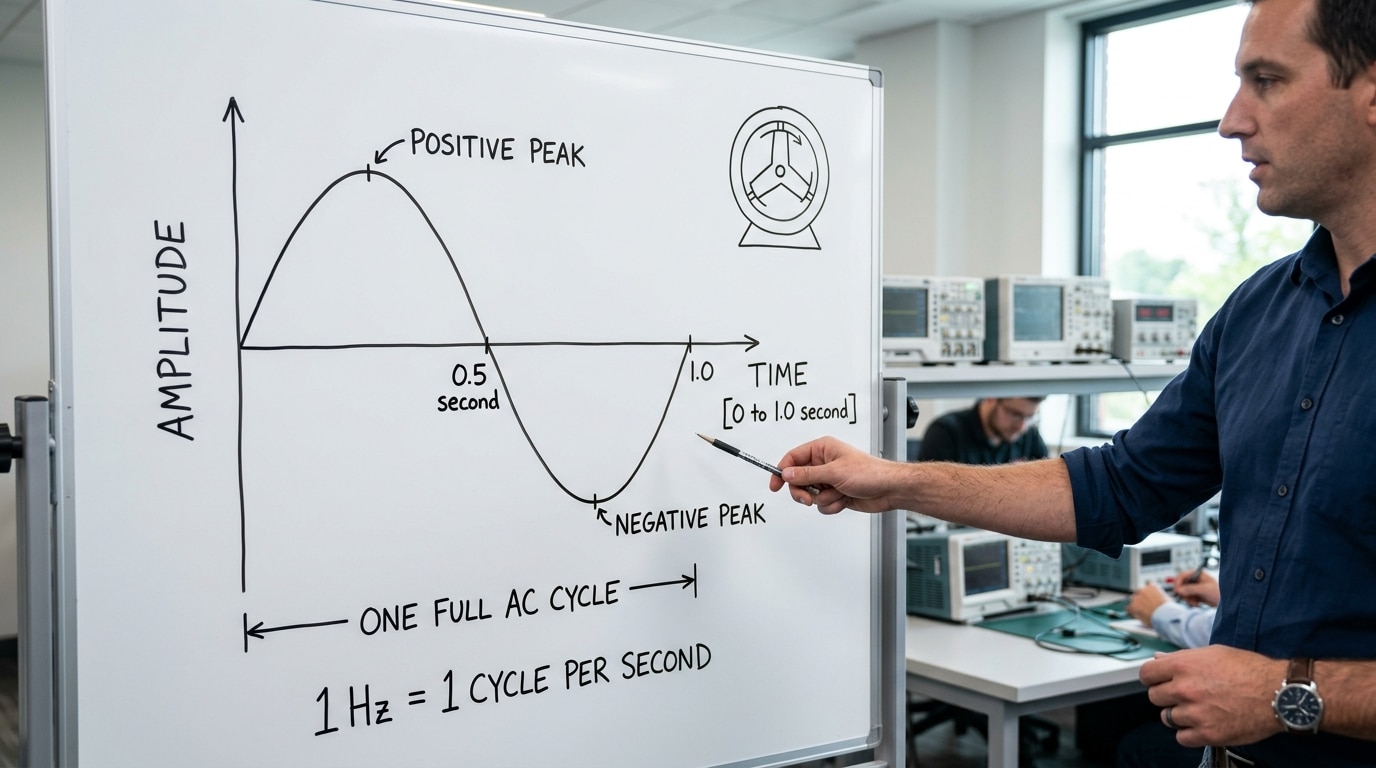
Frequency in electrical systems is measured in hertz (Hz), where 1 hertz means 1 complete cycle per second. So a current that switches direction 60 times per second has a frequency of 60 Hz. That single number tells you how fast the AC waveform repeats, which determines how every motor, clock, and transformer on the line behaves.
What happens during one full AC cycle?
One AC cycle is a single full trip of the sine wave. Voltage rises from zero up to its positive peak, then falls back through zero, the zero-crossing, and keeps dropping to a negative trough. Finally it climbs back to zero. That round trip is one cycle.
The current physically reverses direction each cycle: at the positive peak, electrons push one way; at the trough, they push the opposite way. Frequency is the rate at which current changes direction. Stack 60 of these reversals into one second and you’ve 60 Hz.
How do you calculate frequency with f = 1/T?
Frequency and time are flip sides of the same coin. The formula is f = 1/T, where T is the period, the time one cycle takes in seconds. Flip it and you get T = 1/f. Here is the math worked out:
| Frequency | Period (T = 1/f) | Cycle duration |
|---|---|---|
| 50 Hz | 1 / 50 s | 20 ms |
| 60 Hz | 1 / 60 s | 16.67 ms |
| 400 Hz (aircraft) | 1 / 400 s | 2.5 ms |
A 50 Hz[3] wave completes in 20 milliseconds; a 60 Hz wave finishes faster, in 16.67 ms. Aircraft run at 400 Hz because faster cycles let transformers and motors shrink, a real weight savings engineers exploit, since each cycle takes just 2.5 ms. To see this rhythm yourself, watch a sine wave on an oscilloscope; one bump-and-dip equals one cycle.

What Does 60 Hz Mean and What Is the Frequency of 240V?
60 Hz means the AC voltage reverses polarity 120 times and completes 60 full cycles every second. Voltage level has nothing to do with it. So 240V can run at 50 Hz or 60 Hz depending on the country, voltage measures pressure, frequency measures cycle speed. They’re two separate things.
Why does 60 Hz equal 120 polarity reversals?
Each full cycle has one positive half and one negative half. The waveform climbs to a peak, crosses zero, dips to a negative peak, then returns. The current reverses at every zero crossing, and there are two per cycle, so 60 cycles per second add up to 120 polarity reversals each second. This is also why a charger or transformer often hums at 120 Hz, double the 60 Hz supply: the magnetic forces inside pulse twice per cycle.
Is 240V always 60 Hz?
No. Voltage and frequency are set independently by each national grid. The United States delivers 240V split-phase at 60 Hz[4] to homes. The United Kingdom delivers 230,240V at 50 Hz. Both are 240V. Both differ in cycle speed.
| Region | Common voltage | Frequency |
|---|---|---|
| United States | 240V (split-phase) | 60 Hz |
| United Kingdom | 230–240V | 50 Hz |
| Australia | 230–240V | 50 Hz |
Practical tip: a 50 Hz motor run on 60 Hz spins faster and may overheat. Mains frequency standards differ by country, so check the nameplate before plugging in abroad, not just the voltage.
Why Do Power Grids Use 50 Hz or 60 Hz and How Do They Differ by Country?
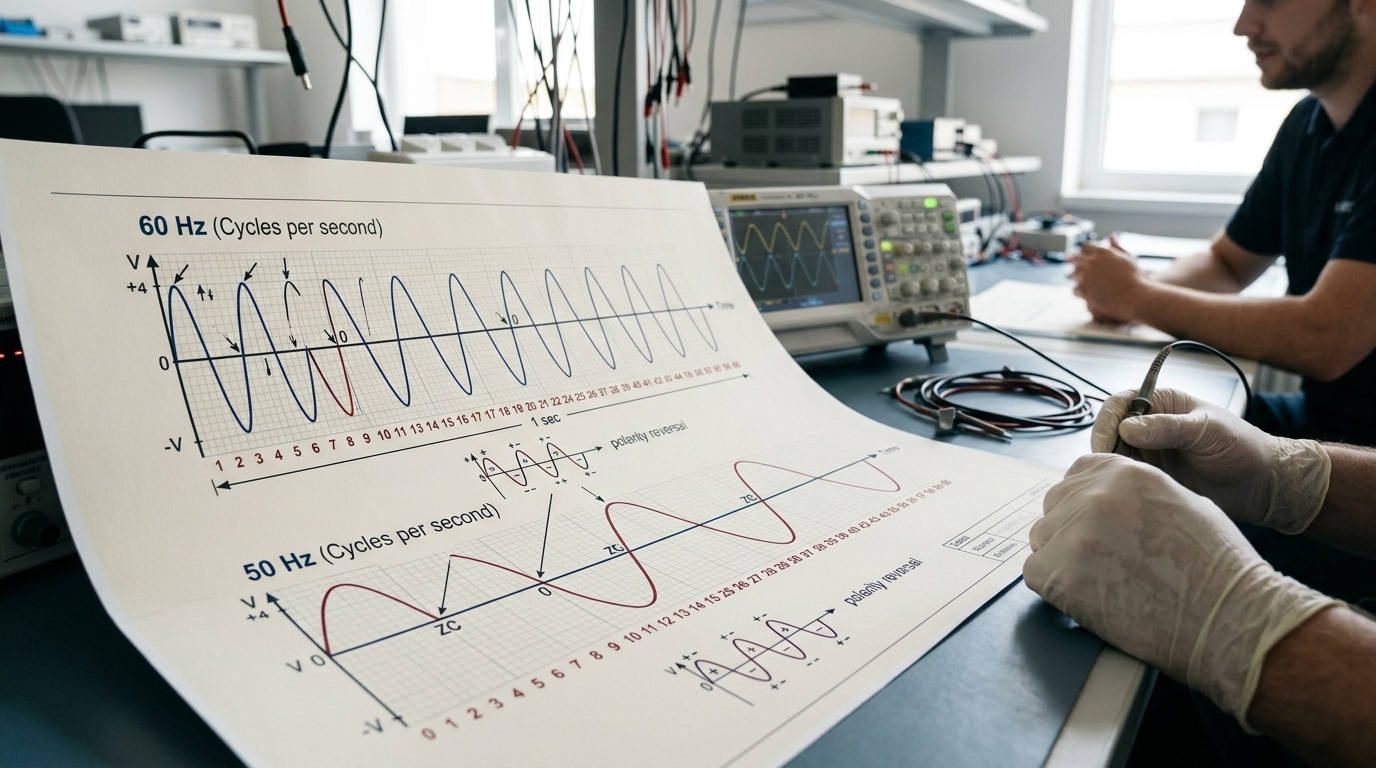
Power grids run at either 50 Hz or 60 Hz mostly because of decisions engineers made back in the 1890s, not because one frequency is genuinely better than the other. North America operates on 60 Hz, while most of Europe, Asia, and Africa rely on 50 Hz mains power. Neither one really wins when you look at pure physics. The split is essentially a frozen accident that now costs billions to undo.
The whole story comes down to two companies. In the United States, Westinghouse chose 60 Hz, partly because it reduced the visible flicker you got from early arc lighting. In Germany, AEG settled on 50 Hz because it fit neatly into the metric counting system. Once factories, motors, and meters were all built around one number or the other, switching became far too expensive. And so the world locked itself into two competing standards.
How does the 50 Hz vs 60 Hz choice affect equipment design?
Going with 60 Hz lets transformers and motors run slightly smaller, because a higher frequency means less iron is needed in the core. Going with 50 Hz, on the other hand, gives you marginally lower losses across long transmission lines. These trade-offs are genuinely tiny, single-digit percentage differences, which is exactly why no country has ever bothered to make the switch.
| Region | Standard Frequency | Typical Voltage |
|---|---|---|
| North America | 60 Hz | 120 / 240 V |
| Europe, most of Asia, Africa | 50 Hz | 230 V |
| Japan (east, incl. Tokyo) | 50 Hz[6] | 100 V |
| Japan (west, incl. Osaka) | 60 Hz | 100 V |
Japan really stands out as the strangest case of all. The country actually runs on two frequencies, because Tokyo bought German AEG generators rated at 50 Hz back in 1895, while Osaka bought American GE generators rated at 60 Hz in 1896. These days four frequency-converter stations link the two halves of the country together, though their combined capacity is fairly limited. That weakness got exposed during the 2011 power crisis, when the 60 Hz west couldn’t freely send electricity over to the 50 Hz east.
The practical consequence of having these two standards is straightforward enough, a 60 Hz motor shipped into a 50 Hz region runs approximately 17% slower and can end up overheating. So if you’ve ever wondered, What Is Frequency in Electrical Systems? this is a good reminder that the answer carries real-world weight.

Why Must Grid Frequency Be Balanced Second by Second?
Grid frequency must stay balanced every second because electricity can’t be stored inside the wires, generation must equal consumption at the exact moment of use. When the two drift apart, frequency falls if demand exceeds supply and rises if supply exceeds demand. Operators defend a tight band, usually 50 Hz ±0.2 Hz, to keep machines safe.
The spinning generators across a country are physically linked through the AC waveform, all turning in lockstep. Their combined rotating mass stores kinetic energy, engineers call this inertia (the resistance a spinning machine has to changing speed), and that stored energy is what makes the number move. If a large factory switches on and pulls extra power, the generators must work harder; for a split second they can’t, so they slow down slightly and frequency dips. If demand suddenly drops, the turbines speed up and frequency climbs. This is exactly what frequency in electrical systems measures: the rotation rate of synchronized generators, expressed in hertz.
Why fight so hard for a fraction of a hertz? Because the limits are legal, not just technical.
In Great Britain, the statutory range is 49.5,50.5 Hz, and the operator targets 50 Hz ±0.2 Hz under normal conditions. Cross those edges and protective relays trip generators offline to prevent damage, which can cascade into blackouts within seconds.
- Nominal target: 50 Hz ±0.2 Hz — the everyday operating window operators hold.
- Statutory limit: 49.5–50.5 Hz — the legal boundary set by grid codes.
- Trip threshold: below ~49 Hz triggers automatic load shedding to save the grid.
The frequency reading is the grid’s single most honest health signal. A clock-radio in a 50 Hz country even counts those cycles to keep time, proof the rhythm rarely strays.
What Happens When Grid Frequency Drops and How Do Operators Correct It in Real Time?
When grid frequency drops, it signals that electricity demand has outpaced supply. Operators have seconds to react, deploying layered reserves before automatic protection trips parts of the grid. In Great Britain, the target is 50 Hz, and a drop toward 48.8 Hz can trigger emergency load-shedding, cutting power to chosen customers to save the rest.
A falling number means generators are slowing under too much load, so three reserve layers respond in sequence to push it back up.
- Inertia response: The spinning mass of large generators resists speed change. This kinetic energy buys 2–5 seconds before any control kicks in. Wind and solar lack this naturally.
- Primary reserve: Automatic governors raise output within 10 seconds to halt the fall.
- Secondary reserve: Operators ramp up backup plants over 30 seconds to several minutes to restore exactly 50 Hz.
- Tertiary reserve: Slower units replace used reserves so the grid is ready for the next event.
What Happens When Correction Fails?
When reserves run out, the grid sheds load to survive. On 9 August 2019, a lightning strike caused two generators to disconnect almost together, and frequency fell to 48.8 Hz. According to the Ofgem investigation, automatic systems cut power to roughly 1.1 million customers and stopped trains across England. Recovery took about 45 minutes.
The practical lesson for operators: hold enough fast reserve to cover the single largest plant that could fail at once. Skip that margin, and one fault becomes a blackout.
What Happens to Motors and Appliances When Frequency Is Wrong or Unstable?
When frequency is wrong, AC motors change speed in direct proportion to it. The formula N = 120f / P (speed equals 120 times frequency divided by the number of poles) means a 50 Hz motor running on 60 Hz spins approximately 20% faster. That extra speed can overheat windings, trip protection, and shorten motor life.
Why does a 50 Hz motor overheat on a 60 Hz supply?
A 50 Hz induction motor on a 60 Hz line runs approximately 20% faster than its design speed. A 4-pole motor jumps from 1,500 RPM to 1,800 RPM. Fans and pumps demand power that rises with the cube of speed, so a 20% faster fan can pull roughly 70% more current. The windings heat up, and insulation rated for one temperature class degrades far quicker.
Run a 60 Hz motor on 50 Hz and the opposite happens. It spins slower, but the voltage-to-frequency ratio climbs. That over-fluxes the magnetic core and pushes it toward saturation (when iron can’t hold more magnetic field, so extra energy turns into heat).
How do transformers and clocks react to bad frequency?
Transformers saturate at low frequency. Drop the frequency while voltage stays fixed and the core current spikes, causing buzzing, heat, and possible failure. Old synchronous clocks count grid cycles to keep time. The North American grid targets 60 Hz[9] precisely so these clocks stay accurate over the day.
| Device | Frequency tolerance | Main risk |
|---|---|---|
| AC induction motor | ±5% | Overheating, speed error |
| Transformer | Sensitive below rated | Core saturation |
| Synchronous clock | Cumulative drift | Time loss |
| VFD / electronics | Wide (45–66 Hz) | Minimal |
Variable frequency drives (VFDs) rectify AC to DC, then rebuild any frequency they need. That’s why a VFD-fed motor barely notices a 50 or 60 Hz source. Switch-mode power supplies in laptops and phones do the same trick, accepting a wide input range without complaint.
How Do Renewables and Inverter-Based Sources Change Frequency Regulation?
Solar and wind plants weaken the grid’s natural frequency stability because they connect through inverters and spin no heavy turbine. Traditional generators store kinetic energy in massive spinning rotors, and this inertia resists sudden frequency drops. Inverter-based sources have almost none, so frequency can fall faster after a fault. Engineers fix this with synthetic inertia and faster control.
This matters more as grids shed spinning machines. When a large generator trips, inertia buys operators a few seconds to respond. A low-inertia grid loses that cushion, and frequency can plunge below safety limits before backup power arrives.
What’s grid-forming inverter technology and how does it help?
A grid-forming inverter actively sets voltage and frequency instead of just following the grid. Older “grid-following” inverters need an existing AC signal to lock onto. Grid-forming units behave more like a virtual generator, injecting power within milliseconds to oppose frequency swings and mimicking the physics of a spinning rotor.
Synthetic inertia (also called virtual inertia) is the software trick behind this. The inverter measures the rate of frequency change and pushes stored energy fast. Battery systems pair well here because they discharge instantly.
How fast must frequency response act on low-inertia grids?
Fast frequency response (FFR) delivers power within one second, far quicker than older reserves. The UK grid operator now procures FFR that responds in under one second, replacing the seconds-long buffer that inertia once provided. As regions push toward 50 Hz or 60 Hz grids with more renewables, this speed becomes the new standard for stability.
Frequently Asked Questions About Electrical Frequency
Electrical frequency raises the same handful of questions over and over. Below are direct answers to the searches people type most, each tied to the physics covered earlier and to what frequency in electrical systems actually does to your home and bill.
What are the three types of frequency?
Engineers split frequency into three bands by use, not by physics. The wave behaves the same way at every band, only the speed changes.
- Power (mains) frequency: 50 Hz or 60 Hz — the AC that runs your outlets and motors.
- Audio frequency: roughly 20 Hz to 20,000 Hz — the range human ears can hear, used in speakers and microphones.
- Radio frequency (RF): above 20,000 Hz, often millions of cycles per second — used in Wi-Fi, phones, and broadcasting.
What does 50 Hz mean in everyday terms?
50 Hz means the AC voltage completes 50 full cycles every second, reversing direction 100 times. Europe, India, and most of Africa use 50 Hz mains power. In practice, a 50 Hz wall clock motor or a kitchen timer keeps time by counting these cycles, so a stable grid keeps your clocks accurate.
Does frequency affect my electricity bill?
No. Your bill charges for energy used in kilowatt-hours, not for frequency. A steady 50 Hz or 60 Hz costs you nothing extra. But wrong frequency still hurts your wallet indirectly, a motor running at the wrong speed wastes energy and wears out sooner, raising repair and replacement costs.
Key Takeaways on Why Frequency Matters in Electrical Systems
Frequency is the grid’s live heartbeat, a single number that shows whether electricity supply and demand match each second. When you ask what’s frequency in electrical systems, the short answer is the count of AC cycles per second, measured in hertz (Hz). Watch that number and you can read the health of an entire power network.
Here is the core takeaway. Frequency stays fixed by design, 50 Hz across most of Europe, Asia, and Africa, or 60 Hz across North America and parts of South America. It doesn’t change because you want a different voltage. It drifts only when the balance breaks: demand above supply pushes it down, supply above demand pushes it up. Operators in most regions act to keep deviation inside roughly ±0.2 Hz.
What should you check before using a device abroad?
Check the rating plate first. It lists voltage and frequency, for example, “100,240V, 50/60 Hz.” Dual-rated gear works anywhere. Single-rated gear doesn’t.
- Clocks and timers: A 60 Hz clock plugged into a 50 Hz supply runs slow, losing about 20 minutes every two hours.
- AC motors: A 60 Hz motor on 50 Hz spins 17% slower and can overheat from extra current draw.
- Switching power supplies: Most phone chargers and laptops accept both 50 and 60 Hz, so they travel safely.
Know your region’s standard, read the label, and skip cheap voltage adapters that ignore frequency. That one habit prevents burned-out motors and ruined imported appliances.
7 Key Symbols on a Digital Panel Meter and How to Read Them
IEC 60947-6-1 Explained (Without the Confusing Jargon)
Ultimate Guide to 120V vs 220V for Engineers
How to Check and Confirm Your Circuit Breaker’s Brand
7 Essential ATS Controller Functions for Power Systems
Reference Sources
- [1]hioki.com/global/learning/electricity/frequency.html — supports: In electrical systems, **frequency** is the number of AC wave cycles per second, and it …
- [2]fluke.com/en-us/learn/blog/electrical/what-is-frequency — supports: In electrical systems, **frequency** is the number of AC wave cycles per second, and it …
- [3]electronics.stackexchange.com/questions/13363/what-is-frequency-in-electronics — supports: Electrical frequency is commonly defined only for **alternating current (AC)**; direct c…
- [4]gridbeyond.com/frequencyexplained/ — supports: In power systems, the grid frequency reflects how fast the AC waveform repeats and is ti…
- [5]neso.energy/energy-101/electricity-explained/how-do-we-balance-grid/what-freq… — supports: In power systems, the grid frequency reflects how fast the AC waveform repeats and is ti…
- [6]next-kraftwerke.com/knowledge/utility-frequency — supports: Many regions use **50 Hz** mains power, while others use **60 Hz**.
- [7] — supports: Sonar real-time citation (HEAD-verified)
- [8] — supports: Sonar real-time citation (HEAD-verified)
- [9]fiveable.me/introduction-electrical-systems-engineering-devices/key-terms/fre… — supports: Sonar real-time citation (HEAD-verified)
- [10] — supports: Sonar real-time citation (HEAD-verified)

Discover more from SENTOP Electrical Co., Ltd
Subscribe to get the latest posts sent to your email.
