
When planning power capacity, you should pay attention to load analysis as it helps you understand how much electricity your system needs. The main factors to consider include reliability, regulatory compliance, equipment selection, system protection, infrastructure, future growth, and cost. Think about how each part connects with the others.
Tip: By considering all these main factors, you can make your system stronger and safer.
Key Takeaways
- Do a careful load analysis to know how much electricity is needed now and later. This helps you make smart choices for power capacity planning.
- Add backup systems and redundancy to make the system more reliable. This keeps your power working even if something fails.
- Follow safety codes and standards to keep people and equipment safe. Following rules helps stop accidents and makes sure your system works right.
- Pick equipment that can grow with your needs. This makes it easy to upgrade or change things as energy needs go up.
- Use good data sources to make better predictions. Trustworthy data helps you guess future needs and keep the system working well.
Main factors in load analysis
Evaluating current and future demand
It is important to know how much electricity people use now and later. This helps you make good choices for power capacity planning. You should think about new technology and how energy needs change. Data centers and electric vehicles are making people use more electricity. Utilities look at big load forecasts, mostly for data centers. These centers are a big part of their predictions. There are different ways to guess future demand. You can look at long-term trends or see how new sectors change the system. The table below lists ways experts check demand and what each way means for planning:
| Methodology Description | Implications for Planning |
|---|---|
| Long-term hourly forecasting | Helps you plan for future generation needs |
| Tracking new sector demands | Lets you adjust for changes not seen in old data |
| Studying peak demand factors | Guides you in sizing the grid and generation capacity |
| Improving load forecasts | Supports better market models and grid management |
Maximum demand and diversity
It is important to watch maximum demand and diversity when you size your power system. Maximum demand is the most electricity needed at one time. Diversity means not all parts use their highest power at the same time. Using the diversity factor helps you avoid buying too much equipment. This saves money. If the diversity factor is less than one, it means loads peak at different times. This helps you make a system that works well and costs less. Engineers use models to study diversity. These models help you guess how homes and buildings use electricity. Here are some common models:
| Model Type | Description |
|---|---|
| Probabilistic | Shows how usage changes over time and between homes |
| Mathematical | Predicts load profiles for different buildings |
| Stochastic | Uses random data to reflect real-life changes |
| Markov Chain | Tracks activities and predicts future demand |
Data sources for forecasting
Good data helps you make better forecasts. Reliable sources are regional committees and working groups. These groups collect and check electricity use. They make long-term guesses and study seasonal peaks. You can use their data to see if your system will work in the future and stay strong. The main factors in load analysis need trusted data. Always pick sources that update their information and use experts.
Voltage and current requirements
Application-specific needs
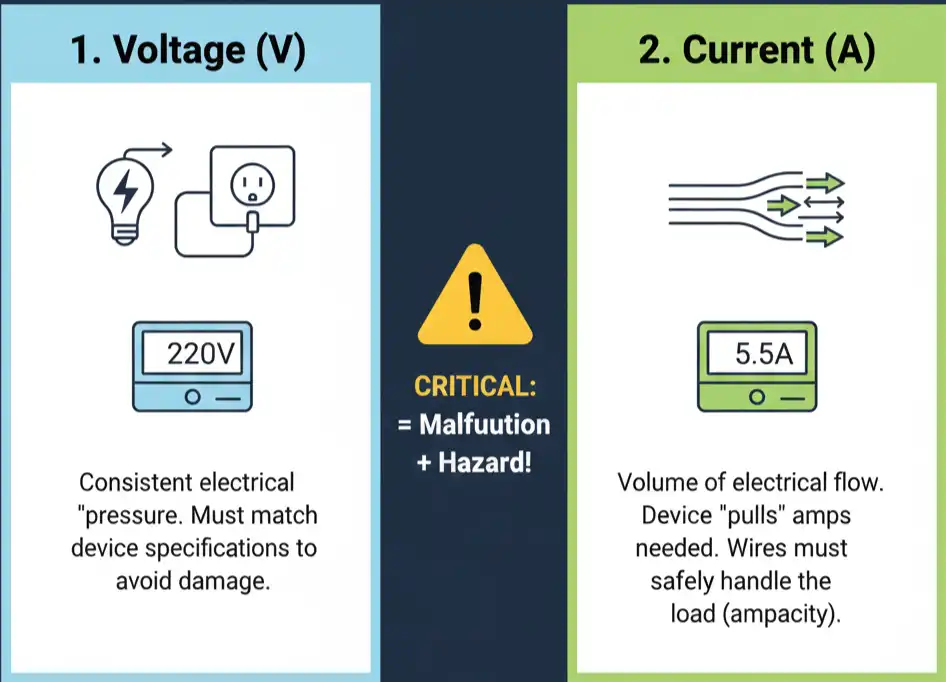
You need to match voltage and current to your equipment. Each device has its own needs. If you pick the wrong power supply, things can go wrong. Your system might not work or could break. Power supplies work in two main ways:
- Constant Voltage (CV): This keeps voltage the same, even if the load changes.
- Constant Current (CC): This keeps current the same, even if the load changes.
You should check how exact the voltage and current settings are. This makes sure your equipment gets the right power. If you skip this step, you could hurt sensitive devices or cause mistakes.
Tip: Always look at the equipment manual to find the right voltage and current.
Sizing for safety and efficiency
You should add a safety margin when you size electrical systems. This means picking parts that can handle more than the biggest load. A safety factor keeps your system safe from overloads. It also helps your system work well. For example, if your device needs 10 Amps, use a part rated for at least 15 Amps. This extra room helps stop failures, especially in important systems.
| Application Type | Recommended Safety Margin | Example |
|---|---|---|
| Personal Devices | 50% | If target current is 10 Amps, use 15 Amps |
| Power Grid Distribution | 10% – 100% | Varies by conditions and ratings |
You can use these common safety margin standards:
- MIL-SPEC STANDARD: Use 150% or more for aerospace and military.
- MOTORSPORT STANDARD: Use 130-149% for racing vehicles.
- ACCEPTABLE: Use 100-129% for commercial systems.
- UNSAFE: Less than 100% is not safe.
If your system is too small, it will work too hard and break a lot. Filters and parts can get clogged, and repairs will cost more. If your system is too big, it will turn on and off too much. This wastes energy and makes temperatures uneven. Both problems cost more money and can cause failures.
Reliability and system protection
Reliability standards
You must follow reliability standards to keep your power system strong. These standards say how much downtime is allowed each year. Different places have different Loss of Load Expectation (LOLE) targets. The table below shows LOLE targets for each country:
| Region/Country | LOLE Target (hours/year) |
|---|---|
| Most U.S. systems | 2.4 |
| Belgium, France, GB, Italy, Poland | 3 |
| Netherlands, Germany | 4 |
| Ireland, Portugal | 8 |
You should check these targets when you plan your system. Meeting the right target helps you stop outages and keep your system reliable.
Redundancy and backup
Redundancy and backup help your system stay online. You can use different ways to make your system more reliable:
- Redundant Power Supplies: Devices have more than one power supply. If one fails, the other works.
- N+1 Configuration: One extra unit is ready if another stops working.
- 2N and 2(N+1) Configurations: Two systems can each handle the full load.
- Redundant Power Distribution: Many power units connect to backup systems.
- Independent Power Feeds: Separate sources lower the chance of failure.
- Physical and Logical Separation: Problems in one area do not hurt the whole system.
- Regular Testing and Maintenance: Checks make sure backups work when needed.
- Load Balancing and Automatic Failover: Power spreads out and switches fast if there is a problem.
The table below shows how redundancy models change uptime:
| Redundancy Model | Description | Typical Uptime |
|---|---|---|
| N | No redundancy; one path to load. | 99.671% |
| N+1 | One extra part for failover. | 99.982% |
| 2N | Full copy of parts and paths. | 99.995% |
More redundancy means higher uptime. This keeps your system working even if something fails.
Safety measures
Safety measures protect people and equipment. You should use batteries to keep important devices powered. Electrostatic discharge protection stops shocks. Surge protection keeps voltage spikes from causing damage. Fast relays find and stop faults quickly. Fuses melt if current gets too high and stop damage. Instrument transformers measure voltage and current. Relays and circuit breakers disconnect bad parts of the system.
You also need to use personal protective equipment (PPE) to keep workers safe. Safety rules help everyone follow safe steps. Regular checks help you find problems early. Good grounding removes unwanted voltage and lowers the risk of electrocution.
Tip: Always add safety checks to your planning. This lowers hazards and keeps your system reliable.
Regulatory compliance and safety
Codes and standards
You have to follow certain codes and standards when planning power systems. These rules keep people safe and help your system work right. Many countries use the same main codes. The table below lists some important ones:
| Regulatory Code | Description |
|---|---|
| IEEE 446 (Orange Book) | For emergency and standby power systems. |
| NFPA 70 (National Electrical Code) | Electrical safety. |
| IEC 62040 | UPS standards. |
Check these codes before you start your design. They tell you what is allowed and what is not. Following them helps you avoid accidents and fines.
Energy efficiency and emissions
You need to think about energy efficiency and emissions when designing a power system. New rules say buildings must use less energy and make less pollution. The table below shows the latest requirements:
| Requirement | Description |
|---|---|
| Energy Efficiency Level | Buildings must be 30% better than the new standard if LCC effective. |
| Minimum Efficiency | Buildings must at least meet the new standard. |
| Compliance Timeline | Design must start one year after the rule is published. |
Plan for these rules early. This saves money and helps the environment. It also helps you get building permits.
Note: Energy efficiency is a main factor in power capacity planning.
Protective devices
You need protective devices to keep people and your system safe. These devices stop fires, shocks, and damage. Some common protective devices are:
- Circuit breakers
- Fuses
- Ground fault interrupters
- Surge protectors
Test these devices often. If you find a problem, fix it fast. Good protection keeps your system working and helps you follow safety codes.
Equipment selection and infrastructure
Choosing distribution equipment
You have to pick the right distribution equipment for your power system. Good equipment keeps people safe and helps your system work well. Before you choose, look at a few important things. The table below shows what you should think about:
| Criteria | Description |
|---|---|
| Safety | Protect people from live wires and stop overloaded circuits fast. |
| Minimum Initial Investment | Think about the total cost, including buying and installing equipment. |
| Maximum Service Continuity | Critical places need less downtime; other places can handle longer outages. |
| Maximum Flexibility and Expandability | Make sure your system can change as your needs grow. Use smaller transformers for flexibility. |
| Maximum Electrical Efficiency | Lower losses in wires and transformers. Balance cost now with cost to run the system. |
| Minimum Maintenance Cost | Simple designs need less fixing. Sealed equipment helps you avoid long repairs. |
Tip: Always pick equipment that fits your building’s needs. This saves money and keeps your system safe.
Updating existing systems
You should check your current equipment before planning upgrades. If your equipment is still good, you can upgrade it instead of replacing it. Upgrades usually cost less and take less time. You can keep your system working while you make changes. People may want to keep old buildings if they think they are useful. If people do not like the building, you might have trouble upgrading. Think about risks and costs before you decide.
Physical and network constraints
Space and network limits can change what you pick. You need enough room for new equipment. Old buildings may be small, so you need smaller devices. Network limits, like cable size and connection points, can change how much power you move. Check these limits before you buy new parts. If you do not, your system might not work right. You can use diagrams to see your network and find problems early.
Note: Good planning helps you avoid mistakes and keeps your power system strong.
Planning for future growth
Scalability and expansion
You should plan for growth when you design a power system. If you want more users or new equipment, think about scalability. There are many ways to make your system flexible and ready to expand. The table below lists some good ways to do this:
| Strategy | Description |
|---|---|
| Regular Load Assessments | Shows how much power you use now and helps guess future needs. |
| Redundancy | Backup power and failover systems keep things working if something fails. |
| Modular Electrical Systems | Lets you upgrade or add parts without changing everything. |
| Optimizing Space Utilization | Smart planning helps you fit more equipment in the same space. |
| Enhancing Cooling Systems | Better cooling keeps equipment safe as you add more devices. |
| Gradual Implementation of Smart Grids | Small projects test new technology before using it everywhere. |
You can use these ideas when you plan:
- Check power use often.
- Add backup systems for safety.
- Pick equipment you can upgrade.
- Plan space for more devices.
- Make cooling better as you grow.
- Try new technology in small steps.
If you use these methods, your system will be strong and ready for changes. Building a system that can grow helps you meet future energy needs.
Adapting to new technology
You need to keep up with new technology to make your power system last longer. Battery storage and power-to-heat systems help lower carbon dioxide emissions. Battery storage can cut emissions by almost 80%. Power-to-heat technology can lower emissions by about 60%. More places use these technologies every year.
New modeling methods help you plan better. These methods show which changes matter most for your system. You can look at costs, rules, and new devices. Smart grids and digital solutions help you handle more complex systems. Always check for updates in technology and rules. This helps you make good choices and keeps your system ready for the future.
Tip: When you plan for growth, remember to leave room for new technology and expansion.
Cost estimation and efficiency
Budgeting and lifecycle costs
It is important to guess costs well when you plan a power system. Good budgeting helps you get support and keeps your project moving. You need to know about direct costs, like buying equipment and paying workers. Indirect costs include things like permits and insurance. You should plan for all costs, even extra money for surprises. There are different ways to guess costs:
- Analogous estimation means you look at other similar projects.
- Bottom-up estimation adds up each part’s cost.
- Parametric estimation uses math formulas based on size or features.
- Three-point estimation checks best, worst, and average cases.
Make sure your project goals match your budget. This helps you use resources well and talk clearly with your team.
Cost-effective design
Smart design choices help you save money and make your system better. You should follow safety codes to stop costly mistakes. A small layout can save land and cut building costs by up to 15%. If you pick equipment that can grow, you will not need big changes later. Safety and security, like redundancy, keep your system safe from problems. Automation can lower repair costs by 30%. Here are some ways to design for less cost:
- Follow safety and reliability standards.
- Use space well with a good layout.
- Pick equipment that can grow with your needs.
- Make safety and security a top goal.
- Use automation to save money over time.
Power quality
You need good power quality to keep your equipment safe and avoid problems. Bad power quality can make lights flicker, break equipment, or cause data loss. You should use voltage regulators, surge protectors, and filters to keep power steady. Check your system often to find problems early. Good power quality helps your system last longer and work well.
Tip: Buying power quality devices saves money by stopping repairs and keeping your system strong.
You have learned the main things to think about for power capacity planning. These include knowing what you need now, getting ready for more use later, and following safety rules. To help you with your project, use this checklist:
- Check what resources you have now
- Guess what you will need in the future
- Find any problems that could slow things down
- List all the hardware you already have
- See how well your software works
- Check how strong your network is
- Look at old data to learn from it
- Try to see what might happen next
- Watch for problems like running out of CPU or memory
Make sure you think about technical, rule-based, and money needs. Keep looking at your plan and change it if you need to.
FAQ
What is the most important step in power capacity planning?
You should start with load analysis. This step helps you know how much electricity your system needs. Accurate load analysis lets you make smart choices and avoid problems later.
How do you make sure your power system stays reliable?
You can use backup systems and regular checks. Redundant power supplies and automatic failover keep your system running. Testing and maintenance help you find issues before they cause trouble.
Why do you need to follow codes and standards?
Codes and standards keep people safe. They also help your system work the right way. You must check the rules before you design or build. Following them helps you avoid fines and accidents.
How can you plan for future growth in your power system?
You should pick equipment that can expand. Modular systems let you add new parts easily. Regular load checks and space planning help you get ready for more users or new technology.
What helps lower costs in power capacity planning?
Smart design choices save money. You can use automation, pick equipment that grows with your needs, and follow safety rules. Good planning helps you avoid expensive repairs and upgrades.
See also
How to choose the size of the distribution board
Why Customized RCCB Is the Future of Electrical Safety
How to determine the size of the solar combiner box
How to Replace the Distribution Panel and Wiring in Your Home
The delivery cycle for customized circuit breakers