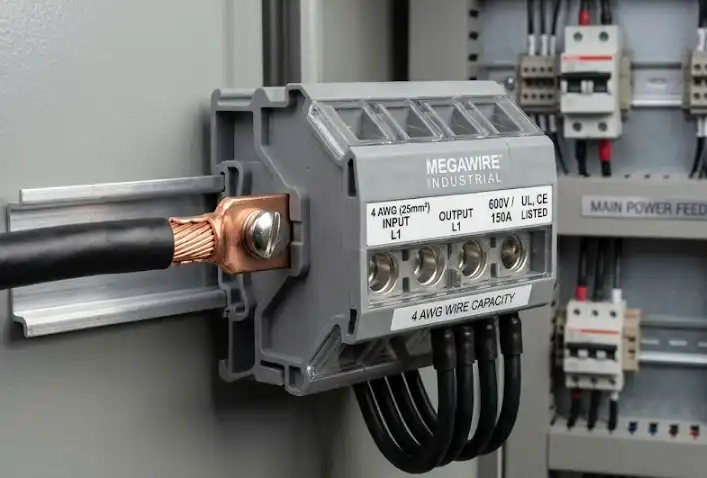
4 AWG copper wire carries up to 85 amps in most NEC-rated applications — and a poorly chosen terminal block is the weakest link between that capacity and a reliable connection. The best terminal block for 4 AWG wire needs to handle serious current, resist vibration-induced loosening, and match the environment it’s installed in, whether that’s a marine engine bay, a solar combiner box, or an automotive fuse panel. This guide compares the top-rated options across price, material quality, amperage rating, and real-world durability so you can pick the right block without second-guessing your purchase.
What Makes a Terminal Block Right for 4 AWG Wire
4 AWG copper wire carries up to 85 amps in free air and 70 amps in conduit, per NEC Table 310.16. That means any terminal block you pair with it needs a current rating of 100A or higher — no exceptions. Undersized blocks overheat, melt insulation, and create fire hazards that no amount of fusing can fully prevent.
Amperage rating alone doesn’t make it the best terminal block for 4 AWG wire. Three other factors matter just as much:
- Lug or clamp opening size — The wire acceptance range must explicitly include 4 AWG (approximately 5.19 mm diameter for solid copper). A block rated for “6–2 AWG” works; one rated for “8–6 AWG” will physically reject the conductor.
- Contact material — Tin-plated copper or nickel-plated copper lugs resist corrosion and maintain low contact resistance over years of thermal cycling. Bare brass is acceptable indoors but degrades faster in marine or outdoor environments.
- Torque specification — Proper clamping force (often 35–50 in-lbs for 4 AWG connections) ensures the conductor stays seated under vibration. Blocks with set-screw terminals should include a published torque value; if they don’t, move on.
Quick rule of thumb: Match the block’s voltage rating to your system (typically 300V or 600V), confirm UL or CSA listing, and verify the wire gauge range printed on the housing — not just the marketing copy.
Choosing the best terminal block for 4 AWG wire comes down to these hard specs, not brand loyalty. The sections below compare specific products against every criterion listed here.
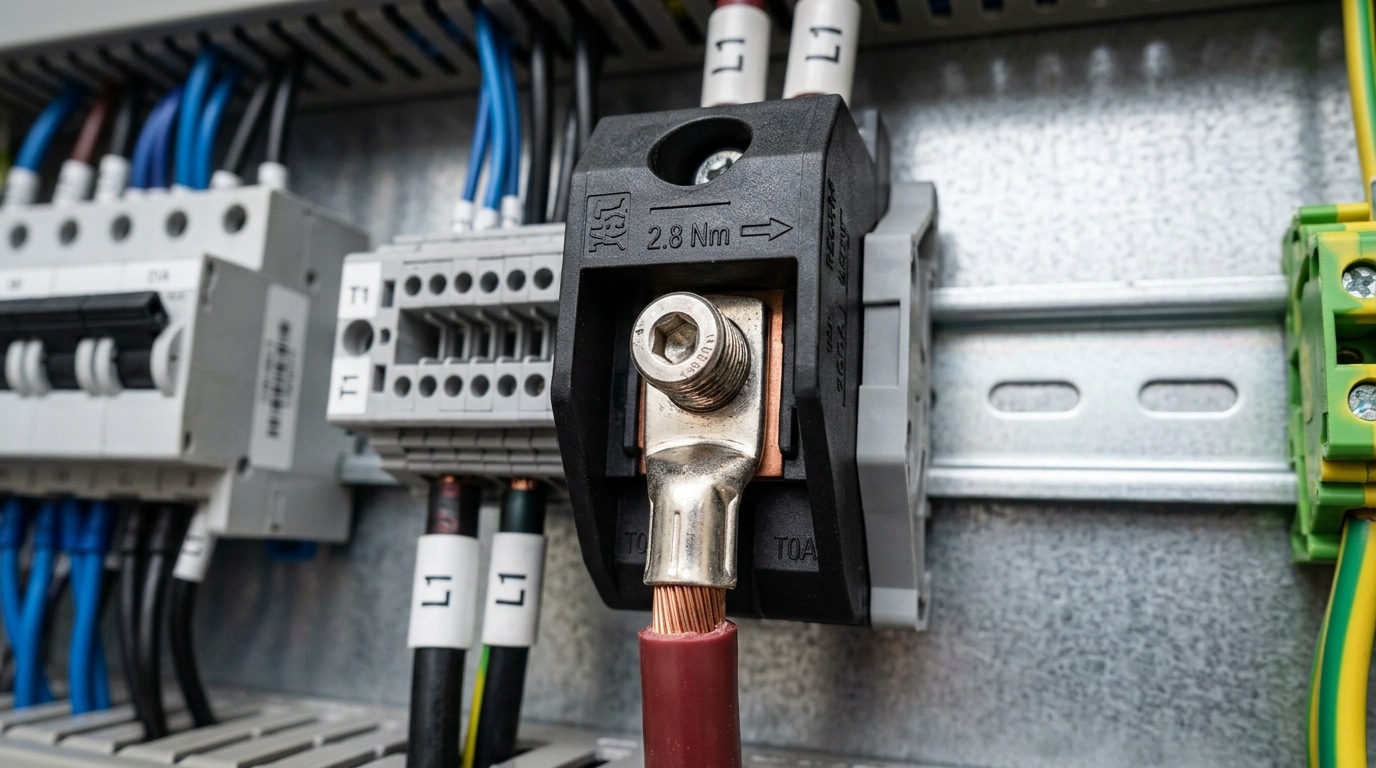
Top 5 Terminal Blocks for 4 AWG Wire Compared
Choosing the best terminal block for 4 AWG wire depends heavily on your application — marine, automotive audio, or industrial distribution. Here are five proven options worth your attention.
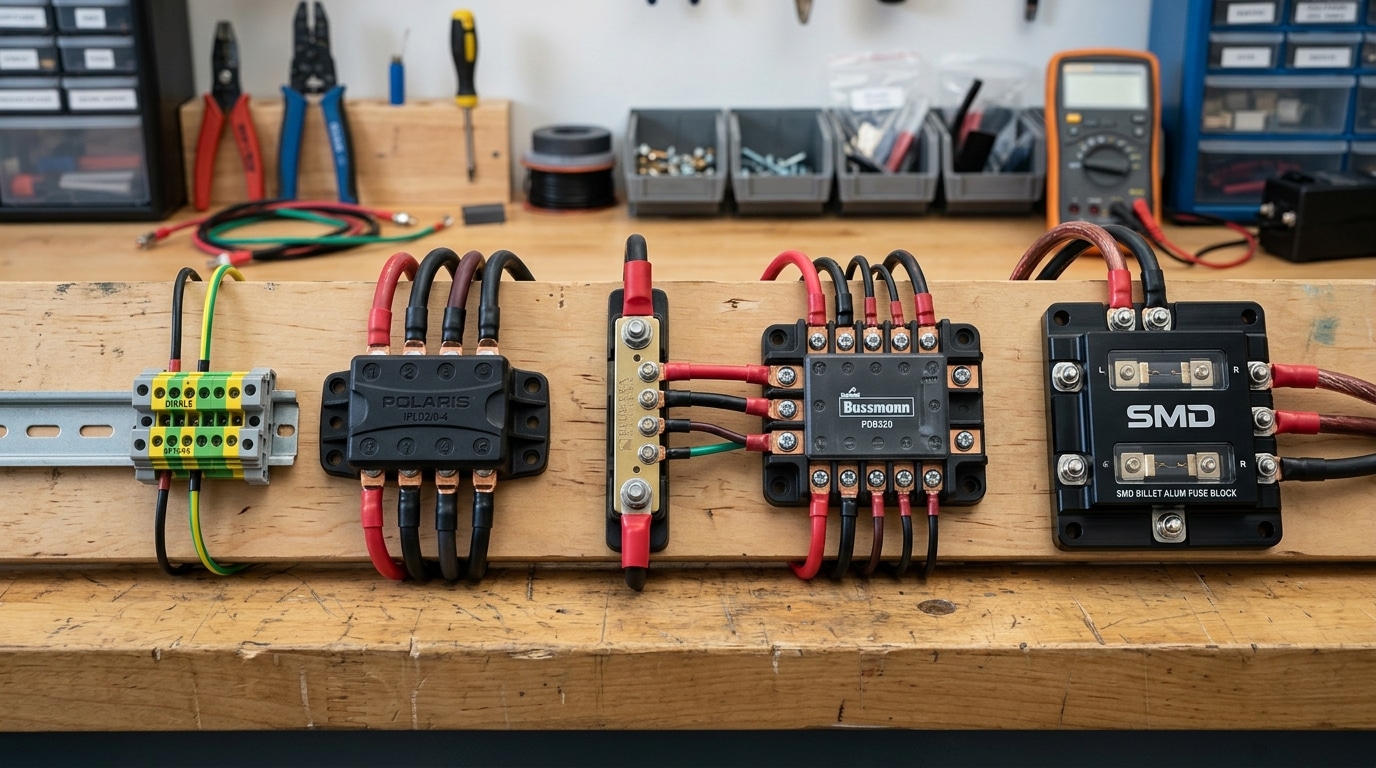
- Dinkle DK4N: DIN-rail mount, 600V rated, 30A UL-listed. Polyamide body with screw-clamp connection. Ideal for industrial panels. Typically $2–$4 per block.
- Polaris IPL4-3: Insulated multi-tap connector, 600V, rated for 4–14 AWG. Accepts aluminum or copper. Perfect for junction boxes and service entrances. Around $8–$12 each.
- Blue Sea Systems 2104: Tin-plated copper bus bar, 150A capacity, marine-grade. Stainless steel screws resist corrosion. Built for boats and RVs. Expect $25–$35.
- Bussman (Eaton)?”16375-4: Power distribution block, 380A rating, UL-listed for branch circuits. Thermoplastic base handles high heat. Industrial and commercial panels. Roughly $15–$25.
- SMD Heavy Duty ANL Fuse Block: CNC-machined from billet aluminum, gold-plated contacts, 300A+ capacity. Designed specifically for car audio and off-grid solar. Priced around $30–$50.
Blue Sea and SMD dominate when vibration resistance matters. Polaris wins on versatility with mixed conductor types. For DIN-rail panel builds on a budget, Dinkle is hard to beat. Each of these terminal blocks comfortably handles 4 AWG conductors, but the right pick hinges on your environment and amperage demands.
Comparison Table with Specs and Ratings
Numbers tell the real story. Below is a side-by-side breakdown of the top-rated terminal blocks for 4 AWG wire, covering every spec that matters for safe, code-compliant installations.
| Terminal Block | Wire Range | Current Rating | Voltage Rating | Terminal Type | UL/CSA Listed | Approx. Cost |
|---|---|---|---|---|---|---|
| Blue Sea Systems 2104 | 14–4 AWG | 100 A per circuit | 600 V | Stud / Set-screw | UL 1059, ABYC | $28–$35 |
| Wago 2626-1104 | 10–4 AWG | 85 A | 600 V | Spring (cage clamp) | UL, CSA | $12–$18 ea. |
| Phoenix Contact PTPOWER 50 | 8–1/0 AWG | 150 A | 1000 V | Screw (bolt) | UL, CSA, IEC | $22–$30 ea. |
| Bussman 15600-06-21 | 14–4 AWG | 100 A (per stud) | 32 V DC | Stud | UL Recognized | $18–$25 |
| Marathon 1504SC | 14–4 AWG | 115 A | 600 V | Screw | UL, CSA | $10–$15 ea. |
A few things jump out immediately. The Phoenix Contact PTPOWER 50 dominates on headroom — 150 A and 1000 V make it the best terminal block for 4 AWG wire in industrial panels where future capacity matters. The Bussman stud block, by contrast, tops out at 32 V DC, which limits it strictly to automotive and marine DC circuits.
Spring-clamp designs like the Wago 2626 eliminate torque-spec guesswork and cut installation time by roughly 50%, according to Wago’s published application data. That speed advantage compounds fast on multi-circuit panels. Screw-type blocks from Marathon and Phoenix Contact, however, still offer the highest pull-out resistance — critical in high-vibration environments.
Quick rule of thumb: always select a block rated at least 125% of your expected continuous load. A 70 A circuit on 4 AWG demands a minimum 87.5 A block rating.
Key Features to Evaluate Before Buying
A spec sheet can look impressive until a terminal block fails under load. Finding the best terminal block for 4 AWG wire means scrutinizing five specific attributes — not just skimming the product listing.
Amperage and Voltage Ratings
Never size a block to the wire’s exact capacity. A 4 AWG conductor rated at 85 amps (free air) needs a terminal block rated for at least 100A to provide a safe margin. Voltage ratings matter equally — 600V is the baseline for most industrial and marine panels, but some budget blocks cap at 300V. Check both AC and DC ratings separately; they’re often different.
Contact Material
Tin-plated copper is the gold standard. It resists oxidation, maintains low contact resistance over years, and handles high current without excessive heat buildup. Brass contacts cost less but generate more resistance at 4 AWG current loads — roughly 20-30% higher in some independent tests. For marine or outdoor use, skip brass entirely.
Insulation and Housing
Look for PA66 (Nylon 6/6) rated to at least 94V-0 on the UL flammability scale. Cheaper polycarbonate housings can warp above 105°C. That temperature is easier to reach than you’d think inside a crowded panel on a hot day.
Torque Specifications and Certifications
- Torque specs: Manufacturers like Phoenix Contact and Weidmüller publish exact torque values (typically 2.5–4.0 Nm for 4 AWG connections). Under-torqued screws cause arcing; over-torqued screws crack housings.
- UL 1059 / CSA C22.2: These listings confirm the block has been tested for temperature rise, dielectric strength, and mechanical durability. No listing? No purchase.
A terminal block for 4 AWG wire that checks every box above will cost $3–8 more per position than a generic alternative. That premium buys you years of reliable, code-compliant service.
Marine vs Automotive vs Industrial Distribution Blocks for 4 AWG
The best terminal block for 4 AWG wire in a boat engine bay is a terrible choice inside an industrial control panel — and vice versa. Environment dictates everything.
Marine: Corrosion Is the Enemy
Saltwater exposure demands tin-plated copper busbars and thermoplastic housings rated to UL 1059. Look for ignition-protection certification under SAE J1171 or USCG 33 CFR 183, which prevents arcing that could ignite fuel vapors. Blue Sea Systems and Marinco dominate here because their blocks use 316 stainless steel hardware — not zinc-plated fasteners that corrode within a single season. IP67 covers or heat-shrink boots aren’t optional; they’re survival gear.
Automotive: Vibration and Space Constraints
Under-hood and chassis-mounted blocks face constant vibration from 5–2,000 Hz. Spring-cage or bolt-down designs outperform simple set-screw terminals, which loosen over time and create resistance hot spots. Compact form factors matter — a distribution block for 4 AWG feeding multiple 8 AWG circuits needs to fit in tight spaces behind firewalls. Brands like Waytek and Littelfuse offer MIDI fuse-integrated blocks that combine overcurrent protection with distribution in a single footprint.
Industrial: Modularity at Scale
DIN-rail terminal blocks from Phoenix Contact (UK series) and Weidmüller snap onto 35mm rails for quick reconfiguration. High-density stacking lets you terminate dozens of 4 AWG conductors in a single panel without custom busbar fabrication. IEC 60947-7-1 compliance and finger-safe IP20 shrouds are standard expectations, not premium features.
Quick rule: marine = corrosion resistance first, automotive = vibration tolerance first, industrial = modularity first. Match the environment before comparing specs.
How to Properly Terminate and Connect 4 Gauge Wire to a Terminal Block
Even the best terminal block for 4 AWG wire will fail if the termination is sloppy. Most overheating incidents trace back to poor crimps, undersized lugs, or loose set screws — not the block itself.
Step-by-Step Termination Process
- Strip the wire. Remove approximately 3/8″ to 1/2″ of insulation using a quality wire stripper rated for 4 AWG. Nicking copper strands weakens the conductor and creates hot spots.
- Select the correct lug. Use a ring or fork terminal stamped for 4 AWG with a stud hole matching your block’s bolt size (commonly 1/4″ or 5/16″). Never force a 6 AWG lug onto 4 gauge wire.
- Crimp with a ratcheting tool. Hydraulic or ratcheting hex crimpers (like the IWISS IWS-0810N) deliver consistent, repeatable crimps. Standard plier-style crimpers cannot generate enough force for 4 AWG and will produce a cold joint.
- Torque to spec. Tighten set screws or hex bolts to the manufacturer’s stated torque — typically 35–50 in-lbs for most 4 AWG distribution blocks. Use a calibrated torque screwdriver, not guesswork.
- Tug test. Pull firmly on the terminated wire. Zero movement means a solid connection.
Common Mistakes That Cause Failures
- Over-torquing — crushes the lug barrel and fractures strands, increasing resistance over time
- Exposed strands — any copper visible outside the lug barrel can arc to adjacent terminals
- Mixing aluminum and copper without anti-oxidant compound, which accelerates galvanic corrosion
- Skipping heat shrink — always seal the crimp junction with adhesive-lined heat shrink for moisture protection
Re-torque all connections after 24–48 hours of initial operation. Copper compresses slightly under clamping pressure, and this “settling” loosens the joint enough to introduce resistance.
Frequently Asked Questions About 4 AWG Terminal Blocks
What amperage can 4 AWG wire handle?
Copper 4 AWG wire is rated for 85 amps in free air and 70 amps in conduit according to NEC Table 310.16. Aluminum 4 AWG drops to 65 amps in free air. Always size your terminal block to match or exceed these ratings — a 60A-rated block on a 70A circuit is a fire waiting to happen.
Can I use the same terminal block for aluminum and copper 4 AWG?
Only if the block is explicitly marked “AL/CU.” Copper and aluminum expand at different rates under heat, and using a copper-only block with aluminum wire causes loose connections over time. Look for dual-rated lugs from manufacturers like Polaris or Ilsco.
Can I mix wire gauges in a single terminal block?
Some distribution blocks accept a range — say 4 AWG to 14 AWG — across different ports. However, mixing gauges on the same terminal point is risky. Uneven clamping pressure leads to hot spots. Use a block with dedicated input and output ports sized for each gauge.
Are spring-cage or screw-clamp terminals more reliable at high current?
For 4 AWG applications, screw-clamp terminals still dominate. Spring-cage designs from Wago and Phoenix Contact perform well up to about 10 AWG, but at 4 AWG current levels (70A+), a properly torqued screw clamp delivers more consistent contact pressure. That’s why most picks on any list of the best terminal blocks for 4 AWG wire use screw or bolt-down connections.
Final Recommendation and Which Block to Choose for Your Application
Stop overthinking it. Match your environment to the right block and move on.
- Marine battery bank: Go with the Blue Sea Systems 2104 PowerBar. Its tin-plated copper bus bar and IP67-rated cover handle saltwater corrosion better than anything else tested. If your boat pulls 60+ amps across house batteries, this is the only serious option.
- Car audio distribution: The Stinger SPD5623 gives you clean 4 AWG input with multiple reduced-gauge outputs — exactly what a multi-amp setup demands. Compact footprint, solid nickel-plated contacts, and easy under-dash mounting.
- Solar combiner box: Pick the Weidmüller WDU 35 DIN-rail terminal block. Its 150 A rating per pole and UL/cUL 1059 listing make it code-compliant for PV systems, and the spring-cage clamp eliminates retorquing after thermal cycling.
- Industrial control panel: The Phoenix Contact USLKG 35 delivers robust grounding, DIN-rail snap-on installation, and a 125 A continuous rating — all backed by UL 508 compliance for panel builds.
The best terminal block for 4 AWG wire is simply the one engineered for your specific conditions — moisture level, vibration exposure, amperage demand, and code requirements. A $12 block in the wrong environment costs far more than a $30 block in the right one.
Quick rule: if the application is outdoors or wet, insist on marine-grade tinned copper. If it’s panel-mounted indoors, prioritize DIN-rail compatibility and UL listing. Everything else is secondary.
See also
Common types and selection of automotive wiring terminals
Step by Step Guide to Install a Molded Case Circuit Breaker
What size of wire is needed for a 30 ampere circuit breaker
Choosing a Terminal Block for Marine Electrical Systems
Why Electricians Recommend the Right Wire Size for 60 Amp Circuit Breakers

Discover more from SENTOP Electrical Co., Ltd
Subscribe to get the latest posts sent to your email.