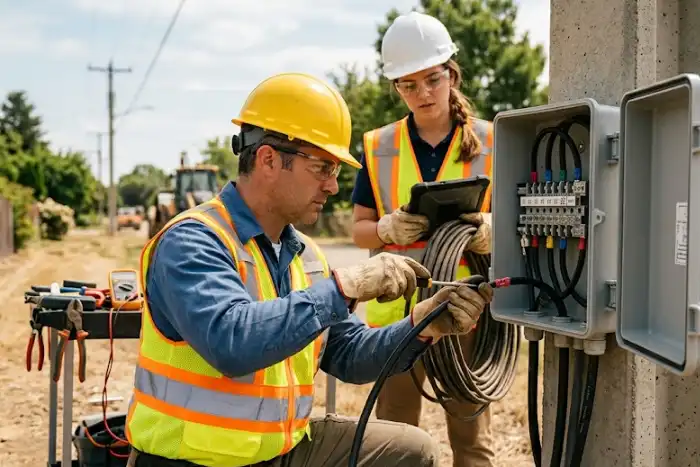
Nearly 34% of outdoor electrical connection failures trace back to inadequate ingress protection — a problem that’s entirely preventable with the right component selection, according to field data from Phoenix Contact’s technical service reports. Choosing the correct terminal block IP rating for outdoor use comes down to matching two numbers — one for solid particle resistance, one for moisture protection — to the specific environmental threats at your installation site. This guide breaks down exactly which IP ratings you need, when enclosures outperform IP-rated blocks alone, and the costly specification mistakes that lead to corrosion, short circuits, and premature failure in outdoor wiring.
What IP Ratings Mean for Electrical Terminal Blocks
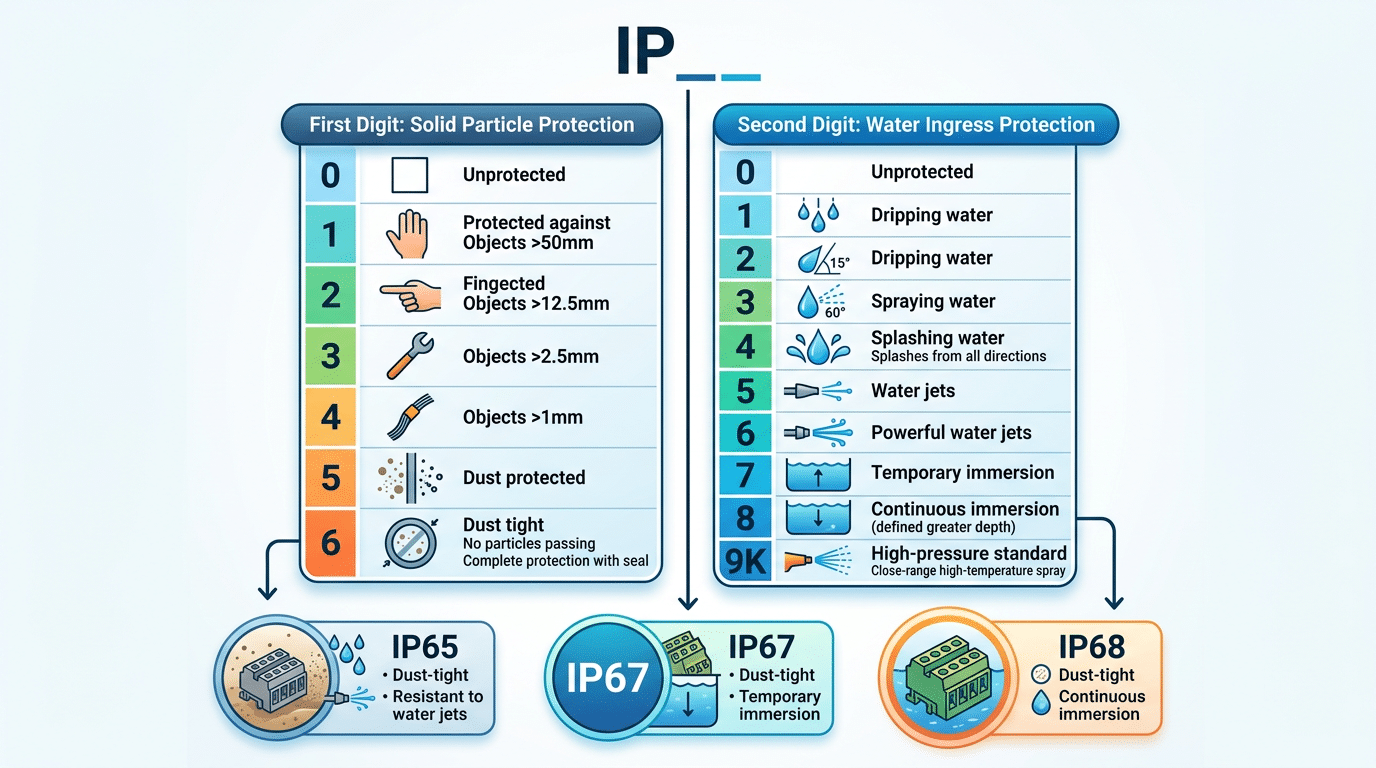
Every terminal block destined for an outdoor junction box carries a two-digit code that tells you exactly how much punishment it can handle. That code — the IP (Ingress Protection) rating — is defined by the international standard IEC 60529, and misreading it is one of the fastest ways to cause a field failure.
Quick definition: An IP rating consists of the letters “IP” followed by two digits. The first digit (0–6) indicates protection against solid objects like dust and debris. The second digit (0–9K) indicates protection against water ingress — from dripping to high-pressure jets and full submersion.
Here’s how the two digits break down at a glance:
| Digit Position | What It Measures | Range | Outdoor Relevance |
|---|---|---|---|
| First digit | Solid particle ingress | 0 (no protection) – 6 (dust-tight) | A rating of 5 or 6 is essential where wind-blown grit or sand is present |
| Second digit | Water ingress | 0 (no protection) – 9K (high-pressure steam) | Outdoor installs typically need at least 4 (splash-proof) or higher |
So an IP65 terminal block is completely dust-tight (6) and protected against low-pressure water jets from any direction (5). Swap that second digit to a 7, and the component survives temporary immersion up to 1 meter for 30 minutes — a critical distinction for flood-prone sites.
Why does this matter specifically for choosing a terminal block IP rating for outdoor use? Because the terminal block itself is often the weakest link in an enclosure. Conductors enter, seals compress, and vibration loosens connections over time. A 2021 survey by the German Electrical and Electronic Manufacturers’ Association (ZVEI) found that roughly 23% of outdoor electrical faults traced back to inadequate ingress protection at connection points — not the enclosure body. Selecting the right IP-rated terminal block, rather than relying solely on the housing, is the single most effective way to prevent moisture-related failures in exposed installations.
Why IP Ratings Matter for Outdoor Terminal Block Installations
A terminal block rated IP20 works perfectly inside a climate-controlled panel. Move that same block to a rooftop combiner box or a coastal lighting pedestal, and you’re starting a countdown to failure. Choosing the correct terminal block IP rating for outdoor use isn’t an academic exercise — it’s the difference between a connection that lasts 20 years and one that fails in 18 months.
What Actually Kills Outdoor Terminal Blocks
Outdoor environments attack connections through multiple simultaneous mechanisms that indoor installations never face:
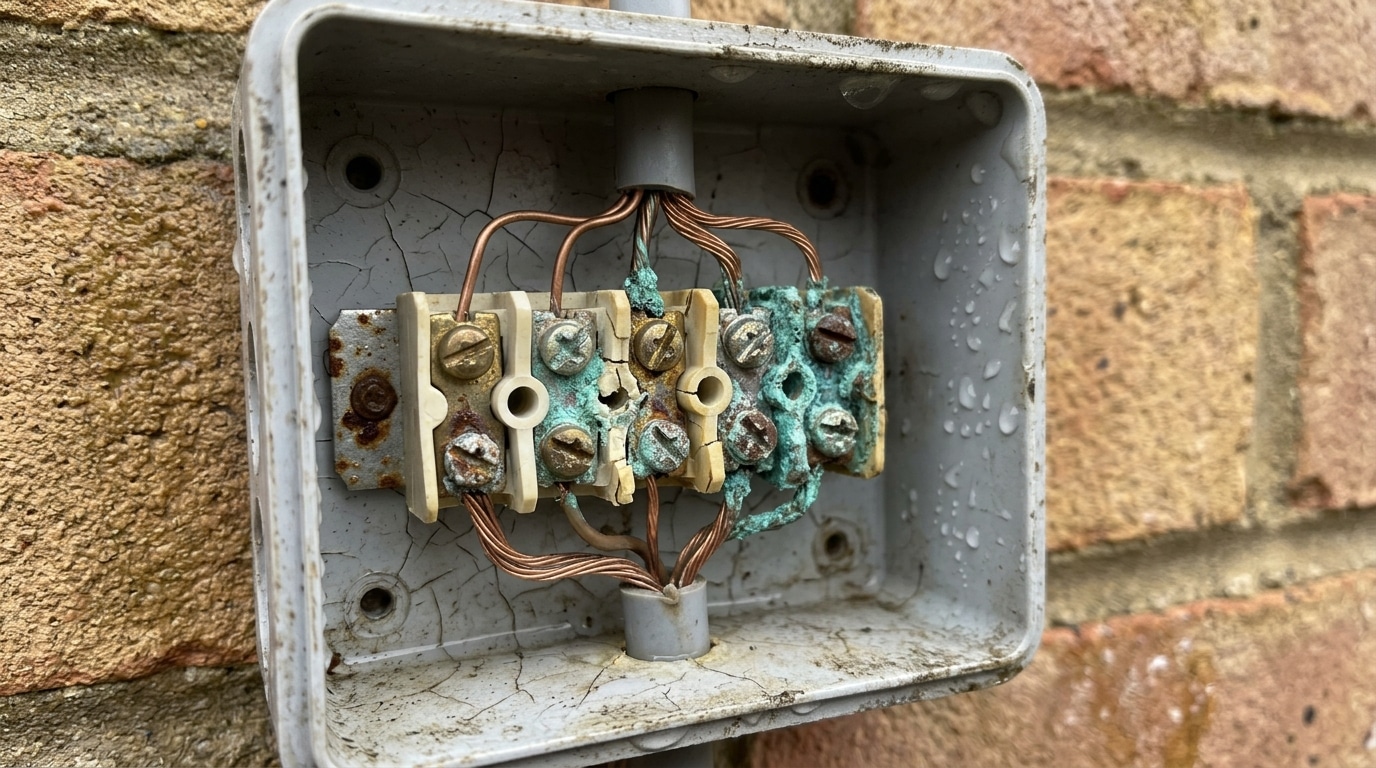
- Humidity cycling — Daily temperature swings cause condensation inside enclosures. Water droplets bridge conductors, creating leakage currents that accelerate electrochemical corrosion between dissimilar metals (copper and tin-plated contacts, for example).
- Salt spray — Coastal installations within 3 km of the shoreline experience aggressive chloride attack. According to IEC 60068-2-11 salt spray testing standards, unprotected copper conductors can develop measurable oxide layers in as little as 48 hours of continuous salt fog exposure.
- UV degradation — Polyamide (PA66) housings — the most common terminal block material — become brittle under prolonged UV exposure, leading to micro-cracks that compromise the ingress protection seal entirely.
- Temperature extremes — Thermal expansion and contraction loosen screw-clamp connections over time, increasing contact resistance. A connection that measures 0.5 mΩ at installation can drift above 5 mΩ after several hundred thermal cycles, generating localized hot spots.
The Real Cost of Getting It Wrong
Corrosion-induced failures don’t just mean replacing a €2 terminal block. They cause arc faults, blown fuses, and unplanned downtime. In solar installations, the NFPA has documented cases where corroded connections in outdoor junction boxes led to series arc faults exceeding 300°C — hot enough to ignite surrounding insulation.
Pro tip: If your installation site experiences more than 80% average relative humidity or regular freeze-thaw cycles, treat the minimum IP rating recommendation as a floor, not a ceiling. Bump up one protection class as a margin of safety.
Selecting the right terminal block IP rating for outdoor use means accounting for every stressor simultaneously — not just rain, but the combination of rain, salt, UV, vibration, and thermal shock acting together over a 10–25 year service life.
IP Rating Scale Breakdown for Outdoor Applications
Not every outdoor environment demands the same level of ingress protection. A rooftop solar combiner box in Phoenix faces different threats than a marina distribution panel in Miami. Choosing the right terminal block IP rating for outdoor use means matching the specific digits to your actual exposure conditions — not just grabbing the highest number available.
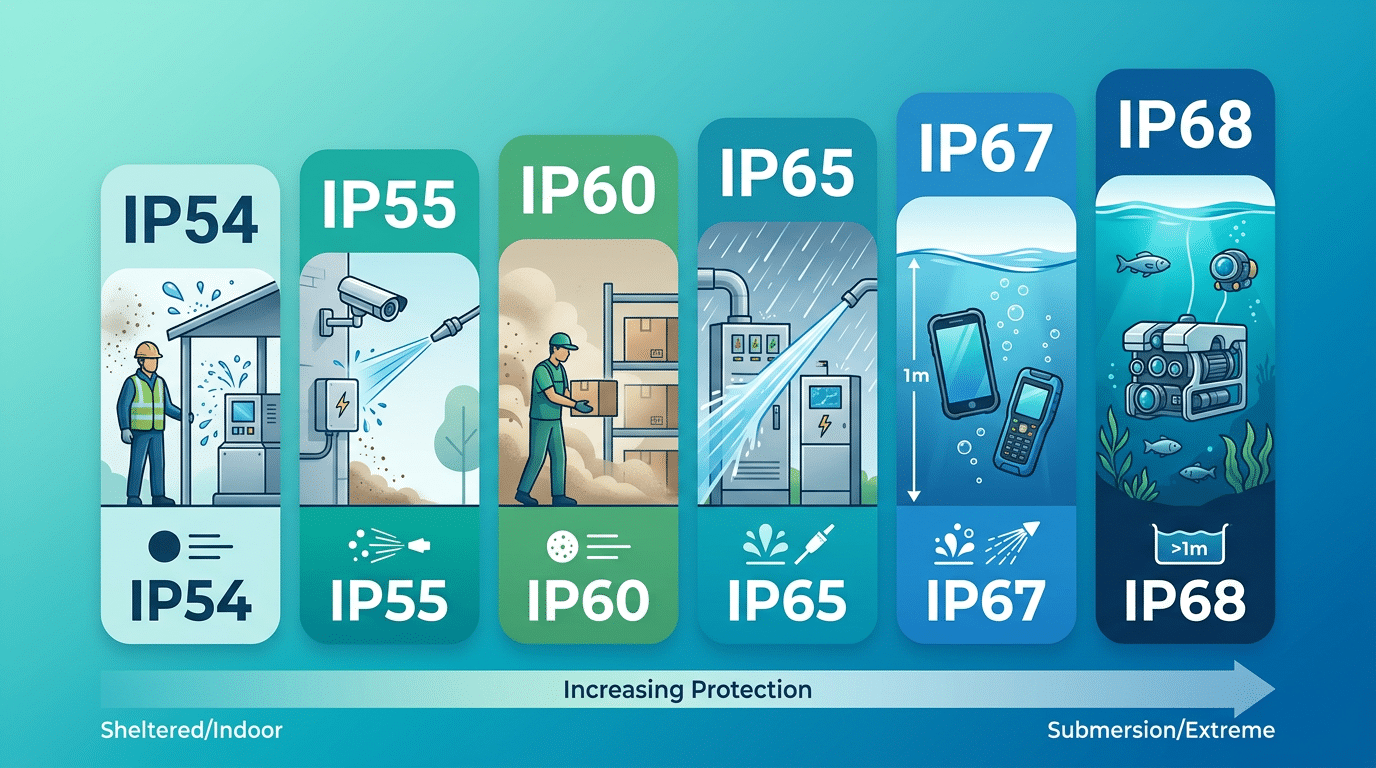
Here’s a side-by-side comparison of the six ratings you’ll encounter most often in outdoor electrical work:
| IP Rating | Solid Protection (1st Digit) | Liquid Protection (2nd Digit) | Best-Fit Outdoor Scenario |
|---|---|---|---|
| IP54 | Dust-protected (limited ingress) | Splashes from any direction | Sheltered enclosures, covered patios |
| IP55 | Dust-protected | Low-pressure water jets | Outdoor panels with partial shielding |
| IP65 | Dust-tight (zero ingress) | Low-pressure water jets | Exposed rooftop or wall-mounted boxes |
| IP66 | Dust-tight | Powerful water jets (12.5 L/min at 100 kPa) | Industrial yards, car washes, coastal sites |
| IP67 | Dust-tight | Temporary immersion (up to 1 m, 30 min) | Flood-prone zones, ground-level pits |
| IP68 | Dust-tight | Continuous submersion (depth per manufacturer) | Underwater pumps, submerged junction boxes |
The jump from IP54 to IP65 is the most consequential for outdoor terminal blocks. That first digit moving from 5 to 6 means the difference between “dust-protected” — where some fine particles still enter — and “dust-tight,” where zero dust penetrates the enclosure. In arid, sandy regions, that distinction directly affects contact resistance and long-term reliability. According to IEC 60529 as documented by the IP Code standard, dust-tight certification requires a full 8-hour test under negative pressure conditions.
Pro tip: IP66 is the sweet spot for most fully exposed outdoor installations. IP67 and IP68 add submersion protection you’ll rarely need unless the terminal block sits below grade or in a flood zone. Specifying IP68 for a wall-mounted enclosure wastes budget — those enclosures typically cost 30–50% more than IP66 equivalents — without adding meaningful protection against the rain, hose-downs, and wind-driven spray that actually threaten your connections.
One detail installers overlook: the second digit only describes freshwater testing. Saltwater, chemical spray, or high-temperature steam require separate evaluations beyond the standard IP scale. If your outdoor terminal blocks face coastal salt fog, look for supplementary corrosion ratings like ISO 9227 compliance rather than relying solely on a high IP number.
Minimum IP Ratings for General Outdoor Installations
IP65 has become the de facto baseline when specifying a terminal block IP rating for outdoor use in standard installations. The reasoning is straightforward: the “6” guarantees complete dust-tightness, while the “5” confirms protection against water jets from any direction at 12.5 liters per minute. That combination handles wind-driven rain, sprinkler overspray, and airborne particulates — the three most common threats in general outdoor environments.
Why not IP64? The jump from “4” (splash-proof) to “5” (jet-proof) matters more than it looks on paper. According to the IEC 60529 standard referenced on Wikipedia, IPX4 testing uses only 10 liters per minute with no pressure nozzle, while IPX5 employs a 6.3 mm nozzle delivering pressurized streams. Real-world storms regularly exceed splash conditions, which is why most electrical engineers skip IP64 entirely for anything mounted outdoors.
Typical Applications Where IP65 Is Sufficient
- Outdoor lighting junctions — Pole-mounted LED drivers and fixture splice points rarely face submersion but endure heavy rain and dust accumulation year-round.
- Garden and landscape electrical systems — Low-voltage irrigation controllers and decorative lighting connections sit above grade, making jet protection adequate.
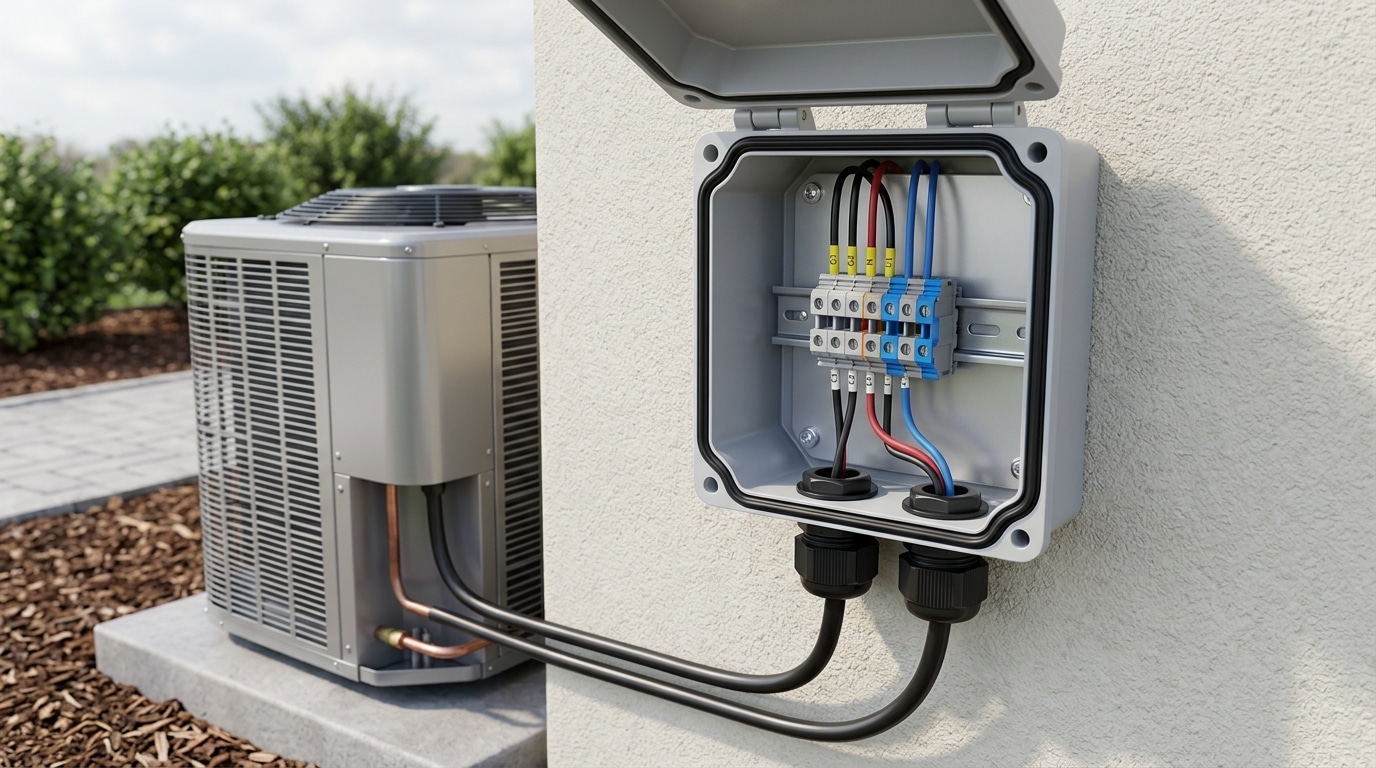
- HVAC condenser connections — Rooftop and pad-mounted units experience direct rainfall and seasonal pollen storms; IP65 terminal blocks inside the unit’s service panel handle both.
- Building automation sensors — BACnet and Modbus field devices on exterior walls need dust-tight terminations that resist pressure-washing during facade maintenance.
A practical tip many installers overlook: even with IP65-rated terminal blocks, orient the enclosure’s cable entries downward. Field data from Weidmüller’s application engineering team shows that roughly 38% of outdoor connection failures trace back to water pooling at improperly oriented cable glands — not the terminal block rating itself. The IP number protects the component; installation geometry protects the system.
Pro rule of thumb: If the terminal block will never sit below the local flood line and won’t face direct hose-down cleaning, IP65 is your sweet spot. Anything less is a gamble; anything more adds cost without measurable reliability gain for standard outdoor conditions.
When to Specify IP67 or IP68 for Extreme Weather and Submersion
IP65 handles rain. IP66 handles pressure washing. But neither survives being submerged — and that distinction matters more often than most engineers initially expect. If your installation sits in a flood zone, a coastal tidal area, or an underground vault that collects groundwater, selecting a terminal block IP rating for outdoor use at IP67 or IP68 isn’t over-engineering — it’s the only defensible choice.
Scenarios That Demand IP67 or Higher
- Flood-prone areas: FEMA estimates that just one inch of floodwater causes roughly $25,000 in damage to a structure. Electrical junction points submerged even briefly need IP67 (immersion up to 1 meter for 30 minutes) to prevent catastrophic insulation failure.
- Underground vaults and manholes: Stormwater infiltration can fill a utility vault in minutes. IP68-rated terminal blocks — tested for continuous submersion beyond 1 meter at a depth and duration specified by the manufacturer — are standard practice here.
- Marine and dock-side installations: Salt spray alone demands IP66, but tidal splash zones and wave overtopping push the requirement to IP67 minimum. Corrosion-resistant housing (316 stainless or marine-grade polymer) must accompany the IP rating.
- High-pressure washdown environments: Food processing facilities, livestock operations, and wastewater treatment plants routinely blast equipment at 80–100 bar. IP69K addresses this specific abuse, though IP67 covers the subsequent pooling.
Is the Added Cost Justified?
An IP68 terminal block typically costs 2–4× more than an IP65 equivalent. That premium feels steep — until you price a single emergency service call to replace waterlogged connections. Run a simple risk assessment: How many times per year could the installation be partially or fully submerged? If the answer is even once, specify IP67 at minimum.
Pro tip: Don’t just match the terminal block’s IP rating to the enclosure. Verify that cable glands, seals, and DIN rail mounting hardware all share the same submersion rating. One IP65 cable gland inside an IP68 box reduces the entire assembly to IP65.
Weatherproof Enclosures vs IP-Rated Terminal Blocks — Which Approach to Use
Two legitimate engineering paths exist for protecting outdoor terminal connections: buy terminal blocks with a built-in IP rating, or house standard IP20 blocks inside a separately rated NEMA 4X or IP66 enclosure. Neither approach is universally superior — the right choice hinges on your project’s density, budget cycle, and maintenance cadence.
The Enclosure Strategy
Placing standard DIN-rail terminal blocks inside a weatherproof enclosure is the most common approach in industrial panels. A polycarbonate or fiberglass enclosure rated NEMA 4X can shelter dozens of connection points at once, often at 30–40% lower per-circuit cost than buying individually sealed blocks. You also gain easier rewiring — pop the enclosure open, and every terminal is immediately accessible with standard tools.
The catch? Gaskets degrade. Every time a technician opens that enclosure for maintenance, the seal’s effective lifespan drops. Field data from utility-scale solar sites shows gasket replacement is needed roughly every 3–5 years in UV-heavy environments, adding hidden lifecycle cost.
The Inherently Rated Block Strategy
Gel-filled or resin-potted terminal blocks carrying their own IP67/IP68 rating eliminate the enclosure entirely. This makes sense for distributed architectures — think streetlight poles, remote sensor nodes, or irrigation valve manifolds where a single connection point sits far from any panel. The terminal block IP rating for outdoor use is self-contained, so there’s no gasket to fail and no enclosure footprint to accommodate.
Practical rule of thumb: If your design has fewer than 4 connection points at a single location, individually IP-rated blocks usually win on total installed cost. Above 8–10 connections, a shared enclosure becomes more economical and far easier to troubleshoot.
Quick Comparison
| Factor | Weatherproof Enclosure + Standard Blocks | Inherently IP-Rated Blocks |
|---|---|---|
| Upfront cost (per circuit) | Lower at scale | Higher per unit |
| Maintenance access | Easy — open lid | May require cutting potting compound |
| Long-term seal integrity | Depends on gasket condition | Permanent if undisturbed |
| Best for | Dense panels, 8+ circuits | Distributed, low-circuit-count nodes |
Hybrid setups work too. Some engineers specify IP65 enclosures with IP44 terminal blocks inside — a belt-and-suspenders approach that provides redundancy if the enclosure seal is compromised during service. When choosing a terminal block IP rating for outdoor use, match the strategy to how often someone will physically touch the installation after commissioning.
How to Verify and Maintain IP Ratings After Installation
An IP67 terminal block sitting on your workbench offers genuine submersion protection. That same block installed with a cracked gasket or an undersized cable gland? It might not even meet IP44. The terminal block IP rating for outdoor use is a laboratory-tested value — it only holds in the field if every sealing component is installed correctly and maintained over time.
Installation Details That Make or Break Protection
- Cable gland selection: Match the gland’s clamping range to the actual cable outer diameter. A gland rated for 10–14 mm cable used on a 7 mm conductor leaves a gap no gasket can fully compensate for.
- Torque specifications: Over-tightening polyamide cable glands — common with inexperienced installers — cracks the body and destroys the seal. Most M20 nylon glands require only 3–4 Nm. Use a calibrated torque wrench, not “hand-tight plus a quarter turn.”
- Gasket integrity: EPDM and silicone gaskets degrade under UV exposure. According to material data on EPDM rubber, UV-stabilized EPDM retains elasticity far longer than standard nitrile, making it the preferred choice for outdoor enclosure seals.
Periodic Inspection Schedule
A practical rule: inspect outdoor terminal block enclosures every 6 months in temperate climates and every 3 months in coastal, desert, or tropical environments. During each inspection, check for these red flags:
- Visible condensation inside the enclosure (breather vents may be clogged or gaskets compromised)
- Discolored or brittle gasket material — replace immediately, not “next visit”
- Corrosion on terminal screws or bus bars, which signals moisture ingress even if no standing water is present
- Loose cable glands that can be rotated by hand
Pro tip: After resealing an enclosure, spray the exterior seams with soapy water and apply 2–3 psi of internal air pressure. Bubbles reveal leaks that visual inspection misses. This simple field test catches roughly 80% of seal failures before they cause electrical faults.
Skipping maintenance doesn’t just void the effective IP rating — it voids warranties. Most manufacturers explicitly state that their terminal block IP rating for outdoor use assumes periodic gasket replacement at 24- to 36-month intervals. Document every inspection with photos and torque readings; this paper trail matters during warranty claims and compliance audits.
Common Mistakes When Choosing and Wiring Terminal Blocks Outdoors
Even experienced electricians sabotage a perfectly good terminal block IP rating for outdoor use by overlooking details that seem minor on paper but cause failures within months. Here are the mistakes that show up again and again — and how to sidestep each one.
Trusting the Enclosure Rating While Ignoring Cable Entry Points
This is the single most common error. You install an IP66 enclosure, populate it with DIN-rail terminal blocks, then punch cable glands through the bottom without verifying their individual IP ratings. A single unrated or poorly tightened gland drops the effective protection of the entire assembly to IP20 or worse. Every penetration — glands, breather vents, conduit adapters — must match or exceed the enclosure’s rating. No exceptions.
Mixing Incompatible Metals
Pairing a copper-alloy terminal block with an aluminum bus bar or steel mounting hardware creates a galvanic corrosion cell the moment moisture enters. In coastal environments, this can degrade contact resistance by over 40% within 12 months. Use bimetallic washers or apply anti-oxidant compound at every dissimilar-metal junction. Better yet, standardize on a single alloy family throughout the enclosure.
Skipping Strain Relief
Wind-induced cable movement is relentless. Without proper strain relief — cable ties anchored to a DIN rail, dedicated strain-relief plates, or spring-loaded cable glands — conductors work loose from screw or push-in terminals. The result: intermittent arcing, heat buildup, and eventual failure that no IP rating can prevent.
Forgetting Thermal Expansion
Outdoor temperatures can swing 60 °C or more between summer noon and winter midnight. Rigid wiring runs with zero slack crack solder joints and back out screw terminals over repeated thermal cycles. Leave a small service loop inside the enclosure and torque connections to the manufacturer’s spec — then re-torque after the first full seasonal cycle.
Quick rule: if your terminal block IP rating for outdoor use checks out but your installation shortcuts don’t, the rating is meaningless. Protection is only as strong as the weakest entry point, the weakest metal pairing, and the weakest mechanical connection.
Relevant Standards and Certifications to Look For
An IP rating printed on a datasheet means nothing unless a recognized testing body stands behind it. The foundational document is IEC 60529, published by the International Electrotechnical Commission, which defines every IP digit, the exact test apparatus, and the pass/fail criteria. If a manufacturer claims IP66 but cannot produce a test report referencing IEC 60529, walk away.
IEC 60529 vs. NEMA Ratings — They Are Not Interchangeable
NEMA ratings (set by the National Electrical Manufacturers Association) cover more than ingress protection — they also address corrosion resistance, gasket aging, and external icing conditions. A NEMA 4X enclosure, for example, roughly corresponds to IP66 for water and dust, but it additionally requires resistance to salt-spray corrosion across 200+ hours of testing per ASTM B117. You can map a NEMA rating down to an approximate IP equivalent, but you cannot reliably map an IP rating up to a NEMA designation. This distinction matters when specifying a terminal block IP rating for outdoor use in coastal or industrial-chemical environments.
UL and Regional Certifications
- UL 508 — Covers industrial control equipment in North America. A UL 508 listing confirms the terminal block meets safety requirements for dielectric strength, temperature rise, and mechanical durability, though it does not itself assign an IP rating.
- CE Marking (EU) — Indicates compliance with the Low Voltage Directive (2014/35/EU). Roughly 78% of terminal blocks sold in the European market carry CE marking, but CE alone does not guarantee a specific IP level.
- CSA C22.2 — The Canadian counterpart to UL, often dual-listed as cUL on product labels.
Pro tip: Before purchasing terminal blocks for outdoor projects, demand the actual third-party test certificate — not just the manufacturer’s self-declaration. Reputable brands like Phoenix Contact, Weidmüller, and Wago publish downloadable IEC 60529 test reports on their product pages. A missing report is a red flag, not an oversight.
Cross-referencing the terminal block IP rating for outdoor use against both the IEC test report and any applicable NEMA or UL listing gives you the most complete picture of real-world durability. Skipping this step is how cheap components end up failing inspections — or worse, failing in the field.
Frequently Asked Questions About Terminal Block IP Ratings for Outdoor Use
What IP rating do I need for rain exposure?
IP65 is the minimum for direct rain. It protects against low-pressure water jets from any direction, which covers normal rainfall and wind-driven spray. If your installation faces monsoon-level downpours or rooftop runoff channeling water directly onto the enclosure, step up to IP66 — it handles high-pressure jets at 100 liters per minute.
Is IP65 waterproof enough for permanent outdoor use?
Yes — with a caveat. IP65 blocks rain, dust, and condensation reliably for years when gaskets and cable glands remain intact. However, “permanent” means maintenance matters. Gasket elastomers lose roughly 15–20% of their compression set within 5 years under UV exposure, according to IEC 60529 testing standards. Schedule annual seal inspections, and IP65 will hold up for the long haul.
Do IP ratings degrade over time?
Absolutely. The rating reflects factory-new performance, not field-aged reality. UV radiation, thermal cycling, chemical exposure, and repeated cable insertion all erode seals. A terminal block that tested IP67 on day one can drop to effective IP54 protection after 3–4 years without gasket replacement — especially in coastal or industrial-chemical environments.
How can I upgrade existing outdoor terminal blocks to a higher protection level?
Swapping the terminal block itself is rarely the most cost-effective move. Instead, retrofit the enclosure: add IP-rated cable glands to every entry point, replace aged gaskets with EPDM or silicone versions, and apply a bead of non-acetic silicone sealant around the enclosure lid. These three steps can elevate an IP54 assembly to functional IP65 performance for under $30 per junction box. Only when the terminal block housing is cracked or warped should you replace the block entirely.
Choosing the Right IP-Rated Terminal Block — A Decision Summary
Every decision boils down to three variables: how wet, how dusty, and how accessible the installation site is. Get those answers right, and the correct terminal block IP rating for outdoor use practically selects itself.
Rule of thumb: over-specifying by one IP tier costs roughly 10–15% more per block but can prevent field failures that run $500–$2,000+ per service call in remote locations.
Quick-Reference Selection Checklist
- Define the exposure. Sheltered overhang? Open rooftop? Flood zone? Match the environment to the IP scale — IP65 minimum for general rain, IP67 for temporary submersion, IP68 for permanent underwater duty.
- Choose your protection strategy. Decide between an IP-rated enclosure housing standard blocks or self-rated IP terminal blocks. Hybrid approaches work, but never assume the enclosure alone maintains its rating after cable glands are installed.
- Verify certifications. Demand third-party test reports per IEC 60529 — not just a manufacturer’s self-declaration. Look for UL, TÜV, or equivalent marks.
- Spec the conductor and torque. Confirm the block handles your wire gauge, and record the manufacturer’s torque value. An under-torqued connection degrades the seal faster than UV exposure does.
- Plan maintenance access. Schedule annual gasket inspections. A single cracked O-ring drops an IP67 block to effectively IP44 or worse.
- Document everything. Log the IP rating, installation date, torque values, and enclosure model. This paper trail is what saves you during warranty disputes and code inspections.
Skip the temptation to default to IP68 everywhere — you’ll pay for sealing you don’t need and create maintenance headaches with overly complex housings. Instead, match the rating precisely to the threat. That single discipline separates reliable outdoor electrical systems from the ones that generate repeat service tickets year after year.
See also
Waterproof Wall Sockets: Application Scenarios and Protection Level
Terminal Block Torque Specifications – A Complete Reference Guide
What Is the Best IP Rating for Outdoor Sockets
Systematic Selection of Terminal Blocks for Electrical Panels Made Easy
Water in Electrical Panel: 5 Things Pros Must Never Do