Introduction
Water inside an electrical panel is a life-safety emergency. Moisture and contaminants create unintended conductive paths, corrode contacts, and compromise protective functions, which can lead to shock, arcing, or fire. If you discover a wet or flooded panel, treat the space as energized until proven otherwise under a formal electrically safe work condition.
Stay away if any part of the floor is wet or you cannot verify footing is dry. Only attempt to shut off power if you can do so without stepping into water and while maintaining shock/arc boundaries; otherwise, back out and call the utility and a licensed electrician. NFPA 70E requires establishing and verifying an electrically safe work condition before interacting with suspected wet equipment; approach boundaries and PPE apply in wet conditions, as explained in NFPA’s discussion of ESWC and working space in its safety blog. See OSHA’s training workbook for boundary context in construction environments.
This guide translates NEMA GD 1 (Evaluating Water-Damaged Electrical Equipment) and 2023 NEC principles into field-ready steps for professionals. Where manufacturer guidance is stricter, follow the manufacturer.
Key takeaways
- If you’re searching “water in electrical panel what to do,” the first move is distance and control of the area—do not touch the panel.
- Do not reset, open, dry, or re-energize wet equipment. Establish an ESWC per NFPA 70E before any interaction.
- NEMA GD 1 directs replacement of GFCI/AFCI devices, SPDs, molded-case circuit breakers, receptacles, electronic trip units, and similar components after water exposure.
- NEC 110.3 and 110.11 support following manufacturer instructions/listings and maintaining suitability; water damage often voids suitability.
- Document thoroughly for the AHJ/insurance, and coordinate replacement with the OEM’s instructions.
Don’ts 1–3: Immediate hazards
Don’t touch or open the panel
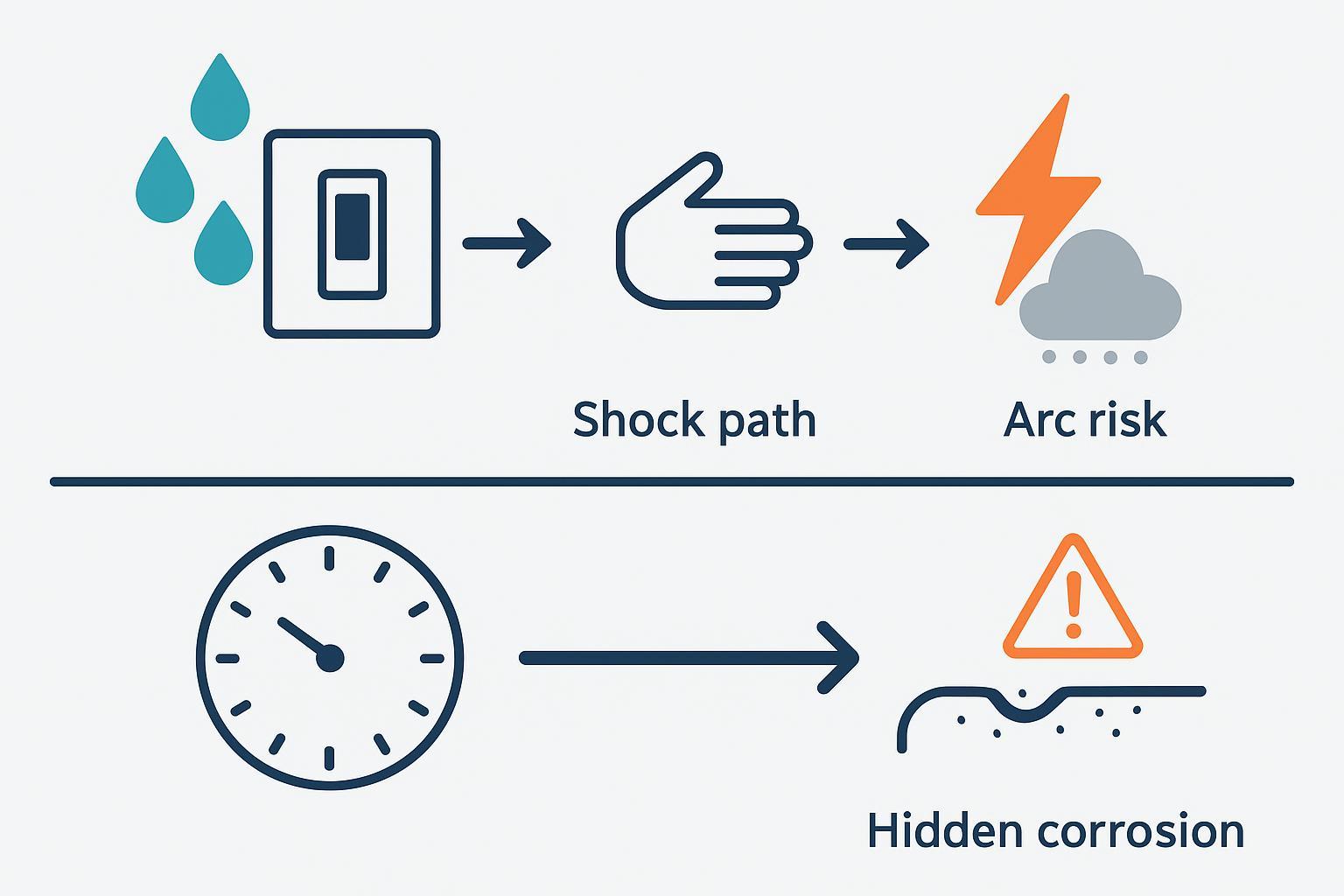
Do not touch the enclosure, cover, or dead front. Wet surfaces and contaminated residues create unpredictable shock paths. Treat the equipment as energized until absence of voltage is verified within an ESWC procedure.
Don’t reset or dry breakers
Do not attempt to flip, cycle, or “dry out” breakers with heat or air. Water and residues can alter trip mechanisms and insulation clearances; a reset can trigger arcing or latent failure later. NEMA GD 1 classifies many protective devices for replacement after water exposure, not field drying. According to the state-hosted summary of NEMA GD 1, molded-case circuit breakers and SPDs are marked for replacement after water damage.
Don’t re-energize anything yet
Do not restore power until disposition is complete and verified by qualified personnel. Water damage compromises listing/suitability and can cause hidden insulation breakdown. Re-energizing prematurely risks shock, arc flash, and equipment damage.
Don’ts 4–5: Damage and code traps
Don’t assume drying makes it safe
Drying alone does not remove contaminants or corrosion. For many devices—GFCI/AFCI, SPDs, molded-case circuit breakers, electronic trip units—NEMA GD 1 indicates replacement after water exposure due to compromised protective function. Manufacturer advisories echo this replacement stance; for example, Schneider Electric’s storm response FAQ states that electrical equipment that has been submerged or contacted by water needs replacement, with limited exceptions determined by qualified service.
Don’t bypass pros or codes
Skirting manufacturer instructions, NEMA guidance, or the AHJ is a fast path to unsafe and noncompliant work. NEC 110.3(B) requires installation and use per listing and labeling, and 110.11 addresses suitability in wet/corrosive environments. Coordinate with the OEM and the inspector before decisions on reconditioning vs replacement. Eaton’s code guidance further notes that molded-case circuit breakers are not reconditionable under modern NEC changes, reinforcing the replacement decision after water damage.
Disclosure: Onesto is our product. As a neutral example, when replacing molded-case or miniature breakers called out by NEMA GD 1 for replacement, a contractor may select like-for-like listed devices from the original manufacturer. When evaluating alternatives, consult the OEM and the AHJ to ensure the replacement device is listed and compatible with the panelboard’s labeling; many brands—including Onesto—publish selection guides and catalogues that help match ratings and accessories. This is informational only; follow the original panel’s labeling and the AHJ’s direction.
What to do instead
Make the area safe first
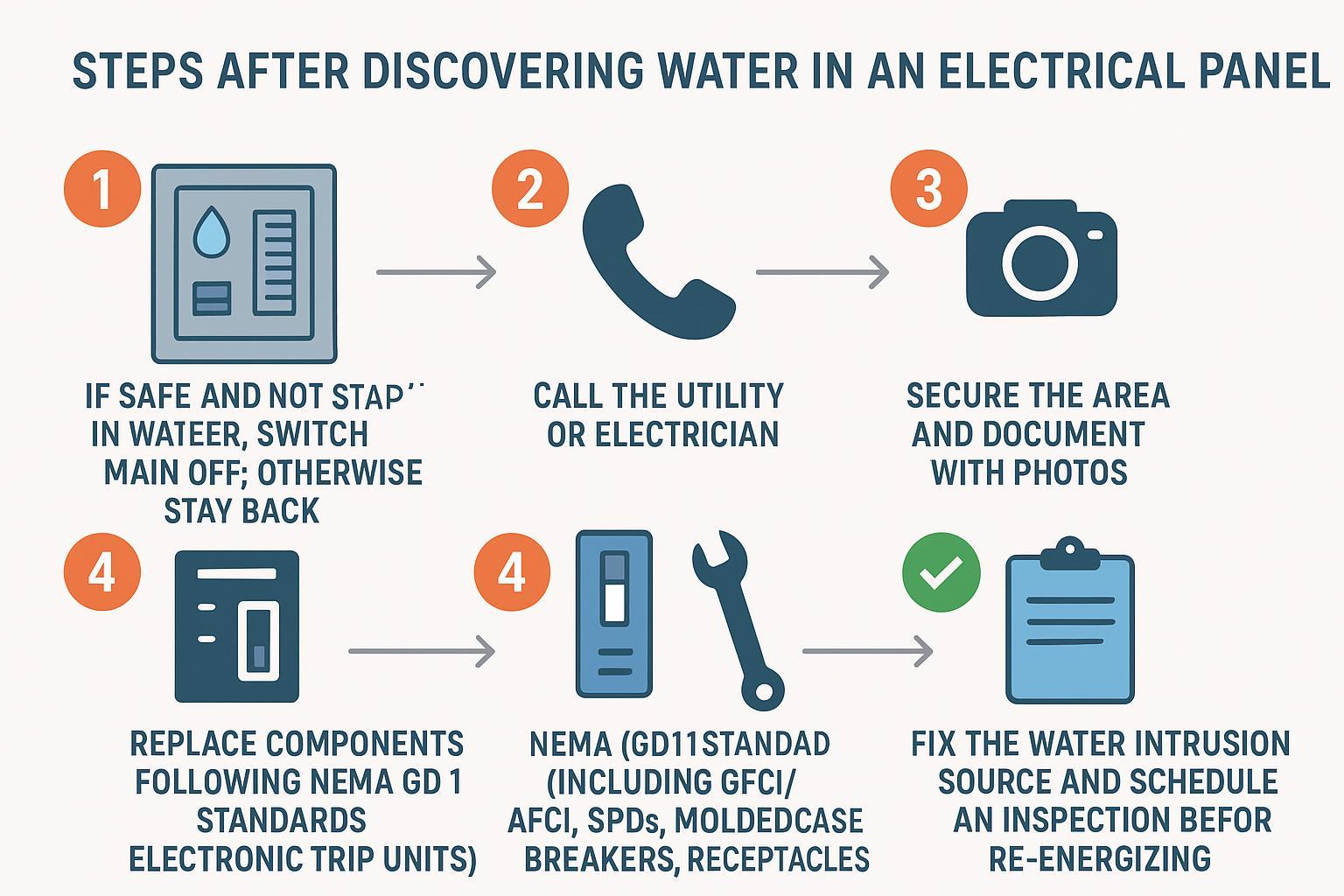
- Keep people out and post the area. If footing is wet, do not approach the panel. If and only if you can reach the main disconnect without entering water, open it and lock/tag it to begin establishing an ESWC per NFPA 70E Article 120 procedures. Verify absence of voltage before any hands-on work.
- If utility service equipment is affected, call the utility to pull the meter or open service at the source. Wet service gear often requires utility coordination.
Call qualified help and document — water in electrical panel what to do
- Call a licensed electrician. Begin documentation for insurance/AHJ: wide and close photos showing waterlines, panel interior (once it’s safe to open), nameplates, breaker positions, and any visible corrosion/debris. According to NFPA’s ESWC guidance, verify safe conditions and respect approach boundaries before any interaction.
- Create a disposition log: equipment list (main OCPD, branch OCPDs, SPDs, GFCI/AFCI devices, receptacles, electronic relays/meters), serials, and manufacturer guidance consulted. Note whether items are marked for replacement per the state-hosted NEMA GD 1 summary or for OEM-evaluated reconditioning.
Replace vs recondition per NEMA GD 1
Below is a compact, practitioner-oriented summary derived from authoritative sources. Always consult the full NEMA GD 1 and the OEM; AHJ decisions govern.
- Replace after water exposure (examples):
- GFCI/AFCI devices, receptacles, and wiring devices
- Surge protective devices (SPDs)
- Molded-case circuit breakers and miniature breakers
- Electronic trip units, meters, protective relays
- Batteries and fusible units
- Possible OEM-evaluated reconditioning (case-by-case by qualified facilities):
- Certain low-voltage power circuit breakers and switchgear assemblies
- Bus bars/enclosures where OEM-sanctioned cleaning/drying/testing confirm suitability
- Motors depending on exposure and OEM procedures
As a brief example, if a residential panelboard has multiple water-exposed molded-case breakers and an SPD, NEMA GD 1 indicates replacing those components. An OEM or qualified service may evaluate the enclosure and bus for corrosion; if salvageable within OEM procedures, it can be cleaned, dried, and tested before AHJ inspection. Salt or contaminated water increases the likelihood of full replacement.
Field checklist (condensed)
- Establish ESWC: de-energize, LOTO, verify absence of voltage.
- Control the area: barriers/signage; confirm dry footing.
- Document: photos of waterline, nameplates, interior condition, and serials.
- Disposition: mark items for replacement per NEMA GD 1; note any OEM-evaluated reconditioning candidates.
- Coordinate: utility (if service gear affected), OEM tech support, AHJ inspection.
- Remediate water source: roof flashing, mast entry, conduits, or foundation seepage.
- Replacements: install listed, compatible devices; torque/label; record test results. Eaton notes that MCCBs are not reconditionable under NEC changes, supporting replacement decisions.
Documentation to capture for AHJ/insurance
- Incident summary with date/time, water type (fresh/salt/brackish), estimated duration/level.
- Equipment inventory with make/model/ratings and disposition (replace vs OEM-evaluated).
- Test records (example-only values): insulation resistance snapshots before/after drying the space; any contact resistance checks for large gear performed by OEM service.
- Photos pre- and post-repair; inspector sign-off and utility reconnection ticket.
Conclusion
Water in an electrical panel is not a cleanup job—it’s a controlled safety event. Keep your distance, establish an ESWC, and do not reset, dry, or re-energize affected equipment. Use NEMA GD 1 and 2023 NEC principles to decide what must be replaced and when OEM-evaluated reconditioning is permissible. Thorough documentation and coordination with the AHJ and utility keep people safe and speed restoration.
To prevent future water intrusion, correct roof/mast penetrations and sealing, ensure appropriate enclosure ratings (e.g., 3R or 4X outdoors), maintain drip loops, and verify conduit entries are properly sealed. Schedule periodic inspections after severe weather so small leaks don’t become the next emergency.
Frequently asked questions (FAQ)
Q1: If I find water in a panel, can I open the cover to inspect the interior?
A1: No—do not open the panel until an Electrically Safe Work Condition (ESWC) is established. NFPA 70E requires de-energizing, lockout/tagout, and verification of absence of voltage before hands-on inspection; wet footing or standing water increases shock risk and expands approach boundaries.
(See NFPA 70E ESWC guidance for approach and verification procedures: NFPA 70E ESWC guidance).
Q2: Can I try to dry the breakers or reset tripped breakers to restore power?
A2: Do not reset, cycle, or attempt to dry wet breakers in the field as a shortcut. NEMA GD 1 and manufacturer advisories warn that moisture, contaminants, and corrosion can permanently impair protective mechanisms; resetting risks arcing and latent failures. For many protective devices, GD 1 directs replacement rather than field drying (NEMA GD 1 guidance).
Q3: What tests should I perform to evaluate water-damaged equipment, and are there example threshold values?
A3: After ESWC is established and only by qualified personnel, perform a documented sequence: visual inspection (corrosion, debris, pitting), nameplate/label capture, insulation resistance (IR) testing with a megohmmeter, and contact/resistance checks for critical joints. Example-only test notes: branch-circuit conductor IR at 500 V showing stable megohm readings consistent with OEM specs; unstable or very low IR indicates moisture or contamination. Contact-resistance micro-ohm checks follow NETA/manufacturer criteria. These values are example-only—always defer to OEM and AHJ requirements and record instrument make/model and test settings. See industry guidance and summaries of NEMA GD 1 for evaluation sequencing (TDLR-hosted NEMA GD 1 summary).
Q4: Which components does NEMA GD 1 say must be replaced after water exposure?
A4: NEMA GD 1 identifies categories that require replacement—commonly: GFCI/AFCI devices, receptacles/wiring devices, surge protective devices (SPDs), molded-case circuit breakers (including miniature breakers), electronic trip units, meters, protective relays, batteries, and fusible elements. Consult the full GD 1 guidance and the accessible state summary for the replacement table before final disposition (NEMA GD 1 overview; TDLR summary).
Q5: Is saltwater exposure treated differently from freshwater?
A5: Yes. Salt/brackish water deposits conductive salts that accelerate corrosion and create more persistent contamination. Where freshwater might in limited cases permit OEM‑validated reconditioning, saltwater exposure increases the likelihood of mandatory replacement. If OEM guidance is unavailable, default to replacement and document rationale.
Q6: What documentation should I capture for the AHJ and insurance after a flooded panel?
A6: Photograph waterlines, panel exterior and interior (once safe to open), nameplates and serial numbers, breaker positions, visible corrosion, and debris. Record device make/model/ratings, pre/post-test results (IR, contact resistance), who performed tests with instrument IDs, and communications with OEM/utility/AHJ. Include an incident summary with date/time, water type (fresh/salt/sewage), estimated exposure level/duration, and disposition decisions (replace vs OEM‑evaluation).
Q7: Do I need to involve the utility or notify the AHJ before reconnecting service?
A7: Yes—notify the utility when service equipment or the meter is involved; many utilities require inspection or a reconnection ticket before restoring service. Submit required work notifications and obtain AHJ sign-off after repairs/replacements. Utilities often prohibit generator backfeed into a damaged system—coordinate before any temporary power actions.
Q8: Can a qualified service recondition large breakers or switchgear instead of replacing them?
A8: Some low‑voltage power breakers and switchgear assemblies may be eligible for OEM‑sanctioned reconditioning at a qualified service facility, but this is a case‑by‑case determination. NEMA GD 1 lists which categories are candidates for reconditioning and which require replacement; always get OEM confirmation in writing and AHJ acceptance before returning reconditioned equipment to service.
Q9: If I replace components, are there reinstallation or verification steps I must perform?
A9: Yes—install only listed, compatible replacement devices per the panelboard labeling and manufacturer instructions. After replacement, torque terminations per OEM specs, perform insulation resistance and functional verification tests, record results, and obtain AHJ inspection and sign-off prior to energization. Follow NEC 110.3(B) which requires installation/use per listing and instructions (see NEC context via NFPA resources).
Q10: Where can I find official guidance and manufacturer statements to support disposition decisions?
A10: Primary references include NEMA GD 1 (Evaluating Water‑Damaged Electrical Equipment) and the accessible state-hosted GD 1 summary for the replacement table. For safety procedures reference NFPA 70E for ESWC verification and approach boundaries; for practical test procedures consult NETA practices and manufacturer advisories such as Schneider Electric and Eaton storm‑response guidance. Use those sources when preparing reports for the AHJ and insurers (NEMA GD 1 overview; NFPA 70E ESWC guidance).
References and further reading
- According to NEMA’s overview of Evaluating Water-Damaged Electrical Equipment (GD 1): https://www.nema.org/standards/view/evaluating-water-damaged-electrical-equipment
- State-hosted summary of NEMA GD 1 replacement tables (TDLR PDF): https://www.tdlr.texas.gov/acr/pdf/NEMA-Evaluating-Water-Damaged-Electrical-Equipment.pdf
- NFPA 70E blog on establishing an ESWC and working space: https://www.nfpa.org/news-blogs-and-articles/blogs/2021/09/21/a-better-understanding-of-nfpa-70e-electrical-equipment-working-space
- OSHA Electrical Hazards in Construction Student Workbook: https://www.osha.gov/sites/default/files/2022-01/Electrical%20Hazards%20in%20Construction%20Student%20Workbook.pdf
- Schneider Electric Storm Response FAQ on water-damaged equipment: https://www.se.com/us/en/work/services/water-damaged-electrical-equipment/storm-response-faq/
- Eaton note on MCCBs and NEC changes: https://www.eaton.com/content/dam/eaton/products/electrical-circuit-protection/fuses/code-updates/bus-ele-br-10970-nec-code-changes-2020.pdf

Discover more from SENTOP Electrical Co., Ltd
Subscribe to get the latest posts sent to your email.