
5 Sizing Rules for Cold Press Terminals (AWG to Stud)
To choose a cold press terminal size, start with the terminal maker’s documented conductor range—not the insulation color. Then confirm conductor type, tongue and stud geometry, insulation support, electrical and environmental ratings, and the exact crimp tool, die and acceptance criteria.
Color and part codes are shortcuts, not specifications. A safe purchase order identifies the terminal part number or drawing, conductor construction, hardware, tooling and required approvals.

How do you choose the right cold press terminal size?
“Cold press terminal” is a common market term. Technical standards and manufacturer literature more often use crimp terminal, terminal lug or solderless terminal. This guide focuses on small and medium insulated or uninsulated ring and fork terminals. Large compression lugs, ferrules, coaxial contacts and sealed automotive connector systems may use different standards and tooling.
The main selection mistake is treating one visible feature as enough. A red sleeve does not prove the wire range, an “M6” description does not prove the exact hole and tongue dimensions, and a barrel that accepts the strands does not prove the crimp is qualified.
- Keep the terminal, wire and crimp tooling within one documented application combination.
- Use catalog drawings and application specifications instead of generic clearance or pull-force rules.
- For production or safety-related wiring, validate first-off crimps and control the process.
The five rules form one verified connection
Use the rules in order. Each one eliminates a different mismatch before the crimp becomes difficult to inspect or costly to rework.
Conductor
Confirm AWG or mm², copper or aluminum, solid or stranded, strand construction and quantity of conductors.
Terminal family
Use color and stamping only to find the maker’s datasheet. Verify the exact part number and conductor range.
Stud interface
Match the tongue style, hole, width, material stack and available space to the equipment drawing.
Wire preparation
Follow the specified strip length and insulation-diameter range without nicked strands or misplaced insulation.
Rating and tooling
Confirm approvals, environment and the exact crimp tool, die, locator, setting and inspection plan.
IEC 60352-2:2024 provides general requirements, tests and practical guidance for solderless crimped connections, but the terminal manufacturer’s application data still controls the specific wire, terminal and tooling combination.
Match the barrel to the actual conductor
Read the wire marking or controlled bill of materials. Do not estimate conductor size from the outside diameter of its insulation.
Record AWG or nominal mm², conductor material, solid or stranded construction, strand count or class when relevant, plating, and whether one or more conductors enter the barrel.
Two wires with the same conductor area can have very different insulation diameters and temperature ratings.
Removing strands changes both conductor area and crimp geometry and invalidates the intended combination.
Use a terminal specifically approved for the conductor rather than improvising barrel fill.
| AWG | Nominal copper area | AWG | Nominal copper area | Selection instruction |
|---|---|---|---|---|
| 22 | 0.326 mm² | 16 | 1.31 mm² | Confirm the product explicitly lists the gauge or area. |
| 20 | 0.518 mm² | 14 | 2.08 mm² | Do not treat a rounded metric value as exact equivalence. |
| 18 | 0.823 mm² | 12 | 3.31 mm² | Verify conductor material and strand construction too. |
| 10 | 5.26 mm² | 8 | 8.37 mm² | Move to the correct terminal and tooling family as size increases. |
Nominal AWG areas are reference values from the US National Bureau of Standards/NIST Copper Wire Tables. A terminal’s certified range may list both AWG and metric sizes without implying that the rounded labels are mathematically identical.

Use color and stamping to find the datasheet—not to replace it
Red, blue and yellow sleeves are familiar in many pre-insulated terminal families, but their wire ranges are not globally universal. For example, one TE PIDG family uses red for 22–18 AWG, blue for 16–14 AWG and yellow for 12–10 AWG, while other product families include different boundaries and additional colors.
Likewise, codes such as RV2-4 are common in supplier catalogs but are not a universal international language. They may suggest an insulated ring terminal in a nominal conductor series with an M4-compatible stud, yet the actual conductor range, hole diameter, material, plating, sleeve construction and approved die must come from that supplier’s drawing.
Keep the maker, exact part number, package label and applicable drawing traceable. When changing suppliers, treat the part as a new terminal-and-tool combination and revalidate it.
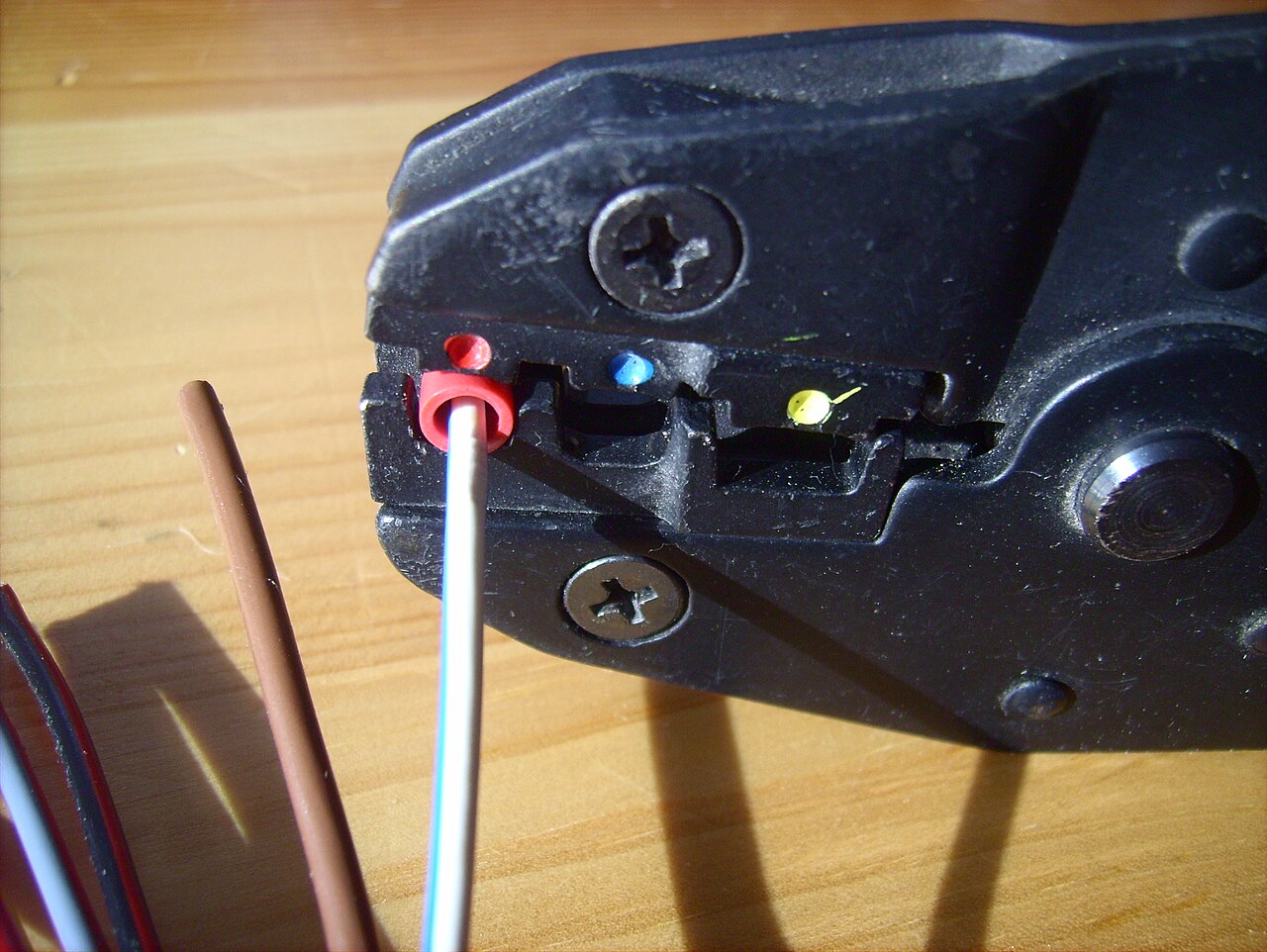
Terminal and tool assortment. Photo: Asurnipal, via Wikimedia Commons, CC BY-SA 4.0.

Match the complete tongue geometry—not only the nominal stud
An M6 label is a selection category, not a promise that every “M6” ring has the same hole or tongue. Check the product drawing for hole inside diameter, tongue width and thickness, outside diameter, centerline length and material. Then confirm the connector seats flat within the equipment’s available contact area.
The ring must pass over the intended hardware without being forced, yet it must not be so oversized that the tongue can shift outside the intended bearing area. Use the equipment manufacturer’s nut, washer, surface preparation and torque instructions. Do not enlarge a ring, force it over threads or use a washer as a substitute for the correct terminal.
| Catalog selector | What it normally points to | What must still be checked |
|---|---|---|
| M3 / M4 | Small screw or stud category | Exact hole ID, tongue width, head/washer bearing and device clearance. |
| M5 / M6 | Medium metric hardware category | Drawing dimensions, terminal stack, tightening hardware and torque instruction. |
| M8 / M10 | Larger stud category | Required lug family, conductor size, tongue thickness, plating and equipment listing. |
| #8 / #10 / 1⁄4 in | Imperial hardware category | Do not substitute the nearest metric label; verify the actual product drawing. |
Manufacturer catalogs often group imperial and metric selectors where one tongue fits both, but that equivalence is product-specific. TE’s PIDG quick-reference guide, for example, lists the actual stud category and hole dimensions for each part.
Check insulation support, strip length and full insertion
The conductor crimp and insulation support do different jobs. Use the terminal’s application specification to position both correctly.

Prepare the wire for the terminal design you actually bought
- Strip to the specified length. Expose enough conductor to fill the conductor barrel and reach the inspection or brush zone defined by the maker.
- Protect the strands. Reject nicked, cut, missing or folded-back strands. Do not add a pre-twist unless the application instruction explicitly calls for one.
- Position conductor and insulation separately. Keep insulation out of the conductor crimp while placing it inside the support area where the terminal has an insulation grip.
Some insulated terminals mainly cover the metal barrel. Others add a support sleeve that is crimped around the wire insulation for strain relief. Measure jacket OD only when the product data defines an accepted insulation range.
Sleeve bore and jacket OD are product-specific
A fixed “0.1–0.3 mm” gap or a promise that one insulation material accepts “30% more” is not a general standard. Verify the accepted insulation diameter, strip length and temperature or fluid resistance on the exact terminal datasheet.
Confirm ratings and use the specified crimp tooling
A terminal is not selected solely by a generic ampacity table. The complete installation must satisfy conductor, connector, equipment, temperature, environment and applicable-code requirements.
Check conductor material, number and type; terminal material and plating; temperature; voltage or equipment category; and any required certification.
Use the maker’s tool, die, locator or wire stop, cavity and setting. Similar-looking color-coded jaws are not proof of compatibility.
Check visible features, crimp height where specified and pull force against the exact application or quality standard—not an online universal number.
Terminal, wire, tool and process must agree
Molex describes crimp quality as the interaction of the terminal, wire, tooling, people, methods and environment. TE tooling likewise uses features such as locators, wire stops and full-cycle ratchets to position and form a repeatable crimp.
For a new combination, make sample crimps with the production wire and terminal lot. Follow the maker’s application specification for visual acceptance, crimp dimensions and tensile testing. If the terminal is used in regulated equipment or premises wiring, verify the certification category and conditions of acceptability for that exact use.
Do not copy conductor ampacity into the terminal catalog
Conductor ampacity depends on installation conditions and governing rules. The termination may add separate limits through its certification, conductor range, temperature marking, equipment use and mating interface. The allowable circuit is constrained by the applicable system—not whichever number is largest.
For North American applications, UL evaluates different connector categories under standards including UL 486A-486B for wire connectors, UL 486E for equipment wiring terminals and UL 310 for quick-connect terminals. Select the category that matches the product and use; a generic “UL compliant” statement is not enough.
Five mistakes that invalidate terminal sizing
These errors may look acceptable before energization but remove the evidence that the connection matches its qualified design.
Trimming strands, folding the conductor or using filler strands changes the designed conductor-to-barrel relationship.
Red, blue or yellow is treated as a universal size even though families and regional practices differ.
A loose tongue is accepted because a washer covers it instead of selecting the correct hardware interface.
Multiple conductors are allowed only when the terminal and application instructions identify that combination.
The barrel is visibly flattened but the intended crimp height, support and tensile performance are unknown.
What should a finished crimp inspection cover?
Confirm the right terminal and wire, correct strip length, full insertion, no damaged strands, the specified bellmouth or brush where applicable, insulation in the correct support zone, no cracked barrel or damaged plating, and no deformation of the tongue or mating surface.
Visual inspection alone cannot prove internal compression. Where the application specification defines crimp height, measure it with the required method. Use a calibrated tensile tester and the specified pull rate and minimum force when pull testing is required. Production lines should also control tooling wear, setup and lot traceability.
NASA’s active workmanship standard and the Molex quality handbooks are useful process references, but they do not replace the drawing and acceptance requirements for your purchased terminal.
Do not install, adjust or inspect exposed energized connections unless the work is specifically authorized and performed under the applicable electrical-safety program by qualified personnel. Follow the equipment maker’s instructions and local regulations.
Use this five-step terminal checklist
The same information qualifies a supplier quotation, a sample approval and the first crimp on the production floor.
Identify the conductor
Record AWG or mm², copper or aluminum, solid or stranded construction, strand data, insulation OD and number of conductors.
Define the connection
Choose ring, fork or another style; state stud or mating size, tongue limits, space, fastener stack and environment.
Lock the exact part
Approve the manufacturer, part number, drawing revision, material, plating, insulation and required certifications.
Lock the process
Specify strip length, tool, die, locator, cavity, setting, calibration and any crimp-height or pull-test requirement.
Approve evidence
Inspect samples made with production wire and terminals; retain results, lot identity and the approved setup.
Need help matching a cold press terminal to your wire and stud?
Send the terminal style, wire AWG or mm², conductor construction, stud size, insulation type, required certification, quantity and a product photo or drawing. SENTOP can review available terminal models, samples, bulk supply and OEM packaging requirements.
Related SENTOP resources
Cold press terminal sizing FAQ
Short answers for buyers, panel builders and wire-harness teams checking a terminal before crimping.
How do I choose the right cold press terminal size?
Match the terminal maker’s documented conductor range to the exact wire AWG or mm², material and construction. Then verify the terminal style, stud or mating dimensions, insulation support, electrical and environmental suitability, and the specified crimp tool, die and acceptance criteria.
Are red, blue and yellow terminal colors universal?
No. Those colors identify familiar wire ranges in many insulated-terminal families, but the boundaries and extra colors vary by manufacturer and product line. Use color as a quick check only after confirming the exact part-number datasheet.
Does RV2-4 always mean the same terminal size?
No. RV2-4 is common supplier notation and may suggest an insulated ring terminal in a nominal conductor series for an M4 stud, but it is not a universal standard code. Verify the supplier’s conductor range, hole diameter, material, insulation and compatible tooling.
Can I crimp a larger terminal onto a smaller wire?
Only if the terminal’s application data explicitly includes that conductor. Do not fold the wire, add scrap strands or rely on extra tool force to fill an oversized barrel; choose the correctly approved terminal instead.
Can two wires go into one cold press terminal?
Only when the terminal and its application specification identify the exact multiple-conductor combination. Otherwise use a terminal or splice designed and qualified for two conductors.
Can cold press terminals be used with solid wire?
Some crimp systems permit solid conductors and many do not. IEC 60352-2 includes both stranded- and solid-wire crimped connections within its general scope, but the individual terminal datasheet and application specification decide whether a specific solid wire is allowed.
How do I match a ring terminal to an M6 stud?
Select a terminal explicitly listed for M6 hardware, then check the drawing’s actual hole diameter, tongue width and thickness against the equipment and fastener stack. Do not assume one universal clearance or force a smaller ring over the threads.
How do I verify that a finished crimp is acceptable?
Use the terminal maker’s application specification. Inspect wire position, strand condition, bellmouth or conductor brush where applicable, insulation support and barrel damage; then measure crimp height or perform a controlled pull test when the specification requires it.
References and further reading
Standards bodies, safety organizations and original manufacturer guidance used to correct the sizing, tooling and inspection rules in this article.
- IEC 60352-2:2024 — Solderless connections, Part 2: Crimped connections. Scope, general requirements, test methods and practical guidance.
- UL Solutions — Connector Certification Services. Connector categories and relevant UL standards, including UL 486A-486B, UL 486E and UL 310.
- Molex — Quality Crimp Handbook. Terminal, wire and tooling interaction; crimp features; measurements; pull testing and process control.
- Molex — Industrial Crimp Quality Handbook. Solderless terminal construction, insulation support, wire preparation and inspection examples.
- TE Connectivity — Simple Guide to Crimping. Tool-to-terminal identification and visible acceptance features for closed-barrel terminals.
- NASA-STD-8739.4 — Workmanship Standard for Crimping, Interconnecting Cables, Harnesses, and Wiring. Active workmanship reference for critical cable and harness assemblies.
- National Bureau of Standards/NIST — Copper Wire Tables. Nominal AWG dimensions and cross-sectional areas.
- SENTOP — Cold Pressed Terminal Range. Internal next step for model matching, samples, bulk orders and OEM packaging.
Engineering note: This guide is a selection and procurement aid, not an installation approval or a substitute for the terminal maker’s current drawing, application specification, equipment instructions, governing standards or qualified electrical review. Rehost and optimize the external images before production while preserving their license credits.
