A string solar inverter is important in solar systems. It changes direct current (DC) from solar panels into alternating current (AC). AC is the type of electricity used in homes and businesses. The inverter connects several solar panels in a row, called a “string,” to gather power well.
Why are these inverters useful? Modern string solar inverters work with over 95% efficiency. This means they waste very little energy when converting power. The global market for solar inverters is growing by 5.78% each year until 2029. This shows more people are using renewable energy. Picking a string solar inverter helps the planet and makes energy use better.
Key Takeaways
- String solar inverters change DC power from solar panels into AC power for homes. This step is needed to use solar energy.
- These inverters are affordable, making them great for small homes or businesses. They save money upfront and give good energy returns.
- String solar inverters work best in sunny places. They are over 95% efficient, giving lots of energy when sunlight is strong.
- Taking care of string inverters is simple. They are easy to check and fix, saving time and money compared to systems with many microinverters.
- Shade can lower their performance. If one panel in a string is shaded, it affects the whole string, so they aren’t ideal for shaded areas.
What is a String Solar Inverter?
Definition
A string solar inverter changes direct current (DC) from solar panels into alternating current (AC). AC is the kind of electricity used in homes and businesses. The word “string” means the inverter links several solar panels in a row. This setup lets the inverter handle all the panels as one big unit.
Since the 1990s, string inverters have improved a lot. Early ones were between micro-inverters and central inverters in size and function. Newer models are safer, smaller, and more efficient. They also use Maximum Power Point Tracking (MPPT) to get the most energy by adjusting the load.
| Feature | Description |
|---|---|
| Definition | Changes DC from panels to AC for home or business use. |
| Functioning | Links panels in a row, working like one big panel. |
| Efficiency | Uses MPPT to get the most energy possible. |
| Limitations | Shading or a bad panel can lower performance. |
| Technological Advancements | Adds features to reduce shading issues and improve efficiency. |
Role in Solar Energy Systems
String solar inverters are key in solar systems. They connect your solar panels to the grid or your home’s power. Solar panels make DC electricity when sunlight hits them. But homes and grids need AC electricity. The inverter changes the energy so it can be used.
These inverters work best when all panels get the same sunlight. For example, if your roof faces one direction, a string inverter works well. Studies show they save money, boost energy use, and cut carbon emissions. Whether for a small home or a big solar farm, they are reliable and efficient.
Rules like IEEE 1547-2018 and UL 1741-SA make sure string inverters are safe and work well. These rules help them connect to the grid, keep voltage steady, and improve system reliability.
Tip: If your solar panels get even sunlight, a string solar inverter is a smart pick. It’s affordable and works efficiently.
How Does a String Solar Inverter Work?
Collecting DC Power
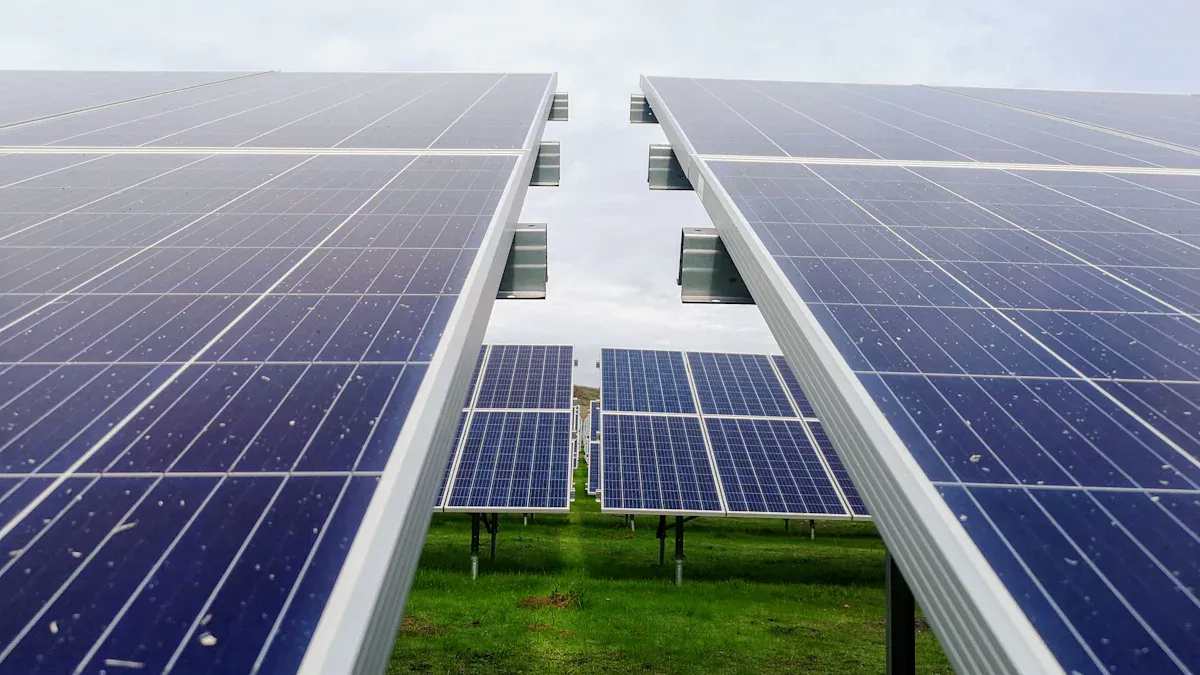
Solar panels make direct current (DC) electricity when sunlight hits them. A string solar inverter gathers this DC power from panels linked in a row, called a “string.” This setup is often used in homes and medium-sized businesses.
Here’s how it works:
- Each panel sends DC power straight to the inverter.
- Unlike central inverters, which mix power from many arrays, string inverters handle one string at a time.
- This design makes power collection simple and efficient.
By collecting DC power this way, string inverters capture energy well and keep the system easy to manage.
Converting DC to AC
After collecting DC power, the inverter changes it into alternating current (AC). AC is the type of electricity used in homes and sent to the grid. The inverter uses advanced tools to make this process smooth and reliable.
String inverters use Maximum Power Point Tracking (MPPT) to get the most energy. MPPT adjusts how much load is on the panels to pull out the highest power. This ensures your system works well, even when sunlight changes.
The conversion happens automatically, so you can enjoy clean energy without worrying about how it works.
Distributing AC Power
Once DC is turned into AC, the inverter sends the electricity to your home or the grid. String inverters are great at this because of their smart design and features.
| Technology/Feature | Description |
|---|---|
| Modular Design | Allows backup power, so the system works even if one inverter breaks. |
| Smart Features | Adjusts based on sunlight and grid needs, improving performance. |
| Maximum Power Point Tracking (MPPT) | Keeps getting the most power from panels, boosting efficiency and system output. |
These features help distribute energy well and keep the system running smoothly. Whether powering your home or sending energy to the grid, string inverters work reliably.
Advantages of String Solar Inverters
Cost-effectiveness
String solar inverters are a budget-friendly way to use solar power. They cost less than central inverters, making them great for smaller setups. For instance, a string inverter costs around INR 20,000 to 50,000. In contrast, central inverters can cost over INR 1,00,000. This price gap makes string inverters perfect for homes and small businesses.
Also, systems with string inverters give great returns on investment (ROI). A 10 kW DIY solar system with a string inverter costs about INR 1,035,000. It pays for itself in six years and has an ROI of 247.82%. This makes it easy to save money while using clean energy.
| Type of Inverter | Initial Cost | Lifespan | Suitable Application |
|---|---|---|---|
| String Inverters | INR 20,000 – 50,000 | 10-15 years | Smaller commercial environments |
| Central Inverters | INR 1,00,000+ | 15-20 years | Utility-scale industrial plants |
| Microinverters | INR 5,000 – 15,000 | 10-20 years | Residential to medium commercial |
High efficiency in uniform sunlight
String solar inverters work best in places with steady sunlight. They turn DC power from panels into AC power with little energy loss. Features like Maximum Power Point Tracking (MPPT) help them adjust to sunlight changes for better energy output.
Here’s how they perform:
- Efficiency Ratings: They convert over 95% of energy effectively.
- Load Performance: They manage different energy loads smoothly.
- Rated Output Capacity: They give maximum power under good sunlight.
These inverters are ideal for rooftops with no shading and one direction. Their ability to stay efficient in steady sunlight makes them a dependable choice for solar systems.
| Metric | Description |
|---|---|
| Efficiency Ratings | Shows how well the inverter changes DC to AC power. |
| Load Performance | Checks how the inverter handles different energy loads. |
| Rated Output Capacity | Tells the highest power the inverter can give in good conditions. |
Simplified maintenance
String solar inverters are easy to maintain, saving time and money. Unlike microinverters, you replace them as one unit, not individually. This makes repairs quicker and reduces downtime.
Their central location adds convenience. Usually installed in one spot, they are easy to check and fix. This is helpful during bad weather. Once set up, they need little care, so you can enjoy clean energy without much hassle.
Benefits of easy maintenance include:
- Lower costs over time due to fewer repairs.
- Compact design that’s practical to use.
- Central placement for quick troubleshooting.
Choosing a string solar inverter gives you a simple and reliable solar energy solution.
Limitations of String Solar Inverters

Shading Problems
Shading can lower how well a string solar inverter works. If one panel gets less sunlight, the whole string loses power. This happens because panels are linked in a series, and the weakest panel sets the limit for all. For example, studies show shadows from poles or buildings can cut energy during certain times.
| Time | Affected Strings | Current Drop Seen | Cause of Shading |
|---|---|---|---|
| 9:15 – 9:45 | 1 to 7 | Yes | Shadows from front rows |
| 10:30 | 3 | Yes | Pole shadow |
| Winter months | 1 to 7 | Yes | Nearby objects blocking light |
Panels have bypass diodes to reduce shading effects, but these can fail. When they fail, solar cells may overheat and get damaged. Using microinverters or power optimizers can help fix this issue. Microinverters let each panel work alone, so shading on one doesn’t affect others. This is helpful in areas with frequent shading from weather or surroundings.
Note: If your site has shading issues, try microinverters for steady energy output.
Issues with Scaling Up
Making a system bigger with string inverters can be tricky. Each inverter has a power limit, so they’re not great for large solar farms. Adding more inverters raises costs and makes setup harder. Reports show that bigger systems with string inverters need more parts and care, which increases costs and lowers reliability.
| Challenge | Description |
|---|---|
| Higher costs per unit | More inverters mean higher total expenses. |
| Complex setup and upkeep | Bigger systems need extra parts, making maintenance harder. |
| Limited power per inverter | Designed for small outputs, so not ideal for big projects. |
String inverters are central devices that convert DC to AC for a whole string. This design is simple but limits monitoring. If one panel has dirt or shade, the whole string suffers. Microinverters are better for large systems. They let each panel work alone and give detailed performance data, helping improve energy output.
Tip: For big projects, check if string inverters fit your needs or if microinverters are a smarter choice.
String solar inverters help turn sunlight into usable electricity. They are a budget-friendly option for homes and small businesses. These inverters work well in places with steady sunlight. Their high efficiency and easy upkeep make them a favorite choice. But they don’t perform as well in shaded areas or large systems.
Reports show home solar setups grew by 34% from 2020 to 2021. This growth was boosted by government support and incentives. While string inverters cost less, they rely on even sunlight. They also can’t optimize power for each panel, which limits their use. Comparing them to microinverters shows they’re great for simple setups. However, they struggle in shaded or more complex environments.
| Aspect | Details |
|---|---|
| Market Growth Drivers | 34% rise in home solar setups from 2020 to 2021, thanks to government support. |
| Restraints | High upfront costs and sunlight reliance slow adoption. |
| Opportunities | Rising demand in new markets and better energy storage tech. |
| Feature | String Inverters | Microinverters |
|---|---|---|
| Cost-effectiveness | Lower starting cost | Higher starting cost |
| Performance under shading | Affected by one panel’s shading | Each panel works on its own |
| Optimization capability | Limited for single panels | Better for different conditions |
| Suitability for installations | Best for simple setups | Great for complex setups |
When picking a solar system, think about your site’s sunlight and needs. String inverters are reliable for basic setups. For shaded or tricky layouts, microinverters might work better.
FAQ
Why pick a string solar inverter for your home?
A string solar inverter is a budget-friendly choice. It works best in places with steady sunlight. It needs little care and is easy to maintain. If your roof gets even sunlight, it gives great performance. It’s perfect for small to medium solar setups.
Why does shading affect string solar inverters more?
Shading lowers how well string inverters work. All panels in a string are connected. If one panel gets less sunlight, the whole string loses power. The weakest panel sets the limit for all others. Microinverters or optimizers can help fix this problem.
Why aren’t string solar inverters good for big solar farms?
String inverters can’t handle very large systems. Each one has a power limit. To expand, you need more inverters, which costs more money. This also makes the setup harder. Central inverters or microinverters are better for big projects.
Why is it easier to maintain string solar inverters?
String inverters are placed in one spot, making them simple to fix. Microinverters are on each panel, so they’re harder to repair. With string inverters, you only fix or replace one unit. This saves time and reduces repair costs.
Why do string solar inverters use MPPT?
MPPT helps get the most energy from solar panels. It adjusts based on sunlight to improve power output. This keeps the system efficient, even when sunlight changes during the day.
The following information may be of interest to you
2 strings of 1000v 25A solar combiner boxes
How to determine the size of the solar combiner box
How to calculate the power generation of a 400 watt solar panel