
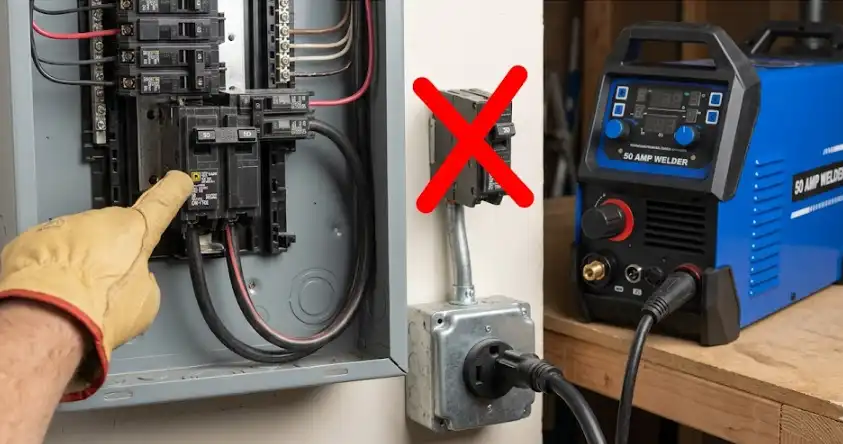
Roughly 80% of tripped breakers on welder circuits trace back to one problem: the breaker was sized to the welder’s nameplate rating instead of its actual demand under load. So, what size circuit breaker do I need for a 50 amp welder? For most 50-amp-rated welders, you’ll need a 50-amp double-pole breaker on a 240-volt dedicated circuit — but if your welder’s duty cycle is above 40%, NEC Article 630 may push that requirement up to a 60-amp breaker with appropriately heavier wire. This guide breaks down the exact breaker size, wire gauge, and code rules so you get it right the first time.
The Short Answer — What Size Breaker for a 50 Amp Welder
A 50 amp welder needs either a 50 amp or 60 amp circuit breaker. The exact size depends on the welder’s rated duty cycle and how the National Electrical Code (NEC) classifies the equipment. Most home shop welders with a duty cycle at or below 20% can run on a 50 amp breaker. Push that duty cycle higher — say 40% or above — and you’ll want a 60 amp breaker to handle the sustained current draw safely.
So if you’re asking what size circuit breaker do I need for a 50 amp welder, here’s the rule of thumb: match the breaker to the welder’s nameplate amperage, then adjust upward based on duty cycle using NEC Article 630 multipliers. A 20% duty cycle calls for a multiplier of roughly 0.71, which keeps the effective load under 50 amps. A 60% duty cycle bumps that multiplier to about 1.0, meaning the full 50 amps flows nearly continuously.
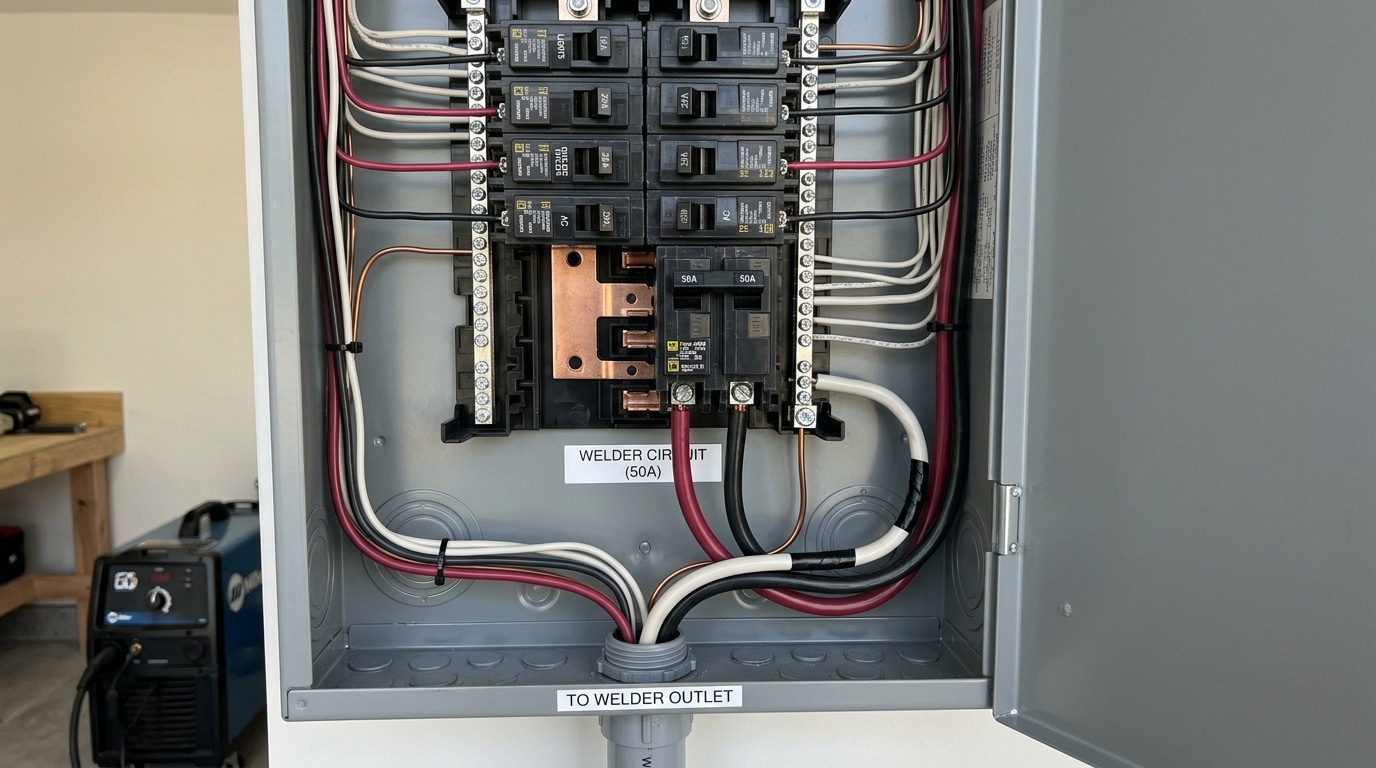
Pair the breaker with the correct wire gauge — typically 6 AWG copper for a 50 amp circuit, or 4 AWG for a 60 amp setup. Undersized wire is a fire risk. Oversized breakers without matching wire are equally dangerous. The breaker protects the wire, not the welder itself, and that distinction matters more than most people realize.
Why a 50 Amp Breaker Isn’t Always the Right Choice
Here’s the thing most people miss: welders don’t pull a constant load. They cycle on and off. A welder rated at 50 amps might only sustain that draw for 60% of a 10-minute period, then idle for the rest. That intermittent behavior changes how you size the breaker protecting the circuit.
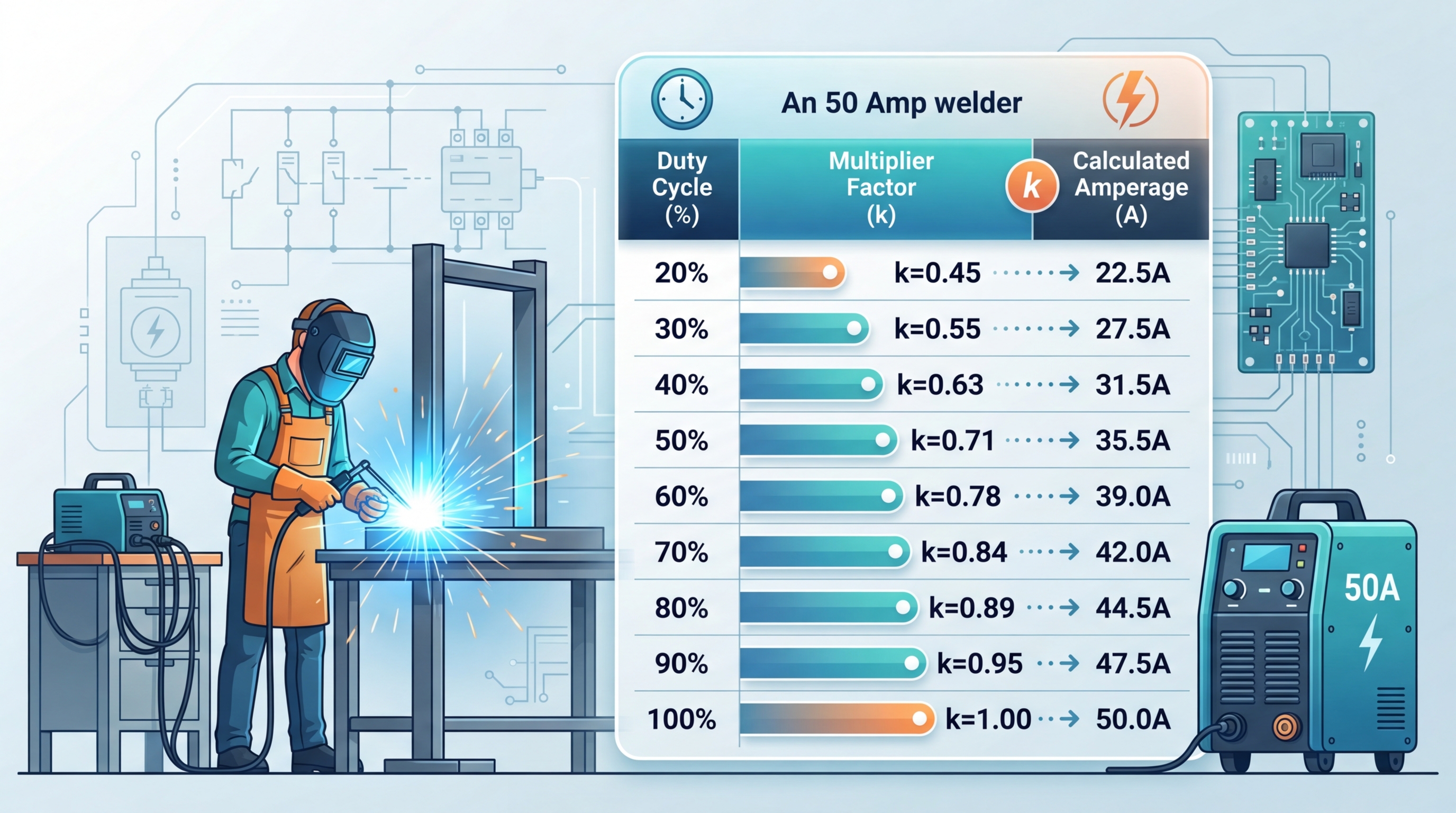
The NEC Article 630 specifically addresses arc welders and transformer-type welders. It doesn’t tell you to simply match the breaker to the nameplate. Instead, it requires you to multiply the welder’s rated primary current by a duty-cycle factor — a decimal derived from the square root of the duty cycle percentage. For a 50 amp welder at 60% duty cycle, that multiplier is 0.78, giving you an effective current of roughly 39 amps. That means a 40 amp breaker could be code-compliant.
Flip the scenario. A welder with a 100% duty cycle at 50 amps needs a breaker rated at or above 50 amps — often 60 amps to satisfy the NEC’s overcurrent protection margins. So when someone asks what size circuit breaker do I need for a 50 amp welder, the honest answer depends entirely on how hard and how long the machine actually runs.

How Duty Cycle Affects Breaker Sizing
Duty cycle is the single most important variable when figuring out what size circuit breaker do I need for a 50 amp welder. It tells you how many minutes out of a 10-minute window the machine can weld at rated output before it needs to cool down. A 60% duty cycle means 6 minutes of arc time, then 4 minutes off. That ratio changes everything about your effective current draw.
NEC Table 630.11(A) provides multiplier factors tied directly to duty cycle percentages. For a welder rated at 50 amps with a 60% duty cycle, you multiply 50 × 0.78, which gives you an effective current of 39 amps. That’s a 40 amp breaker territory. Bump the duty cycle to 100%, and the multiplier jumps to 1.0 — now you need the full 50 amps, and a 60 amp breaker becomes the safer choice.
Most hobbyist and light-industrial welders sit between 20% and 60% duty cycle. The lower the percentage, the smaller the effective load on your circuit. Don’t skip this calculation. It’s the difference between an oversized breaker that wastes money and an undersized one that trips mid-bead.
Nameplate Amps vs Actual Operating Amps
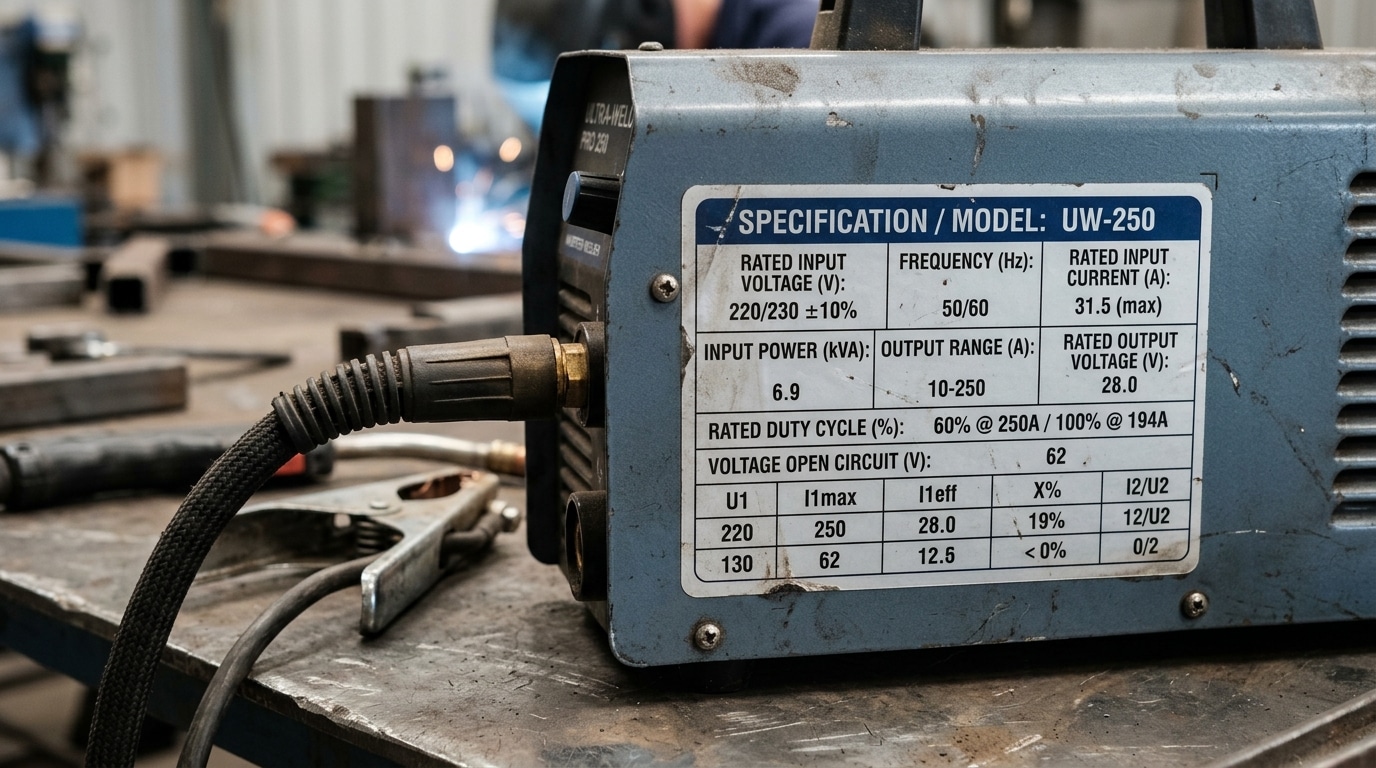
Flip your welder over and look at the data plate. That number stamped next to “rated input current” — say, 50A — represents the maximum current the machine can draw at its highest output setting and rated duty cycle. It does not mean the welder pulls 50 amps every second it’s plugged in.
During a typical MIG pass on 3/16″ mild steel, a nominally 50-amp-input welder might only draw 32–38 amps from the wall. Crank the voltage dial to maximum and run thick flux-core wire, and you’ll get closer to that nameplate figure. But most hobby and light-fabrication work sits well below peak demand. This gap between nameplate and real-world draw is exactly why asking “what size circuit breaker do I need for a 50 amp welder” doesn’t have a one-number answer.
The danger cuts both ways. Size your breaker strictly to the nameplate without considering inrush spikes, and you’ll chase nuisance trips. Oversize it too aggressively, and the breaker won’t protect the wiring during a fault. The NEC (NFPA 70) accounts for this by using a multiplier method tied to duty cycle — not raw nameplate amps — which we’ll break down in the next section.
NEC Code Requirements for Welder Circuits
The National Electrical Code isn’t optional reading — it’s the legal backbone of residential and commercial electrical work across most U.S. jurisdictions. When figuring out what size circuit breaker do I need for a 50 amp welder, NEC Article 630 is your primary reference. This section covers electric welders specifically, addressing overcurrent protection, conductor sizing, and supply circuit calculations in ways that differ from standard appliance circuits.
Article 630.12 governs overcurrent protection for arc welders. It permits breaker sizing based on the welder’s effective current draw — not just the nameplate rating — which is why the multiplier method (covered in the next section) exists. Articles 210 and 215 also apply, since they set baseline rules for branch circuits and feeders that supply any load, welders included.
Here’s the practical side: most local building departments require a permit for new 240V circuits. Skip the permit, and you risk voiding your homeowner’s insurance if a fire traces back to that circuit. Inspectors will check breaker size, wire gauge, grounding, and box fill. Code compliance isn’t bureaucratic filler. It’s the difference between a safe shop and an insurance nightmare.
NEC Article 630 and the Multiplier Method
Article 630 gives you a straightforward formula. Take the welder’s rated primary current, then multiply it by the duty-cycle factor listed in NEC Table 630.11(A). That product is your minimum conductor ampacity — and it directly informs your breaker size.
Here’s the math for a 50 amp welder. At a 60% duty cycle, the NEC multiplier is 0.78. So: 50A × 0.78 = 39A. A 40 amp breaker technically covers the calculated load, but most electricians round up to a 50 amp breaker for headroom. Drop to a 20% duty cycle and the multiplier falls to 0.45 — giving you just 22.5A, which changes the wire and breaker equation dramatically.
Now bump that duty cycle to 100%. The multiplier is 1.0, meaning the full 50 amps flows continuously. That scenario demands a 60 amp breaker to satisfy the NEC’s requirement that continuous loads not exceed 80% of the breaker rating (50A ÷ 0.80 = 62.5A, rounded to the next standard size). This is exactly the calculation to run when figuring out what size circuit breaker do I need for a 50 amp welder — the duty cycle multiplier does the heavy lifting.
Correct Wire Gauge for a 50 Amp Welder Circuit
Wire size is non-negotiable. Get it wrong, and you’re looking at overheated conductors, melted insulation, or worse — a fire inside your wall. For a 50 amp circuit, the NEC specifies 6 AWG copper or 4 AWG aluminum as the minimum conductor size, based on the 60°C column of Table 310.16 that most residential terminations require.
Here’s the critical rule: wire gauge must match the breaker rating, not the welder’s actual draw. If you installed a 60 amp breaker using the NEC Article 630 multiplier method discussed earlier, you need wire rated for 60 amps — that bumps you up to 4 AWG copper or 2 AWG aluminum. Undersizing the wire while oversizing the breaker creates a dangerous mismatch where the breaker won’t trip before the wire overheats.
When figuring out what size circuit breaker do I need for a 50 amp welder, always select the wire gauge last — after you’ve locked in the breaker size. Think of it as a chain: welder nameplate → duty cycle calculation → breaker amperage → wire gauge. Each link depends on the one before it. A 50 amp breaker with 6 AWG copper works. A 60 amp breaker with 6 AWG copper does not.
Use THHN/THWN-2 insulated conductors run through conduit, or NM-B (Romex) cable where local code permits. Both are common for garage welder circuits, but conduit gives you easier future upgrades.
Copper vs Aluminum Wire for Welder Circuits
Copper dominates garage and workshop wiring for good reason. It carries more current per gauge size, resists corrosion, and terminates easily on virtually every breaker and receptacle. Aluminum costs roughly 40–50% less per foot, but it expands and contracts more with heat cycling — a real concern on a welder circuit that surges repeatedly. That thermal movement can loosen connections over time, creating hot spots at terminals.
If you’re figuring out what size circuit breaker do I need for a 50 amp welder and trying to keep material costs down, aluminum is viable — but you must upsize the wire. Aluminum also requires anti-oxidant compound at every termination and breakers or lugs rated “AL/CU.” Skip either step and you’re inviting a fire. The Copper Development Association publishes detailed ampacity comparisons that confirm copper’s edge in tight conduit runs where heat dissipation matters most.
| Breaker Size | Copper (THHN/THWN) | Aluminum (THHN/THWN) |
|---|---|---|
| 40 Amp | 8 AWG | 6 AWG |
| 50 Amp | 6 AWG | 4 AWG |
| 60 Amp | 6 AWG | 4 AWG |
For most workshop welder installs under 50 feet, copper 6 AWG is the practical sweet spot — affordable enough that the savings from aluminum rarely justify the extra precautions.
Wire Run Length and Voltage Drop Considerations
Distance kills performance. Every foot of wire between your breaker panel and the welder outlet adds resistance, and that resistance steals voltage. The NEC recommends keeping voltage drop below 3% for branch circuits — on a 240V circuit, that means no more than 7.2 volts lost.
Here’s the quick formula: Voltage Drop = (2 × Length × Current × Resistance per foot) ÷ 1,000. For 6 AWG copper carrying 50 amps, resistance sits around 0.491 ohms per 1,000 feet. At a 50-foot run, you lose roughly 2.5 volts — well within limits. Push that to 100 feet, and you’re looking at about 4.9 volts of drop, which creeps past the 2% mark and starts affecting arc stability.
When asking what size circuit breaker do I need for a 50 amp welder, the breaker itself doesn’t change based on distance — but the wire absolutely does. Once your run exceeds 75–80 feet with 6 AWG copper, bumping up to 4 AWG is the smart move. For aluminum runs beyond 50 feet, you may need to jump two gauge sizes. The Southwire Voltage Drop Calculator makes this math painless if you want exact numbers for your specific layout.
One detail people overlook: voltage drop doesn’t just reduce weld quality. It also causes the welder to draw more current to compensate, which generates extra heat in the wire. That’s a compounding problem you want to avoid before it starts.
Single-Phase vs Three-Phase 50 Amp Welders
Most garage and home workshop welders run on single-phase 240V power. That means two hot legs, one neutral (sometimes omitted), and a ground — fed through a 2-pole breaker that occupies two slots in your panel. When asking what size circuit breaker do I need for a 50 amp welder, this is the setup 90% of hobbyists and small-shop owners are dealing with. A standard NEMA 6-50R or 14-50R outlet handles the connection.
Three-phase welders are a different animal. They use three hot conductors plus a ground, require a 3-pole breaker, and pull power from all three phases simultaneously. The advantage? Smoother arc characteristics and roughly 1.73× more power delivery at the same amperage. The downside is obvious — most residential panels don’t supply three-phase power at all.
Wire requirements shift too. A single-phase 50 amp circuit typically needs 6 AWG copper (two hots plus ground). A three-phase circuit at 50 amps still uses 6 AWG copper, but you’re running three hot conductors instead of two, which increases conduit fill and material cost. The outlet changes to a NEMA 15-50R or hardwired disconnect, depending on local code. Check your welder’s data plate — it explicitly states “1PH” or “3PH” next to the voltage rating. If you see 208V or 480V listed, that’s almost certainly three-phase, and you’ll want a licensed electrician to handle the panel configuration. The NEMA wiring device standards outline exact receptacle configurations for each setup.
Do You Need a Dedicated Circuit for a 50 Amp Welder
Yes. A 50 amp welder absolutely requires its own dedicated circuit — no exceptions. The NEC treats welders as continuous-duty equipment for circuit design purposes, and sharing a branch circuit with a shop vac, air compressor, or even overhead lighting invites trouble fast.
Think about what happens when a welder draws 40–50 amps and a 15 amp grinder kicks on simultaneously. That’s 55–65 amps on a circuit rated for 50 or 60. The breaker trips mid-bead. Worse, if the breaker is slow to respond — which happens with aging thermal-magnetic units — conductors heat beyond their rated temperature. That’s how insulation breaks down and fires start inside walls where nobody can see them.
Voltage sag is the other headache. Sharing a circuit drops voltage at the welder’s terminals, which degrades arc stability and produces weak, porous welds. If you’re already asking what size circuit breaker do I need for a 50 amp welder, the answer only holds true when that breaker feeds one outlet and one machine. A dedicated 240V circuit with properly sized wire, a matching breaker, and a single NEMA 6-50R or 14-50R receptacle is the only setup that meets code and keeps your welds clean.
Common Mistakes When Wiring a 50 Amp Welder Circuit
The biggest blunder? Using 12 AWG or 10 AWG wire because “it was already in the wall.” Undersized conductors overheat under sustained welding loads, and no breaker can fully protect wire that’s too thin for the circuit — the damage happens before the breaker trips. If you’re asking what size circuit breaker do I need for a 50 amp welder, you also need to ask what wire feeds it.
Plug and receptacle mix-ups are equally common. A NEMA 14-50 has a neutral pin designed for range circuits, while a NEMA 6-50 carries two hots and a ground — the correct choice for most 240V welders. Plugging into the wrong outlet type won’t just violate code; it creates a grounding path that doesn’t behave the way your welder expects.
- Skipping a dedicated circuit — sharing a 50 amp breaker with a compressor or dust collector invites nuisance trips and potential overloads.
- Ignoring voltage drop on long runs — a 75-foot run of 6 AWG copper can lose enough voltage to trigger arc instability and thermal faults.
- Omitting a disconnect — NFPA 70 requires a disconnecting means within sight of the welder for safety during maintenance.
Every one of these errors has a simple fix: match the wire gauge to the breaker rating, install the right NEMA receptacle, run a dedicated home run back to the panel, and size up the conductor if your run exceeds 50 feet. Shortcuts here cost far more than the extra $30 in copper.
Step-by-Step Installation Overview for a 50 Amp Welder Circuit
Disclaimer first: if you’re not comfortable working inside a live breaker panel, hire a licensed electrician. Panel work can kill you. This overview assumes you’ve already determined what size circuit breaker do I need for a 50 amp welder based on the NEC calculations covered earlier.
- Kill the main breaker. Verify the panel is dead with a non-contact voltage tester. The bus bars can still be energized even with the main off in some split-bus panels — double-check.
- Mount the double-pole breaker (50A or 60A, depending on your duty cycle math) into an open slot. Snap it firmly onto the bus bar until it clicks.
- Run your wire. Pull 6 AWG copper NM-B (or conduit with THHN) from the panel to the outlet location. Secure it with staples or straps every 4.5 feet per NEC 334.30.
- Install the receptacle. A NEMA 6-50R is standard for 240V welders — two hots, one ground, no neutral. Torque terminal screws to manufacturer specs.
- Connect at the panel. Land each hot on the breaker terminals, and bond the ground to the ground bar. Tighten lugs to the torque value printed on the breaker.
- Test. Restore power, verify 240V at the outlet with a multimeter, then plug in the welder and run a short bead to confirm stable arc performance.
The whole job typically takes 2–4 hours for a 30-foot run. Permit requirements vary by jurisdiction — some counties require inspection even for garage circuits, so check before you start cutting drywall.
Frequently Asked Questions About 50 Amp Welder Breaker Sizing
Can I use a 40 amp breaker for a 50 amp welder? No. A 40 amp breaker will trip repeatedly under normal welding loads. The breaker must match or exceed the welder’s rated input current — typically 50A or 60A per NEC Article 630 calculations.
What happens if my breaker is too small? Nuisance tripping mid-bead. Worse, a breaker that trips constantly can weaken its internal mechanism over time, eventually failing to trip during an actual fault. Replace it with the correct size.
Do I need a GFCI breaker for a welder? Generally, no. Most garage and workshop circuits don’t require GFCI protection for 240V outlets. However, if your welder operates outdoors or in a wet location, the NEC may mandate it — check local amendments.
Can I plug a 50 amp welder into a dryer outlet? Only if the dryer outlet is a NEMA 6-50R or the plug configuration matches exactly. A NEMA 14-30 dryer outlet is rated for 30 amps — plugging a 50 amp welder into it is a fire hazard, full stop.
What size circuit breaker do I need for a 50 amp welder on 220V? A 50 amp double-pole breaker handles most 240V (commonly called “220V”) welders. If your unit’s duty cycle exceeds 80% or the nameplate shows current spikes above 50A, step up to a 60 amp breaker with 6 AWG copper wire.
Final Recommendations and When to Call an Electrician
Here’s the quick-reference checklist. A 50 amp welder typically needs a 50A or 60A double-pole breaker on a dedicated 240V circuit, sized using the NEC Article 630 multiplier method based on your welder’s actual duty cycle. Wire it with 6 AWG copper (or 4 AWG aluminum) for runs under 50 feet, and bump up a gauge for longer distances to keep voltage drop under 3%.
So when should you handle this yourself? If you’ve wired a 240V outlet before, own a multimeter, and feel confident working inside a breaker panel with the main disconnect off — the job is manageable. But confidence isn’t the same as competence.
Call a licensed electrician if:
- Your panel is already at or near capacity
- You need a sub-panel installed in a detached garage
- Your local jurisdiction requires a permit and inspection
- You’re unsure about any calculation — breaker size, wire gauge, or conduit fill
- The run exceeds 75 feet and requires voltage drop compensation
Figuring out what size circuit breaker do I need for a 50 amp welder is the easy part. Getting the installation right — torque specs, proper grounding, code-compliant routing — that’s where mistakes turn expensive. A typical electrician charges $300–$600 for a dedicated welder circuit, according to HomeAdvisor. Cheap insurance against a house fire.
See also
Understanding the OEM Workflow in Micro Circuit Breaker Production
What size of wire is needed for a 30 ampere circuit breaker
The delivery cycle for customized circuit breakers
What is the recommended breaker size for Line 12 wiring
Why Electricians Recommend the Right Wire Size for 60 Amp Circuit Breakers

Discover more from SENTOP Electrical Co., Ltd
Subscribe to get the latest posts sent to your email.
