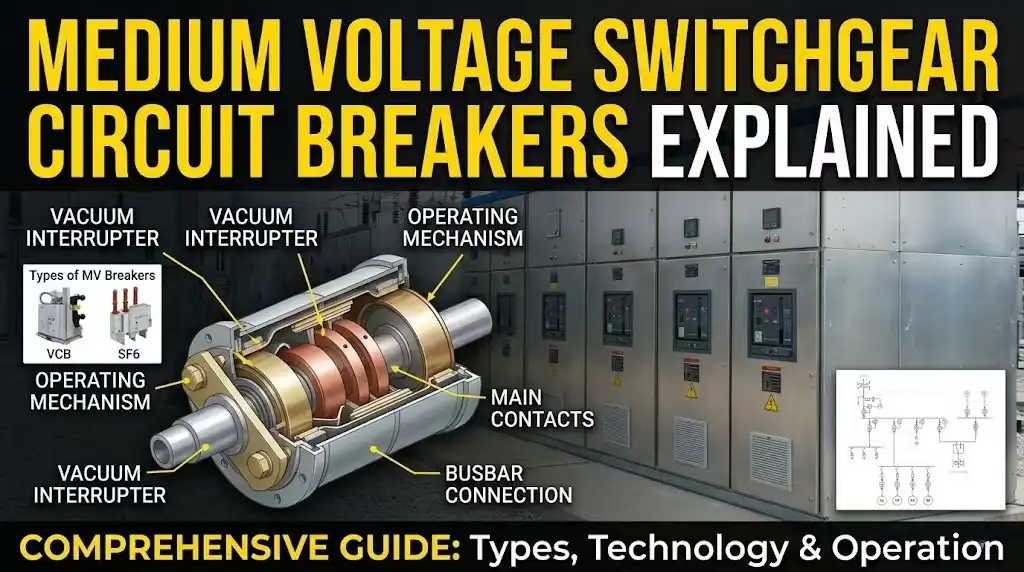
Roughly 70% of all electrical faults in industrial power distribution originate at the medium voltage level — between 1 kV and 36 kV — where a single breaker failure can cascade into millions of dollars in downtime and equipment damage. A circuit breaker in medium voltage switchgear is the primary protective device responsible for detecting abnormal current conditions and interrupting fault arcs within milliseconds, safeguarding transformers, motors, feeders, and the people who work near them. This guide breaks down how these breakers function, what separates vacuum from SF6 designs, and how to match the right breaker technology to your specific application.
What Is a Circuit Breaker in Medium Voltage Switchgear
Medium voltage switchgear refers to the metal-enclosed assemblies that distribute and protect electrical circuits operating between 1 kV and 52 kV. Power utilities, industrial plants, and commercial facilities rely on these systems to manage electricity flowing from transmission networks down to end-use equipment. At the heart of every switchgear panel sits one device that matters more than any other: the circuit breaker.
A circuit breaker in medium voltage switchgear serves as the primary protective switching device. Its job is deceptively simple — detect abnormal current conditions, interrupt the resulting electrical arc, and isolate the faulted section before damage spreads. In practice, this happens in roughly 40 to 80 milliseconds, depending on breaker technology and relay response time. That speed is critical. A fault at 12 kV can deliver tens of thousands of amperes, enough to melt copper busbars and destroy transformers within seconds.
The operating principle follows three stages. First, protective relays sense an overcurrent, ground fault, or other abnormal condition and send a trip signal. Second, the breaker’s mechanism drives contacts apart, stretching and then extinguishing the arc through a quenching medium — vacuum, SF₆ gas, or air. Third, the open contacts establish a reliable insulation gap that isolates the fault from the rest of the network. The IEEE C37 series of standards governs the ratings, testing, and performance benchmarks these breakers must meet before they can be installed in any switchgear lineup.
Without a properly rated breaker, switchgear is just a metal box with busbars. The breaker gives it the ability to protect people, equipment, and system stability under the worst-case electrical events a network can produce.
How Medium Voltage Circuit Breakers Work — Arc Interruption Fundamentals
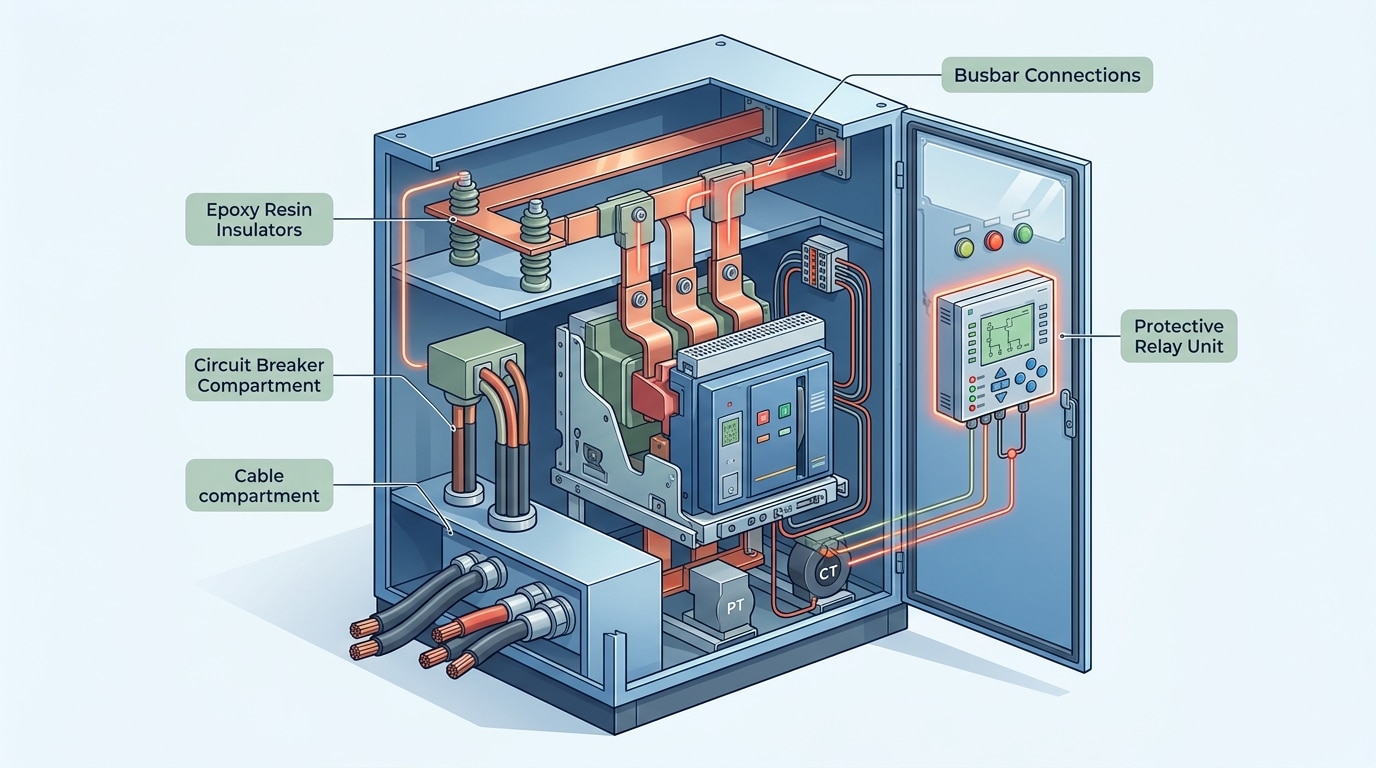
Every time a circuit breaker in medium voltage switchgear opens under load, an electric arc forms between the separating contacts. This arc is essentially a plasma channel — ionized gas conducting thousands of amperes at temperatures exceeding 20,000 K. The breaker’s entire purpose is to extinguish this arc quickly and permanently. Fail at that, and the fault continues unabated.
Arc extinction hinges on one physical reality: AC current passes through zero twice per cycle, roughly every 8.3 milliseconds in a 60 Hz system. At that current-zero crossing, the arc momentarily loses its energy supply. The breaker must seize this window. Within microseconds, it needs to rebuild the dielectric strength of the contact gap faster than the transient recovery voltage (TRV) can re-strike the arc. Engineers call this race between rising dielectric strength and rising TRV the “dielectric recovery” process.
The quenching medium is what makes or breaks this race. Vacuum interrupters rely on the near-perfect dielectric properties of a hard vacuum — once the arc’s metal vapor condenses on contact surfaces, the gap recovers almost instantly. SF₆ breakers use the electronegative properties of sulfur hexafluoride gas to capture free electrons and suppress re-ignition. Each medium creates a fundamentally different interruption dynamic, which is exactly why multiple breaker technologies coexist for medium voltage applications. The EEP technical reference provides additional detail on these interruption characteristics.
Fault current magnitude matters too. A 40 kA symmetrical fault generates far more arc energy than a 25 kA fault, demanding faster gas flow or stronger magnetic fields to drive the arc into cooling channels. This is the physics that shapes every design choice downstream.
Types of Circuit Breakers Used in MV Switchgear
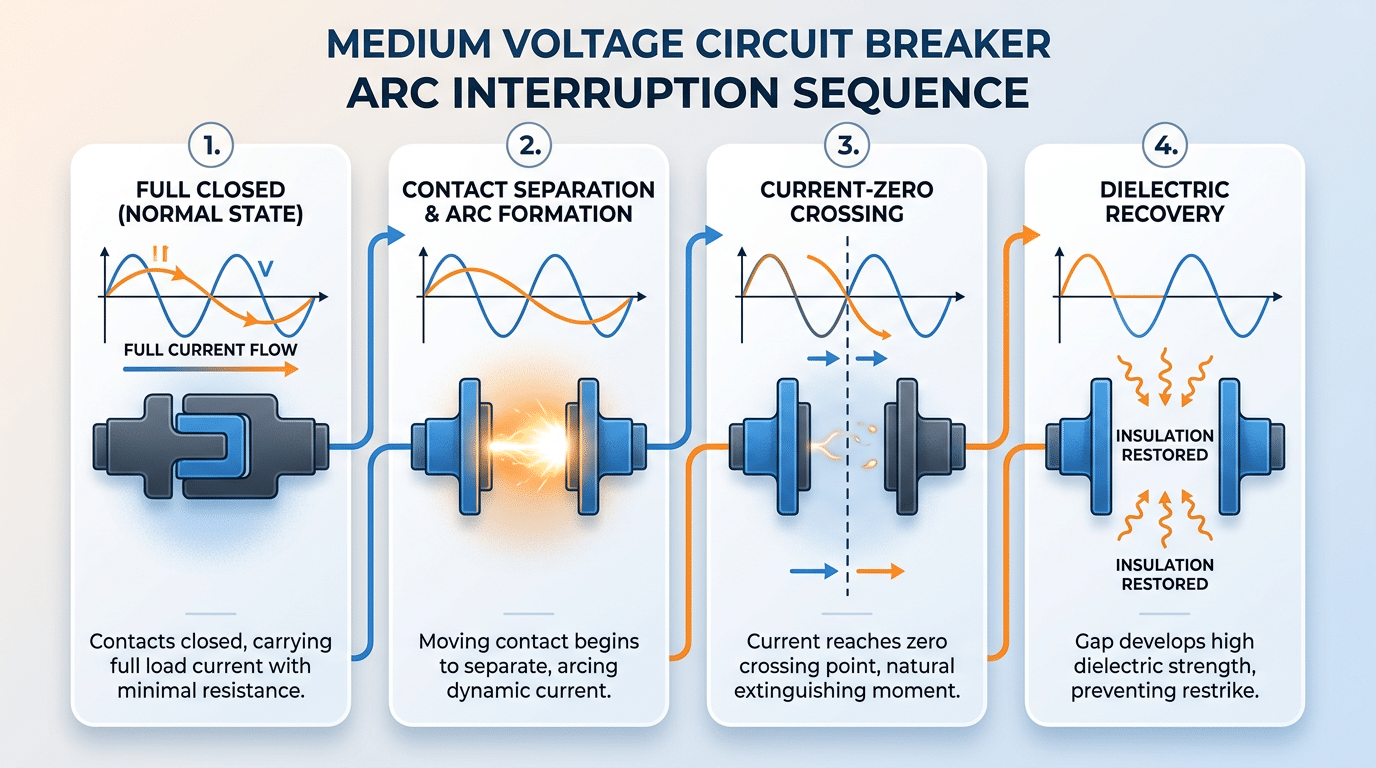
Not all arc interruption methods are created equal. The choice of circuit breaker in medium voltage switchgear hinges on the specific medium used to extinguish the arc — and each technology brings a distinct set of trade-offs in performance, maintenance burden, environmental impact, and cost. Three primary technologies dominate the market today, though their relative popularity has shifted dramatically over the past few decades.
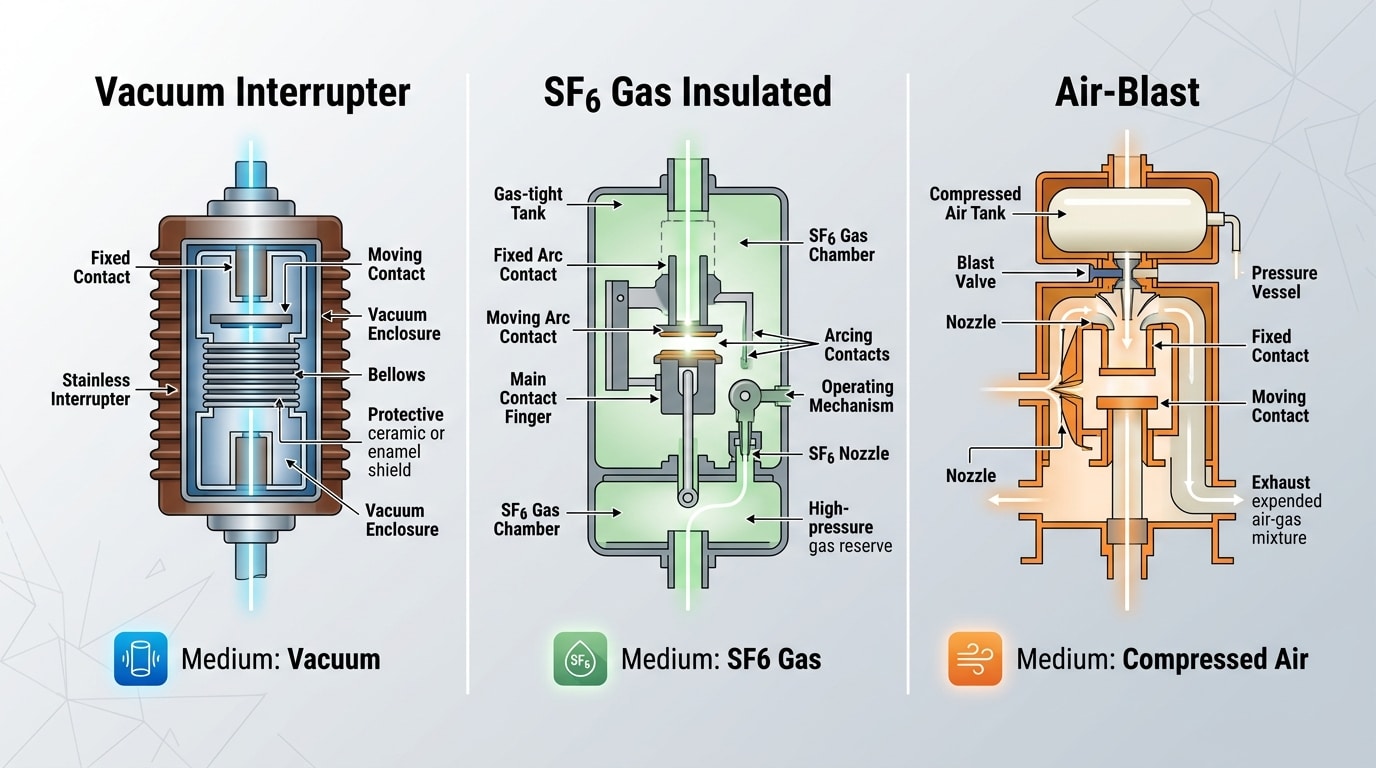
Vacuum circuit breakers (VCBs) extinguish arcs inside a sealed vacuum interrupter, where the absence of ionizable gas causes the arc to collapse rapidly at current zero. SF₆ circuit breakers rely on sulfur hexafluoride gas — an exceptionally effective dielectric — to cool and quench the arc. Air circuit breakers and air-blast designs, once the industry standard, use compressed air or ambient air to stretch and cool the arc column. A fourth, older category — oil circuit breakers — still exists in legacy installations but has largely been phased out of new MV switchgear projects due to fire risk and maintenance complexity.
Market data from MarketsandMarkets shows vacuum technology commanding over 60% of new MV breaker installations globally, with SF₆ holding most of the remaining share above 24 kV. The split isn’t arbitrary. Voltage class, fault current levels, switching duty, and environmental regulations all push engineers toward one technology over another. The sections that follow break down each type in detail — covering operating principles, ideal applications, and the limitations you won’t find on a datasheet.
Vacuum Circuit Breakers
Inside a vacuum interrupter, two copper-chromium contacts sit sealed within a ceramic or glass envelope from which virtually all gas has been evacuated — typically to a pressure of about 10⁻⁶ mbar. When the contacts separate, an arc forms briefly in metal vapor boiled off the contact surfaces. Without a surrounding gas medium to sustain it, the arc extinguishes almost instantly at the next current zero. The dielectric strength of the vacuum gap recovers in microseconds, far faster than any gaseous alternative.
This rapid recovery is exactly why the vacuum circuit breaker in medium voltage switchgear has become the dominant technology for ratings between 1 kV and 40.5 kV. A typical VCB rated at 12 kV needs only an 8–12 mm contact gap to withstand full impulse voltage levels. That tiny gap translates directly into a compact breaker mechanism, which in turn allows switchgear panels to shrink by 30–40% compared to older oil or air-blast designs.
Maintenance demands are remarkably low. Manufacturers like ABB rate their vacuum interrupters for 30,000 mechanical operations and up to 50 full short-circuit interruptions at rated capacity before replacement is needed. No gas refills, no oil filtering, no arc chute inspections. The sealed interrupter is essentially a fit-and-forget component for most of its service life.
Environmental credentials add another edge. VCBs produce no greenhouse byproducts during switching — a sharp contrast to SF₆ alternatives. They generate minimal noise, emit no toxic decomposition gases, and the interrupter materials are fully recyclable. For indoor substations, hospitals, data centers, and industrial plants where space and air quality matter, vacuum technology is the clear first choice.
SF6 Gas Circuit Breakers
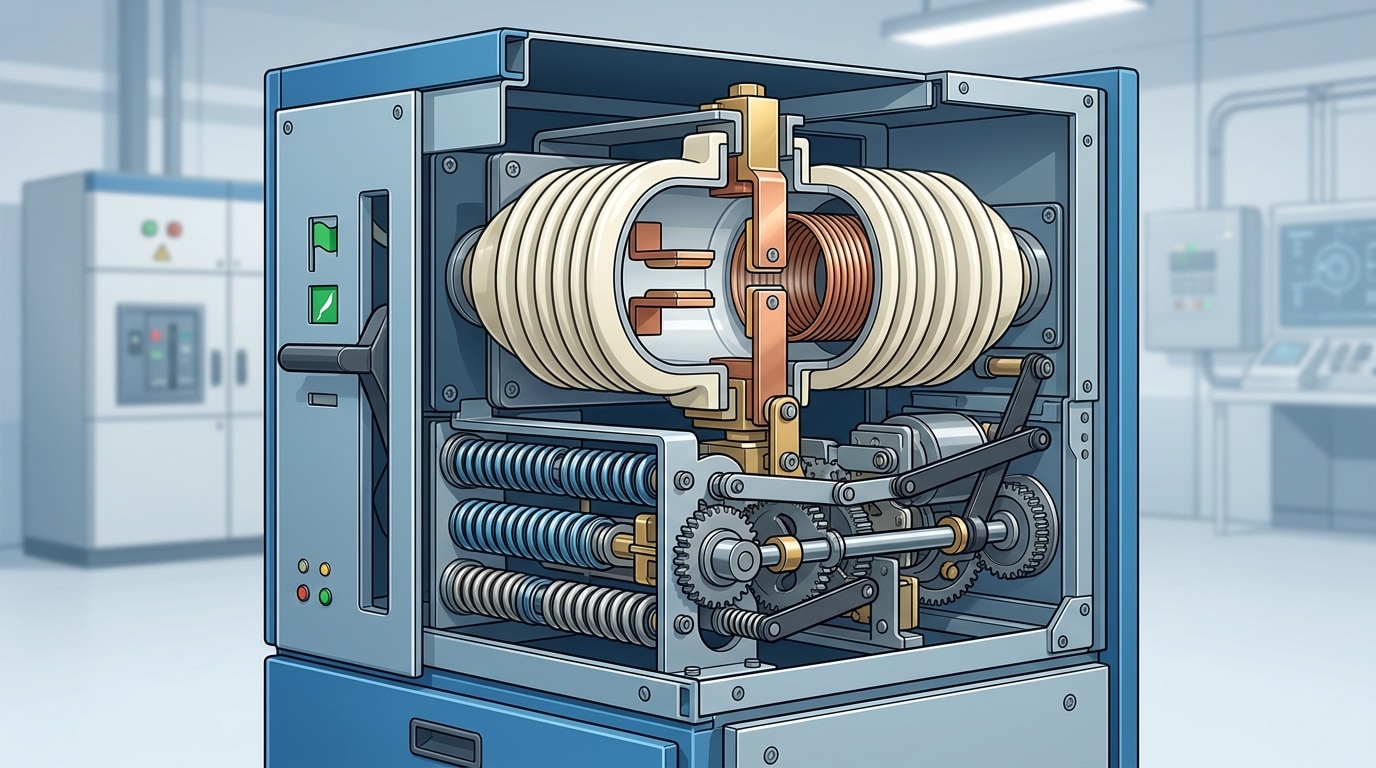
Sulfur hexafluoride pulls double duty. It serves as both the insulating medium and the arc-quenching agent inside the interrupter chamber, which is why SF6-based designs have dominated the higher end of medium voltage applications — particularly at 24 kV and above — for decades. The gas has a dielectric strength roughly 2.5 times that of air at atmospheric pressure, and its electronegative molecules aggressively capture free electrons, snuffing out arcs with remarkable efficiency.
In a typical puffer-type SF6 circuit breaker in medium voltage switchgear, the mechanical opening stroke compresses the gas through a nozzle directed at the arc. This high-velocity jet cools the arc plasma to below 2,000 K in just a few milliseconds, forcing current zero and preventing re-strike. The result is reliable interruption of fault currents up to 50 kA at rated voltages where vacuum technology historically struggled with dielectric recovery.
But there’s a serious catch. SF6 carries a global warming potential 23,500 times that of CO₂ over a 100-year horizon, according to the U.S. EPA. Even small leaks — and annual leakage rates of 0.5–1% are considered normal — accumulate atmospheric damage that persists for roughly 3,200 years. The EU’s revised F-Gas Regulation (2024) is already tightening restrictions, and several utilities have announced SF6-free procurement policies. For any new circuit breaker in medium voltage switchgear rated below 24 kV, vacuum alternatives now match or exceed SF6 performance, making the environmental trade-off increasingly hard to justify.
Air Circuit Breakers and Air-Blast Designs
Air circuit breakers were the workhorses of medium voltage distribution from the 1930s through the 1970s. Plain-break designs relied on arc chutes — stacked steel or ceramic plates that stretched and cooled the arc until it extinguished at a natural current zero. Simple, rugged, and cheap to build. But the interruption chambers were bulky, and the arc energy scorched contacts fast, demanding frequent maintenance.
Air-blast breakers took a different approach. Compressed air at 1.4–2.1 MPa was blasted across the contacts at supersonic speed, forcibly deionizing the arc column in as little as 2–3 cycles. These units handled fault currents up to 63 kA and found a home in high-power substations and industrial plants where rapid reclosing mattered. The trade-off? A dedicated compressor system, moisture separators, and air receivers that added complexity and footprint to every installation.
You can still find air-blast circuit breakers in medium voltage switchgear operating at legacy utility substations and older steel mills, particularly in regions where replacement budgets are tight. However, new installations have almost entirely moved to vacuum and SF6 technologies. The reasons are straightforward: vacuum interrupters need roughly 80% less maintenance, occupy a fraction of the panel space, and eliminate the compressor infrastructure entirely. According to CIGRE survey data, air-blast units accounted for less than 2% of MV breaker orders globally by 2015.
That said, understanding air-based designs still matters for anyone managing aging assets or evaluating retrofit options — the mechanical interfaces and control logic of these older breakers often dictate what modern replacements can physically fit into existing cubicles.
Vacuum vs. SF6 Circuit Breakers — A Detailed Technical Comparison
Choosing the right circuit breaker in medium voltage switchgear often comes down to a head-to-head matchup between vacuum and SF6 technology. Both dominate the market, but they diverge sharply on environmental footprint, maintenance burden, and voltage-class suitability.
Vacuum breakers excel at 1–38 kV. They require almost zero gas monitoring, handle 10,000+ mechanical operations before contact replacement, and produce no greenhouse byproducts. SF6 units, by contrast, shine at 36–72.5 kV where their superior dielectric strength—roughly 2.5 times that of air at atmospheric pressure—justifies the added complexity of sealed gas systems. The U.S. EPA classifies SF6 as a potent greenhouse gas with a global warming potential of 23,500 over 100 years, which increasingly tips procurement decisions toward vacuum alternatives.
| Parameter | Vacuum | SF6 |
|---|---|---|
| Typical voltage range | 1–38 kV | 12–72.5 kV |
| Interrupting capacity | Up to 63 kA | Up to 80 kA |
| Dielectric recovery | Very fast (~10 µs) | Fast (~100 µs) |
| Maintenance interval | 10,000 ops or 20 years | 2,000 ops or 10 years (gas checks) |
| Environmental impact | Negligible | High (GWP 23,500) |
| Lifecycle cost (20 yr) | Lower | Higher (gas handling, disposal) |
For most circuit breaker in medium voltage switchgear applications below 40.5 kV, vacuum technology now represents the default choice. SF6 retains a niche at higher voltage classes and extreme fault-current ratings—but that niche is shrinking fast as regulatory pressure mounts.
Key Selection Criteria for MV Switchgear Circuit Breakers
Picking the right circuit breaker in medium voltage switchgear starts with three non-negotiable electrical ratings: rated voltage (kV), rated normal current (A), and short-circuit breaking capacity (kA). Get any one of these wrong, and the consequences range from nuisance tripping to catastrophic failure. A 12 kV breaker rated at 25 kA might look adequate on paper, but if the prospective fault current at the bus reaches 31.5 kA after a transformer upgrade, that breaker becomes a liability overnight.
Operating environment matters just as much as nameplate data. Indoor metal-clad switchgear in a climate-controlled substation faces very different stresses than an outdoor metal-enclosed unit at 2,000 m altitude, where air density drops roughly 20% and dielectric strength decreases accordingly. Temperature extremes also affect contact resistance, lubricant viscosity, and spring mechanism performance. The IEC 62271-100 standard defines derating factors for altitude above 1,000 m, and ignoring them is a common engineering oversight.
Duty cycle is another critical filter. A breaker protecting a capacitor bank may see hundreds of operations per year, demanding a design rated for class M2 mechanical endurance — typically 10,000 operations. Compare that to a main incomer breaker that might trip five times across its entire service life. Switchgear configuration plays a role too: withdrawable breakers suit applications needing frequent maintenance isolation, while fixed-mount designs reduce cost where operational flexibility is less important.
Finally, verify compliance with the applicable standard framework — IEC 62271 for most global markets, IEEE C37 series in North America. These aren’t interchangeable. Test procedures, TRV envelopes, and rated sequences differ between the two, so specifying a breaker tested only to IEC for an IEEE-governed utility project can stall procurement and delay commissioning by months.
Installation, Testing, and Commissioning Requirements
Proper installation of a circuit breaker in medium voltage switchgear demands precision at every step. Mechanical alignment comes first — the breaker truck must roll smoothly into the cubicle and engage the primary disconnects without binding or excessive force. Misalignment of even 2–3 mm can cause uneven contact engagement, leading to localized hotspots that degrade connections over time.
Once mechanically seated, secondary wiring connections for protection relays, trip coils, and position indicators need verification against the schematic. A single miswired trip circuit can leave a breaker unable to clear a fault. That’s not a theoretical risk — it’s a commissioning failure that shows up more often than most engineers would like to admit.
Essential Pre-Energization Tests
Before any voltage is applied, a sequence of tests confirms the breaker is ready for service. Insulation resistance testing with a 5 kV megger should yield readings well above 1,000 MΩ for new equipment. Contact resistance, measured with a micro-ohmmeter at 100 A DC minimum, must fall within the manufacturer’s specified range — typically under 100 µΩ per pole for vacuum breakers. High values signal contamination or insufficient contact pressure.
Timing tests verify that open and close operations meet the rated speeds. A typical vacuum breaker should complete its opening stroke in 40–60 ms. Finally, high-potential dielectric testing per IEEE C37.09 applies an AC voltage (typically 36 kV for 15 kV class equipment) for one minute to confirm insulation integrity across all phases. Skipping or rushing any of these steps invites failures that are far more expensive to fix after energization.
Maintenance Strategies and Lifecycle Management
A circuit breaker in medium voltage switchgear doesn’t fail without warning — it degrades. Contact erosion, mechanism wear, and insulation deterioration all progress incrementally over years. The question isn’t whether to maintain, but how intelligently you schedule it.
Preventive vs. Condition-Based Approaches
Traditional time-based maintenance follows fixed intervals: inspect every 2–5 years, overhaul after 10,000 mechanical operations or 20 years of service, whichever comes first. It works, but it’s blunt. Condition-based maintenance (CBM) layers in real diagnostic data — contact resistance trends, trip coil current signatures, SF6 gas density readings — to trigger service only when degradation actually warrants it. CIGRE working group studies have shown CBM can reduce unnecessary maintenance interventions by 30–40% while catching developing faults earlier.
Critical Inspection Points
- Vacuum bottle integrity: Magnetron or DC hi-pot testing at 80% of rated withstand voltage confirms the vacuum hasn’t leaked. A failed bottle looks fine externally but won’t interrupt fault current.
- SF6 gas pressure: Monitor density-compensated gauges annually. A drop below the manufacturer’s alarm threshold — typically around 0.1 bar below nominal — signals a seal leak requiring immediate attention.
- Operating mechanism: Lubricate pivot points with manufacturer-specified grease. Check spring charge motor current; a 15% increase often indicates binding linkages.
- Contact wear indicators: Many modern breakers include mechanical counters tracking cumulative fault current interrupted, not just operation count.
Replacement timing depends on cumulative duty. Most vacuum breakers are rated for 30,000 mechanical operations and 50 full fault-current interruptions at rated short-circuit capacity. Once either threshold hits 80%, plan the swap. Waiting until 100% is gambling with protection reliability.
Emerging Trends — Eco-Friendly Alternatives and Digital Integration
SF6 has a global warming potential 23,500 times that of CO2, and regulators are tightening the noose. The EU’s revised F-gas Regulation targets a phase-down of SF6 in medium voltage equipment, pushing manufacturers toward alternatives like dry-air insulation and 3M™ Novec™ 4710 fluoronitrile blends. Siemens, ABB, and Schneider Electric have all released SF6-free switchgear lines rated up to 40.5 kV, with Siemens reporting that its “clean air” portfolio eliminates greenhouse gas emissions from insulation entirely. These fluoronitrile mixtures offer dielectric strength roughly 90% that of SF6 at equivalent pressures — close enough that panel dimensions barely change.
Digital integration is reshaping how every circuit breaker in medium voltage switchgear gets monitored. Embedded sensors now track contact wear, coil current signatures, gas moisture levels, and partial discharge activity in real time. That data feeds into IIoT platforms where machine-learning algorithms flag anomalies weeks before a failure materializes. Digital twin models go further — they simulate breaker aging under actual load profiles, letting operators schedule maintenance around predicted degradation rather than fixed calendars.
The convergence is significant. An eco-friendly breaker paired with continuous condition monitoring slashes both environmental liability and unplanned downtime. Utilities adopting these systems report 30–40% reductions in maintenance costs within the first three years. The technology isn’t speculative anymore. It’s shipping.
Frequently Asked Questions About MV Switchgear Circuit Breakers
What voltage range qualifies as medium voltage? The IEEE and IEC generally define medium voltage as 1 kV to 52 kV, though some North American utilities draw the line at 38 kV. Anything below 1 kV falls into low voltage territory, and anything above 52 kV is high voltage.
How often do MV circuit breakers need maintenance? It depends on the technology. Vacuum breakers typically require inspection every 10,000 operations or 5 years — whichever comes first. SF6 units need annual gas-density checks plus contact inspections roughly every 2,000 operations. Condition-based monitoring can stretch these intervals significantly.
Can vacuum breakers fully replace SF6 at all voltage levels? Not yet. Vacuum interrupters perform exceptionally up to 40.5 kV. Beyond that, dielectric challenges multiply fast, and SF6 or newer alternatives like clean-air breakers still dominate the 52 kV range.
What causes circuit breaker failure? Contact erosion tops the list. Slow operating mechanisms, moisture ingress, and control-circuit wiring faults follow close behind. A failed circuit breaker in medium voltage switchgear almost always traces back to deferred maintenance or missed diagnostic signals.
How do you read a nameplate? Focus on five ratings: nominal voltage (kV), rated current (A), short-circuit breaking capacity (kA), short-time withstand current, and impulse withstand voltage (kVp). These numbers define exactly what the circuit breaker in medium voltage switchgear can handle safely — mismatching even one puts the entire installation at risk.
Choosing the Right Circuit Breaker for Your MV Switchgear Application
The decision comes down to specifics. Voltage class, fault current magnitude, switching duty, environmental constraints, and long-term maintenance budget all feed into a single question: which interruption technology best fits your operating reality? A 12 kV distribution feeder in a hospital basement demands different priorities than a 36 kV utility substation exposed to coastal humidity.
Match the breaker to the job. Vacuum technology dominates below 24 kV for good reason — minimal maintenance, compact footprint, and 30,000+ mechanical operations before overhaul. SF6 still earns its place at higher voltage ratings and extreme fault levels, though eco-gas alternatives like clean air and fluoronitrile mixtures are closing the gap fast. If your facility faces EU F-gas regulation pressure, factor replacement timelines into your capital plan now.
Don’t shortcut the engineering review. A circuit breaker in medium voltage switchgear protects equipment worth millions and, more critically, protects people. Verify rated short-circuit breaking capacity against actual prospective fault currents — not just today’s values, but projected levels after planned network expansions. Confirm TRV compatibility. Validate seismic ratings if your site requires them.
Consult directly with the switchgear OEM or a qualified protection engineer before finalizing any specification. They can run coordination studies, recommend relay settings, and flag compatibility issues that datasheets alone won’t reveal. The right breaker, properly selected and maintained, will serve reliably for 25 to 30 years. A rushed choice costs far more than the time spent getting it right.
See also
What You Need to Know About Industrial Circuit Breaker Types
Vacuum Circuit Breaker and SF6 Pros and Cons Explained
What is low voltage in the field of electrical engineering?
Essential power distribution equipment for shipbuilding industry