
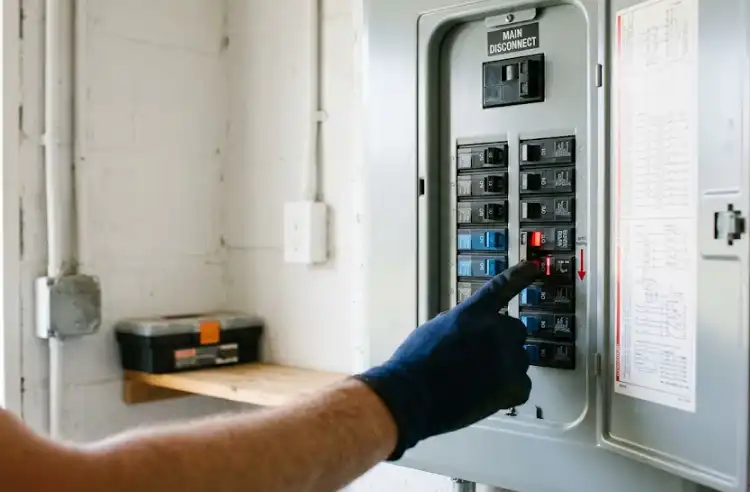
According to the National Fire Protection Association, electrical failures or malfunctions account for roughly 46,700 home fires each year in the United States — and a breaker that trips repeatedly is one of the earliest warning signs something has gone wrong behind your walls. A circuit breaker tripping without load connected almost always points to a problem in the wiring, the breaker itself, or a hardwired device you’ve forgotten about — not a random glitch you can safely ignore. This guide walks through every likely cause, explains how to narrow down the culprit safely, and tells you exactly when the situation demands a licensed electrician.
Quick Answer — Why a Circuit Breaker Trips With Nothing Plugged In
A circuit breaker tripping without load connected almost always points to a problem behind your outlets, not at them. The breaker doesn’t care whether a lamp or toaster is drawing current — it reacts to any abnormal current flow on its circuit, and that flow can originate deep inside your walls where you can’t see it.
Here are the most likely culprits, ranked roughly by how often electricians encounter them:
- Damaged or deteriorated wiring insulation — Heat, age, rodent chewing, or a nail driven through Romex during a renovation can expose conductors and create a short circuit that trips the breaker instantly.
- Ground fault from moisture intrusion — Water seeping into a junction box, outdoor receptacle, or basement conduit creates a low-resistance path to ground. Even a few milliamps of leakage will trip a GFCI breaker.
- A defective breaker — Internal components wear out. A breaker that’s been tripping repeatedly can develop a weakened bimetal strip or degraded trip coil, causing it to open at well below its rated amperage.
- Loose wire connections — A backstab connection that has worked itself loose generates arcing, which produces enough heat and irregular current to trip AFCI-protected circuits.
- Hardwired loads you forgot about — Smoke detectors, bathroom exhaust fans, under-cabinet lighting, and doorbell transformers are permanently wired. They’re “plugged in” even when you think nothing is.
The National Fire Protection Association reports that electrical distribution equipment — breakers, wiring, outlets — is involved in roughly 34,000 home fires per year in the United States. A breaker that trips with no apparent load is doing exactly what it’s designed to do: interrupt a dangerous condition before it becomes a fire. Ignoring it is a gamble.
The sections below walk through each cause in detail, show you safe diagnostic steps you can take yourself, and explain when the situation demands a licensed electrician. Start with the next section to narrow down your specific problem.
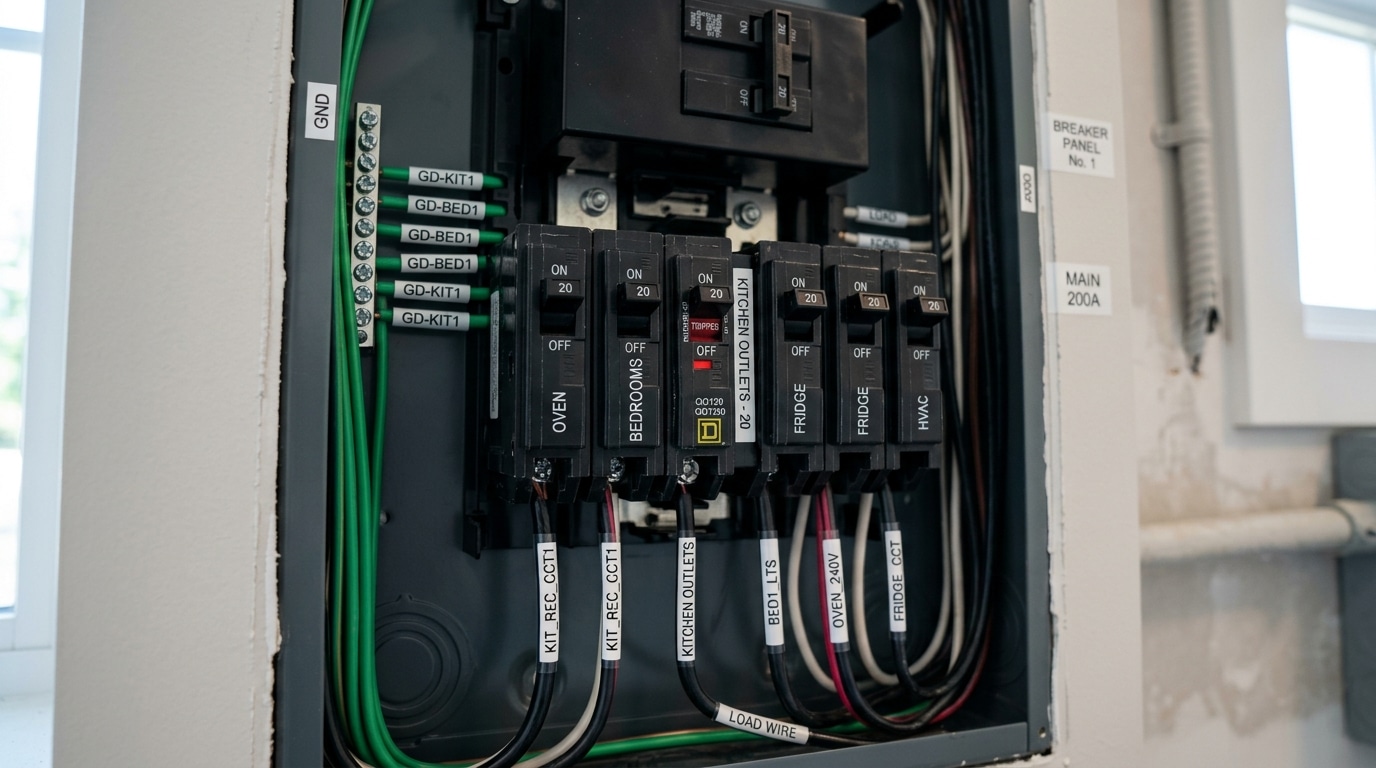
Common Reasons a Circuit Breaker Trips With No Apparent Load
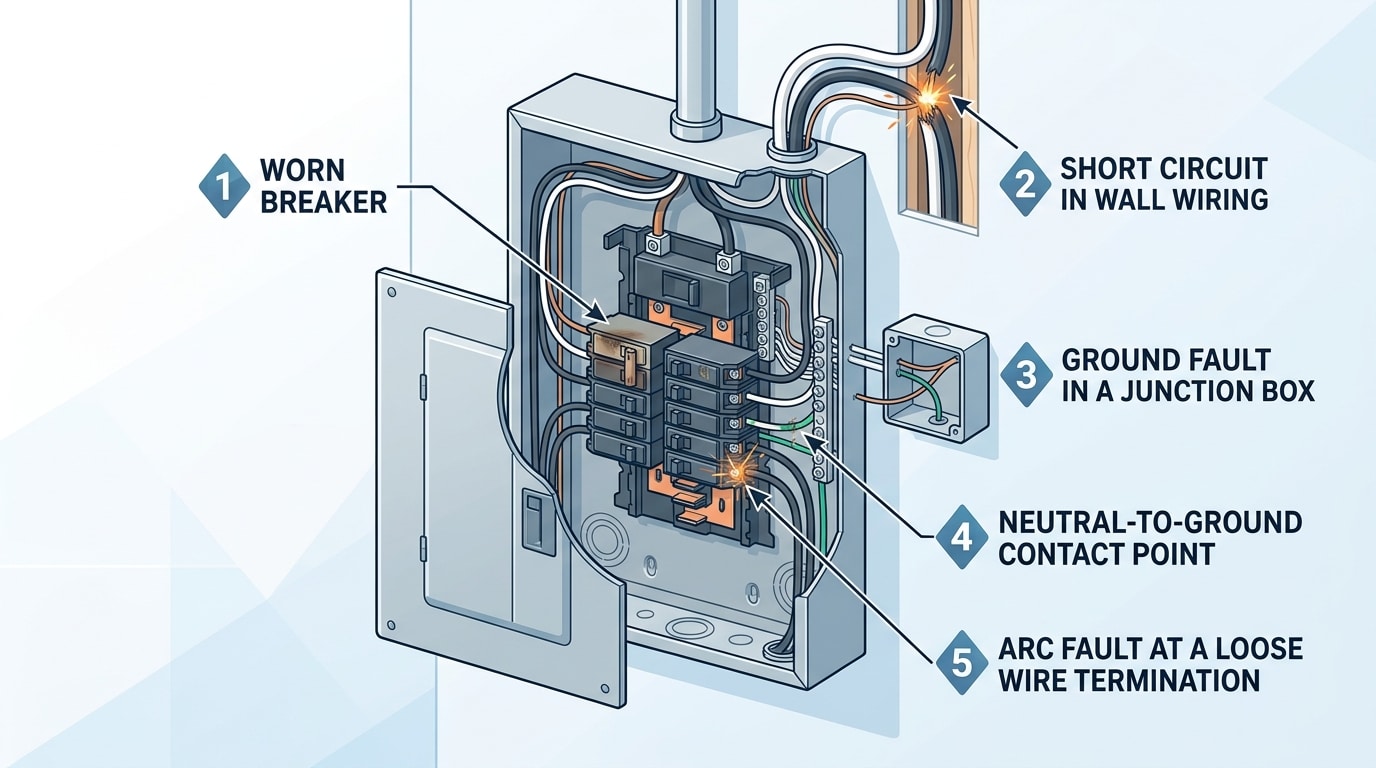
Five root causes account for the vast majority of cases where a circuit breaker keeps tripping without load connected. Understanding each one helps you narrow down the problem before picking up a multimeter—or a phone to call an electrician.
Internal Breaker Failure
Breakers are mechanical devices with a limited lifespan. The bimetallic strip inside can weaken after thousands of thermal cycles, causing the breaker to trip at currents far below its rated amperage. A breaker manufactured 25–30 years ago may simply be worn out. Loose bus bar connections inside the panel also generate heat that mimics an overload condition.
Short Circuits Behind Walls
A hot wire touching a neutral or another hot wire creates a short circuit—a near-zero-resistance path that spikes current instantly. This can happen when a nail or screw pierces Romex cable inside a wall cavity. The damage may have occurred during a renovation years ago, only now degrading enough to make contact. You won’t see it. The breaker does.
Ground Faults in Junction Boxes
When a hot conductor contacts a grounded metal box or bare ground wire, current leaks along an unintended path. Junction boxes buried behind drywall or hidden in attics are common culprits. According to the NFPA 70 (National Electrical Code), ground-fault protection exists precisely because these faults can occur without any appliance being involved.
Neutral-to-Ground Contact
This one is sneaky. If a neutral wire touches a ground wire downstream of the panel, return current splits between two paths. Standard breakers may not catch it, but GFCI breakers will trip immediately because they detect the current imbalance—typically anything over 4–6 milliamps. The circuit looks “dead” to you, yet the breaker won’t stay reset.
Arc Faults
Damaged insulation, loose wire terminations, or corroded connections can produce tiny electrical arcs. These arcs generate erratic current signatures that AFCI breakers are designed to detect. An arc fault draws minimal current—sometimes under 1 amp—so it genuinely feels like nothing is connected. But the breaker senses the dangerous waveform pattern and shuts things down.
Hidden Short Circuits and Ground Faults Buried in Your Wiring
Your walls hide secrets. Behind drywall, inside junction boxes, and along stapled cable runs, wiring can fail in ways that are completely invisible from the outside. A short circuit occurs when a hot wire contacts a neutral or another hot wire, creating a sudden surge of current that the breaker must interrupt. A ground fault is similar but involves current leaking to a grounding conductor or a metal box. Either one can cause a circuit breaker tripping without load connected — because the fault exists in the wiring itself, not in any appliance.
One of the most common culprits is a nail or drywall screw driven through a cable during a renovation. The fastener may nick the insulation just enough to create a partial contact that arcs intermittently, sometimes only when humidity swells the wood framing or when temperature shifts cause the cable to expand. According to the NFPA’s electrical fire data, electrical distribution equipment — which includes in-wall wiring — is a leading factor in home structure fires, making these hidden faults genuinely dangerous rather than just annoying.
Loose wire connections inside outlet and switch boxes are another frequent source. A backstab connection — where the wire is spring-loaded into a slot rather than secured under a screw terminal — can loosen over years of thermal cycling. The resulting gap arcs, generates heat, and may trip the breaker sporadically. What makes these faults maddening is their intermittent nature: the circuit works fine for days, then trips at 2 a.m. for no apparent reason.
Degraded insulation is harder to spot. Older homes with cloth-wrapped Romex or knob-and-tube wiring are especially vulnerable because the insulation becomes brittle and cracks with age. Even modern NM-B cable can suffer if it was routed too close to a heat source like a recessed light housing or a hot-water pipe. Once bare copper touches bare copper — or a grounded metal box — the fault path is complete, and the breaker does exactly what it was designed to do.
How Moisture, Pests, and Environmental Damage Cause Phantom Tripping
Water is electricity’s uninvited dance partner. When moisture seeps into an outdoor junction box through a cracked gasket or a missing knockout plug, it forms a thin conductive film across wire terminations. That film doesn’t need to be a puddle — even a light layer of condensation can create a leakage path of 5–15 milliamps, which is more than enough to trip a GFCI breaker rated at 4–6 mA. This is one of the sneakier explanations for a circuit breaker tripping without load connected, because the “load” is really just water bridging two conductors.
Condensation inside walls follows predictable patterns. It peaks during spring and fall when daytime warmth meets cool nighttime surfaces, causing moisture to collect on cold metal boxes and wire connectors. Homes with poor vapor barriers in crawlspaces or uninsulated exterior walls are especially vulnerable. If your phantom tripping happens mostly on humid mornings or after heavy rain, moisture is the prime suspect.
Rodents cause a different kind of havoc. Mice and rats gnaw through NM-B cable sheathing to wear down their ever-growing incisors, exposing bare copper that can contact grounded metal framing or other conductors. The NFPA estimates that rodent-damaged wiring contributes to thousands of residential electrical fires each year. Telltale signs include small droppings near the panel, visible gnaw marks on exposed cable runs in attics or basements, and a faint urine smell near baseboards.
Insects pose their own risks. Wasps sometimes build nests inside weatherproof panel enclosures, and their mud-dauber nests can pack conductive debris against bus bars. Ants — particularly invasive species like Rasberry crazy ants — are attracted to electrical fields and swarm relay contacts and breaker terminals, creating short circuits with their own bodies. Seasonal pest activity explains why these trips often cluster in late spring through early fall, then vanish in winter.
How to Safely Test Whether the Breaker Itself Is Faulty
Before touching anything inside your electrical panel, put on rubber-soled shoes and dry leather gloves. Stand on a dry surface — a rubber mat is ideal. Keep one hand behind your back or in your pocket while working near live bus bars; this old electrician’s habit prevents current from traveling across your chest if something goes wrong.
Step 1: Reset and observe. Flip the tripping breaker fully to the OFF position, then back to ON. Listen closely. A healthy breaker clicks firmly and holds. A faulty one may feel mushy, refuse to latch, or trip again within seconds — even with every device on that circuit disconnected. If it trips instantly with zero load, the breaker mechanism itself is a strong suspect.
Step 2: Disconnect the circuit wire. Turn off the main breaker first. Remove the panel cover and locate the hot wire (typically black or red) feeding out of the suspect breaker. Loosen the terminal screw and carefully pull the wire free, then cap it with a wire nut. Reinstall the cover, restore main power, and flip the suspect breaker ON. If it still trips with no wire attached at all, the breaker has failed internally — replace it.
Step 3: Check voltage with a multimeter. Set your meter to AC voltage. With the breaker ON and the circuit wire reconnected, measure between the breaker’s output terminal and the neutral bus bar. A standard single-pole breaker should read between 115 V and 125 V. Readings that fluctuate wildly — jumping from 80 V to 130 V within seconds — suggest a loose connection or degraded breaker contacts. According to NFPA 70 (National Electrical Code), loose connections are a leading contributor to electrical failures in residential panels.
A circuit breaker tripping without load connected can absolutely be the breaker’s own fault, especially in panels older than 20 years. But here’s the critical boundary: if you’re uncomfortable removing the panel cover, or if you see scorching, melted plastic, or smell burning, stop immediately and call a licensed electrician. DIY testing is useful for narrowing the problem — not for heroics.
AFCI and GFCI Breakers — Why They Trip More Easily and What It Means
Standard breakers respond to one thing: excessive current. AFCI and GFCI breakers are different animals entirely. They monitor the waveform of the current, hunting for signatures that indicate arcing or ground leakage as small as 4–6 milliamps. That hair-trigger sensitivity is exactly why the NEC (NFPA 70) now requires them in bedrooms, kitchens, bathrooms, laundry rooms, and garages — and it’s also why they account for a disproportionate share of cases where a circuit breaker tripping without load connected leaves homeowners baffled.
Shared Neutrals — The Silent Troublemaker
Older homes often share a single neutral conductor between two circuits. AFCI and GFCI breakers interpret that shared return path as a current imbalance — because current leaving on the hot wire doesn’t all come back on its own neutral. The breaker reads this as a ground fault and trips instantly. Fixing it means running a dedicated neutral for each protected circuit, which can be labor-intensive in finished walls.
Incompatible Devices and Nuisance Trips
Certain LED dimmers, treadmill motors, and vacuum cleaners produce electrical noise that mimics an arc signature. Early-generation AFCI breakers (pre-2017 models) are especially prone to this. Upgrading to a current-generation combination AFCI breaker often eliminates the false trips without sacrificing protection.
Nuisance Trip vs. Real Fault — How to Tell
Both AFCI and GFCI breakers have a test button and, on many models, a small LED indicator. A solid light or specific blink pattern after tripping tells you the fault type — check your breaker’s data sheet for the code. If the breaker trips the moment you reset it with every device disconnected and every switch off, the fault is in the wiring itself, not a nuisance event. That distinction matters. Nuisance trips happen intermittently and stop when you remove the offending device; genuine faults are persistent and demand professional investigation.
Hardwired Appliances and Fixtures You Might Be Overlooking
You unplugged every lamp, charger, and appliance on the circuit. The breaker still trips. Here’s the catch: “nothing plugged in” and “nothing connected” are two very different statements. Dozens of devices in a typical home are hardwired directly into the electrical system, meaning they stay energized whether you think about them or not.
Ceiling fans, recessed LED fixtures, bathroom exhaust fans, garbage disposals, range hoods, doorbell transformers, and hardwired smoke detectors all live permanently on your circuits. A single failing ballast inside a fluorescent fixture, a shorted motor winding in a 15-year-old exhaust fan, or corroded wire nuts inside a recessed light’s junction box can absolutely cause a circuit breaker tripping without load connected — at least no visible load. The NFPA 70 (National Electrical Code) requires hardwired smoke detectors on dedicated or shared circuits, and these are easy to forget during troubleshooting because they sit quietly on the ceiling doing nothing obvious.
How to Systematically Isolate Hardwired Devices
Turn the breaker off first. Then disconnect each hardwired device one at a time — this usually means opening the fixture’s junction box and separating the wire connections. Start with the easiest access points: pull-chain ceiling fans, under-cabinet lights, and garbage disposals with a clear junction box beneath the sink. After disconnecting one device, restore the breaker and wait. If it holds, you found your culprit.
Pay special attention to recessed lighting cans installed before 2010. Older IC-rated cans trap heat, and their internal thermal switches can degrade over time, creating intermittent short circuits that mimic phantom tripping. Garbage disposal motors are another frequent offender — a seized motor draws locked-rotor current of 30–60 amps on a 20-amp circuit, and the disposal stays hardwired even when you think everything is “off.” If you’re uncomfortable disconnecting wire nuts inside junction boxes, this is the point where a licensed electrician earns their fee in minutes.
When to Call a Licensed Electrician and What to Tell Them
DIY troubleshooting has limits. Some symptoms signal genuine danger — the kind that causes house fires — and pushing past your skill level isn’t worth the risk. If you’ve worked through the earlier diagnostic steps and your circuit breaker tripping without load connected persists, a professional visit is the right call.
Red Flags That Demand Immediate Professional Help
- Burning or acrid smell near the panel, an outlet, or a switch — even faint. This often means insulation or wire sheathing is charring.
- Discolored, melted, or warm outlet covers. A cover plate that’s too hot to hold comfortably against your cheek suggests arcing behind the wall.
- The breaker trips again within seconds of resetting, every single time, with all loads confirmed disconnected.
- Visible scorch marks on the breaker itself or the bus bar inside the panel.
- A buzzing or crackling sound coming from inside the panel or a wall cavity.
- The breaker won’t stay in the ON position at all — it snaps back immediately, which points to a dead short or a mechanically failed breaker.
Any one of these warrants a same-day service call. Two or more together? Stop resetting the breaker entirely and leave it off until the electrician arrives. The NFPA reports that electrical distribution equipment is involved in roughly 34,000 home fires per year in the U.S. — many preventable with timely intervention.
What to Prepare Before the Electrician Arrives
A well-prepared homeowner saves the electrician diagnostic time, which directly saves you money. Most residential electricians charge $75–$150 per hour, so shaving 30 minutes off the visit matters. Have these details ready:
- Which breaker number and amperage keeps tripping (e.g., “Breaker 14, 20-amp, labeled ‘Master Bedroom'”).
- Breaker type: standard thermal-magnetic, AFCI, GFCI, or dual-function.
- Frequency and pattern — does it trip instantly on reset, after 10 minutes, only at night, or only when the HVAC runs?
- What you’ve already tested — disconnected loads, swapped breakers, checked for moisture, etc.
- Age of the home and panel. A 1970s Federal Pacific panel tells a very different story than a 2019 Square D.
- Any recent work — remodeling, new fixture installation, or a storm that may have introduced water.
Write this down or keep it in a phone note. Electricians appreciate specifics over vague descriptions like “it just keeps tripping.” The more context you provide, the faster they can pinpoint why a circuit breaker tripping without load connected won’t stop recurring.
Frequently Asked Questions About Circuit Breakers Tripping Without Load
Can a bad breaker cause a fire?
Yes. A breaker that fails to trip when it should allows wires to overheat past their insulation rating, and that’s exactly how electrical fires start inside walls. Conversely, a breaker with a loose bus-bar connection can arc internally, generating enough heat to melt the plastic housing. The NFPA estimates that electrical failures cause roughly 46,700 home fires per year in the U.S. — faulty breakers and worn wiring rank among the top contributors.
Is it safe to keep resetting a tripping breaker?
Once or twice to confirm the pattern? Fine. Repeatedly forcing it back on is dangerous. Each reset energizes whatever fault is causing the trip, which can degrade wire insulation further or intensify an arc. A good rule: if the breaker trips three times in a row with nothing visibly connected, stop resetting and call a professional.
How much does diagnosis and repair typically cost?
A licensed electrician’s diagnostic visit usually runs $75–$200, depending on your region. Replacing a standard breaker adds $150–$300 including parts and labor. If the root cause is damaged wiring inside a wall, expect $300–$800 or more, since drywall may need to be opened. AFCI breaker replacements sit at the higher end — around $40–$80 for the part alone.
Can a tripping breaker damage my electronics?
Abrupt power cuts stress sensitive components. Hard drives can lose data mid-write, and capacitors in power supplies suffer from repeated surge-and-drop cycles. The breaker itself isn’t sending a harmful surge, but the sudden loss and return of power mimics one.
Why does my breaker only trip at night or during rain?
Nighttime tripping often correlates with temperature drops that cause condensation inside outdoor junction boxes or attic wiring runs. Rain introduces moisture directly — even a hairline crack in exterior conduit lets water reach a wire splice. A circuit breaker tripping without load connected specifically during wet weather is a strong indicator of a ground fault tied to moisture intrusion. Check outdoor outlets, landscape lighting circuits, and any wiring that passes through exterior walls first.
Summary — Troubleshooting Checklist and Next Steps
Use this checklist in order. Stop at the step that reveals your problem.
- Confirm “nothing is plugged in” is actually true. Disconnect every cord on the circuit, then check for hardwired loads — smoke detectors, bathroom exhaust fans, garbage disposals, doorbell transformers, and in-wall heaters.
- Identify the breaker type. Read the label on the breaker face. AFCI and GFCI breakers trip on faults that a standard thermal-magnetic breaker ignores entirely, so the diagnosis path differs.
- Inspect accessible wiring and junction boxes. Look for scorched insulation, rodent gnaw marks, corroded connections, or moisture. Pay special attention to outdoor boxes, basement runs, and attic staple points.
- Test the breaker itself. With the branch wiring disconnected from the breaker’s load terminal, reset it. If it still trips with no wire attached, the breaker is defective — replace it with an identical unit rated for your panel.
- Perform a megohmmeter insulation test. This catches degraded insulation that a standard multimeter misses. Readings below 1 MΩ between any conductor and ground confirm a fault buried in the wire run.
- Check environmental factors. Recent storms, plumbing leaks, or new landscaping irrigation near exterior outlets can introduce moisture that triggers ground faults intermittently.
If you work through every step and the circuit breaker tripping without load connected still has no clear explanation, the fault likely sits inside a wall cavity or conduit where visual inspection is impossible. That’s the point where a licensed electrician with thermal imaging or a time-domain reflectometer earns their fee. The NFPA 70 (National Electrical Code) exists because hidden electrical faults cause roughly 46,700 home fires per year in the U.S. Don’t gamble with that statistic.
Your next step: bookmark this page, grab a flashlight, and start at item one. Document everything you find — photos, breaker labels, megger readings — so an electrician can pick up exactly where you left off if needed.
See also
Combiner box and junction box: main differences
How to Tell If You Need a Junction Box for Outdoor Lighting
Maintenance and inspection checklist for solar combiner box
Maintenance and inspection checklist for solar combiner box
How to Recognize High-Quality Wall Switches in Today’s Market