

You do quality checks in Circuit Breaker Manufacturing by using a careful, step-by-step plan. Each step keeps people safe by ensuring the product works correctly and adheres to strict regulations. You begin with checking materials. Then you check how it is assembled. After that, you conduct rigorous tests before the final inspection. Testing includes mechanical operations, voltage cycles, and additional checks, as shown below:
| Test Type | Description |
|---|---|
| Mechanical Operating Tests | Perform five open and close moves at high and low voltages. |
| Rated Supply Voltage Tests | Execute five open-close cycles with the tripping mechanism activated. |
| Additional Inspections | Inspect wires, control switches, extra components, and conduct numerous operational tests. |
You might encounter challenges like aligning circuit breaker parts with system requirements. You also need to comply with standards such as IEC or UL. It is essential to perform extensive testing to ensure safety and optimal performance.
Key Takeaways
- Begin quality checks by looking at raw materials for problems. Check for cracks and rust. Measure the size to make sure it matches the design.
- Pick certified suppliers to get good materials. This lowers the chance of problems and makes the product safer.
- Do careful visual checks during assembly. Look for missing parts. Make sure labels are correct and everything lines up.
- Test circuit breakers often. Do insulation resistance and mechanical operation tests. This keeps things safe and follows rules.
- Write down all test results and inspections. Keeping good records helps track quality and find ways to get better.
Material Inspection
Raw Material Checks
You begin by checking the raw materials for problems. Look for any damage, rust, or other defects. Measure each part’s size and weight to see if they match the design. Test how strong and bendy the metals and plastics are. These steps help you find weak parts before building starts.
- Look at metals for cracks or rust.
- Check plastics for color, shape, and smoothness.
- Use tools to measure size and thickness.
- Test samples to see if they are strong and flexible.
Tip: Keep your inspection area clean and bright. This makes it easier to see any problems.
Supplier Certification
You need good suppliers for your materials. Supplier certification is very important in circuit breaker manufacturing. Certified suppliers follow strict rules and international standards. They use quality systems like ISO 9001 and IEC standards. These systems help stop bad parts from being used. Reports from the International Electrotechnical Commission say about 30% of circuit breaker failures are from poor manufacturing. Choosing certified suppliers helps stop these failures. It also makes your products safer and more reliable.
You should:
- Ask for proof that suppliers are certified.
- Check supplier audit reports.
- Only work with suppliers who meet your quality rules.
Note: Supplier certifications protect your company and your customers. They make sure every circuit breaker is safe and works well.
Assembly Line Control
Assembly line control is very important in Circuit Breaker Manufacturing. This process helps every product meet the same high standards. Each station on the line does one main job. This setup saves time and keeps things organized. Workers follow clear steps for each task. These steps help keep quality and make sure everything is the same.
Visual Inspection
First, you do a visual inspection. This step helps you find problems early. Look for broken or missing parts. Check if screws, wires, and labels are in the right spots. If you see a problem, fix it before moving on. You also check the color and finish of each part. Every circuit breaker should look and work just right.
Here is an easy checklist for visual inspection:
- Look for cracks, dents, or scratches.
- Make sure all parts are there.
- Check if labels and markings are easy to read.
- See if any screws are loose or missing.
- Make sure moving parts are lined up right.
Tip: Bright lights help you see small problems better.
Calibration and Configuration
After checking how it looks, you do calibration and configuration. This step makes sure each circuit breaker works as it should. You check and set the controls for safety and use. For new setups, check all settings you can change. Test the breaker to see if it trips at the right current. Write down your results in a digital logbook so you can track them.
Follow these steps for calibration and configuration:
- Check if all settings match the design.
- Test if the breaker finds overcurrent.
- Write down all settings and test results.
- Give a test report before you install it.
- Plan regular checks to keep it working well.
You should follow rules like IEC 60364-6 for how often to test. Regular calibration keeps your products safe and working right.
Testing in Circuit Breaker Manufacturing
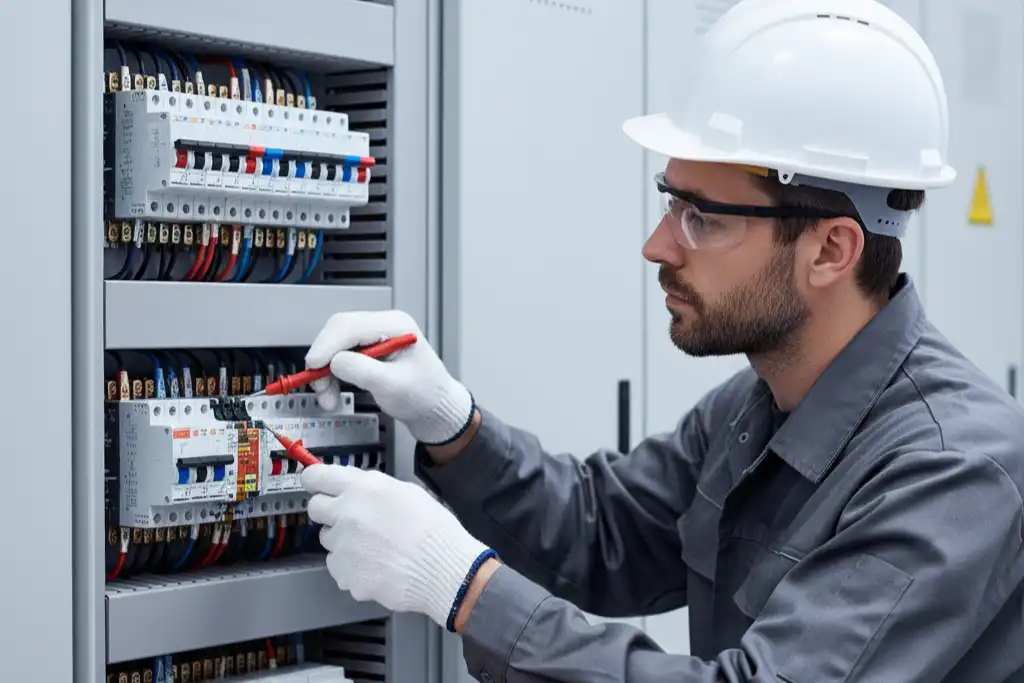
Testing is a key part of Circuit Breaker Manufacturing. You must check that every breaker is safe. It also needs to meet tough rules. This step uses tools and computers to check how it works. Delay and timing, contact resistance, and insulation tests help you find problems. These tests happen before the breaker leaves the factory.
Delay and Timing Tests
Delay and timing tests show how fast a breaker opens or closes. The breaker should react fast when there is a problem. If it is slow, it can cause damage or fires. Special timing tools measure how long it takes to open or close. You send a signal and then check the time.
Here is a table with opening and closing times for different brands:
| Manufacturer | Model | Opening Time (ms) | Closing Time (ms) | Testing Requirement |
|---|---|---|---|---|
| Siemens | GMSG | ≤56 (5-cycle) | ≤65 | N/A |
| Siemens | FSV/MSV | 33/75 (2.0/4.5 cycles) | N/A | N/A |
| Eaton | VCP-W | 30–45 | 45–60 | Recommended |
| Westinghouse | DHP | N/A | 6.5-10.5 ft/sec | Part of inspection |
| GE | VB1 | 35–45 | 60–90 | N/A |
| SENTOP | HK | 50–95 | 23–35 | Recommended |
You should check your results with these numbers. If your breaker is too slow or too fast, fix it. Good timing keeps your electrical system safe.
Tip: Always write down your timing test results. This helps you see patterns and find problems early.
Contact Resistance
Contact resistance shows how well electricity moves through the breaker’s contacts. High resistance means the contact is not good. This can make the breaker overheat or stop working. You use a DC test and a low-resistance ohmmeter when the breaker is closed.
Here are some facts about contact resistance:
- Contact resistance should be less than 100 micro-ohms.
- Switchgear should be below 150 micro-ohms.
- Good breakers and switchgear are between 10 to 100 micro-ohms.
- Some tools need resistance lower than 10 micro-ohms.
- Always test with the breaker closed and use a DC test.
If resistance is high, clean the contacts or change old parts. Low resistance helps the breaker last longer and work better.
Note: Clean and dry contacts give the best results.
Insulation and Injection Tests
Insulation and injection tests check if the breaker can handle high voltage and current. These tests make sure there are no leaks or failures. You use different ways to test this:
| Method | Description |
|---|---|
| Primary Injection Testing | You send a strong current through the breaker to see if it can carry and stop current. This checks if it works under real loads. |
| Secondary Injection Testing | You send a signal into the relay circuits to see if the relays work right. This uses less power and checks the control system. |
| Insulation Resistance Testing | You use a Megger to send high DC voltage and measure leaks. This shows if the insulation is strong and safe. |
Do these tests when you start, fix, or check the breaker. If it fails, fix or change it before using.
Alert: Never skip insulation tests. Bad insulation can cause dangerous problems.
Hardware and Digital Validation
You must check both hardware and digital parts. Here are common steps for validation:
- Product calibration checks if the breaker works as it should.
- Firmware configuration makes sure smart breakers have the right software.
- Smart energy management checks if the breaker talks to energy systems.
- Mechanical testing checks if the breaker is strong.
- Safety certification shows the breaker meets safety rules.
- Safety testing makes fake faults to see if the breaker reacts right.
- Contact force checks pressure between contacts for good flow.
- Trip-unit testing makes fake overloads and short circuits.
- Burn-in and stress testing runs the breaker for a long time to find early problems.
Use these steps to make sure every breaker is safe and ready to use. Circuit Breaker Manufacturing needs these tests to keep quality high.
Quality Control and Compliance
Routine Testing
Routine testing makes sure each circuit breaker is safe. These tests help you find problems before shipping. You must follow international rules for these checks. Here is a table that lists the main tests you need:
| Testing Method | Description |
|---|---|
| Dielectric Withstand Test | Pretends there is a high-voltage surge to check for breakdowns. |
| Contact Resistance Test | Checks resistance between main contacts; high resistance can cause overheating. |
| Tripping Function Test | Tests how the breaker reacts to overloads and short circuits. |
| Insulation Resistance Test | Checks insulation quality using 500–1000V DC. |
| Mechanical Operation Test | Tries real-life use with many ON/OFF cycles. |
| Visual and Dimensional Inspection | Checks labels, torque, housing, and extra parts. |
Keep all contact points clean and dry during tests. Use electrical contact cleaner to remove dirt. In wet places, clean more often and use a wire brush for rust. Do not put grease on contacts. Grease can make them hotter and raise resistance.
Tip: Always check if latch faces and rollers have clean grease. Change them if the grease is thick or dirty.
Safety Certification
You must follow strict rules before selling a circuit breaker. Safety certifications prove your product meets important standards. Here are the main certifications you need:
- UL certification is needed.
- You must follow NEC rules.
- Local codes also matter.
- UL 489 is a key safety rule.
- Circuit breakers must pass hard tests for UL Listing.
Keep good records to show you follow the rules. These records include marks, numbers, manuals, and test reports. You also need to follow IEC 60947-2 for low-voltage breakers. These steps show your product is safe and ready to use.
Note: Good paperwork protects your company and customers. It proves you follow the rules in Circuit Breaker Manufacturing.
Reliability and Stress Testing
Reliability and stress testing help you see if circuit breakers work well. These tests show how a breaker handles heat, too much power, and tough places. You use these tests to find weak spots and make your products better.
Thermal and Overload
Thermal and overload testing checks if a circuit breaker can take high heat and heavy loads. You want to see if the breaker trips at the right time and stays safe. Here is a simple table that shows the steps for thermal and overload testing:
| Step | Description |
|---|---|
| 1 | Turn off the power to stay safe. |
| 2 | Use tools to check if power flows and voltage. |
| 3 | Find any breakers that have tripped. |
| 4 | Look for damage or signs of getting too hot. |
You use tools like a multimeter, insulation tester, contact tester, and a thermal camera. The Noyafa IR Thermal Imaging Camera NF-521S helps you find hot spots. It checks the temperature of parts and warns you if they get too hot. This lets you fix problems before they cause bigger issues.
You also use reliability tests to see how well the breaker works under stress. Here is a table of common ways to test:
| Testing Method | Description |
|---|---|
| Electrical Performance Tests | Check how the breaker works in normal and problem times. |
| Insulation Performance Tests | Measure how safe the insulation is. |
| Mechanical Testing | Test if moving parts work together well. |
| Contact Resistance Measurement | Check if the main contacts connect well. |
| Dynamic Contact Resistance Measurement | See how worn the arcing contacts are. |
| Three-Phase Desynchronization Measurement | Measure timing differences between the three poles. |
| Motion Characteristic Testing | Track how fast and far the parts move. |
| Minimum Operating Voltage Test | Find the lowest voltage where the breaker still works. |
These tests help you find problems early and keep your products safe.
Environmental Testing
Environmental testing checks if a circuit breaker can last in different places. You test how it works in heat, cold, and wet air. You follow rules like IEC 62271-100 and IEEE C37.09. These rules tell you how to test things like tripping time and how well the breaker stops current.
- IEC 62271-100 covers high-voltage breakers and includes design, testing, and care.
- IEEE C37.09 explains how to test AC high-voltage breakers.
- Routine tests check if the breaker does what the maker says.
- You also test in different temperatures and wetness to see if the breaker still works.
You use the test results to make your designs better. If you find a weak spot, you can fix it before selling the product. Using reliability and stress testing in Circuit Breaker Manufacturing helps you make safer and stronger products.
You are important in Circuit Breaker Manufacturing because you follow each quality check. These steps help keep products safe and reliable. They also make sure products follow the rules. To keep high standards, do these things:
- Plan regular checks and electrical tests.
- Clean and oil breakers so they work well.
- Write down what you do and teach your team often.
NFPA 70B says you must check and change your testing steps. You can see how well you do by using these numbers:
| Metric | Description |
|---|---|
| Overall equipment effectiveness (OEE) | Checks how well machines work and their quality. |
| Defect rates | Tells how many products do not pass checks. |
| Customer satisfaction scores | Shows how happy customers are with your products. |
| Scrap rate | Counts wasted materials from bad products. |
| Warranty costs | Tells how much you spend to fix or replace products. |
If you follow these steps, every circuit breaker will meet top standards.
FAQ
What is the most important quality check for circuit breakers?
You should do insulation resistance testing first. This test finds weak spots that may cause problems. Good insulation keeps your circuit breaker safe and working.
How often should you perform routine testing?
Test each circuit breaker before you send it out. You also need to check them often while they are being used. Routine testing helps you find problems early and keeps products working.
Why do you need supplier certification?
Supplier certification helps you trust your materials. Certified suppliers follow strict rules. This lowers the chance of failures and keeps customers safe.
What tools help you check contact resistance?
You use a low-resistance ohmmeter and a DC test set. These tools measure resistance between contacts. Clean contacts give you the best results.
See also
How to Test Molded Case Circuit Breakers in 3 Easy Steps
How to Test Air Circuit Breakers Safely and Effectively
Why a bad circuit breaker can cause low voltage
What Are Main and Arcing Contacts in Circuit Breakers
The manufacturing process of miniature circuit breakers
