
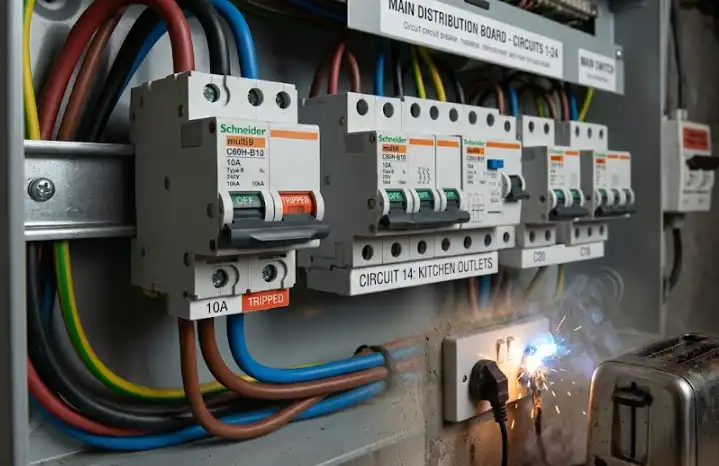
Over 70% of unplanned downtime in commercial and industrial facilities traces back to poorly coordinated overcurrent protection — a problem that proper breaker coordination eliminates. The debate around circuit breaker selectivity vs backup protection comes down to a single trade-off: do you pay more upfront for full discrimination, keeping the rest of your system energized when a fault occurs, or do you accept a cheaper cascading (backup) scheme that sacrifices upstream continuity to safely clear high fault currents? Selectivity isolates only the faulted circuit; backup protection lets a downstream breaker rely on an upstream device to help interrupt faults beyond its solo breaking capacity. Understanding exactly where each strategy fits — and where it fails — determines whether your facility stays running or goes dark.
Quick Answer — Selectivity vs Backup Protection at a Glance
Circuit breaker selectivity (also called discrimination) ensures that only the breaker nearest the fault trips, leaving every other circuit energized. Backup protection (cascading) lets a smaller downstream breaker rely on a larger upstream breaker to help clear high-level faults it cannot interrupt on its own.
The core difference: Selectivity maximizes uptime by isolating the faulted circuit alone. Backup protection reduces hardware cost by sharing interrupting duty between two breakers — but sacrifices continuity because the upstream device also trips.
| Criterion | Selectivity (Discrimination) | Backup Protection (Cascading) |
|---|---|---|
| Which breakers trip? | Only the one closest to the fault | Downstream and upstream breaker |
| Service continuity | High — unaffected circuits stay live | Lower — broader outage possible |
| Breaking capacity requirement | Each breaker rated for full prospective fault current | Downstream breaker can have a lower Icu/Ics rating |
| Typical cost | Higher upfront (larger breakers, CTs, protection relays) | Lower upfront hardware spend |
| Standards reference | IEC 60947-2 Annex A | IEC 60947-2 Annex B |
When comparing circuit breaker selectivity vs backup protection, the decision hinges on how much downtime your facility can tolerate versus how much you can invest in properly rated protective devices. Hospitals, data centers, and continuous-process plants almost always demand full selectivity; cost-sensitive commercial installations often leverage cascading tables published by manufacturers like Schneider Electric or ABB.

What Is Circuit Breaker Selectivity (Discrimination)
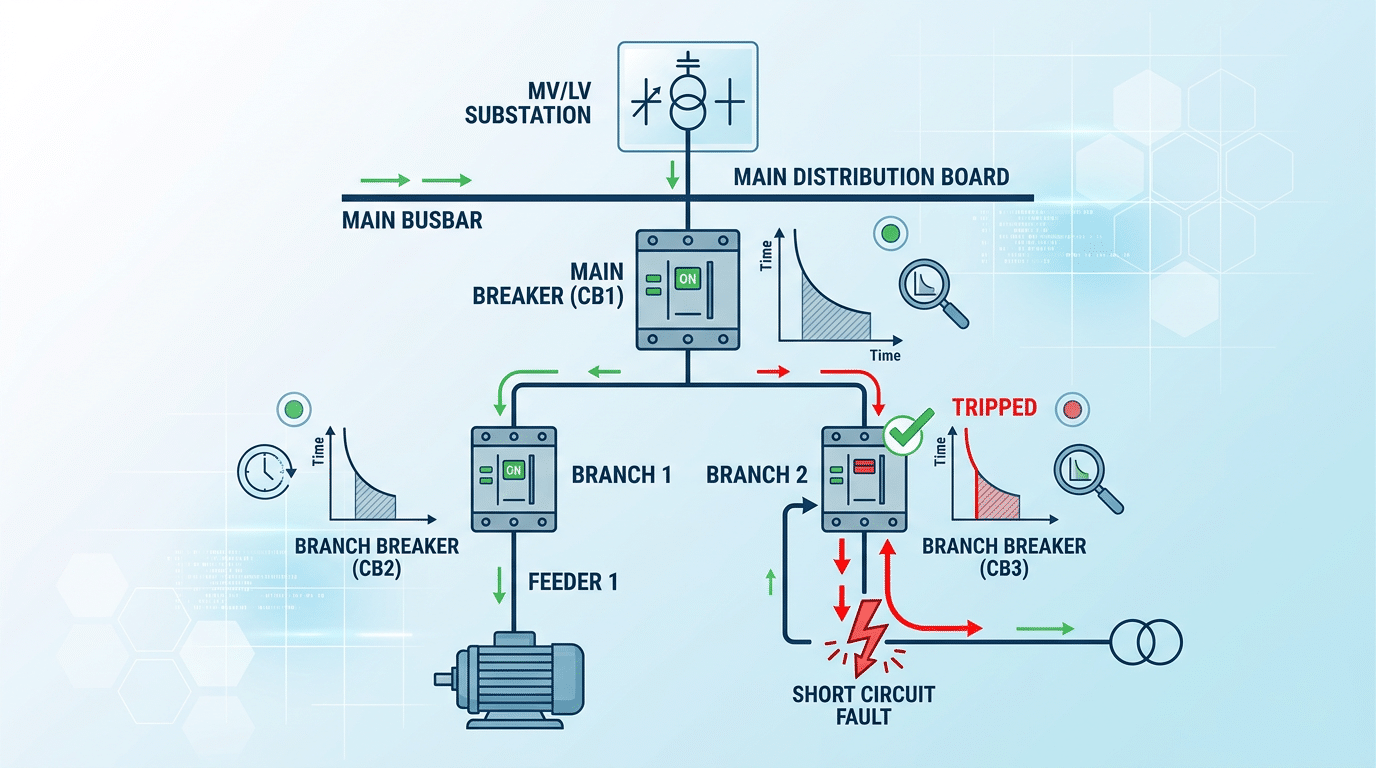
Selectivity — called discrimination in IEC terminology — means only the breaker immediately upstream of a fault opens, while every other breaker in the network stays closed. The rest of your facility keeps running. That single principle separates a five-second nuisance from a full-floor blackout in a hospital or data center.
Full Selectivity vs Partial Selectivity
Full selectivity exists when coordination holds across the entire prospective fault-current range, from overload up to the maximum short-circuit capacity at the installation point. Partial selectivity applies only up to a defined current threshold — called the selectivity limit current (Is) — beyond which both upstream and downstream breakers may trip simultaneously. IEC 60947-2 Annex A formalizes these definitions and requires manufacturers to publish selectivity tables showing exact Is values for breaker pairs.
In NEC-governed installations, Article 240 addresses overcurrent protection coordination, while Article 700 explicitly demands selective coordination for emergency systems. The 2020 NEC revision reinforced this requirement for legally required standby and critical operations power systems.
When comparing circuit breaker selectivity vs backup protection, the core distinction is intent: selectivity prioritizes service continuity by isolating only the faulted zone, whereas backup protection prioritizes cost savings by allowing upstream devices to assist downstream ones.
Why Critical Facilities Treat Selectivity as Non-Negotiable
- Hospitals (IEC 60364-7-710): A non-selective trip on an ICU distribution board can de-energize life-support equipment across multiple rooms.
- Data centers (Uptime Institute Tier III/IV): Concurrent maintenance capability requires fault isolation without propagating outages — full selectivity is a design prerequisite.
- Industrial process plants: An unplanned shutdown of a continuous furnace or chemical reactor can cost $50,000–$500,000 per event.
Achieving circuit breaker selectivity typically requires careful time-current curve coordination, zone-selective interlocking (ZSI), or energy-based discrimination using current-limiting breakers from the same manufacturer family — such as Siemens SENTRON or ABB Emax series — where tested selectivity data is available.
How Backup Protection (Cascading) Works in Power Systems
Backup protection — often called cascading or series protection — relies on a simple principle: a downstream breaker with a lower interrupting capacity borrows fault-handling muscle from a stronger upstream breaker. When a fault current exceeds the downstream device’s rated breaking capacity, the upstream breaker intervenes, limiting the energy that passes through the circuit and preventing catastrophic failure of the smaller device.
Both breakers trip. That’s the key trade-off when comparing circuit breaker selectivity vs backup protection: cascading sacrifices targeted isolation for cost savings, because the downstream breaker can carry a lower (and cheaper) interrupting rating.
Manufacturer-Tested Combinations Matter
You cannot pair any two breakers and call it backup protection. IEC 60947-2 Annex A requires that cascading combinations be verified through type testing by the manufacturer. Schneider Electric, ABB, and Siemens each publish tested coordination tables specifying exactly which upstream–downstream pairs are certified. Using an untested pairing voids the protection guarantee and may violate local electrical codes.
Energy Let-Through and Simultaneous Tripping
- I²t let-through: The upstream current-limiting breaker caps the energy reaching the downstream device — typically to values below its rated short-circuit withstand.
- Simultaneous trip: During high-fault events (often above 10–15× the downstream breaker’s rated current), both devices open within milliseconds. The entire feeder loses power, not just the faulted branch.
- Fault threshold: Below the cascading activation point, only the downstream breaker trips — mimicking selective behavior at lower fault levels.
Bottom line: backup protection is a deliberate engineering compromise. It reduces panel costs by 20–40% compared to fully selective systems, but it widens the outage zone during severe faults — a distinction central to the circuit breaker selectivity vs backup protection decision.
Key Differences Between Selectivity and Backup Protection
Strip away the theory, and the core debate around circuit breaker selectivity vs backup protection comes down to one trade-off: service continuity versus upfront cost. Every other difference flows from that tension.
| Criteria | Selectivity (Discrimination) | Backup Protection (Cascading) |
|---|---|---|
| Trip Behavior | Only the nearest upstream breaker trips | Both downstream and upstream breakers may trip together |
| Affected Zone | Single faulty circuit isolated | Entire sub-distribution board can lose power |
| Equipment Stress | Lower — fault cleared locally at rated capacity | Higher — downstream breaker operates beyond its standalone rating |
| Service Continuity | Excellent — healthy circuits stay energized | Poor — broad outage until manual reset |
| Cost | 20–40% higher (larger breakers, wider margins) | Significantly lower component cost |
| Code Requirements | Required in critical facilities per IEC 60364-7 and NEC Article 700 | Permitted where manufacturer provides tested cascading tables (IEC 60947-2 Annex A) |
One detail often overlooked: backup protection only works with manufacturer-verified breaker pairs. Swap a downstream MCCB for a different brand and the published let-through energy data becomes meaningless — potentially dangerous.
Selectivity demands careful time-current coordination but rewards you with surgical fault isolation. Backup protection slashes your bill of materials yet gambles on wider disruption. For hospitals, data centers, and process plants, that gamble rarely pays off. For a warehouse lighting panel? It’s perfectly reasonable.
Reading Time-Current Coordination Curves for Each Strategy
A time-current characteristic (TCC) curve is the single most revealing document when evaluating circuit breaker selectivity vs backup protection. If you can’t read one, you’re guessing — and guessing with fault currents is expensive.
What to Look For: Selectivity Margins
Plot the upstream and downstream breaker curves on the same log-log graph. For full selectivity, the downstream curve must sit entirely below and to the left of the upstream curve across the full fault-current range — from overload through maximum prospective short-circuit. A minimum vertical gap of 0.3 seconds between the two thermal (inverse-time) regions is a widely accepted coordination margin per IEEE Std 242 (Buff Book) recommendations.
Crossover Points and Backup Overlap Zones
The crossover point — where two TCC curves intersect — marks the exact current at which selectivity is lost and backup protection begins. Beyond this point, both breakers may trip simultaneously. In a cascading (backup) scheme, that overlap is intentional. In a selective scheme, it’s a failure you need to eliminate by adjusting instantaneous pickup settings or choosing breakers with higher short-circuit current ratings.
Energy Let-Through Matters
Don’t stop at time-current plots. Compare I²t values (energy let-through) published in manufacturer data — Schneider Electric’s Coordination Tables and ABB’s DOCWin software are two reliable tools for this. The downstream breaker’s total let-through energy must remain below the upstream breaker’s pre-arcing I²t for true discrimination. When evaluating circuit breaker selectivity vs backup protection on a TCC, check both the curve separation and the I²t relationship — one without the other gives an incomplete picture.
How to Choose the Right Protection Strategy for Your Facility
Start with one question: what happens to your operation when a healthy circuit trips unnecessarily? If the answer involves ventilators shutting down, server racks going dark, or a production line losing a $200,000 batch, full selectivity isn’t optional — it’s a regulatory and operational mandate. If the answer is “someone resets a breaker in a warehouse lighting panel,” backup protection will serve you fine at a fraction of the cost.
A Three-Factor Decision Framework
- Prospective fault current. Calculate it at every distribution level. Systems with fault levels above 50 kA often demand current-limiting breakers in a cascading arrangement simply because fully selective pairs may not exist at that rating. Below 25 kA, achieving total selectivity with standard MCCBs is straightforward.
- System criticality. IEC 60364 and NFPA 99 both require selectivity in life-safety circuits. Hospitals, data centers rated Tier III or above, and process plants with hazardous atmospheres fall squarely here.
- Budget reality. Full selectivity can cost 30–60% more in breaker hardware alone. For non-critical branch circuits, that premium rarely pays back.
The Hybrid Approach
Most real-world designs blend both strategies — and this is where the debate around circuit breaker selectivity vs backup protection becomes practical rather than theoretical. Use full selectivity from the main incomer down to sub-distribution boards feeding critical loads, then allow verified backup protection on final branch circuits serving general lighting or socket outlets. Schneider Electric’s coordination tables and ABB’s Emax series documentation both publish tested hybrid combinations worth reviewing during design.
Rule of thumb: protect the trunk selectively, protect the twigs with cascading — and document every coordination pair in your as-built drawings.
Frequently Asked Questions About Selectivity and Backup Protection
Can selectivity and backup protection coexist in the same panel?
Yes — and they often should. A common design uses full selectivity on critical feeders (operating theaters, data halls) while applying cascade coordination on general-purpose branch circuits. IEC 60364-5-53 explicitly permits mixing strategies within one distribution board, provided each pairing is documented on the coordination study.
How do I verify a manufacturer’s cascade table?
Never trust marketing PDFs alone. Request the actual test report per IEC 60947-2 Annex A, which lists the prospective short-circuit current, the specific breaker firmware version, and cable lengths used during testing. Schneider Electric, ABB, and Eaton all publish verified cascade tables — but ratings change with trip-unit settings, so confirm every parameter matches your installation.
What happens if the backup breaker fails to clear the fault?
Catastrophic arc energy. Without a functioning upstream device, fault current persists until the next protective device upstream operates — or until equipment melts. This is precisely why IEC 61439-1 requires a rated short-time withstand current (Icw) declaration. Redundant protection or arc-flash detection relays add a safety layer in high-risk boards.
Does zone-selective interlocking eliminate traditional coordination?
ZSI dramatically improves response time — cutting upstream intentional delays from 300 ms to roughly 50 ms — but it does not replace the underlying circuit breaker selectivity vs backup protection decision. ZSI still requires properly rated breakers and correct TCC curve separation. Think of it as an accelerator, not a substitute. If communication wiring fails, the system must fall back on conventional time-graded selectivity, so both layers matter.
Choosing Confidently — Summary and Next Steps
The debate around circuit breaker selectivity vs backup protection boils down to one trade-off: uptime versus upfront cost. Selectivity isolates faults surgically, keeping healthy circuits live. Backup protection leverages a downstream breaker’s let-through energy to boost an upstream breaker’s interrupting capacity — cheaper hardware, but wider outage zones when a fault occurs.
Neither strategy is universally superior. A hospital ICU demands full selectivity; a warehouse lighting panel can tolerate cascading just fine. The right answer lives inside a proper coordination study — not in a catalog.
Your Actionable Checklist
- Commission a coordination study. Plot TCC curves for every breaker pair from the service entrance to the final branch circuit. No study, no confidence.
- Classify each load by criticality. Assign tiers — life-safety, revenue-critical, general — and match protection philosophy to each tier.
- Verify manufacturer cascading tables. Backup ratings are breaker-pair-specific. Confirm the exact catalog numbers, not just frame sizes.
- Document selectivity limits. Record the prospective fault current at which selectivity breaks down so future panel additions don’t silently erode coordination.
- Re-audit after every upgrade. Adding a transformer, extending a feeder, or swapping a breaker changes impedance — and invalidates old curves.
A protection scheme you haven’t verified is a protection scheme you don’t have.
Use this checklist alongside IEC 60947-2 Annex A or the NEC Article 240 selectivity requirements referenced in NFPA 99 for healthcare facilities. When in doubt, engage a protection engineer to run the numbers — the cost of a study is trivial compared to the cost of an unplanned blackout across an entire switchboard.
See also
Understanding Circuit Breaker Short Circuit Ratings in kA
Circuit Breaker vs Fuse in Industrial Settings — Which One Wins
What Homeowners Should Know Before Replacing a Fuse Disconnect