
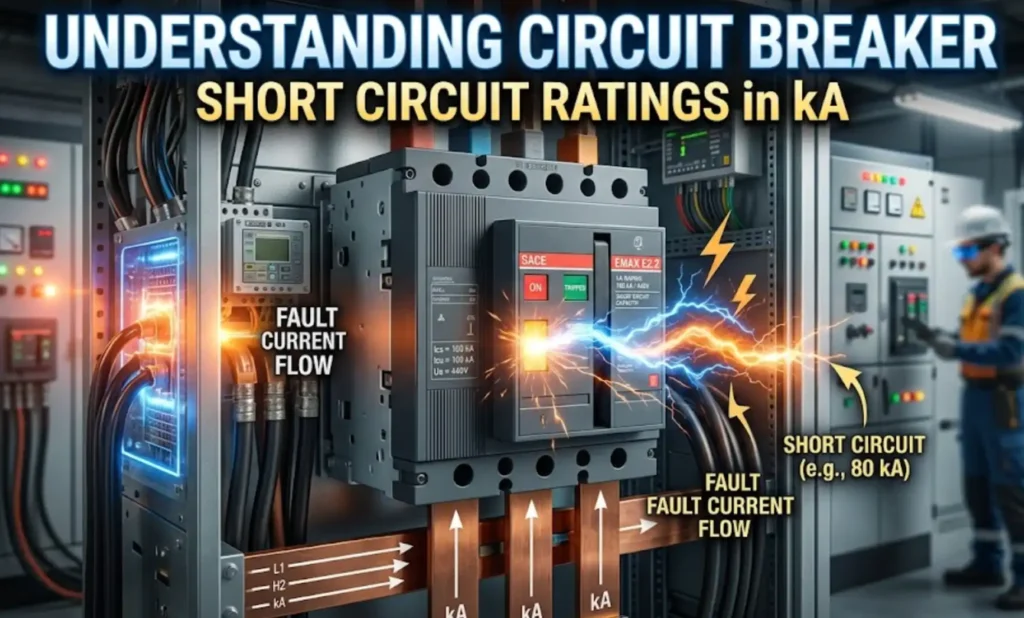
A single mismatched kA rating can turn a circuit breaker into a bomb. According to the National Fire Protection Association (NFPA), electrical failures — including breakers unable to interrupt fault currents — contribute to roughly 46,700 home structure fires annually in the United States. The circuit breaker short circuit rating in kA (kiloamperes) tells you the maximum fault current a breaker can safely interrupt without catastrophic failure, arc flash, or fire. If the available fault current at your panel exceeds that rating, the breaker won’t protect you — it becomes the hazard.
This guide breaks down exactly what kA ratings mean, how they differ from standard ampere ratings, how to read them on breaker labels, and how to calculate whether your breaker’s interrupting capacity actually matches the fault current your electrical system can deliver. Whether you’re specifying breakers for a 200A residential panel or a 4,000A industrial switchgear lineup, getting the short circuit rating in kA right is non-negotiable.
What Is a Circuit Breaker Short Circuit Rating in kA
A circuit breaker short circuit rating in kA — often stamped as kAIC (kiloampere interrupting capacity) — represents the maximum fault current the device can safely interrupt without exploding, welding shut, or failing to clear the fault. Think of it as the breaker’s upper survival limit during the worst-case electrical event on your system.
Featured definition: The short circuit rating is the highest prospective fault current, measured in kiloamperes (kA), that a circuit breaker can break at a specified voltage without sustaining damage that compromises safety or future operation.
Why kiloamperes instead of regular amps? Because fault currents are enormous. A residential panel might see 10,000 A during a bolted short circuit — that’s 10 kA. Commercial and industrial systems routinely produce 25 kA, 50 kA, or even 200 kA at the service entrance. Expressing these values in kiloamperes keeps the numbers manageable.
This rating goes by several names depending on the standard you’re referencing:
- Interrupting capacity (AIC or kAIC) — common in NEC and UL 489 terminology
- Breaking capacity (Ics / Icu) — used in IEC 60947-2 for industrial breakers
- Short-circuit breaking capacity — the formal IEC 60898-1 term for miniature circuit breakers
All three describe the same fundamental capability. If a breaker carries a 10 kA rating but the available fault current at its installation point reaches 15 kA, that breaker is undersized — and the consequences range from arc flash to complete enclosure destruction. The National Electrical Code, specifically NEC Article 110.9, mandates that every overcurrent protective device must have an interrupting rating sufficient for the available fault current at its terminals.
Getting this number right isn’t optional. It’s a code requirement, an insurance condition, and — most critically — a life-safety issue.
Standard Amps vs kA — Why These Two Ratings Are Completely Different
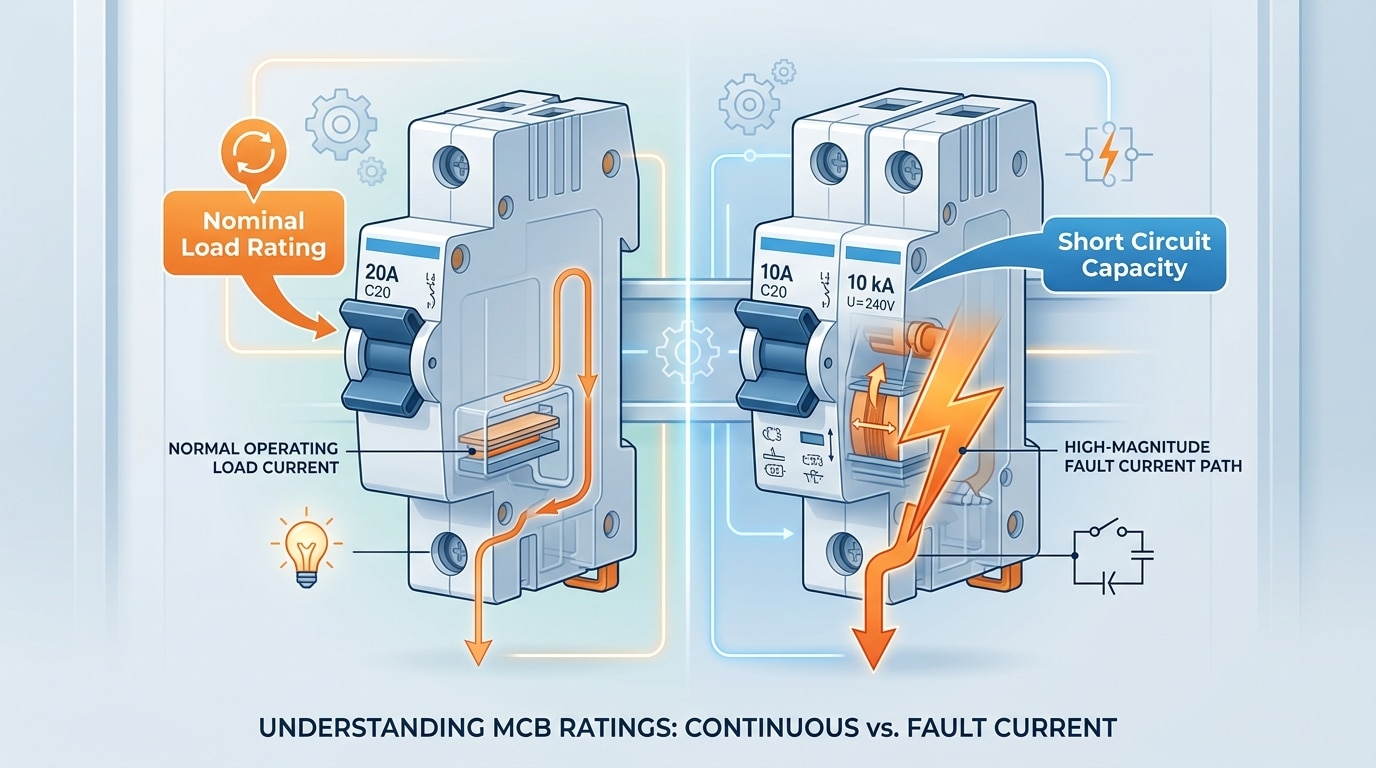
A 20A breaker and a 20A breaker rated at 10 kA are not telling you the same thing twice. The “20A” describes how much current the breaker allows to flow continuously under normal conditions — its continuous current rating. The “10 kA” describes the maximum fault current the breaker can safely interrupt without exploding, arcing, or welding its contacts shut. These are fundamentally different jobs.
Think of it this way: continuous current rating is about everyday operation. It’s the threshold where the breaker trips to protect wiring from overheating — 15A, 20A, 30A, 60A. This value matches your conductor sizing and load calculations per NEC Article 210 and 240.
The circuit breaker short circuit rating in kA, on the other hand, addresses a catastrophic event. During a bolted short circuit, fault currents can spike to 10,000, 22,000, or even 65,000 amps in milliseconds. The breaker must absorb and extinguish that energy in roughly 3–5 cycles (about 50–83 ms at 60 Hz). If its interrupting capacity falls below the available fault current, the breaker can violently fail — molten copper, arc flash, fire.
A 20A breaker rated at 10 kA can handle 10,000 amps of fault current momentarily. A 20A breaker rated at only 5 kA in the same panel with 8 kA of available fault current? That’s a code violation and a genuine hazard.
Confusing these two values is alarmingly common, especially in residential upgrades where homeowners or unlicensed electricians swap breakers based solely on amperage. The UL 489 standard requires both ratings to be clearly marked, yet many people never check the kA figure. According to NFPA 70 (the National Electrical Code), Section 110.9, equipment must have an interrupting rating sufficient for the available fault current — no exceptions.
Bottom line: amperage keeps your circuits from overloading. The kA rating keeps your breaker from becoming a bomb. Never treat them as interchangeable.
How to Read the kA Rating on a Circuit Breaker Label
Grab a breaker off your panel right now. Flip it over or look at the front face — the circuit breaker short circuit rating in kA is there, but most people walk right past it. Knowing exactly where to find this number and how to interpret it can prevent a dangerous mismatch between your breaker and your system’s available fault current.
Where the Rating Physically Appears
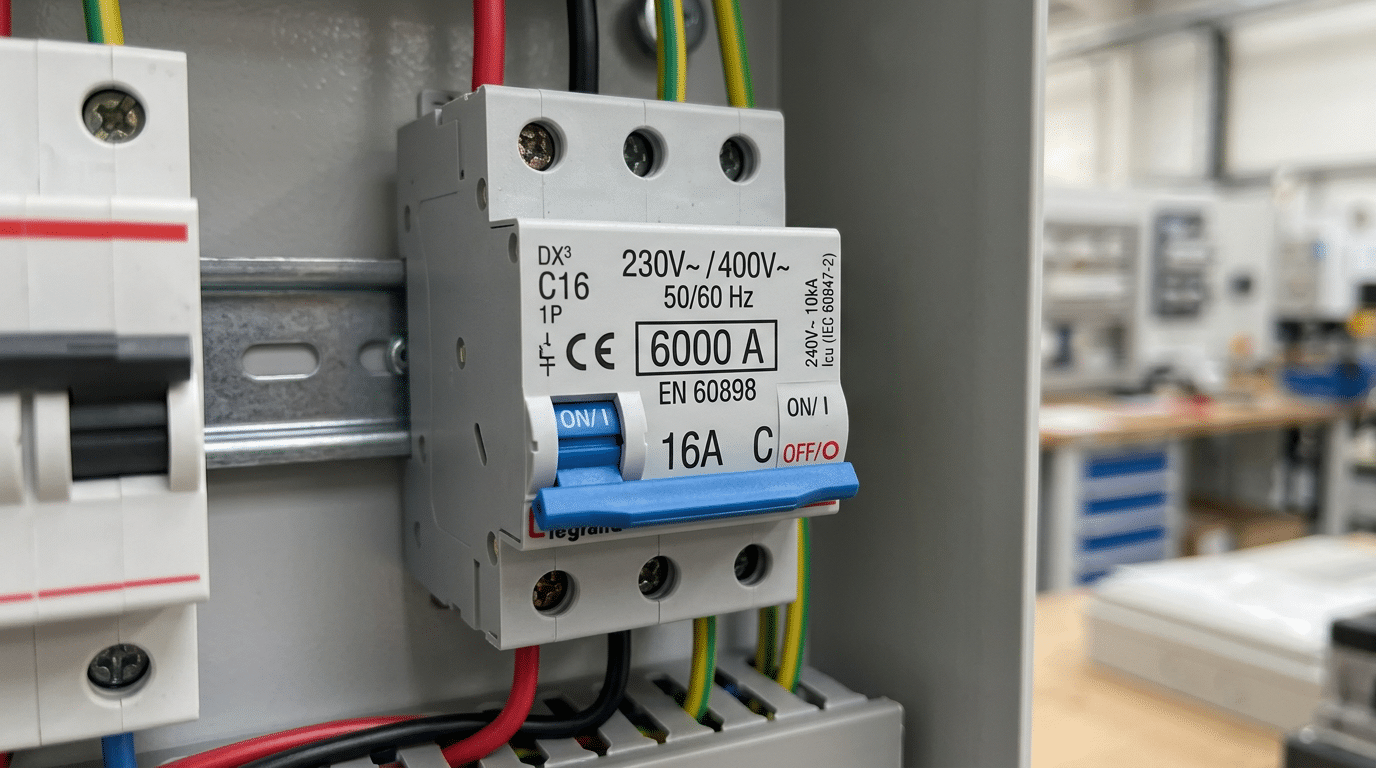
On residential breakers (think Square D Homeline or Eaton BR series), the interrupting rating is typically molded or printed on the front face, often near the bottom or side of the unit. Look for a number inside a rectangular box or frame — that’s the AIC (Ampere Interrupting Capacity) marking. A breaker stamped 10,000 AIC and one marked 10 kA mean the exact same thing: the breaker can safely interrupt up to 10,000 amperes of fault current.
Commercial and industrial breakers from manufacturers like ABB, Siemens, or Schneider Electric display the rating on a more detailed nameplate or data label, sometimes listing multiple values for different voltage levels.
UL vs IEC Labeling Conventions
This is where confusion creeps in. UL-listed breakers (common in North America) follow UL 489 and typically show the rating as “10,000 AIC” or “65 kAIC” at a specific voltage. IEC-rated breakers, tested under IEC 60947-2, use the designation Icu (ultimate short-circuit breaking capacity) and Ics (service short-circuit breaking capacity). Icu represents the maximum fault the breaker can interrupt — but the breaker may not be reusable afterward. Ics indicates the level at which it can interrupt and remain operational.
Quick rule: UL gives you one number. IEC gives you two. Never assume a 10 kA IEC rating equals a 10 kA UL rating — the test protocols differ significantly.
If you’re reviewing a data sheet rather than a physical label, check for a table that cross-references voltage and kA rating. A breaker might be rated 25 kA at 240V but only 14 kA at 480V. Always match the rating to your system voltage.
Common kA Ratings and Where They Are Used
Not every installation faces the same fault current risk. A bedroom circuit in a suburban home sees a fraction of the available fault current that a motor control center in a steel mill does. That’s why circuit breaker short circuit ratings in kA span a wide range — each tier matched to a specific environment and its electrical realities.
| kA Rating | Typical Application | Why This Rating Fits |
|---|---|---|
| 10 kA | Residential panels (single-family homes) | Utility transformers are typically distant; available fault current rarely exceeds 10,000A at the panel. |
| 14 kA | Larger residential / small commercial | Shorter service runs or higher-capacity transformers push fault levels above 10 kA. |
| 22 kA | Mid-size commercial buildings, retail centers | Larger transformers (500–1,000 kVA) and shorter conductor lengths increase prospective fault current. |
| 25 kA | Commercial and light industrial switchboards | Common threshold for NEC-compliant commercial distribution panels. |
| 42 kA | Heavy industrial facilities, data centers | Multiple parallel transformers and large motor loads create substantial fault contributions. |
| 65 kA+ | Utility substations, large manufacturing plants | Proximity to high-MVA transformers can produce fault currents exceeding 50,000A. |
The jump from 10 kA to 65 kA isn’t arbitrary. It directly reflects transformer size, distance from the utility source, and conductor impedance. A 200 kVA pad-mount transformer feeding a home through 150 feet of aluminum SE cable produces far less fault current than a 2,500 kVA unit bolted three feet from an industrial switchgear lineup.
Rule of thumb from IEEE Std 141 (the “Red Book”): the closer and larger the transformer, the higher the available fault current — and the higher the kA-rated breaker you need.
Manufacturers like Eaton, Schneider Electric, and ABB publish breakers across every tier. Picking a 10 kA breaker for a 42 kA environment doesn’t just violate code — it creates a bomb behind the panel door. Always match the breaker’s interrupting capacity to the actual calculated fault current at its installation point, not just the general building type.
Why Interrupting Capacity Matters for Electrical Safety
Install a breaker with an insufficient circuit breaker short circuit rating kA, and you don’t just risk a tripped breaker — you risk a catastrophic failure. When fault current exceeds a breaker’s interrupting capacity, the device physically cannot extinguish the arc that forms between its contacts. The result? Sustained arcing at temperatures exceeding 19,000°C (35,000°F), violent enough to vaporize copper conductors and turn a panel into a blast zone.
The consequences escalate fast:
- Arc flash and arc blast — superheated plasma expands outward, producing pressure waves up to 2,000 lbs/ft² that can throw a worker across a room.
- Breaker explosion — the enclosure ruptures, ejecting molten metal fragments and shrapnel into the surrounding area.
- Electrical fire — sustained arcing ignites insulation, bus bar covers, and adjacent combustible materials within seconds.
- Downstream equipment destruction — uncleared fault current propagates through feeders, damaging transformers, contactors, and connected loads far from the original fault point.
This isn’t theoretical. OSHA and NFPA 70E data consistently rank arc flash among the top causes of electrical workplace fatalities in the United States, with roughly 30,000 arc flash incidents reported annually.
NEC Section 110.9 is unambiguous: every overcurrent protective device must have an interrupting rating “sufficient for the nominal circuit voltage and the current that is available at the line terminals.” IEC 60947-2 mirrors this mandate for international installations, requiring breakers to be tested and certified at their marked short circuit kA rating.
Skipping a proper fault current study to save a few hundred dollars on a lower-rated breaker is a gamble with human life. An inspector who catches the mismatch will red-tag the installation. An inspector who misses it leaves a ticking hazard behind the panel cover.
How to Calculate the Required kA Rating for Your Electrical Panel
Every panel sits at a specific point in the electrical distribution chain, and the fault current available at that point determines the minimum circuit breaker short circuit rating kA you need. Getting this number wrong — even by a small margin — violates NEC 110.9 and creates a genuine explosion risk. So how do you arrive at the right figure?
The Key Variables That Drive Available Fault Current
Three factors dominate the calculation:
- Utility transformer kVA and impedance (%Z): A 1,000 kVA transformer with 5.75% impedance produces far more fault current than a 75 kVA pad-mount with the same impedance percentage. Lower impedance = higher available fault current.
- Conductor size and length: Every foot of wire between the transformer and your panel adds impedance, which reduces fault current. A panel 10 feet from the transformer sees dramatically higher kA than one 200 feet away.
- Utility available fault current: Your local utility can provide this number — typically listed on the service point documentation. In dense urban grids, it can exceed 100 kA at the transformer primary.
Simplified Point-to-Point Method
The point-to-point calculation method, published by Cooper Bussmann (now Eaton) in their Selecting Protective Devices handbook, offers a practical shortcut. You calculate the maximum fault current at the transformer secondary, then reduce it step by step based on conductor impedance at each segment. For a single-phase system, the formula is:
Available Fault Current = (Transformer FLA × Multiplier) ÷ (1 + f factor)
The “f factor” accounts for conductor length, material (copper vs. aluminum), and cross-sectional area. This method gets you within roughly 10–15% of a full computer-based study — accurate enough for many residential and light commercial scenarios.
When You Need a Professional Short Circuit Study
Skip the simplified method for panels rated above 200A, facilities with multiple transformer feeds, or any installation involving motors that contribute fault current. A licensed engineer running software like SKM Power Tools or ETAP will model every impedance point and deliver a stamped report. Most jurisdictions require this study for commercial and industrial projects before issuing permits.
The calculated available fault current at your panel must always fall below the kA rating of every breaker installed in it. No exceptions.
Series Ratings vs Fully Rated Systems — Impact on kA Requirements
Two breakers can share the same panel and face the same fault current — yet carry very different kA labels. How? The answer depends on whether your system is fully rated or series rated.
Fully Rated Systems
In a fully rated system, every circuit breaker independently meets or exceeds the available fault current at its point of installation. If your panel sees 65 kA of prospective fault current, every breaker — from the 200A main down to the last 15A branch — must carry a circuit breaker short circuit rating kA of at least 65 kA. No exceptions, no dependencies. This is the gold standard for reliability, but it comes at a cost: high-kA-rated breakers in every slot add up fast, sometimes doubling the material budget on commercial projects.
Series-Rated Combinations
A series-rated system takes a different approach. A robust upstream breaker (or fuse) with a high interrupting capacity protects a downstream breaker that has a lower kA rating. The upstream device limits the let-through energy before the downstream breaker ever sees the full fault current. NEC Section 240.86 permits this — but only when the specific combination has been tested and listed by UL under UL 489. You cannot mix and match brands or models on your own.
A series-rated combination is not a workaround. It is a tested, UL-listed pairing where the upstream device’s current-limiting ability has been verified to protect the downstream breaker under specific fault conditions.
Pros and Cons at a Glance
| Factor | Fully Rated | Series Rated |
|---|---|---|
| Cost | Higher — every breaker needs full kA | Lower — downstream breakers can be less expensive |
| Flexibility | Any listed breaker that meets the rating | Restricted to UL-tested combinations only |
| Maintenance | Replace any breaker with equivalent rating | Must replace with exact listed pairing |
| Code Compliance | Universally accepted | Requires engineer documentation per NEC 240.86 |
Series ratings can save 15–30% on breaker costs in large commercial panels, according to manufacturer data from Eaton and Siemens. But that savings evaporates if a maintenance electrician swaps in an untested breaker years later. For critical facilities — hospitals, data centers — most engineers specify fully rated systems to eliminate that risk entirely.
How Upstream Components Affect Available Fault Current at the Breaker
Fault current doesn’t teleport from the utility to your breaker unchanged. Every component between the source and the point of fault — transformers, conductors, bus bars, fuses — introduces impedance that shapes the actual kA a breaker must handle. Ignore these upstream variables, and you’ll either over-spec (wasting money) or dangerously under-spec your equipment.
The Transformer Sets the Ceiling
A transformer’s impedance (%Z) is the single biggest factor limiting available fault current. A typical 1,000 kVA, 480V transformer with 5.75% impedance produces roughly 20 kA of prospective fault current at its secondary terminals. Swap that unit for a 2,000 kVA transformer at 4% impedance, and the available fault current can jump beyond 60 kA — tripling the demand on every downstream breaker. This is exactly how system upgrades silently invalidate an existing circuit breaker short circuit rating in kA.
Conductor Length and Size Create Natural Impedance
Every meter of cable adds resistance and reactance. A breaker 50 feet from the transformer sees significantly higher fault current than one 200 feet away on the same feeder. Rough rule: doubling conductor length can reduce available fault current by 20–40%, depending on wire gauge and material (copper vs. aluminum).
- Shorter feeders = less impedance = higher fault current at the breaker
- Larger conductors (e.g., upgrading from #4 AWG to 2/0) reduce resistance, increasing available fault current
- Upstream fuses with current-limiting capability can cap the let-through energy, effectively lowering what downstream breakers experience
Why Upgrades Are Dangerous Without Recalculation
Facilities that install a larger transformer, add a parallel feeder, or shorten distribution runs often forget to re-evaluate breaker ratings. IEEE Std 551 (the Violet Book) provides detailed methods for recalculating fault current after system modifications. A quick short-circuit study — performed in tools like ETAP or SKM Power*Tools — should follow every significant upstream change to confirm each breaker’s kA rating still exceeds the new available fault current.
Bottom line: the circuit breaker short circuit rating kA stamped on your device is fixed, but the fault current arriving at that device is not. Upstream changes shift the target — and the breaker can’t adapt on its own.
Frequently Asked Questions About Circuit Breaker Short Circuit Ratings
What happens if fault current exceeds the breaker’s kA rating?
The breaker may fail to interrupt the arc. That means molten metal, explosive gas expansion inside the enclosure, and potential arc flash — a violent event that can destroy the panel and injure anyone nearby. UL and IEC standards exist specifically to prevent this scenario, which is why matching your circuit breaker short circuit rating kA to available fault current isn’t optional.
Is 10 kA enough for a residential panel?
For most single-family homes fed by a pad-mounted or pole-mounted transformer through 50+ feet of service conductor, yes. Available fault current at a typical 200A residential panel usually falls between 5,000 A and 10,000 A. But homes very close to a large utility transformer — within 10 feet of conductor length — can see fault levels that push past 10 kA. Always verify with a fault current calculation rather than assuming.
What is the difference between kA and kAIC?
Nothing functional. kAIC stands for kiloamperes interrupting capacity, which is simply the full label behind the abbreviation. A breaker stamped “22 kAIC” and one stamped “22 kA” have identical interrupting capability. Manufacturers and standards bodies like NEMA use kAIC; electricians in the field usually just say kA.
Do I need to upgrade breakers after a utility transformer upgrade?
Possibly. A larger transformer has lower impedance, which raises available fault current downstream. If your utility swaps a 50 kVA transformer for a 150 kVA unit, the fault current at your panel could double or triple. NEC Article 110.9 requires every breaker to interrupt the maximum available fault current — so a recalculation is mandatory after any transformer change.
How do I find the available fault current at my panel?
Request a fault current study from your utility or a licensed engineer. Tools like Eaton’s Bussmann fault current calculator or the point-to-point method described in IEEE’s Buff Book (Standard 242) give reliable estimates using transformer kVA, impedance percentage, and conductor length. Your utility can also provide the available fault current at the service point directly.
Key Takeaways for Selecting the Right kA-Rated Circuit Breaker
Choosing a breaker comes down to one non-negotiable rule: the interrupting capacity must meet or exceed the available fault current at the point of installation. Everything else — brand preference, form factor, smart features — is secondary to that single requirement.
If you remember nothing else: a circuit breaker short circuit rating in kA that falls below your panel’s prospective fault level is a code violation and a genuine safety hazard.
Your Selection Checklist
- Get a fault current study. Have a licensed engineer perform a short circuit analysis per IEEE 551 or use utility-provided data. Never guess.
- Match or exceed. Select a breaker whose kA interrupting capacity sits above the calculated available fault current — not at the margin, but comfortably above it.
- Verify during panel upgrades. Swapping a 100A panel for a 200A panel often increases available fault current. Recheck the numbers every time upstream conditions change — new transformer, shorter service conductors, or utility infrastructure upgrades.
- Confirm code compliance. NEC 110.9 requires every breaker to interrupt the maximum fault current available at its terminals. AHJs enforce this, and inspectors will flag mismatches.
- Decide: fully rated or series rated. Fully rated systems offer independent protection at each breaker. Series-rated combinations cost less but demand exact manufacturer-tested pairings — no substitutions.
- Document everything. Keep the fault study, breaker spec sheets, and series-rating certifications accessible for future inspections or insurance claims.
Residential panels near pad-mounted transformers routinely see 10–22 kA of available fault current. A standard 10 kA breaker won’t survive that. Commercial and industrial sites can push well past 65 kA. The stakes scale with the numbers.
Skip the guesswork. Before purchasing any breaker, consult a qualified electrician or engineer who can run the calculations, verify upstream impedances, and confirm that your selected circuit breaker short circuit rating kA aligns with real-world conditions at your site.
See also
What Does the KA Rating Mean on Circuit Breakers
Everything You Need to Know About the Rated Current of ACB
How to choose the most suitable air circuit breaker for your needs
Understanding Short Circuit Current Calculation for MCBs Step by Step