
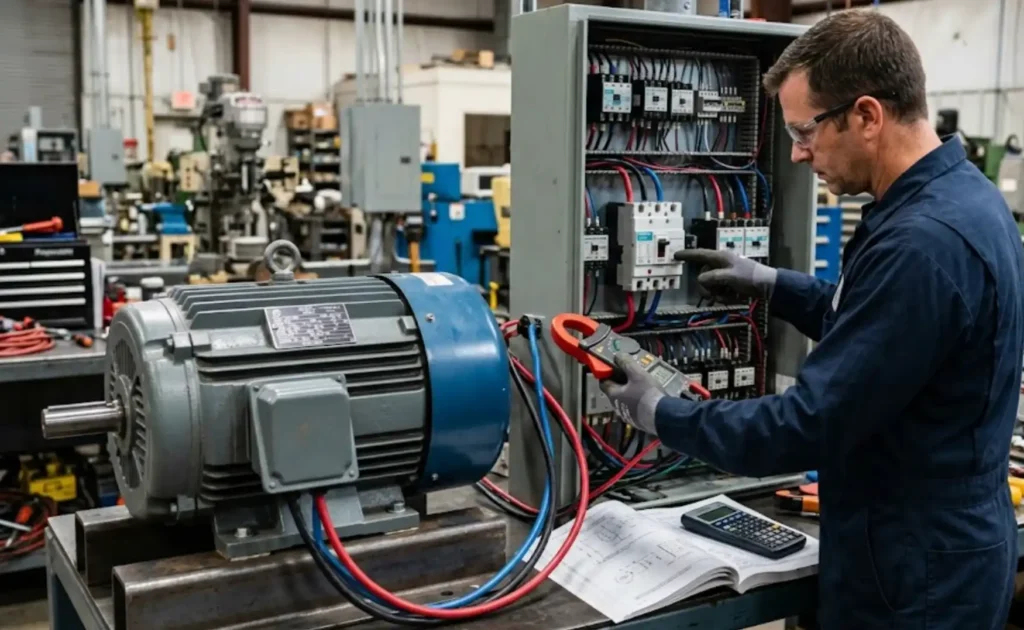
Roughly 80% of motor branch-circuit failures traced back to protection issues stem from one root cause: an incorrectly sized circuit breaker. Knowing how to calculate circuit breaker size for a motor isn’t guesswork — it’s a precise process governed by NEC Article 430, which requires you to multiply the motor’s full-load current (from NEC tables, not the nameplate) by a specific percentage based on the protective device type, then round up to the next standard breaker rating. This guide walks you through every step, formula, and NEC rule you need to get the sizing right the first time.
Quick Answer — How to Size a Circuit Breaker for a Motor
Here’s the short version: look up the motor’s full load current (FLC) in NEC Table 430.250 — not the nameplate — then multiply by the maximum percentage allowed for your breaker type. For a standard inverse-time circuit breaker, that multiplier is 250% per NEC 430.52(C)(1).
Formula: Circuit Breaker Size = Motor FLC (from NEC Table 430.250) × 2.50
So if you’re figuring out how to calculate circuit breaker size for a motor rated at 28 amps FLC, the math is simple: 28 × 2.50 = 70A. You’d select a standard 70-amp breaker. If the result doesn’t land on a standard breaker size, NEC 430.52(C)(1) Exception No. 1 allows you to round up to the next standard size.
Different breaker types have different maximum percentages:
- Inverse-time breaker: 250% of FLC
- Instantaneous-trip breaker: 800% of FLC
- Dual-element time-delay fuse: 175% of FLC
Why not use the nameplate amps? Because the NEC deliberately uses standardized table values to ensure consistent protection across installations — nameplate ratings can vary between manufacturers for the same horsepower motor. The sections below break down each step, explain the NEC tables involved, and walk through a real-world calculation so you can size a motor circuit breaker with confidence.

Understanding NEC Article 430 and Motor Branch-Circuit Protection
Motors are not ordinary loads. A standard 20A resistive heater draws 20A at startup and 20A while running — predictable, steady, boring. A motor rated at 20A full load current can pull six to eight times that amount the instant it starts. That 120–160A inrush surge, called locked rotor current, lasts only a few seconds, but it’s more than enough to trip a breaker sized at the typical 125% rule used for continuous loads.
This is exactly why NEC Article 430 exists as a standalone article — it overrides the general branch-circuit rules in Article 240. The code recognizes that motor circuits need a two-layer protection scheme, not one.
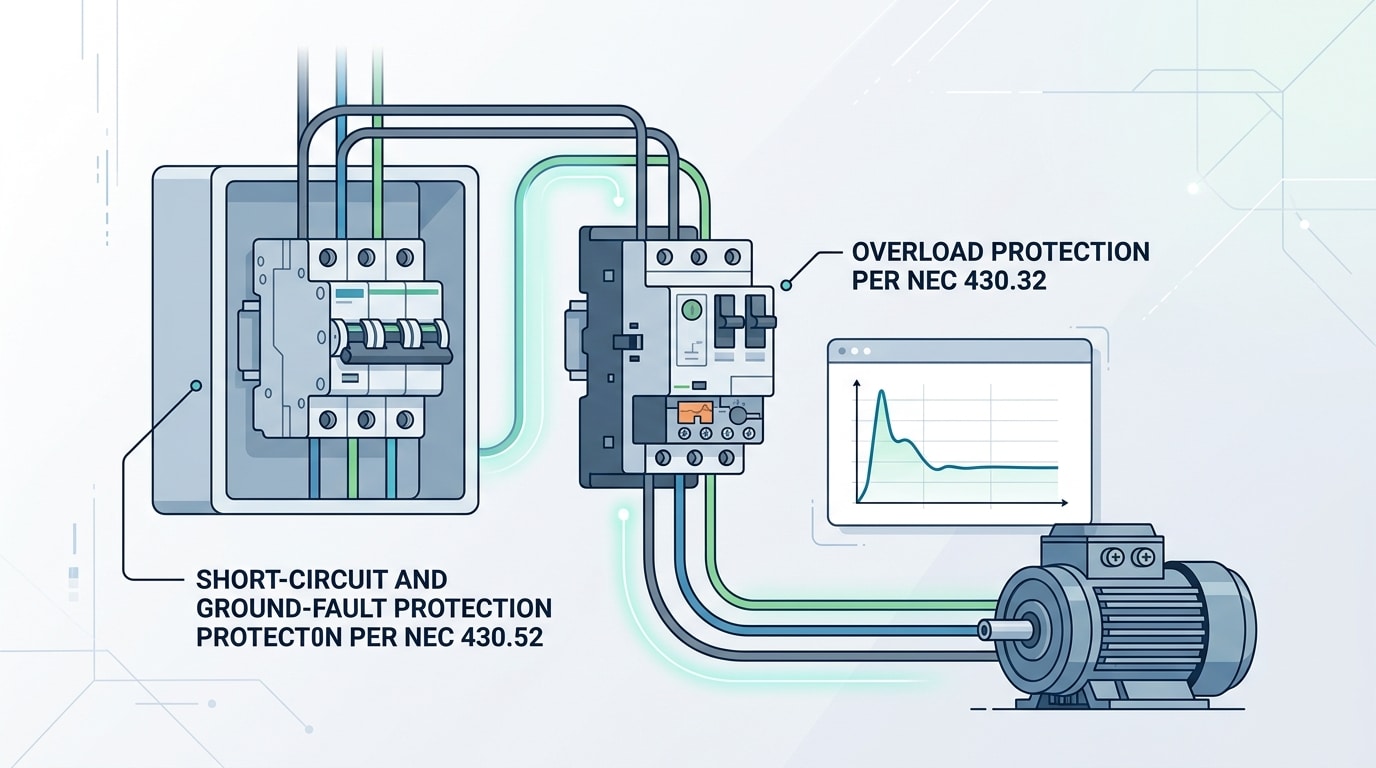
Two Distinct Protection Functions
- Branch-circuit short-circuit and ground-fault protection (NEC 430.52): This is the circuit breaker’s job. It’s sized larger than the motor’s running current — often 250% of FLC for inverse-time breakers — specifically so it won’t nuisance-trip during startup inrush.
- Motor overload protection (NEC 430.32): This is handled separately by thermal overload relays or electronic overload devices, typically set at 115–125% of the motor nameplate current. These protect the motor from sustained overcurrent during normal operation.
Understanding this split is the foundation of knowing how to calculate circuit breaker size for a motor correctly. The breaker isn’t there to protect against overload — the overload relay handles that. The breaker guards against faults: short circuits and ground faults that produce currents far beyond anything the motor or wiring can survive.
Without this two-device approach mandated by Article 430, you’d face an impossible tradeoff: a breaker small enough to protect the motor would trip on every startup, and one large enough to ride through inrush would fail to protect the conductors during a genuine overload.
Full Load Amps vs Nameplate Amps vs Locked Rotor Amps
Here’s a mistake that trips up even experienced electricians: using the amperage stamped on the motor nameplate to calculate circuit breaker size for a motor. The NEC explicitly prohibits this. Instead, you must use the Full Load Amps (FLA) listed in NEC Tables 430.247 through 430.250, which represent standardized current values for motors of a given horsepower and voltage rating.
Why the distinction? Nameplate amps reflect that specific motor’s actual operating current — which varies by manufacturer, efficiency class, and service factor. A 10 HP, 460V motor from one brand might show 13.2A on its nameplate while another shows 13.8A. NEC Table 430.250 lists 14A for all 10 HP, 460V three-phase motors. Using the table value ensures consistent, code-compliant conductor and breaker sizing regardless of the motor installed.
Locked Rotor Amps and Inrush Current
Locked Rotor Amps (LRA) — the current drawn the instant a motor starts with its rotor stationary — can reach 6 to 8 times the full load current. A motor with 14A FLA might pull 100A+ during startup for several seconds. This is exactly why standard thermal-magnetic breakers sized at 250% of FLA exist: they must ride through that inrush without nuisance tripping.
NEC Table 430.52 ties maximum breaker percentages directly to breaker type because different protective devices handle inrush differently. An inverse-time breaker tolerates brief overcurrents better than an instantaneous-trip unit.
Understanding the relationship between FLA, nameplate amps, and LRA isn’t academic — it’s the foundation for how to calculate circuit breaker size for motor circuits correctly. Get the starting current value wrong, and you’ll either overprotect (constant tripping) or underprotect (fire risk).
Step-by-Step Formula for Sizing a Motor Circuit Breaker
Knowing how to calculate circuit breaker size for motor installations comes down to five concrete steps. Miss one, and you risk nuisance tripping — or an undersized breaker that still passes inspection but fails in the field.
- Find the motor FLA from the correct NEC table. For a three-phase motor, use NEC Table 430.250. For single-phase, use Table 430.248. Never use the nameplate amps — this point was covered earlier, but it’s the single most common error.
- Identify your breaker type and its NEC multiplier. Open NEC Table 430.52. An inverse-time (standard thermal-magnetic) breaker allows up to 250% of FLA. An instantaneous-trip breaker allows up to 800%. A dual-element fuse sits at 175%.
- Multiply. FLA × percentage = maximum breaker rating. For a motor with 28A FLA on an inverse-time breaker: 28 × 2.5 = 70A.
- Match to a standard breaker size. If your result lands exactly on a standard rating (15, 20, 25, 30, 35, 40, 45, 50, 60, 70, 80, 90, 100A…), use it. If not, round down to the nearest standard size.
- Apply the NEC 430.52(C)(1) exception. When the calculated value doesn’t correspond to a standard size and the rounded-down breaker causes nuisance tripping, you’re permitted to go to the next higher standard size. This exception is what makes motor circuit breaker sizing practical rather than theoretical.
Quick formula: Breaker Size = FLA (from NEC table) × Multiplier (from Table 430.52), then adjust to the nearest standard rating per 430.52(C)(1).
That’s the complete process for calculating circuit breaker size for a motor branch circuit. The next section walks through a real-world example with actual numbers so you can see each step in action.
Worked Calculation Example for a 3-Phase Induction Motor
Scenario: A 25 HP, 460V, 3-phase squirrel-cage induction motor with a Design B code letter, protected by an inverse-time circuit breaker. No nameplate FLA tricks — we go straight to NEC Table 430.250.
- Look up FLC: NEC Table 430.250 lists a 25 HP, 460V, 3-phase motor at 34 amps.
- Apply the multiplier: Inverse-time breaker max = 250%. So: 34A × 2.50 = 85A.
- Select standard breaker size: 85A isn’t a standard rating. Per NEC 430.52(C)(1) Exception No. 1, round up to the next standard size: 90A.
That’s it — a 90A inverse-time breaker protects this motor branch circuit. Wire sizing, of course, is a separate calculation based on 125% of FLC (34 × 1.25 = 42.5A), pointing to 8 AWG copper THHN minimum.
Single-Phase Example: 5 HP, 230V Motor
NEC Table 430.248 gives a 5 HP, 230V single-phase motor an FLC of 28 amps. With an inverse-time breaker: 28A × 2.50 = 70A. Since 70A is a standard breaker rating, select a 70A breaker — no rounding needed.
Both examples show exactly how to calculate circuit breaker size for motor loads: table lookup, multiplier, then standard size selection. The math is simple; the discipline of using NEC table values instead of nameplate amps is what separates a compliant installation from a code violation.
NEC Maximum Breaker Size Percentages by Breaker Type
Not all protective devices treat motor inrush the same way. NEC Table 430.52 assigns different maximum percentages depending on the type of overcurrent device you select — and choosing the right one directly affects how you calculate circuit breaker size for motor branch circuits.
| Protective Device Type | Max % of Motor FLC | Typical Use Case |
|---|---|---|
| Inverse-Time Circuit Breaker | 250% | General-purpose motor protection; most common choice |
| Instantaneous-Trip (MCP) Breaker | 800% | Motor control centers with separate overload relays |
| Dual-Element (Time-Delay) Fuse | 175% | Tight protection where nuisance tripping is unlikely |
| Non-Time-Delay Fuse | 300% | Less common; older installations |
Why such a wide range? An instantaneous-trip breaker — often called a motor circuit protector (MCP) — relies on a separate overload relay in the motor starter to handle sustained overcurrents. It only guards against short circuits, so the NEC permits that 800% ceiling. You’ll find MCPs in industrial motor control centers where each starter already includes Class 20 overload protection.
Dual-element fuses sit at the opposite end. Their built-in time-delay absorbs normal inrush, so 175% of FLC is usually enough. Pick these when you want the tightest short-circuit protection and your motor starts under light load.
Per NEC 430.52(C)(1) Exception No. 1, if the calculated value doesn’t correspond to a standard device rating, you may round up to the next standard size — but only for inverse-time breakers and fuses, not MCPs.
For most commercial and residential applications, the inverse-time breaker at 250% remains the default when figuring out how to calculate circuit breaker size for motor loads. Reserve MCPs for engineered industrial panels and dual-element fuses for critical equipment where minimal fault energy matters.
Common Mistakes When Sizing Circuit Breakers for Motors
Even after learning how to calculate circuit breaker size for motor circuits, small oversights can trigger nuisance tripping — or worse, code violations during inspection. These five errors show up repeatedly.
Using Nameplate Amps Instead of NEC Table Values
This is the single most common mistake. A motor’s nameplate might read 32A, but NEC Table 430.250 lists 34A for that same HP and voltage rating. The NEC table value governs breaker sizing, period. Using nameplate amps can result in an undersized breaker that trips on normal startup inrush.
Confusing Overload Protection with Short-Circuit Protection
The branch-circuit breaker protects against short circuits and ground faults — not sustained overloads. That’s the job of the overload relay (sized per NEC 430.32 at 115%–125% of nameplate FLA). Trying to make one device do both jobs leads to either inadequate fault protection or constant nuisance trips.
Oversizing Beyond NEC Maximums
When a 250% calculation lands between standard breaker sizes, NEC 430.52(C)(1) Exception No. 1 lets you round up to the next standard size — but only up to the absolute maximum in Table 430.52. Jumping to a 400% breaker “just to be safe” violates code and removes meaningful fault protection.
Ignoring Service Factor and Temperature Rating
A motor with a 1.15 service factor or 40°C temperature rise allows overload sizing at 125% instead of 115%. Miss this detail, and your overload relay setting won’t coordinate properly with the breaker, creating a protection gap during sustained overload conditions.
Neglecting Conductor Sizing Under NEC 430.22
Your breaker doesn’t exist in isolation. Branch-circuit conductors must be rated at least 125% of the NEC table FLC. A 50A breaker on 10 AWG THHN wire rated for only 35A at 75°C is a fire hazard, regardless of whether the breaker math checks out.
Frequently Asked Questions About Motor Circuit Breaker Sizing
Can I use a 100-amp breaker on a 50 HP motor?
It depends on voltage. A 50 HP, 460V motor has an NEC FLC of 65A. With an inverse-time breaker at 250%, that’s 162.5A — so a 100A breaker is actually undersized if nuisance tripping occurs, though you’d typically start at 65 × 2.5 = 162.5A and round down to 150A. At 230V, the FLC jumps to 130A, making 100A far too small. Always verify voltage before selecting.
What size breaker for a 5 HP single-phase motor?
Per NEC Table 430.248, a 5 HP, 230V single-phase motor draws 28A FLC. Multiply by 2.5 for an inverse-time breaker: 70A. A standard 70A breaker works perfectly here.
Do VFD-fed motors change the breaker sizing calculation?
Yes. When you calculate circuit breaker size for a motor fed by a variable frequency drive, the breaker protects the VFD input, not the motor directly. Size it based on the VFD’s rated input current — typically found in the manufacturer’s documentation — not the motor FLC table.
Motor overload protection vs. branch-circuit protection — what’s the difference?
Overload protection (NEC 430.32) guards against sustained overcurrent that overheats windings — think thermal overload relays sized at 115–125% of nameplate FLA. Branch-circuit protection (NEC 430.52) guards against short circuits and ground faults with much higher trip thresholds. Both are mandatory; neither replaces the other.
How do I size wire along with the breaker?
Conductors follow a completely separate rule: NEC 430.22 requires wire rated at 125% of NEC table FLC. For that 65A, 50 HP motor, you need conductors rated for at least 81.25A — typically 4 AWG copper THHN. The breaker can exceed the wire ampacity here because motor branch-circuit rules explicitly permit it under NEC Article 430.
See also
Electric motor circuit breaker selection and usage
What breaker size do well pumps typically need
How to Choose MCCB for Protecting Large Motors in Factories