

Choosing the right mccb keeps your big motor safe. It also helps keep your factory workshop safe. When you pick an mccb, you must think about size and safety. If you pick the wrong size, many problems can happen, such as:
- The motor can get damaged from too much power. This causes over half of motor failures in the world.
- The mccb might not turn off during phase failures. This can make the motor too hot and hurt the windings.
- It is not as good at noticing overloads and phase failures as other protection devices.
An mccb works like a shield for your motor. It stops dangerous currents from hurting it. Picking the right mccb stops expensive breaks and keeps your machines running. These guides will help you pick the best one for your workshop.
Key Takeaways
- Pick an MCCB that is 20-25% higher than your motor’s full load current. This helps stop the MCCB from tripping when it should not. It also keeps your motor safe from too much current.
- Know how your motor starts. This changes the inrush current. Make sure your MCCB can handle this current. It should not trip when the motor starts.
- The MCCB’s breaking capacity must be more than the biggest short-circuit current at your site. This keeps your equipment safe if there is a fault.
- Check your MCCB every year. Look for wear and loose wires. This helps keep things safe and working well.
- Use your MCCB with contactors and overload relays. This gives better protection for your motor. It also helps stop the MCCB from tripping when it should not.
Motor Specifications

Power and Current
When you choose an MCCB for a large motor, you need to know the motor’s power and current. Start by checking the nameplate on your motor. It shows the rated power, voltage, and power factor. These numbers help you figure out the full load current, which is the current your motor draws when running at full capacity.
You can use simple formulas to calculate the full load current for different types of motors. The table below shows how to do this:
| Motor Type | Formula | Example Calculation |
|---|---|---|
| Single-Phase | I = (1000 × P) / (V × pf) | For 5 kW, 240V: I = (5 × 1000) / (240 × 1.0) = 20.8 A |
| Three-Phase | I = (P × 746) / (√3 × V × pf) | For 50 hp, 480V: I = (50 × 746) / (√3 × 480 × 0.85) = 52.7 A |
| Apparent Power (kVA) | I = (1000 × S) / V | For 10 kVA, 240V: I = (1000 × 10) / 240 = 41.67 A |
Tip: Always use the correct formula for your motor type. This helps you size the MCCB properly and avoid problems like overheating or nuisance tripping.
Starting Method
The way you start your motor affects the inrush current. Inrush current is the surge of electricity that flows when you first turn on the motor. If you do not consider this, your MCCB might trip too soon or fail to protect the motor.
Common starting methods for large motors include:
- Soft Starters: These reduce inrush current and give a smooth start. You often use them for pumps and compressors.
- Variable Frequency Drives (VFDs): These control both speed and current. They keep inrush current close to the full load current.
- Direct-On-Line (DOL) Starting: This is the simplest method, but it causes the highest inrush current.
- Star-Delta Starting: This method lowers starting current by switching from star to delta connection.
- Autotransformer Starting: This uses a transformer to cut down voltage and inrush current at startup.
The table below shows how each starting method affects the starting current:
| Starting Method | Starting Current (Multiples of Rated Current) |
|---|---|
| DOL | 6 to 8 |
| Star-Delta | 2 to 3 |
| Auto Transformer | 2 to 3 |
| Soft Starter | 3 to 5 |
| VFD | 1.5 |
Different starting methods lead to different inrush currents. High inrush currents can cause your MCCB to trip when you do not want it to. Knowing your starting method helps you pick the right MCCB and keeps your motor safe. For example, star-delta starting is popular for large motors because it reduces inrush current, but you still get a brief surge during the switch from star to delta.
MCCB Sizing and Ratings
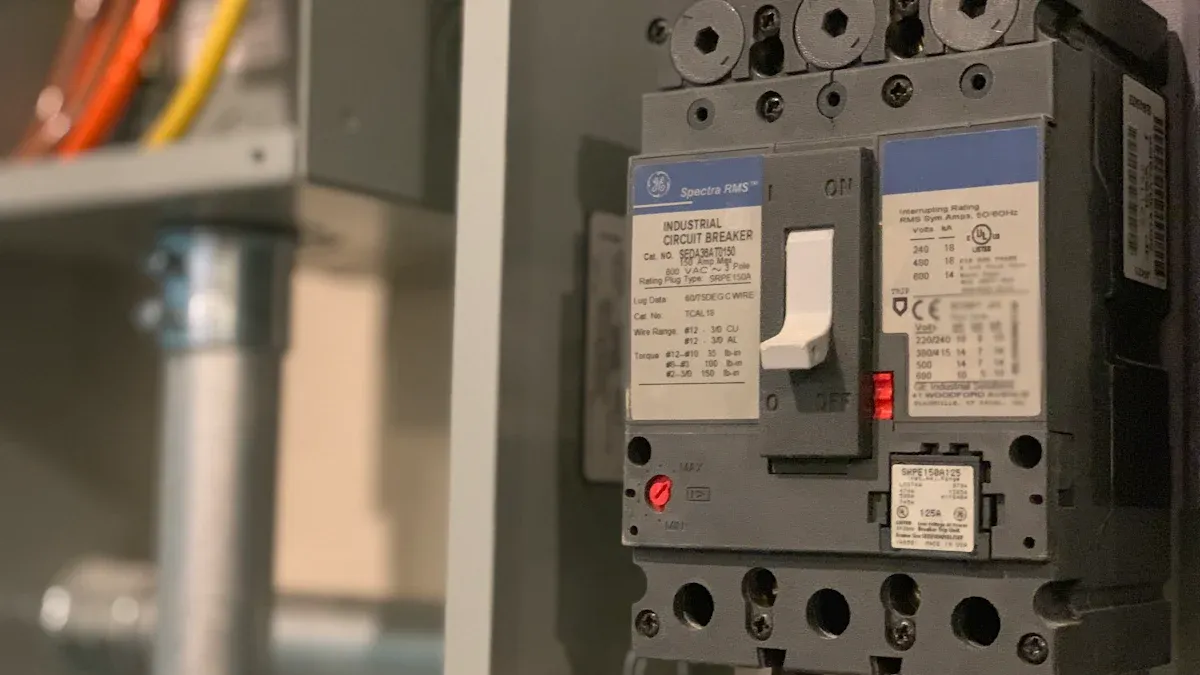
Current Rating
You must pick the right current rating for your mccb. This rating shows how much current the molded case circuit breaker can take before it trips. If you pick the wrong rating, your equipment could get damaged or stop working.
Here is an easy way to find the right current rating for your mccb:
- Check the full load current (FLC) on your motor’s nameplate.
- Make sure the mccb’s frame size fits in your panel.
- Check if the insulation voltage matches your system.
- Change the rated current setting on the molded case circuit breaker if needed.
- Make sure the mccb can get signals from protection relays if you use them.
When you pick an mccb for your motor, set the trip high enough so the inrush current at startup does not trip it by mistake.
Always think about how your motor starts. If your motor uses direct-on-line starting, the inrush current can be very high. The mccb must handle this without tripping. If you use a soft starter or VFD, the inrush current is lower, so you can set the trip closer to the full load current.
Breaking Capacity
Breaking capacity is the biggest fault current an mccb can safely stop. You need to check this to make sure your molded case circuit breaker can protect your motor and wires during a short circuit. The breaking capacity is often called Icu or Ics.
To pick the right breaking capacity:
- Find the highest short-circuit current at your site.
- Make sure the mccb’s Icu is higher than this number.
- Check that the molded case circuit breaker can handle the short-circuit breaking capacity for your system.
If you use an mccb with a breaking capacity lower than the fault current, it might fail during a fault. This can damage equipment or even cause a fire. Always pick a molded case circuit breaker with a high current rating and the right short-circuit breaking capacity for your needs.
Sizing Above FLC
Never size your mccb exactly at the full load current of your motor. Motors use more current when they start and sometimes during heavy loads. To stop nuisance tripping and keep your circuit safe, you need to size the molded case circuit breaker above the FLC.
A good rule is to pick an mccb rated 20-25% higher than the motor’s full load current. This extra space helps the mccb handle inrush currents and short overloads without tripping. Sometimes, you may need to size the mccb even higher, especially if the motor is hard to start.
Here is a table to help you with sizing rules:
| Sizing Rule | Description |
|---|---|
| Up to 250% of FLA | You can size the circuit breaker up to 250% of the motor’s full load amperage (FLA). |
| Up to 300% of FLA | If 250% is not enough for starting, you can go up to 300% of the FLA. |
If you pick an mccb that is too small, it may trip during normal starts or heavy loads. If you pick one that is too big, it may not protect your motor and wires well.
Tip: Always check if you have enough space for your mccb, the insulation voltage, and if it works with protection relays. These things help you pick the best molded case circuit breaker for your motor.
You should also look at both mpcb and mccb options. While mpcb devices have adjustable settings and better motor protection, mccb units have higher breaking capacities and are better for large motors in factories. Both help protect circuits, but you must match the device to your motor’s needs.
Molded Case Circuit Breaker Selection
Trip Unit Type
When you pick an MCCB for big motors, you need to choose between fixed and adjustable trip units. Fixed trip units have set protection levels that you cannot change. Adjustable trip units let you change the settings to fit your motor. This helps stop false trips and gives better protection.
There are two main types of trip units: thermal-magnetic and electronic. The table below shows how they are different:
| Comparison Dimension | Thermal-Magnetic | Electronic |
|---|---|---|
| Protection Function | Overload, short circuit (only two-stage protection) | Overload, short circuit, ground fault, undervoltage (four-stage protection) |
| Response Speed | Fast short-circuit response (20-50ms), slow overload response | Faster response for all fault types (within 10ms) |
| Accuracy & Stability | Highly affected by temperature, +20% error | +5% error, supports temperature compensation |
| Application Scenarios | General power distribution, lighting circuits | Data centers, precision equipment, industrial automation |
| Maintenance Cost | Low (no programming required, simple structure) | High (requires professional setup) |
Electronic trip units protect your motor more exactly. They work faster and can do more things, like ground fault and undervoltage protection. You can adjust the trip settings to match your motor’s normal current and how it starts. This keeps your equipment safe and helps stop downtime.
Some advanced trip units can talk to other systems. You can connect them to SCADA or DCS for live monitoring. This helps you find problems early and keep your motor safe.
Tip: Set the trip level just above your motor’s normal current. This stops the MCCB from tripping during startup or heavy loads.
Load Type Considerations
Motors have different load needs. You need to pick the right MCCB for your motor. The table below shows how MCCB types work with different loads:
| MCCB Type | Operating Current | Operating Time | Application | Suitability |
|---|---|---|---|---|
| Type D | Trips at 10-20 times the rated current | 0.04-3 seconds | Best for heavy industry inrush current | Good for inductive-capacitive loads |
| Type K | Trips in the range of 8-12 times of rated current | 0.04-5 seconds | Suitable for high inrush current loads | Ideal for motor circuits and inductive loads |
If your motor has a big inrush current, like with direct-on-line starting, use a Type D or Type K MCCB. These types can handle big surges without tripping too soon. Adjustable trip settings help you set the trip point for your motor.
You should also think about how an mpcb trips. An mpcb is better for small motors. For big motors in factories, an MCCB with adjustable trip settings is best. Always check the guides from the maker to pick the right one.
Environmental Factors
The place where you use your MCCB matters. High heat can lower how much current an MCCB can handle. Cold can make the parts stiff or break. Humidity can cause water drops inside, which may rust parts or cause short circuits.
The table below shows how temperature and humidity affect MCCBs and what you can do:
| Environmental Factor | Impact | Solution |
|---|---|---|
| Temperature | High ambient temperatures can reduce the current-carrying capacity of an MCCB, leading to derating. Low temperatures may cause mechanical components to become less responsive or brittle. | Choose an MCCB rated for the expected temperature range. Use proper cooling or heating solutions for extreme conditions. |
| Humidity | High humidity can lead to condensation, which may cause corrosion on internal components and affect electrical insulation. Moisture ingress can lead to short circuits or malfunction. | Use MCCBs with appropriate IP ratings for humid or wet environments. Install in climate-controlled enclosures or use heaters in panels. |
Always pick an MCCB that fits your workshop’s temperature and humidity. If your workshop is tough, get MCCBs with high IP ratings and good covers. Check for rust and tighten wires often to make your MCCB last longer. Most MCCBs last 15 to 30 years if you take care of them.
New MCCBs have extra features for safety and reliability. Some have microprocessors, adjustable settings, and real-time monitoring. These help you find problems fast and stop downtime. Many MCCBs can now work with building management and IoT systems. You can watch your MCCB from far away and know when it needs fixing before it breaks.
Note: Check your MCCB often and do regular maintenance. Always follow the maker’s advice for testing and repairs.
Motor Protection and Compliance
Standards and Regulations
You must always check that your mccb meets the right standards before you install it in your workshop. These standards help you make sure your motor gets the best protection and your system stays safe. When you follow these rules, you avoid legal problems and keep your equipment running longer.
- MCCBs must be tested and certified to standards like UL 489.
- IEC 60947 is another key standard for reliability and legal compliance.
- UL 489 closely matches IEC 60947-2 for low-voltage circuit breakers.
- Both standards require high-fault interruption ratings, usually between 10kA and 100kA.
- IEC standards require endurance testing of over 8,000 cycles.
Always look for the certification marks on your mccb. These marks show that the device passed strict tests for protection under overloads and protection under short circuits.
System Integration
You can improve protection for motors by using your mccb with other devices. In large workshops, you should connect your mccb with a contactor and an overload relay. This setup gives you full coverage for your motor.
The mccb protects the feeder and stops big faults. The contactor controls when the motor turns on or off. The overload relay watches for slow rises in current and trips if the motor works too hard. When you use all three together, you get selective tripping. This means only the part with a problem shuts down, and the rest of your system keeps working.
Here is a simple guide to set up your system:
- Install the mccb at the feeder to handle short circuits.
- Add a contactor to control the motor’s start and stop.
- Use an overload relay to sense and react to long-term overloads.
This method helps you avoid nuisance tripping and keeps your workshop running smoothly. You also make sure your motor gets the right protection at every stage.
Tip: Always follow the wiring diagrams from the manufacturer. Good coordination between your mccb, contactor, and relay gives you the best results.
You can choose the right MCCB for your motor by following these steps:
- Find the rated current and add a 20%-30% margin for safety.
- Select a breaking capacity that matches your system’s short circuit current.
- Pick the correct polarity for your circuit.
You should always check safety standards like IEC 60947-2 and UL 489. These standards help you keep your equipment safe and reliable.
If you have a complex setup, talk to an expert or the manufacturer. Regular checks and proper installation help you protect your motor and keep your workshop running smoothly.
FAQ
What size MCCB should you use for a large motor?
You should choose an MCCB rated 20–25% above your motor’s full load current. This helps prevent nuisance tripping during startup and protects your motor from overloads.
Can you use the same MCCB for different motor starting methods?
No, you should match the MCCB to your motor’s starting method. Motors with high inrush currents need MCCBs with higher trip settings or special types like Type D or K.
How often should you check or maintain your MCCB?
You should inspect your MCCB at least once a year. Look for signs of wear, loose connections, or dust buildup. Regular checks help prevent failures and keep your motor safe.
What happens if you pick an MCCB with a low breaking capacity?
If you choose an MCCB with a breaking capacity lower than your system’s fault current, it may fail during a short circuit. This can damage your equipment or cause a fire.
Do you need extra protection devices with your MCCB?
Yes, you should use overload relays and contactors with your MCCB for large motors. This combination gives you better protection against both short circuits and long-term overloads.
See also
What to Consider When Operating Two Transfer Switches on a Generator
Exploring the Components of Molded Case Circuit Breakers
What Is the Full Name of MCCB in Electrical Engineering
MCB and MCCB Compared Which Circuit Breaker Is Right for You
How to Match the Type of MCB to Your Electrical Load