

Choosing the right 200 ampere molded case circuit breaker is important. It helps keep your electrical system safe and working well. If you pick the wrong breaker, you could have problems. These problems include overheating, tripping, or even dangerous failures in a short circuit. Many people forget to check things like voltage rating or breaking capacity. They also forget to see how the breaker works in heat, moisture, or high places. If you use this checklist, you can avoid these mistakes. You will feel sure that your setup meets the newest safety rules.
Key Takeaways
- Always make sure your breaker’s current rating matches your system’s load. Use the 80% rule to keep things safe for a long time.
- Check if the breaker’s voltage and frequency ratings fit your electrical system. This helps you avoid problems and failures.
- Pick a breaker with a breaking capacity at least 30% higher than your highest fault current. This gives you strong protection.
- Choose the right number of poles for your system type. Use single-pole for single-phase and three-pole for three-phase systems.
- Check and take care of your breaker often. This keeps it working well and safe for many years.
Current Rating
Load Requirements
When you pick a 200 ampere molded case circuit breaker, you need to know how much electricity your system will use. Start by adding up the power ratings of all the equipment and appliances that will run at the same time. This includes things like lights, air conditioners, and machines. You also need to check the voltage of your system, like 120V, 240V, or 480V, because this affects your calculations.
Here’s a simple way to figure out your maximum expected load:
- Add up the ratings of each appliance or machine.
- Use demand factors from the National Electrical Code (NEC) to adjust for equipment that won’t run all the time.
- For loads that run for three hours or more, multiply by 125% to get the right size for wires and breakers.
- Check the NEC tables for special rules about things like kitchen equipment or laundry circuits.
- Always round up if your total is halfway between two numbers.
You want your total load to stay below the breaker’s rating. If you go over, you risk tripping the breaker or even damaging your system.
Molded case circuit breakers come in many sizes, from 10 amps up to 2,500 amps. This means you can find the right breaker for almost any job, from small homes to big factories.
80% Rule
The 80% rule is a key safety tip. For any load that runs for three hours or more, you should only use 80% of the breaker’s rated current. So, with a 200 ampere molded case circuit breaker, you should not run more than 160 amps for long periods. This helps prevent overheating and keeps your system safe.
Some special breakers can handle 100% of their rating, but they need special enclosures and bus bars. Most of the time, you should follow the 80% rule unless you know your breaker is rated for full load. Always check the labels and instructions before you decide.
Tip: Following the 80% rule helps your breaker last longer and keeps your building safer.
Voltage Compatibility
Solution-for-molded-case-circuit-breakers.webp)
System Voltage
You need to check the system voltage before you pick a 200 ampere molded case circuit breaker. If you choose the wrong voltage, your breaker might not protect your equipment. Most 200 amp breakers work with common industrial voltages. These include 240 volts, 277 volts, 480 volts, and 600 volts. You can see these typical ratings in the table below:
| Frame Size (A) | Typical Supported System Voltages (V) |
|---|---|
| 200 | 240, 277, 480, 600 |
You should always match the breaker’s voltage rating to your system. For example, if your system runs at 480 volts, your breaker must support 480 volts or more. The National Electrical Code (NEC) gives clear rules for this. If your breaker has a straight voltage rating, like 240 V or 480 V, you can use it as long as the voltage between any two wires does not go over that number. Some breakers have a slash rating, like 480Y/277 V. These work in grounded systems, where the voltage from any wire to ground stays below the lower number, and the voltage between wires stays below the higher number.
Tip: Always check the label on your breaker. If you are not sure about your system voltage, ask an electrician. Using the wrong voltage can cause the breaker to fail.
Frequency Match
You also need to check the frequency of your electrical system. Most systems in the United States use 60 Hz. Some special equipment or locations might use 50 Hz. Your breaker must match the system frequency. If you use a breaker rated for 60 Hz in a 50 Hz system, it might not trip at the right time. This can lead to safety problems.
When you look at breaker labels, you will see the frequency rating. Make sure it matches your system. If you are working in a place with both 50 Hz and 60 Hz equipment, choose a breaker that supports both. Many modern breakers do, but you should always double-check.
Note: Matching both voltage and frequency keeps your system safe and helps your breaker work as designed. Never guess—always confirm these ratings before you buy.
Breaking Capacity
Fault Levels
When you choose a 200 ampere molded case circuit breaker, you must think about fault levels. Fault current is a big rush of electricity that happens during a short circuit. If your breaker cannot stop this, it might break. Your equipment could get hurt too. The breaking capacity, or interrupting rating, should be higher than the biggest fault current your system might have.
In most commercial and industrial buildings, main breakers for 200 amp panels need to handle fault currents from 20,000 to 25,000 amperes. Branch breakers can have lower ratings. But the main breaker must always be strong enough for the fault current at its spot. This follows the National Electrical Code (NEC) rules. The NEC says your breaker must be tough enough for the job.
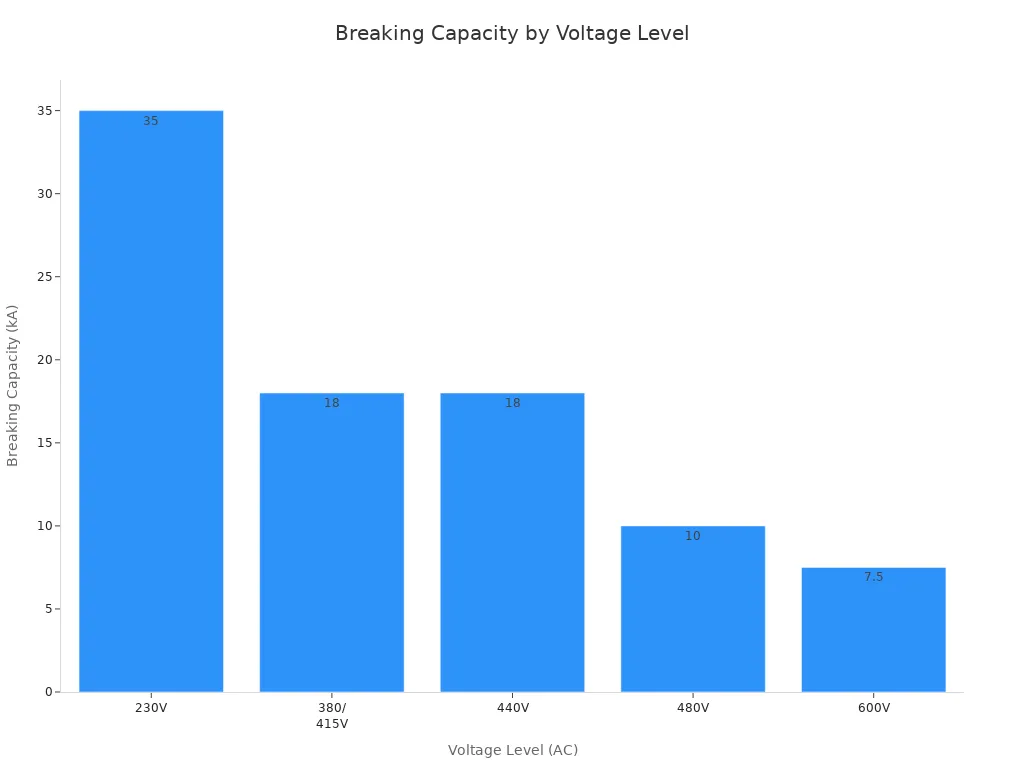
You can see how breaking capacity changes with voltage in the table below:
| Voltage Level (AC) | Breaking Capacity (Icu) |
|---|---|
| 230V | 35kA |
| 380/415V | 18kA |
| 440V | 18kA |
| 480V | 10kA |
| 600V | 7.5kA |
Some breakers, like the Q232200H, have a 22kAIC rating at 240V. Others, such as the Siemens SJD69200, can handle up to 35kAIC at 480V. These high ratings help keep your system safe when fault currents go up.
Safety Margin
You should always add a safety margin when picking your breaker’s breaking capacity. Experts say to pick a breaker with a breaking capacity at least 30% higher than your highest fault current. For example, if your system could have a 25kA fault current, you should pick a breaker rated for at least 35kA. This extra margin helps protect your equipment and gives you peace of mind.
Tip: Never guess your fault current. Always check with an electrician or use fault current calculators to get the right number. Picking a breaker with the right breaking capacity keeps your building safe and your equipment running.
Trip Settings
Trip Unit Types
When you look at a 200 ampere molded case circuit breaker, you will see that it uses special trip units to protect your system. These trip units decide when the breaker should trip and stop the flow of electricity. You will usually find two main types:
- Thermal Trip Unit: This type uses a bimetallic strip. When too much current flows for too long, the strip heats up and bends. This bending action trips the breaker after a short delay. It works best for overloads that last a while.
- Magnetic Trip Unit: This type uses a coil, called a solenoid. If a huge current rushes through, like during a short circuit, the coil creates a strong magnetic force. This force trips the breaker almost instantly. It protects your system from sudden, dangerous spikes.
You get both types in most 200 amp MCCBs. The thermal part handles slow, steady overloads. The magnetic part jumps into action for quick, high-current faults. This combination keeps your equipment safe from many kinds of problems.
Tip: If you want the best protection, always check that your breaker has both thermal and magnetic trip units. Each one guards against a different danger.
Adjustments
Modern 200 amp molded case circuit breakers let you fine-tune how and when they trip. You can set these adjustments to match your building’s needs. Here’s a handy table to show you what you can change and why it matters:
| Trip Setting | What It Does | How You Can Adjust It |
|---|---|---|
| Continuous Amps (Ir) | Sets the normal current limit | 20% to 100% of the breaker’s rating (40A to 200A) |
| Long-Time Delay | Lets motors and big machines start without tripping the breaker | 2.2 to 27 seconds at 6x Ir |
| Short-Time Pickup | Helps the breaker work with other devices during faults | 1.5 to 10 times Ir; can turn OFF |
| Short-Time Delay | Controls how long the breaker waits before tripping on short faults | 0.05 to 0.5 seconds (fixed); 0.18 to 0.45 seconds (ramp) |
| Instantaneous Pickup | Trips the breaker right away if a huge fault happens | 2 to 40 times Ir; fixed override at 10,000A |
| Ground Fault Pickup | Trips the breaker if it senses a ground fault | 20% to 70% of max rating; delays of 0.1, 0.2, or 0.4s |
You can use these settings to match your breaker to your load. For example, if you have big motors, you might set a longer delay so the breaker does not trip every time the motor starts. If you want extra safety, you can lower the ground fault pickup. These adjustments help you get the right balance between protection and keeping your system running.
⚡ Note: Always double-check your settings after you make changes. The right trip settings keep your building safe and your equipment working smoothly.
Number of Poles
Single vs. Three-Phase
When you look at a 200 ampere molded case circuit breaker, you will see options for the number of poles. This choice matters a lot. You need to match the breaker to your electrical system.
A single-pole breaker works best in single-phase systems. You find these in most homes and small shops. Single-pole breakers protect one hot wire. They are simple and easy to use. If you have a single-phase panel, you will likely use a single-pole breaker for each circuit.
Three-pole breakers are different. You use them in three-phase systems, which are common in big buildings, factories, and commercial spaces. A three-pole breaker protects all three wires at once. It trips all three phases together if there is a problem. This keeps your equipment safe and helps prevent damage to motors and other machines. Three-pole breakers often have a common trip feature. This means if one phase has a fault, the breaker shuts off all three phases at the same time.
Sometimes, you might see a three-pole breaker in a single-phase panel. This is not common, but it can happen. Some special setups loop one pole back to make sure current flows through all poles. This is more common with IEC-style breakers. Most NEMA-style breakers do not need this. The National Electrical Code allows three-pole breakers in single-phase panels, but you need to be careful. Always check with your inspector or electrician before you try this.
Tip: Always match the number of poles to your system type. This keeps your setup safe and helps your breaker work as it should.
Circuit Needs
Think about what your circuit needs before you pick the number of poles. Here are some questions to help you decide:
- Do you have a single-phase or three-phase system?
- Are you protecting one wire or three?
- Does your equipment need all phases to shut off together for safety?
If you have a single-phase load, a single-pole breaker is usually enough. For three-phase loads, like big motors or heavy equipment, you need a three-pole breaker. This ensures balanced protection and keeps everything running smoothly.
| System Type | Breaker Type | Typical Use |
|---|---|---|
| Single-Phase | Single-Pole | Homes, small offices |
| Three-Phase | Three-Pole | Factories, large buildings |
Choosing the right number of poles helps you avoid problems and keeps your electrical system safe. If you are not sure, ask a licensed electrician for advice.
200 Ampere Molded Case Circuit Breaker Selection
Wire Size Compatibility
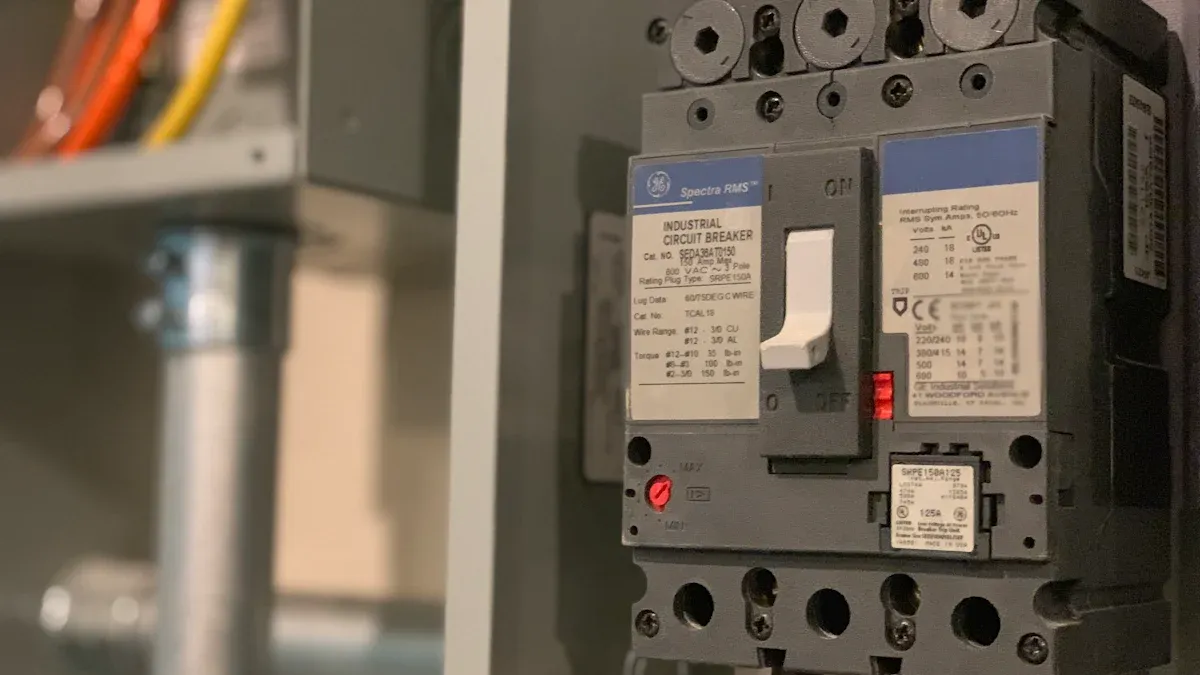
Your 200 ampere molded case circuit breaker must fit the right wire size. Wires that are too small can get hot and start fires. Wires that are too big may not fit well in the breaker. Always look at the smallest wire gauge in your circuit before picking a breaker. Most electricians use 3/0 AWG copper or 250 kcmil aluminum wires for a 200 amp breaker. You can find this info in the National Electrical Code or on the breaker’s label.
Tip: Always check the wire size and breaker terminals before you start. This keeps your system safe and helps your breaker work right.
Application Fit
You need to make sure your 200 ampere molded case circuit breaker fits your job. Not every breaker works for every place. Think about what you want to protect and where you will use the breaker. Here are some common places for a 200 ampere molded case circuit breaker:
- Manufacturing plants use these breakers to keep machines safe from overloads and short circuits. This helps the equipment keep working and stops costly shutdowns.
- Commercial buildings use them for HVAC, lights, and big machines. The breaker helps keep people and property safe.
- Construction sites need strong breakers for temporary power. These sites have changing loads and tough conditions, so a good breaker is important.
- New breakers with smart and digital features help you watch energy use and find problems early. This makes them great for modern buildings.
Always pick a breaker that fits your equipment’s needs and follows local rules. If you use the wrong breaker, you could hurt your machines or break the law.
⚡ Note: The right 200 ampere molded case circuit breaker helps you feel safe. It protects your investment and keeps your building safe.
Installation Space
Panel Size
You need to check your panel size before you install a 200 ampere molded case circuit breaker. Not every panel can fit a large breaker. Some panels have limited space between the bus bars or around the mounting area. If your breaker is too big, it will not fit, and you might have to buy a new panel. That can cost a lot of money and time.
Start by measuring the space inside your panel. Look at the height, width, and depth. Most breaker manufacturers list the exact dimensions in their catalogs or on their websites. You can use a simple table to keep track:
| Panel Measurement | Minimum Needed for 200A MCCB |
|---|---|
| Height | 8-12 inches |
| Width | 4-6 inches |
| Depth | 3-5 inches |
If you see that your panel is too small, you should talk to an electrician. They can help you find a solution that keeps your system safe.
Tip: Always check the panel’s label for the maximum breaker size. This helps you avoid mistakes and keeps your installation up to code.
Accessibility
You want to make sure you can reach your breaker easily. If you put your 200 ampere molded case circuit breaker in a tight spot, you might have trouble turning it off during an emergency. You also need space to connect wires and check the breaker for problems later.
Here are some things to remember:
- Leave at least 3 feet of clear space in front of the panel.
- Make sure nothing blocks the panel door.
- Place the breaker at a height where you can reach it without a ladder.
If you follow these steps, you will make your electrical system safer and easier to maintain. Good accessibility also helps electricians work faster and safer when they need to test or replace the breaker.
Remember: Easy access to your breaker can save time and prevent accidents.
Environmental Factors
Moisture and Temperature
You might not think about the weather when you pick a circuit breaker, but it matters a lot. High temperatures and humidity can really change how your 200 ampere molded case circuit breaker works. When the air gets hot or damp, the insulation inside the breaker can wear out faster. This makes it easier for electricity to leak or cause a fault. If you use your breaker in a place with lots of moisture, like a basement or near water pipes, you need to be extra careful.
Corrosive gases in the air can also hurt your breaker. These gases can eat away at the metal parts inside, making them weak. Even though most MCCBs have tough plastic shells to protect the inside, these problems can still sneak in over time. If your breaker faces a lot of vibration or shock, like in a factory or near heavy machines, it might not last as long. You want your breaker to stay strong and reliable, so always check the environment before you install it.
Tip: If you know your breaker will be in a tough spot, look for models with extra seals or coatings. These features help keep out moisture and slow down wear.
Dust and Altitude
Dust can be a big problem for circuit breakers. If dust gets inside, it can block moving parts or cause the breaker to trip when it shouldn’t. In places with lots of dust or dirt, you should keep your panel clean and check it often. Choosing a breaker with a high IP (Ingress Protection) rating helps keep dust and moisture out. This can make your breaker last up to 25% longer.
Altitude is another thing you might not expect to matter, but it does. When you go higher up, the air gets thinner. Thin air can’t cool your breaker as well, so it might get too hot. Most 200 amp MCCBs work great at normal heights, but if you install one in the mountains, you may need a special type. Some breakers, like vacuum or SF6 gas models, work better in high places because they handle low air pressure.
| Environmental Factor | What Can Happen? | What Should You Do? |
|---|---|---|
| Dust | Parts may stick or fail | Use high IP rating, clean often |
| High Altitude | Breaker may overheat | Choose special breaker if needed |
Remember: Keeping your breaker clean and picking the right model for your location helps you avoid problems and keeps your system safe.
Certifications and Standards
UL Listing
When you pick a 200 ampere molded case circuit breaker, you want to know it will keep your building safe. That’s where UL Listing comes in. UL stands for Underwriters Laboratories. This group tests electrical products to make sure they meet strict safety rules. If you see a UL Listed mark on your breaker, you know it passed tough tests for fire, shock, and mechanical risks.
The UL Listing Mark means experts checked the breaker for safety and performance. They even visit the factory to make sure every breaker stays up to standard.
Here’s what you should look for in 2025:
- UL 489 Certification: This is the main standard for circuit breakers in North America. It proves your breaker can handle high fault currents and will trip when needed.
- NEC Compliance: The National Electrical Code (NEC) sets the rules for safe wiring. Article 240 covers circuit breakers. Make sure your breaker meets the latest NEC updates, like arc-fault and ground-fault protection.
- Ongoing Inspections: UL keeps checking factories to make sure every breaker stays safe and reliable.
A breaker like the K3200 with a UL Listing gives you peace of mind. You know it will protect your system from overloads and short circuits.
Markings
You should always check the markings on your breaker before you buy or install it. These markings tell you if the breaker meets the right standards and if it’s safe for your job.
Look for these important markings:
| Marking | What It Means |
|---|---|
| UL Listed | Passed UL safety tests (UL 489) |
| IEC 60947-2 | Meets international switchgear standards |
| RoHS | Limits hazardous materials for a safer environment |
| Voltage & Current | Shows the max voltage and current the breaker can handle |
| Date Code/Serial Number | Helps track the product for recalls or support |
Tip: If you don’t see these markings, don’t use the breaker. Always double-check before you install.
These markings help you pick a breaker that’s safe, legal, and ready for your system. You can trust your breaker to do its job when you see the right labels.
Maintenance and Testing
Inspection Needs
You want your 200 ampere molded case circuit breaker to last and work when you need it most. Regular inspection keeps your breaker safe and reliable. Here’s a simple checklist you can follow:
- Visual Inspection: Look for cracks, burns, or signs of overheating on the case and terminals.
- Thermal Imaging: Use an infrared camera to spot hot spots that could mean trouble inside.
- Mechanical Operation Test: Flip the breaker on and off a few times. It should move smoothly without sticking.
- Insulation Resistance Test: Use a megohmmeter to check insulation. If you see values below 1 megaohm, you may have a problem.
- Contact Resistance Test: Measure the resistance across the contacts. High resistance can mean worn or dirty contacts.
- Overload and Short Circuit Tripping Tests: Test the breaker by simulating overloads and short circuits. It should trip within the time the manufacturer says.
- Preventive Maintenance: Keep the area clean, check that wires are tight, and make sure the breaker is wired correctly.
- Follow Standards: Always use NEMA AB4 and UL 489 guidelines for inspections and maintenance.
Tip: After any big fault or if the breaker trips, check it before turning the power back on. For small overloads, a quick look and a few flips may be enough. For big faults, do a full check following industry standards.
Long-Term Reliability
You want your breaker to last for years. Most problems come from things you can spot early if you know what to look for. Here are some common causes of long-term failure:
- The coil inside the breaker can get loose or stick, which may cause it to burn out.
- Auxiliary switches might not open or close right, leading to coil problems.
- If the control circuit has low voltage or high resistance, the coil may not work well and could fail.
- Contacts can get dirty or worn, which raises resistance and causes overheating.
- Arcing from switching can damage contacts and make the breaker less reliable.
If you keep up with regular checks and fix small issues early, your 200 ampere molded case circuit breaker will protect your system for a long time. Always keep records of your inspections and tests. This helps you spot patterns and plan for replacements before problems happen.
🛠️ Remember: A little maintenance now saves you from big headaches later!
Accessories and Features
Auxiliary Options
You can add accessories to your 200 ampere molded case circuit breaker. These extras help you watch and control your breaker from far away. They also let you know if something changes. Here are some common options you might like:
- Auxiliary contact blocks give extra contacts for signals. You can use them to turn on a light or alarm when the breaker trips.
- Shunt trips let you turn off the breaker from another room. You just press a button to shut off power fast.
- Voltage trip options make the breaker trip if voltage gets too high or low. This keeps your equipment safe from bad voltage changes.
- Under voltage trips keep the breaker on only if voltage is safe. If voltage drops too much, the breaker trips to protect your system.
- Labeled auxiliary contacts help you see which accessories are there. You can look at the wires to know what each contact does.
🛠️ Tip: These accessories help you watch your system and act fast if there is a problem.
Advanced Functions
Circuit breakers are getting smarter every year. In 2025, you will find many new features that make your system safer and easier to use. Top brands like Siemens, Schneider Electric, and ABB have breakers with smart upgrades.
- Smart MCCBs use IoT so you can check them from your phone or computer.
- Some breakers warn you before something breaks, so you can fix it early.
- Small and modular designs save space but still protect well.
- New models can handle bigger faults and help you get power back faster.
- Many breakers now use less energy and last longer, which saves money and helps the planet.
- Extra features like anti-vibration and high breaking capacity make them good for tough jobs in big buildings or factories.
⚡ Note: Picking a breaker with advanced features gives you better safety, more control, and peace of mind for a long time.
If you use every step in this checklist, your setup will be safer. You will also make your system work better for a long time. Choosing the right 200 ampere molded case circuit breaker helps you stop costly errors. It also keeps your electrical system safe from harm. Easy steps like checking lockout/tagout, wearing PPE, and using thermal imaging can find issues early. This helps you fix problems before they get risky.
- Always check that your breaker matches your system and meets safety rules.
- Doing regular checks and taking care of your breaker helps it last longer.
If you are ever not sure what to do, ask an expert for help. Your safety is the most important thing! - Obtain high-quality 200 ampere molded case circuit breakers from ONESTOP

FAQ
What size wire should you use with a 200 amp molded case circuit breaker?
You should use 3/0 AWG copper or 250 kcmil aluminum wire for most 200 amp breakers. Always check the breaker’s label and local codes before you start. Using the right wire keeps your system safe.
Can you use a 200 amp breaker for both single-phase and three-phase systems?
Yes, you can. Just pick the right number of poles. Use a single-pole breaker for single-phase and a three-pole breaker for three-phase. Always match the breaker to your system type.
How often should you test or inspect your 200 amp breaker?
You should check your breaker at least once a year. Look for signs of wear, heat, or damage. If your system runs in tough conditions, check it more often. Regular checks help you catch problems early.
What does “breaking capacity” mean on a circuit breaker?
Breaking capacity shows the highest fault current your breaker can safely stop. If a short circuit happens, your breaker must handle the surge. Always pick a breaker with a breaking capacity higher than your system’s possible fault current.
The following information may be of interest to you
What Makes 16 Ampere Circuit Breakers Essential for Home Safety
Molded case circuit breaker 125 ampere 4P
What You Need to Know About How Molded Case Circuit Breakers Work
What Are the Key Benefits of Using High Quality MCCB