How to Source Terminal Blocks Factory Direct from China
Factory-direct sourcing is not a shortcut around qualification. It is a controlled path from a frozen RFQ and verified legal entity to approved samples, a traceable production lot and a documented release.
Compare factories only after every bidder receives the same specification, quality plan, delivery rule, named place and commercial assumptions. A low unit quote without those controls is not a comparable offer.
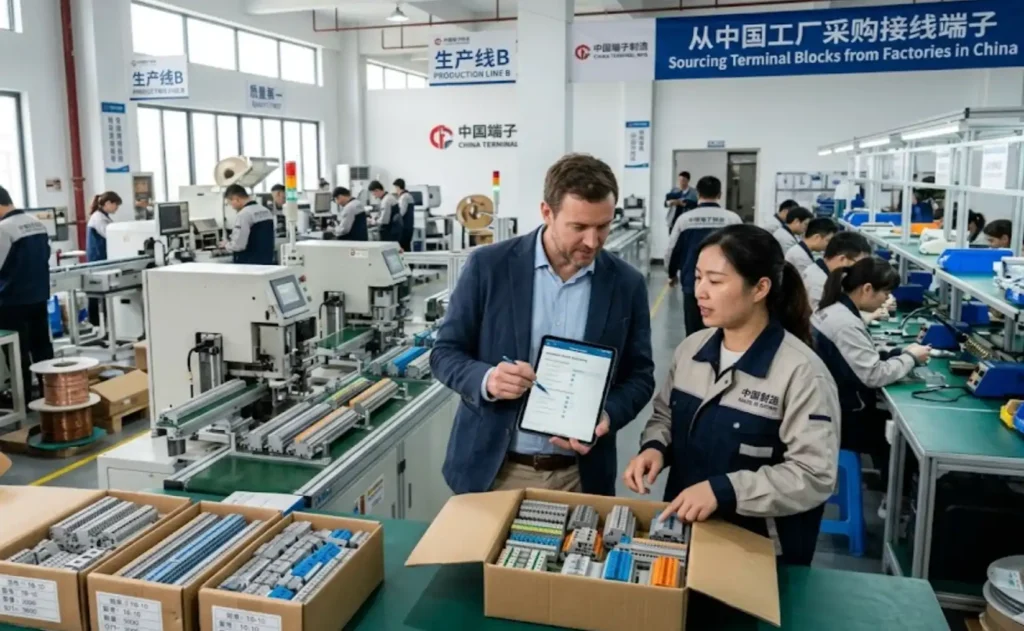
Start with the buying situation
A catalogue reorder, an OEM modification and a first import do not need the same evidence. The product risk, amount at stake, destination market and cost of a field failure determine how deep the qualification must go.
Catalogue product
Confirm the exact part number, current approval scope, conductor range, accessories, packaging and lot traceability. Do not approve a visually similar substitute.
OEM or modified product
Freeze drawings, materials, markings, tooling ownership, validation tests and change-notification rules before production authorization.
First order or high consequence
Add independent legal checks, a process audit, production-lot samples, pre-shipment inspection and a conservative payment release plan.
The goal is not to prove that a supplier can make one good sample. It is to prove that the contracted factory can repeat the approved product under controlled production.
Direct answer
Factory direct means a verified and controlled chain
A factory-direct relationship exists when you know which legal entity contracts and receives payment, which site performs each manufacturing step, which entity owns the product approvals, and how the shipped lot is tied back to the approved specification.
Buying directly can improve engineering access, product-version control, packaging flexibility and cost transparency. It does not automatically make the product cheaper, compliant or consistent. A manufacturer may legitimately use an export affiliate, an outside plating supplier or an independent laboratory; those arrangements become acceptable when they are disclosed, controlled and reflected in the contract and quality file.
Identity, process and approvals align
The Chinese legal name, Unified Social Credit Code, registered status, factory address, contract party, invoice issuer, payment beneficiary, manufacturing site and certification holder either match or have a documented relationship.
The released lot matches the baseline
The purchase order cites the same drawing revision, BOM, approved sample, test plan, marking, packaging and change-control terms used for production and final inspection.
Do not start by asking, “What is your best price?” Start by asking, “Can you quote this controlled requirement and show objective evidence for the exact model?”
Gate 01 · specification
Make every factory quote the same requirement
“DIN rail terminal block, 24 A” is not a sourcing specification. Create one RFQ package with a controlled cover sheet, technical specification, drawing or reference part, required approval evidence, inspection plan and commercial questionnaire. Give every candidate the same revision and record all clarifications in writing.
| RFQ field | Define before quotation | Evidence requested |
|---|---|---|
| Product architecture | DIN rail, feed-through, PE, multi-level, barrier, PCB, pluggable or another exact function; connection technology; positions; pitch and key dimensions. | Part number, controlled drawing, datasheet and accessory compatibility list. |
| Electrical and conductor data | Required circuit values, conductor material, solid/stranded/flexible class, cross-section or AWG, strip length and ferrule policy for the selected approval condition. | Model-specific rating table and installation instructions—not a family brochure alone. |
| Installation | Rail profile or panel/PCB mounting, available space, orientation, required end plates, partitions, jumpers, markers, covers and tools. | Dimensioned assembly drawing and complete BOM. |
| Environment | Operating temperature, pollution degree, altitude, vibration, enclosure, corrosion exposure and any application-specific constraints. | Applicable test data and declared conditions of use. |
| Market access | Destination country, end-equipment standard, required product certification, declarations and labeling language. | Certificate database record, file number, model scope, reports or declarations as applicable. |
| Commercial baseline | Sample quantity, trial quantity, forecast, order mix, packaging, currency, payment milestone, named delivery point and requested Incoterms® 2020 rule. | Itemized quotation with exclusions, validity, capacity assumption and lead-time definition. |
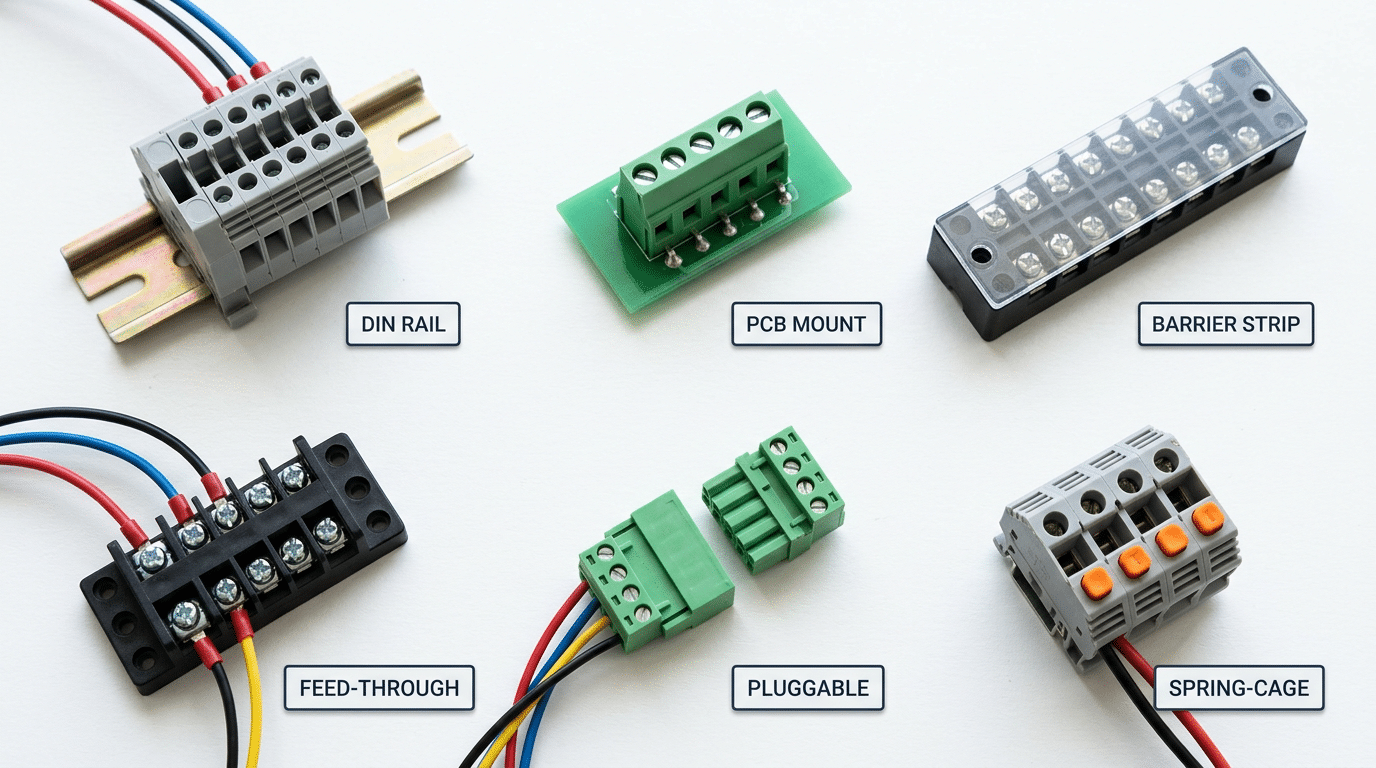
A housing color, marking or catalogue line can be customized; a safety rating cannot simply be “changed to 600 V.” Any altered construction and claim must be supported by the applicable design review, testing and certification route.
Gate 02 · supplier identity
Verify the legal entity, factory role and commercial alignment
Request the Chinese business license and the company’s Chinese legal name. Search the name or Unified Social Credit Code in China’s National Enterprise Credit Information Publicity System. The official system publishes core registration information such as legal name, code, representative, address, business scope and registration status. Treat the result as one evidence layer, not a complete factory audit.
Confirm who exists
Match the current legal name and code to the business license. Review operating status, registered address, representative, business scope and relevant public notices. Transliteration differences are common, so keep the Chinese name in the supplier file.
Confirm who makes what
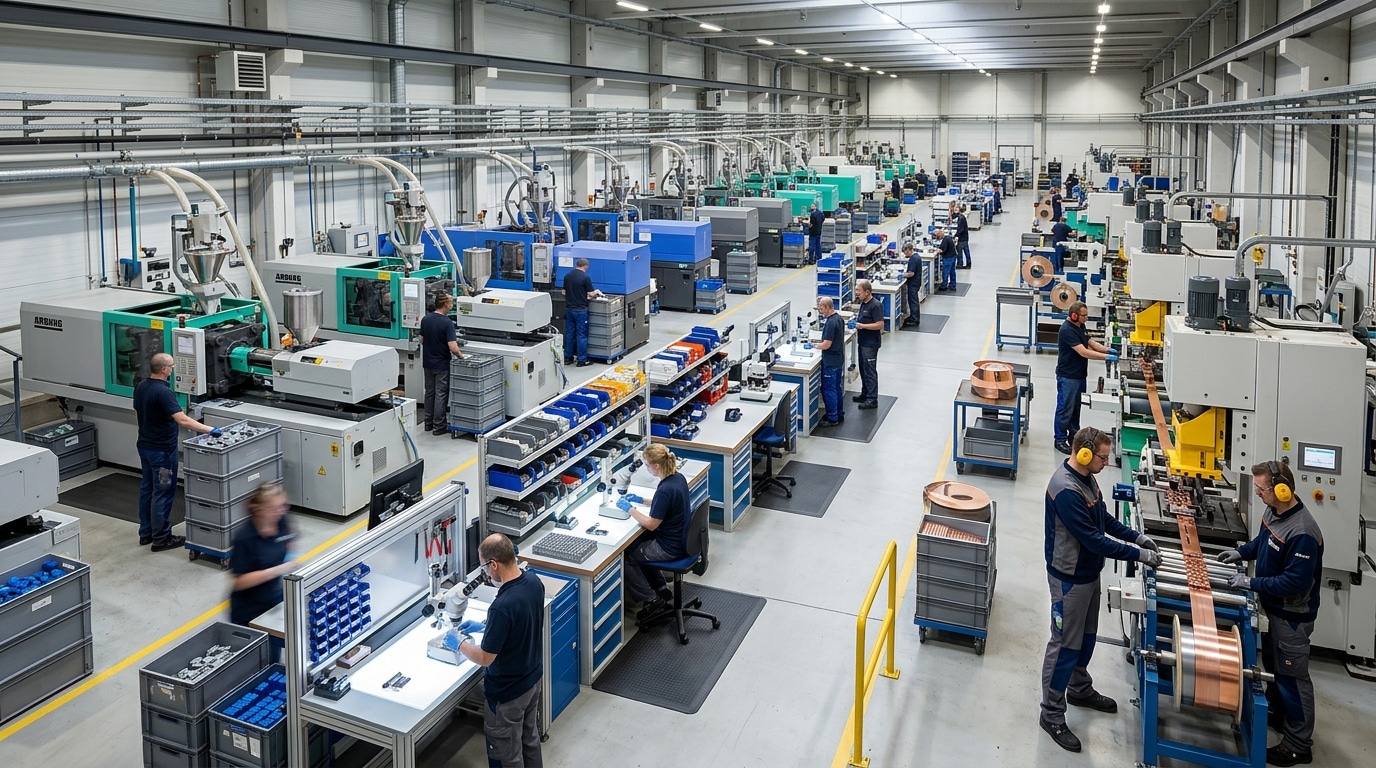
Map injection molding, metal stamping, machining, plating, assembly, testing and packaging. Record which processes are in-house, which are outsourced and how incoming suppliers are qualified and monitored.
Confirm who contracts, invoices, exports and receives payment
An export affiliate is not automatically a red flag, but the relationship must be documented. Resolve any mismatch among the factory, quotation, contract, certificate holder, commercial invoice and bank beneficiary before sending funds.
A live video tour is useful only when it follows your process map. Ask the supplier to show a current work order, incoming material identification, tooling number, in-process inspection, calibrated test equipment, nonconforming-material area and finished-goods lot labels. For higher-risk orders, use an independent on-site process audit and verify the auditor’s scope, competence and conflict controls.

Ask for a process flow
Require the supplier to mark every outsourced operation and critical sub-supplier. A trader may know catalogue features; a process owner should be able to explain controls, records and reaction plans.
Trace one current lot
Select a finished carton and work backward to assembly records, component lots, inspections and raw-material evidence. Then trace a component forward to the finished-goods label.
Review change control
Ask who may change resin, metal alloy, plating, spring geometry, screw source, mold cavity, factory site or test method, and how much written notice the buyer receives.
Test capacity with evidence
Request output by exact family, current utilization, bottleneck process, available tooling, preventive-maintenance status and a dated production plan for your order—not generic daily-capacity claims.
Gate 03 · compliance evidence
Verify the exact model and scope—not the logo
No single “must-have certificate” applies to every terminal block in every country and end product. Build a compliance matrix from the destination market and end-equipment requirements. Then verify the manufacturer name, site, standard edition, model family, ratings, conductor range, conditions and current status for the exact part you plan to buy.
IEC 60947-7-1
IEC 60947-7-1:2025 specifies requirements for industrial terminal blocks for copper conductors within its scope. The scope limit is not the rating of every product; read the selected part’s verified data.
IEC 60947-7-2
IEC 60947-7-2 covers protective conductor terminal blocks and their electrical and mechanical connection to a fixing support. Use it only when that PE function is required.
UL certification record
Search UL Product iQ® by file number, company, category or model. Confirm whether the item is a certified product or Recognized Component and review its conditions of acceptability. UL is not the only OSHA-recognized NRTL.
CE, LVD and technical file
CE marking is a manufacturer declaration that applicable EU requirements have been met; it is not a generic third-party quality certificate. Determine first whether the component and intended use fall within the legislation, then check any applicable model-specific EU Declaration of Conformity, technical documentation and traceability.
RoHS and REACH evidence
Request a current declaration tied to the exact product/material scope, plus supporting supplier or laboratory evidence when risk warrants. Substance declarations do not replace electrical-safety approval.
ISO 9001 certificate
Verify status, scope and certified site through the issuing certification body and, where available, IAF CertSearch. ISO 9001 covers a management system, not the compliance of an individual terminal block.
Do not require CCC automatically for every export terminal block; check whether the exact product and Chinese domestic use fall within the current compulsory-certification catalogue. Do not require a Notified Body certificate merely because a supplier claims CE under the Low Voltage Directive; the applicable conformity route and end-product responsibilities must be determined correctly.
Gate 04 · qualification
Approve a product baseline, then prove production repeatability
Ask for samples only after the supplier accepts the controlled RFQ. Mark every sample with supplier, model, drawing revision, mold/cavity if applicable, production date and material lot. A polished “golden sample” can define appearance and fit, but it does not prove that ordinary production will match.
Catalogue or engineering sample
Confirm function, dimensions, mounting, conductor entry, accessories, markers, mating and basic workmanship. Record every deviation before requesting a pilot lot.
Pilot production lot
Use normal tooling, approved materials, production operators and standard inspection. Pull samples randomly instead of accepting only supplier-selected pieces.
Type and application validation
Test the exact characteristics required by the applicable product and end-equipment standards. Use qualified laboratories where certification or independent evidence is needed.
Approved baseline
Sign and seal representative samples where useful, but also freeze the drawing, BOM, certificates, color/appearance criteria, test plan and packaging specification.
The validation plan may include dimensional inspection; conductor insertion and withdrawal behavior; model-specific tightening or spring operation; terminal retention; accessory fit; marking durability; dielectric, impulse, temperature-rise or short-time-current tests; flammability evidence; environmental tests; and installation in representative end equipment. The applicable standard and product construction determine the method and acceptance limit.
Do not accept a generic “below 1 mΩ,” “50 cycles,” fixed pull force or a material claim based only on XRF as a universal terminal-block rule. XRF can screen elemental composition, but it does not prove that a plastic is PA66 or that it meets a UL 94 flammability classification. Tie every test to an approved method and requirement.
Gate 05 · commercial comparison
Compare landed and quality-adjusted cost
Terminal-block prices move with copper alloy, plating, polymer, automation, order mix, certification scope, packaging, currency, capacity and delivery terms. A universal factory-direct price or savings percentage is not credible without a dated specification and quote. Compare suppliers on the same basis and preserve the calculation with the sourcing decision.
Quality-adjusted landed cost = product + tooling amortization + packaging + inland/export charges + freight + insurance + duty/tax/fees + inspection/testing + expected defect, delay and change risk.
| Cost or condition | What to normalize | Common comparison error |
|---|---|---|
| Unit quotation | Exact part/revision, quantity by SKU, accessories, currency, tax treatment and quote validity. | Comparing a bare terminal with a complete marked and packaged assembly. |
| Tooling and engineering | Design, mold, gauges, samples, validation, maintenance, replacement and amortization. | Treating a one-time fee as free or adding it twice. |
| Quality cost | Audit, laboratory testing, inspection, incoming verification, rework, scrap and line-stop exposure. | Assuming the cheapest quote has the same evidence and failure risk. |
| Logistics | Named place, Incoterms® 2020 rule, packing volume/weight, mode, insurance, broker and destination charges. | Comparing EXW, FCA, CIF and DDP totals as if the included responsibilities were identical. |
| Import charges | Buyer-confirmed classification, origin, destination tariff, trade measures, VAT/GST and local fees. | Applying one HS subheading or duty rate to every terminal block and country. |
| Cash and schedule | Payment timing, bank fees, exchange exposure, deposit duration, lead-time definition and delay remedy. | Ignoring working-capital cost and the date when the lead-time clock actually starts. |
For U.S. imports, research the current classification in the USITC Harmonized Tariff Schedule and confirm it with a qualified customs professional. Other destinations have their own official tariff systems. Similar terminal products may classify differently according to construction and function, and additional trade measures can change the payable rate.
Gates 06–07 · capacity and contract
Turn MOQ, lead time and tooling into written controls
There is no universal MOQ, sample price, tooling fee or production lead time for terminal blocks. Standard stocked models, mixed-SKU orders, new housing colors, custom metal parts and completely new molds have different economic constraints. Ask each factory to quote the assumptions instead of negotiating against an internet average.
MOQ ladder
Request sample quantity, trial MOQ, standard MOQ, carton multiple, mixed-SKU rules and documented price breaks. A smaller trial may cost more per piece but reduce qualification risk.
Lead-time clock
Define whether time starts after deposit, drawing approval, sample approval, material receipt or all conditions. Separate tooling, pilot, mass-production and transit schedules.
Capacity evidence
Ask for the bottleneck operation, available mold cavities or lines, utilization, maintenance plan, long-lead materials and a dated order schedule with contingency.
Tooling clauses to settle before payment
- Tool description, number, drawing revision, approved location and whether it is dedicated or shared.
- Ownership, permitted use, confidentiality, maintenance, expected life, spare inserts and replacement responsibility.
- Acceptance criteria, trial process, cavity identification and ownership of drawings, programs and inspection gauges.
- Storage, insurance, access, audit, transfer or disposal process and what happens if the supply relationship ends.
- Written approval required before relocating the tool or changing material, cavity, sub-supplier, process or site.
Build a purchase order and quality agreement that work together
State the order of precedence among the purchase order, specification, drawing, approved deviation, sample and supplier documents. Define critical, major and minor defects; inspection and test methods; records; traceability; change notification; nonconformance approval; warranty/remedy; delivery; payment milestone; and dispute route. A bilingual contract may reduce ambiguity, but governing law, language priority and enforceability should be reviewed by qualified counsel for the transaction.
There is no universally safe “30/70” formula. Match deposit and release milestones to evidence such as approved drawings, tooling acceptance, pilot-lot approval and pre-shipment release. Independently confirm any new or changed bank instructions through a known contact channel and document the beneficiary relationship. Banks handling a documentary credit examine documents, not the physical goods.
Gate 08 · delivery rule
Choose the Incoterm by risk, mode and control
Incoterms® rules allocate delivery, risk, carriage and customs responsibilities; they do not set price, payment, title, product compliance or remedies. Incorporate the rule as “chosen rule + precise named place/port/point + Incoterms® 2020.” The named point matters as much as the three-letter term.
| Rule | Mode and risk transfer | Buyer review |
|---|---|---|
| FCA | Any mode. Seller clears export and delivers to the carrier at the agreed place/point; risk transfers there. | Often practical for containerized or express shipments. Specify the terminal, warehouse or factory point and loading responsibility. |
| FOB | Sea or inland waterway only. Risk transfers when goods are on board the vessel at the named port of shipment. | Do not use it automatically for container handover before loading; ICC guidance notes FCA is typically better for containers. |
| CIF | Sea or inland waterway only. Seller pays freight and the rule’s minimum insurance cover to the destination port, while risk transfers when goods are on board at origin. | Do not confuse freight payment with risk. Review whether the insurance level is sufficient, plus destination charges and claim process. |
| DAP | Any mode. Seller bears cost and risk to the named destination, ready for unloading; buyer handles import clearance. | Define the exact delivery point, unloading and destination charges. Confirm the buyer can act as importer. |
| DDP | Any mode. Seller bears cost/risk to the named destination and handles export, transit and import formalities; the buyer normally unloads. | Verify that the seller can legally and operationally complete import, tax and importer-of-record obligations in the destination. |
The ICC’s guidance on incorporating Incoterms® 2020 explains why the year and named point should appear in the contract. Obtain a route-specific freight quote using actual carton count, gross/net weight, dimensions, dangerous-goods status if relevant, cargo readiness date, pickup address and destination services.
Gate 09 · production release
Inspect the lot against a pre-agreed release plan
Pre-shipment inspection is effective only when the inspector has the current specification, approved samples, defect catalogue, sample plan, test methods and authority to place the shipment on hold. Randomly select cartons across the lot and preserve carton, inner-box, product and batch identities in the report.
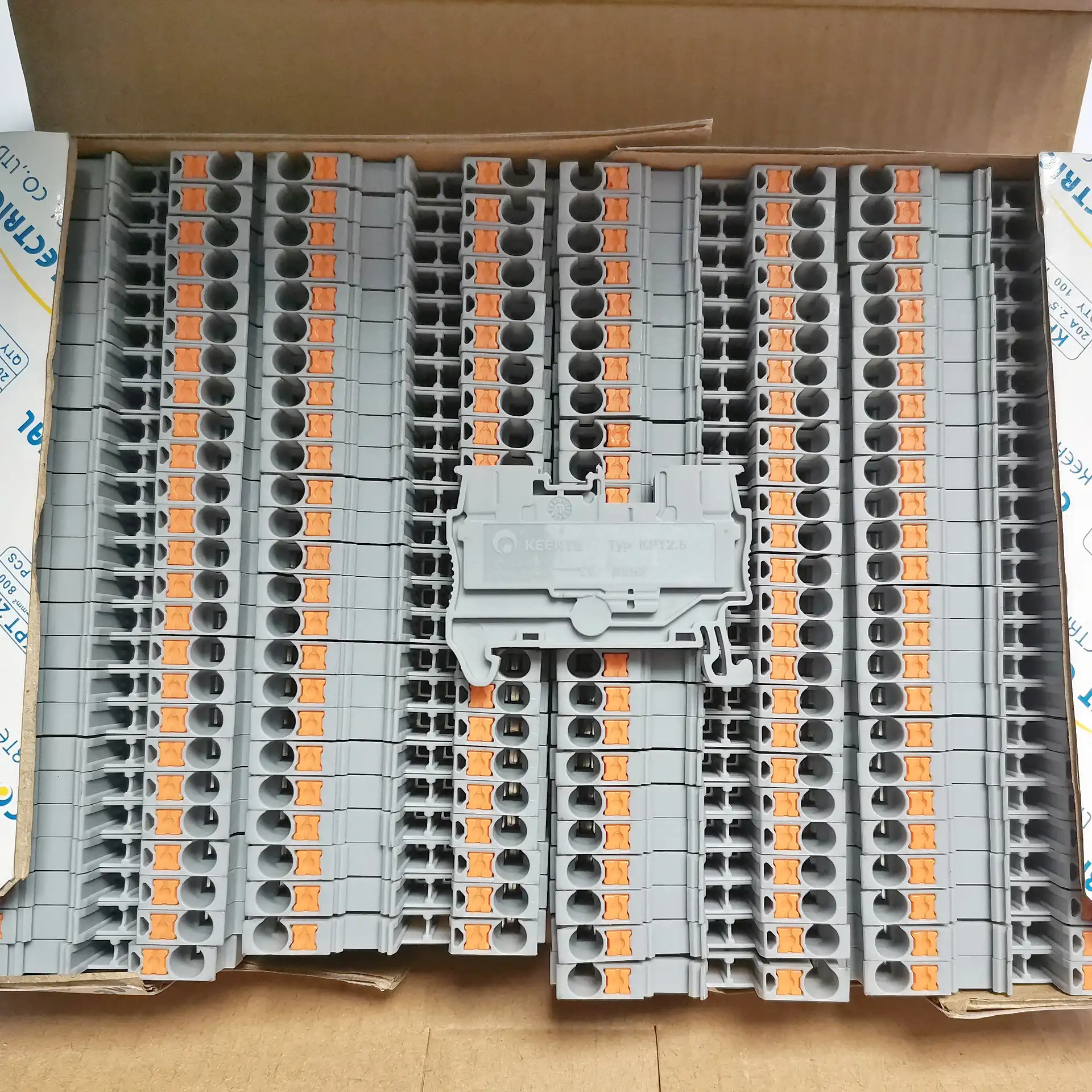
ISO 2859-1:2026 defines AQL-indexed sampling schemes for lot-by-lot inspection by attributes. “AQL 2.5, General II” is not a complete quality plan, does not promise that one lot contains 2.5% or fewer defects, and is not automatically suitable for every defect. Agree the lot definition, inspection level, sampling scheme, critical/major/minor classifications, AQL values where applicable, acceptance numbers, switching rules and characteristics that require another method or 100% control.
First-article release
Confirm drawing revision, BOM, tooling/cavity, key dimensions, installation fit, markings and planned process before authorizing the full lot.
Process confirmation
Review material and component lots, setup records, in-process checks, defects, rework and change status while correction is still possible.
Lot acceptance
Verify random samples, quantity, workmanship, measurements, agreed functional checks, labeling, packaging and shipment-document consistency.
Incoming confirmation
Check transport damage, lot identity, quantity and selected critical characteristics before releasing parts to assembly or distribution.
Require a release pack
- Purchase order and final drawing/specification revision.
- Approved deviation list and engineering-change status.
- Certificate or declaration records required for the exact model and market.
- Lot inspection report with sample identities, instruments, results, photos and nonconformities.
- Certificate of conformity when contractually required, packing list, carton marks and shipment details.
- Corrective-action and concession approval for any accepted departure—never an undocumented verbal waiver.
Final decision
Put the order on hold when evidence stops matching
The supplier cannot connect the exact model to a current database record, file, report or declaration.
The contract, invoice, bank beneficiary, factory and approval holder differ without a documented relationship.
The offer can change meaning later because the item, exclusions, Incoterm or responsibility boundary is incomplete.
The supplier offers a perfect sample but refuses random pilot-lot selection, an audit or independent pre-shipment inspection.
Every model is said to have the same voltage, material, contact resistance, torque, lifetime or certification without part-level data.
A new beneficiary, subcontractor, factory, material or tooling location appears after approval and bypasses formal change control.
Seven pass gates before a repeat order
This guide is a procurement and quality-control framework, not legal, customs or certification advice. Use qualified professionals for the destination market, product and contract.
Send the application and control file, not only a photo
SENTOP can review terminal-block families, model matching, conductor and mounting requirements, accessories, marking, packaging, sample needs, order mix and destination documentation. Exact ratings, approvals, MOQ and lead time remain model- and order-specific.
Shortlist the correct terminal family
Terminal Block Manufacturer
Start with connection method, mounting, circuit function, conductor and target approval.
Review the range → Model shortlistSENTOP Product Catalogue
Prepare reference models and product families before sending a controlled RFQ.
Open the catalogue → Buyer supportService and Quality Process
Review factory-visit, selection, documentation and order-support routes.
Review support → Order releaseProduction and Delivery Checks
See production, inspection, packaging and shipment-preparation information.
Review delivery checks →Use the next guide for selection, cost and customization
Factory-direct terminal block sourcing FAQ
Can a small business buy terminal blocks directly from a China factory?
Yes, if the supplier accepts the required quantity and service level. Ask for a sample quantity, trial MOQ, standard MOQ, carton multiple and mixed-SKU policy. A higher trial-unit price can be reasonable when it limits qualification risk; there is no universal minimum quantity.
How can I tell whether a supplier is a real factory or a trading company?
Verify the Chinese legal name and Unified Social Credit Code, map the manufacturing and outsourced processes, trace a current production lot, and reconcile the factory, contract, invoice, bank beneficiary and certification holder. A trading or export affiliate can be legitimate when its relationship and responsibilities are transparent.
Which certifications should a terminal block factory have?
There is no universal list. Define the destination market, exact terminal function and end-equipment requirements first. Then verify the applicable product-standard evidence, model-level approval scope, EU declarations or substance compliance, and management-system certification separately.
Are samples enough to approve a new terminal block supplier?
No. Samples confirm only the pieces examined. Approval should also cover the controlled drawing and BOM, manufacturing process, compliance evidence, pilot-lot repeatability, change control, commercial terms, production-lot inspection and incoming verification.
Should I use FCA, FOB, CIF or DDP when importing from China?
Choose the rule according to transport mode, desired freight control, customs capability and risk point. FCA is often practical for containerized and multimodal shipments; FOB and CIF are limited to sea or inland-waterway transport; DDP requires the seller to handle import formalities. Always add the precise named place or port and “Incoterms® 2020.”
What payment terms are safest for a first factory-direct order?
No fixed split is universally safest. Use a verified beneficiary and staged releases tied to objective milestones such as drawing approval, tooling acceptance, pilot-lot approval and pre-shipment release. Consider an appropriate letter of credit, platform protection or escrow structure when the transaction and counterpart risk justify it.
Verification tools and authoritative sources
- State Administration for Market Regulation (SAMR) and the linked National Enterprise Credit Information Publicity System.
- UL Solutions Product iQ® certification database overview.
- OSHA—Nationally Recognized Testing Laboratory program FAQ.
- UL Solutions—Component Recognition and Classification.
- IEC 60947-7-1:2025—terminal blocks for copper conductors.
- IEC 60947-7-2—protective conductor terminal blocks for copper conductors.
- Directive 2014/35/EU—Low Voltage Directive.
- European Commission—Restriction of Hazardous Substances (RoHS).
- IAF CertSearch—accredited management-system certificate verification.
- International Chamber of Commerce—incorporating Incoterms® 2020 rules.
- ISO 2859-1:2026—AQL-indexed sampling schemes for lot-by-lot inspection by attributes.
- NIST—X-ray methods for elemental and chemical analysis.
- UL Solutions—how to read a UL Yellow Card for a plastic material.
- United States International Trade Commission—current Harmonized Tariff Schedule.
Standards, certification records, tariff measures and regulations change. Confirm the current edition, status and jurisdiction for the order before relying on any requirement.