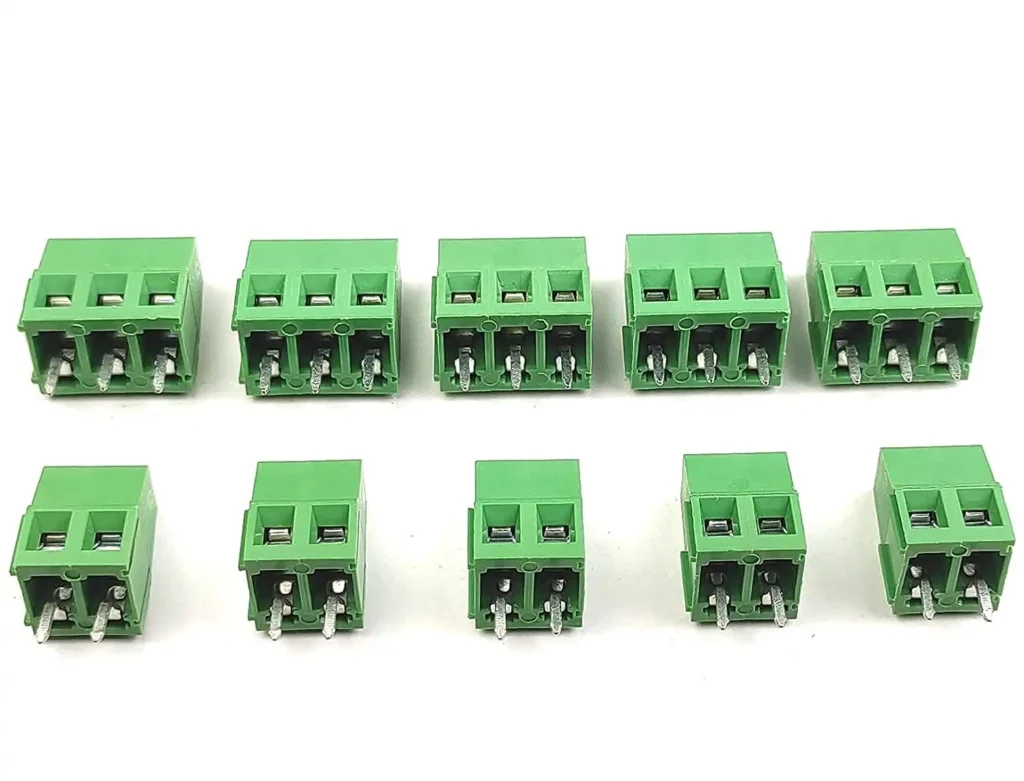
Over 60% of all PCB terminal block orders placed through major distributors like Digi-Key and Mouser involve either 2-pin or 3-pin configurations — and for good reason. A PCB mount terminal block in 2-pin or 3-pin format delivers the simplest, most cost-effective way to create detachable wire-to-board connections for power input, signal routing, and sensor hookups across industrial, consumer, and IoT applications. This guide breaks down the exact specifications, connection types, safety ratings, and real pricing data you need to choose the right block for your next design or production run.
What Are PCB Mount Terminal Blocks and Why 2-Pin and 3-Pin Are Most Common
A PCB mount terminal block is a modular connector soldered directly onto a printed circuit board, creating a reliable, detachable interface between the board and external wiring. Instead of hardwiring conductors with solder joints—which makes field servicing a nightmare—terminal blocks let technicians connect and disconnect wires in seconds using a simple screwdriver or spring lever.
The anatomy is straightforward: a molded plastic housing (typically nylon or polyamide), one or more metal contact pins that solder into PCB through-holes, and a wire-clamping mechanism per pole. Current flows from the stripped wire through the clamp, into the brass or copper-alloy contact, and down into the PCB trace.
So why do PCB mount terminal block 2 pin and 3 pin variants outsell every other configuration? Simple math. The vast majority of board-to-wire connections involve just two or three conductors:
- 2-pin: Power input (V+ and GND), single sensor lines, LED driver outputs, relay coil connections
- 3-pin: Signal + power + ground, three-phase fan control, NTC thermistor circuits, RS-485 bus wiring (A, B, GND)
Applications span LED lighting drivers, HVAC control boards, industrial PLCs, smart home modules, and automotive ECUs. According to connector market data published by Bishop & Associates, terminal blocks with five or fewer poles account for over 60% of PCB-level connector shipments globally.
For designs needing four, six, or eight poles, most engineers simply interlock multiple 2-pin or 3-pin blocks rather than stocking a separate SKU—a flexibility advantage covered later in this guide.
Key Specifications for 2-Pin and 3-Pin PCB Terminal Blocks
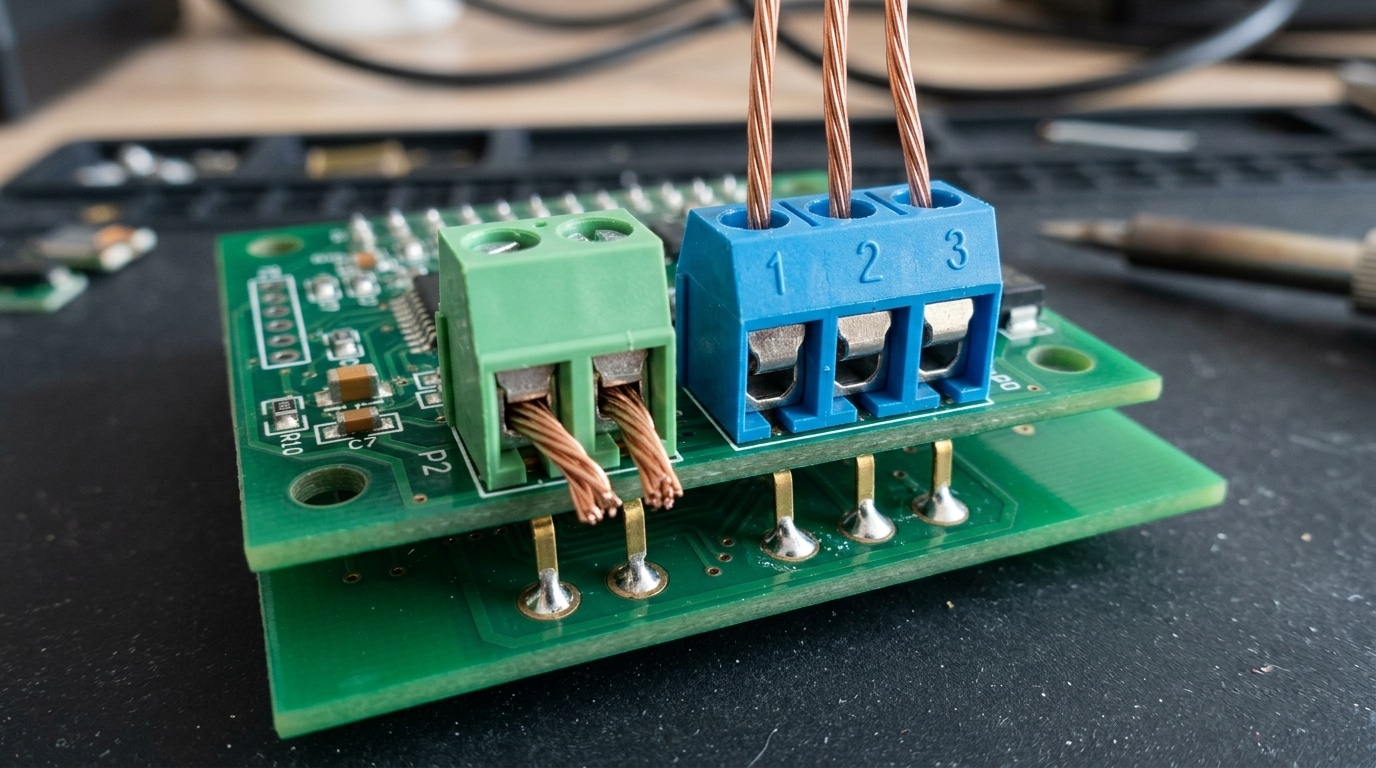
Choosing the wrong spec on a PCB mount terminal block — 2 pin or 3 pin — can mean a failed UL audit or, worse, a field failure. Five parameters matter most: current rating, voltage rating, pitch, wire gauge compatibility, and operating temperature range.
Current ratings for standard blocks range from 6A to 32A, driven largely by the contact material and cross-section. A 5.08mm-pitch block typically handles 10A–16A, while a 7.62mm-pitch variant can push 24A–32A. Voltage ratings span 150V to 600V, with most industrial-grade blocks rated at 300V or higher per IEC 60947-7-1.
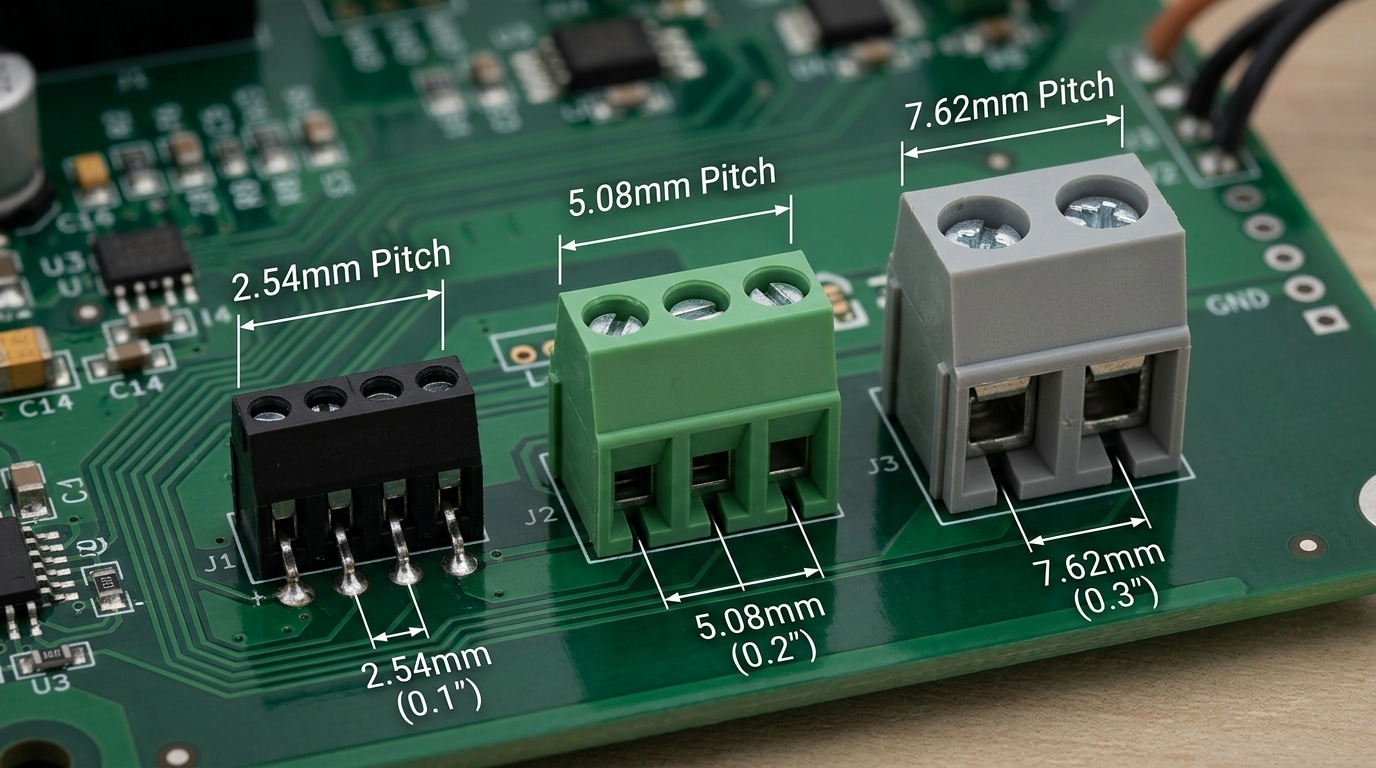
Pitch — the center-to-center distance between pins — dictates board density. Here’s a quick reference:
| Pitch (mm) | Typical Current | Typical Voltage | Wire Gauge (AWG) |
|---|---|---|---|
| 2.54 | 6A | 150V | 26–20 |
| 3.5 / 3.81 | 8A–10A | 300V | 24–16 |
| 5.0 / 5.08 | 10A–16A | 300V | 24–12 |
| 7.5 / 7.62 | 24A–32A | 600V | 18–6 |
Operating temperature ranges typically sit between −40°C and +105°C for PA66 (nylon) housings, though high-temp variants rated to +130°C exist from manufacturers like Phoenix Contact and Weidmüller. Always cross-check the datasheet — a block rated 16A at 25°C may derate to 10A at 85°C.
Screw Type vs Spring-Clamp vs Push-In PCB Terminal Blocks
Three connection mechanisms dominate the market, and each one changes how your PCB mount terminal block — 2 pin, 3 pin, or otherwise — performs under real-world stress. Picking the wrong type costs you field service hours, not just pennies on the BOM.
Screw-Clamp Terminals
The industry workhorse. A flathead or Phillips screw tightens a metal plate against the stripped wire, delivering gas-tight contact at 0.4–0.5 Nm torque. Screw types handle up to 300 re-insertion cycles and excel in power supply applications where connections stay put for years. The downside? They’re slow to wire — roughly 15–20 seconds per conductor — and screws can loosen under sustained vibration (IEC 60068-2-6 testing confirms this above 10 G).
Spring-Clamp Terminals
A stainless-steel spring grips the wire automatically, cutting insertion time to about 5 seconds. Vibration resistance is superior because spring force stays constant — no torque to check during maintenance. Weidmüller and Phoenix Contact both rate their spring-clamp designs for 5,000+ insertion cycles. Ideal for LED driver assemblies and industrial controls where technicians swap wiring frequently.
Push-In Terminals
Fastest of all: insert a ferrule-tipped wire and you’re done. No tools required. Push-in PCB terminal blocks suit high-volume production lines where labor cost per board matters. However, they typically accept a narrower wire gauge range (24–12 AWG) compared to screw types (20–8 AWG).
| Feature | Screw | Spring-Clamp | Push-In |
|---|---|---|---|
| Wiring Speed | ~15 sec | ~5 sec | ~2 sec |
| Vibration Resistance | Moderate | High | High |
| Re-insertion Cycles | ~300 | 5,000+ | 1,000+ |
| Best For | Power supplies | Industrial controls | High-volume assembly |
For most 2-pin and 3-pin PCB terminal block applications, spring-clamp offers the best balance of speed, reliability, and maintenance friendliness. Reserve screw types for high-current, set-and-forget installations.
Material Specifications and UL Safety Ratings to Look For
Housing material determines whether your terminal block survives harsh environments or becomes a fire hazard. The three dominant plastics are PA66 (Nylon 66), PA6, and PBT (polybutylene terephthalate). PA66 with 25% glass-fiber reinforcement is the industry standard — it handles continuous temperatures up to 105°C and resists most industrial solvents. PBT offers superior dimensional stability and slightly better arc resistance, making it preferable for high-voltage applications above 300V.
What about the metal contacts inside? Most PCB mount terminal block 2 pin 3 pin variants use brass (CuZn) conductors with tin plating for general-purpose use. Phosphor bronze contacts deliver better spring retention in push-in designs. For corrosive environments, look for nickel plating instead of tin — it resists oxidation at elevated temperatures far longer.
A flammability rating of UL94 V-0 is non-negotiable. This means the housing self-extinguishes within 10 seconds after flame removal with no burning drips. Anything rated V-1 or V-2 should be rejected for production boards.
Beyond UL recognition, verify these certifications before placing orders:
- UL/cUL — confirms electrical safety per North American standards (check listings on the UL Product iQ database)
- CE marking — required for European market compliance
- RoHS 3 (EU 2015/863) — restricts 10 hazardous substances including lead and cadmium
- REACH — covers SVHC (Substances of Very High Concern) reporting obligations
Reputable manufacturers like Phoenix Contact, Weidmüller, and Wago publish full material and compliance datasheets for every SKU. If a supplier can’t provide a UL file number on request, walk away.
How to Interlock 2-Pin and 3-Pin Blocks for Custom Pin Counts
Need a 7-pin configuration? Snap together a PCB mount terminal block 2 pin unit with a 3 pin unit — twice — and you’re done. Most major manufacturers like Phoenix Contact, Weidmüller, and Wago design their modular series with dovetail or tongue-and-groove interlocking features specifically for this purpose.
Pitch Consistency Is Non-Negotiable
Every block you interlock must share the exact same pitch — typically 2.54 mm, 3.5 mm, 3.81 mm, or 5.08 mm. Mixing a 3.5 mm block with a 3.81 mm block creates cumulative misalignment that won’t match your PCB footprint. Even a 0.31 mm per-pin discrepancy compounds across multiple positions, making soldering impossible by the fourth or fifth pin.
When to Go Modular vs. Pre-Assembled
- Choose modular interlocking when your product has multiple SKUs requiring different pin counts — you stock fewer unique parts and assemble per order.
- Choose pre-assembled multi-pin blocks (6-pin, 8-pin, 12-pin) for high-volume production where assembly labor costs outweigh component savings.
- Verify the interlock rating: some modular PCB mount terminal blocks are rated for only 10–15 mating cycles before the snap features degrade.
Pro tip: Always order interlocking blocks from the same product family and manufacturer. Cross-brand compatibility is rare and never guaranteed, even at identical pitch.
Pricing Guide and Bulk Ordering Considerations
A standard 2-pin screw-type terminal block at 5.08 mm pitch typically runs $0.08–$0.15 per unit in quantities above 1,000. The 3-pin equivalent lands between $0.12–$0.22. Spring-clamp and push-in variants cost 20–40% more due to the internal spring mechanism, and smaller pitches like 2.54 mm or 3.5 mm carry a slight premium over the common 5.0 mm and 5.08 mm sizes.
What drives the price beyond pin count and pitch? Two major factors: contact plating and certification. Tin-plated contacts are the baseline. Gold or nickel plating — common in high-reliability applications — can add $0.03–$0.08 per pin. UL, VDE, or CSA certifications also raise per-unit cost because manufacturers pass testing and compliance fees downstream.
Rule of thumb: ordering a PCB mount terminal block 2 pin 3 pin mix above 5,000 units typically unlocks a 10–15% volume discount. At 50,000+ units, expect 25–35% off list price from most manufacturers.
Major distributors like Digi-Key and Mouser maintain stock on popular Phoenix Contact, Weidmüller, and Wurth Elektronik SKUs with same-day shipping. MOQs on these platforms start at just 1 piece, but you’ll pay full retail. Going direct to manufacturers or through authorized regional distributors drops the cost significantly — though lead times stretch to 4–8 weeks for custom orders or non-stock configurations.
Budget tip: standardize on one pitch and connection type across your BOM. Mixing 3.5 mm spring-clamp blocks with 5.08 mm screw terminals fragments your purchasing power and kills volume discount potential.
Top Manufacturers and Where to Source PCB Terminal Blocks
Phoenix Contact and Weidmüller dominate the premium tier — expect UL/cUL listings, robust datasheets, and 10,000+ cycle durability on their 2-pin and 3-pin variants. For cost-sensitive production runs, Degson and Dinkle deliver pin-compatible alternatives at 30–50% lower cost while still carrying relevant safety certifications. TE Connectivity and Würth Elektronik fill the middle ground with strong global distribution networks.
Where you buy matters as much as what you buy. Authorized distributors like Mouser, Digi-Key, and RS Components guarantee authentic stock, full traceability, and datasheets for every PCB mount terminal block — 2 pin, 3 pin, or otherwise. They also offer free samples on most SKUs, which is invaluable for prototyping.
Sourcing OEM bulk orders? Alibaba and Made-in-China connect you directly with factories, but verify authenticity ruthlessly. Request UL file numbers and cross-check them on UL Product iQ. Ask for IATF 16949 or ISO 9001 certificates before committing to any order above 10K units. Counterfeit terminal blocks with substandard PA66 housing are rampant on unvetted platforms — one failed incoming inspection can delay your entire production line by weeks.
Quick tip: Order samples from at least two manufacturers before locking in a supplier. Test solder reflow performance and wire retention force side by side — spec sheets don’t always tell the full story.
Frequently Asked Questions About 2-Pin and 3-Pin PCB Terminal Blocks
What pitch size should I choose for my PCB layout?
Match pitch to your current rating and board density. A 3.5 mm pitch works well for signal-level circuits up to 10 A, while 5.08 mm pitch handles up to 15–20 A and accommodates thicker wire gauges. If board real estate is tight, go with 2.54 mm — but expect lower current limits around 6 A.
Can I mix 2-pin and 3-pin blocks on the same board?
Absolutely — as long as they share the same pitch and series. Most interlocking PCB mount terminal block 2 pin 3 pin designs from Phoenix Contact, Wago, or Degson snap together seamlessly, letting you build custom pin counts like 5, 7, or 11.
What is the maximum wire gauge for a 5.08 mm terminal block?
Typically 12 AWG (2.5 mm²), though some heavy-duty models accept 10 AWG. Always confirm the wire entry aperture in the manufacturer datasheet — not all 5.08 mm blocks are created equal.
Are spring-clamp blocks more reliable than screw types?
In high-vibration environments, yes. Spring-clamp connections maintain consistent contact force without loosening over time. Screw types still dominate where field serviceability matters, since technicians can retorque connections during maintenance.
How do I verify UL listing for a terminal block?
Search the component’s UL file number (e.g., E-number) on UL’s Product iQ database. Cross-check the specific voltage and current ratings listed — a UL 1059 certification covers industrial terminal blocks, while UL 94 V-0 confirms the housing flammability rating.
See also
What You Should Know About the Width of DC Circuit Breakers
ATS vs Interlock Kit: Choosing the Right Backup Power Solution
A Complete Guide to Common Specifications of Terminal Blocks
Top 8 Terminal Block Manufacturers for Reliable Connections

Discover more from SENTOP Electrical Co., Ltd
Subscribe to get the latest posts sent to your email.