

Choosing the right molded case circuit breaker and air circuit breaker is important for safety and how well things work. Many U.S. data centers still use old breakers. This makes failures and dangers more likely as we use more electricity. New circuit breakers have better features like arc flash protection, ground fault detection, and real-time checks. These features help meet new safety rules and let people fix problems before they get worse. Picking the right breaker helps things work well and keeps people safer in important places.
Key Takeaways
- MCCBs are small breakers. They work well for low or medium power. They fit in small spaces. ACBs handle more power. They are used in big systems. ACBs need more space.
- Both MCCBs and ACBs stop overloads and short circuits. They use different designs. They have different trip systems. Each is made for its own job.
- MCCBs cost less money. They are easier to take care of. This makes them good for small factories. They are also good for offices and green energy setups.
- ACBs have extra features. They can be watched from far away. They are easy to fix. But they need more care. They also need skilled people to install them.
- Pick the right breaker for your needs. Think about power, space, and how much you can adjust. Also think about how complex your system is. Always check the maker’s guide for the best choice.
Key Differences
Overview
Molded case circuit breaker and air circuit breaker are important for electrical safety. Both stop circuits from getting too much power or shorting out. They are not the same in how they are built, how much power they handle, or where they are used. MCCBs are good when there is not much space and the power needed is not too high. ACBs work with bigger amounts of power and are used in large places like factories. Knowing these things helps people pick the right one for their job.
Main Features
MCCBs and ACBs have special features for different places. MCCBs are small and can handle many power levels. They work with currents from 15 amps to 2,500 amps. Their voltage can be from 240 Vac up to 1,200 Vac, and some go to 1,500 V. MCCBs are fast and tough, so they work well in hard places like mines or on ships.
ACBs are made for bigger jobs and more power. They protect main power panels in big buildings and factories. ACBs can stop very big power surges and are simple to fix because of their open design.
Note: The table below shows common MCCB types, their power ratings, and where they are used.
| MCCB Type | Amperage Rating (A) | Voltage Rating (Vac/Vdc) | Typical Applications / Features |
|---|---|---|---|
| Series G | 15 – 2500 | 240 Vac to 690 Vac, 125/250 Vdc | High-speed, compact footprint |
| PV Gard / Solar | 30 – 600 | 600 Vdc – 1000 Vdc | Solar PV, EV charging, battery storage, UPS |
| E2 Mining | 3 – 2000 | 240 Vac to 1200 Vac, 250 Vdc | Rugged, mining, underground cable protection |
| Engine Generator | 15 – 1200 | 240/480/600 Vac | Portable power, lower interrupting currents |
| Navy & Marine | 5 – 800 | 1125/500 Vac, 125/250 Vdc | Vibration/fire/moisture resistant, marine specs |
MCCBs are used to protect big motors, HVAC, elevators, and green energy systems. They can stop power surges from 10 kA to 150 kA. This makes them good for many jobs in stores and factories. ACBs are better for main power boards and places that need easy repairs and lots of power.
Molded Case Circuit Breaker and Air Circuit Breaker
MCCB Basics
Molded-case-circuit-breaker-125-ampere-4P.webp)
A molded case circuit breaker and air circuit breaker help keep electrical systems safe. The molded case circuit breaker, called MCCB, stops circuits from getting too much power or shorting out. MCCBs have a hard case that keeps out dust and water. This makes them last longer in tough places.
NEMA AB3 and AB4 rules help people pick and use MCCBs. These rules talk about how fast the breaker works, how much power it can handle, and where it can be used. MCCBs use metal strips to stop overloads and magnets to stop big surges. The trip unit finds problems and opens the breaker. You can change the trip settings to fit what you need.
| Performance Metric / Component | Description |
|---|---|
| Interrupting Rating | Stops very high fault currents safely. |
| Adjustable Trip Settings | Lets you set when it trips. |
| Ampere Range | Works from 10 to 2,500 amps. |
| Arc Extinguishing System | Puts out arcs when breaking the circuit. |
| Accessories | Has extra parts like alarm and control contacts. |
MCCBs can be controlled and checked from far away. Extra contacts show if the breaker is open or closed. Alarm contacts tell you if there is a problem. Shunt and undervoltage releases give more safety and control.
ACB Basics
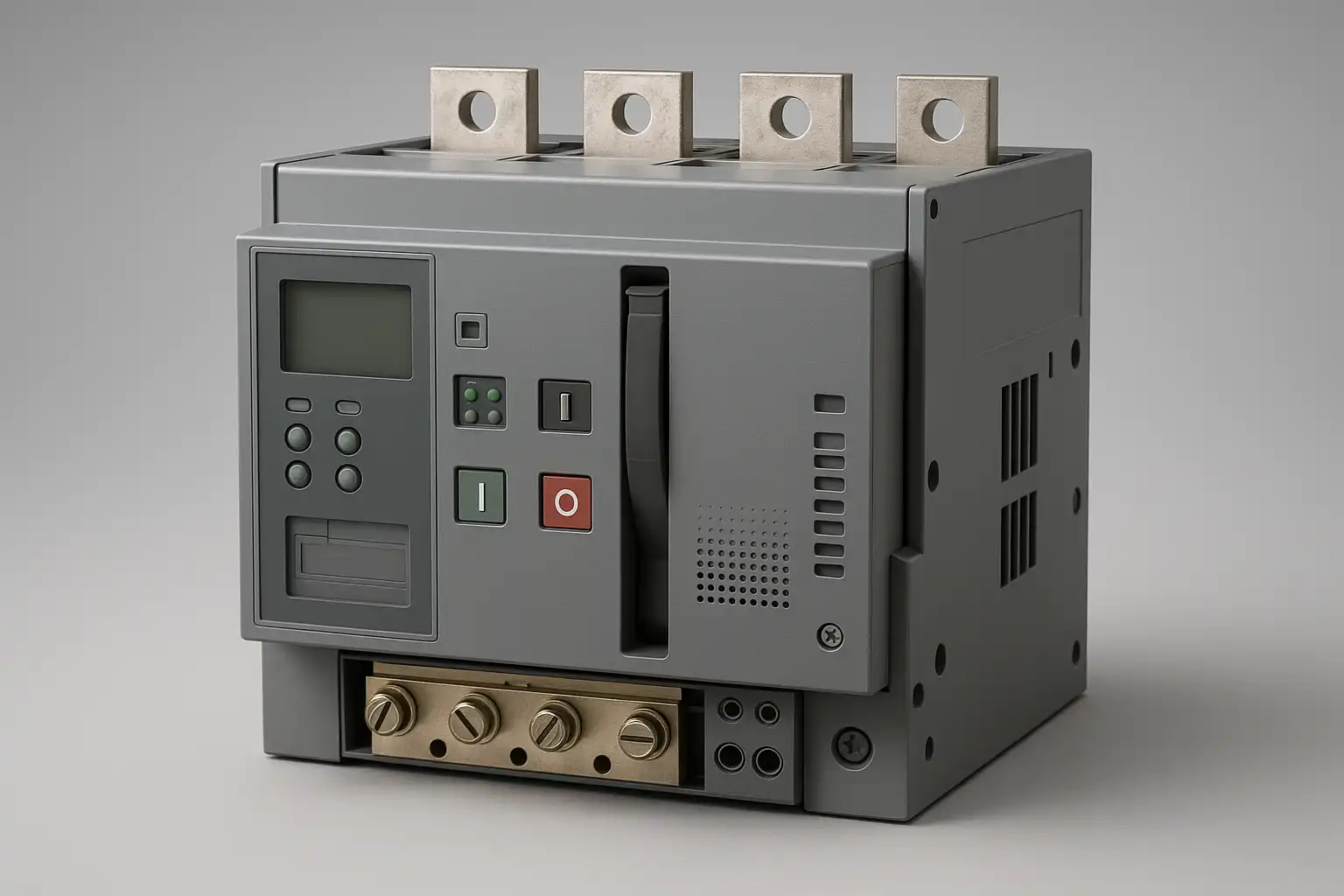
Air circuit breakers, or ACBs, protect big electrical systems in factories. They use air to stop big currents and put out arcs. People use ACBs for main power in large buildings.
Molded case circuit breaker and air circuit breaker are not the same. ACBs have open frames, so it is easy to check and fix them. Their arc system uses air and magnets to break the circuit safely. Rules make sure ACBs are safe and work well.
ACBs can handle more power than MCCBs. They let you change settings and can be controlled from far away. It is easy to find and fix problems with ACBs because of their design. These things make ACBs good for important power jobs.
Construction and Operation
MCCB Structure
Engineers make molded case circuit breakers strong and safe. The main part has a molded case. This case keeps out dust and water. It also stops people from touching inside parts. Inside, many parts work together:
| Component | Material/Type | Function/Role in MCCB Operation |
|---|---|---|
| Arc Chute | Ferromagnetic metal plates | Extinguishes arc by splitting and lengthening it |
| Contacts | Arc-resistant metallic | Conduct current; includes fixed and moving contacts |
| Operating Mechanism | Mechanical linkage | Opens/closes contacts; triggered by trip unit |
| Terminal Connectors | Conductive connectors | Connect MCCB to external circuit (input/output terminals) |
| Thermal Trip Unit | Bimetallic strip | Bends on overload heat to trip breaker |
| Magnetic Trip Unit | Relay with solenoid | Trips breaker on short circuit via magnetic field |
| Handle / Trip-free Mechanism | Mechanical handle | Manual ON/OFF; trips breaker even if handle held ON |
| Trip Button | Mechanical button | Tests breaker operation by manually tripping |
NEMA rules make sure molded case circuit breakers are safe. They can work with up to 1,000 V AC and 1,200 V DC.
ACB Structure
Air circuit breakers have an open frame. This makes it easy to check and fix them. They have special arc chutes, strong contacts, and digital systems. New ACBs use microprocessors for better protection and control. The table below shows important features:
| Technological Aspect | Description |
|---|---|
| Digital Technologies | Microprocessor relays for better coordination and monitoring |
| Arc Quenching Mechanisms | Improved arc chutes and materials for faster arc extinction |
| Smart Technologies | Remote monitoring and predictive maintenance capabilities |
| Design Improvements | Compact, energy-efficient designs using advanced insulation |
Makers follow rules like IEC 60947-2 and UL 1066. These rules help keep ACBs safe and reliable.
How They Work
Molded case circuit breaker and air circuit breaker both stop overloads and short circuits. But they work in different ways. MCCBs use two trip units. The thermal unit bends a strip when it gets hot. The magnetic unit works fast when there is a big current. This helps protect low-voltage systems in places like factories.
ACBs work with higher voltages and currents. They use air to put out the arc. When there is a problem, the breaker opens its contacts. The arc chute cools and splits the arc fast. Modern ACBs have sensors and relays. These give real-time checks and remote control. ACBs are good for important places like data centers and power plants.
Tip: Smart technology in MCCBs and ACBs helps with maintenance. This lowers downtime and keeps things safer.
Applications
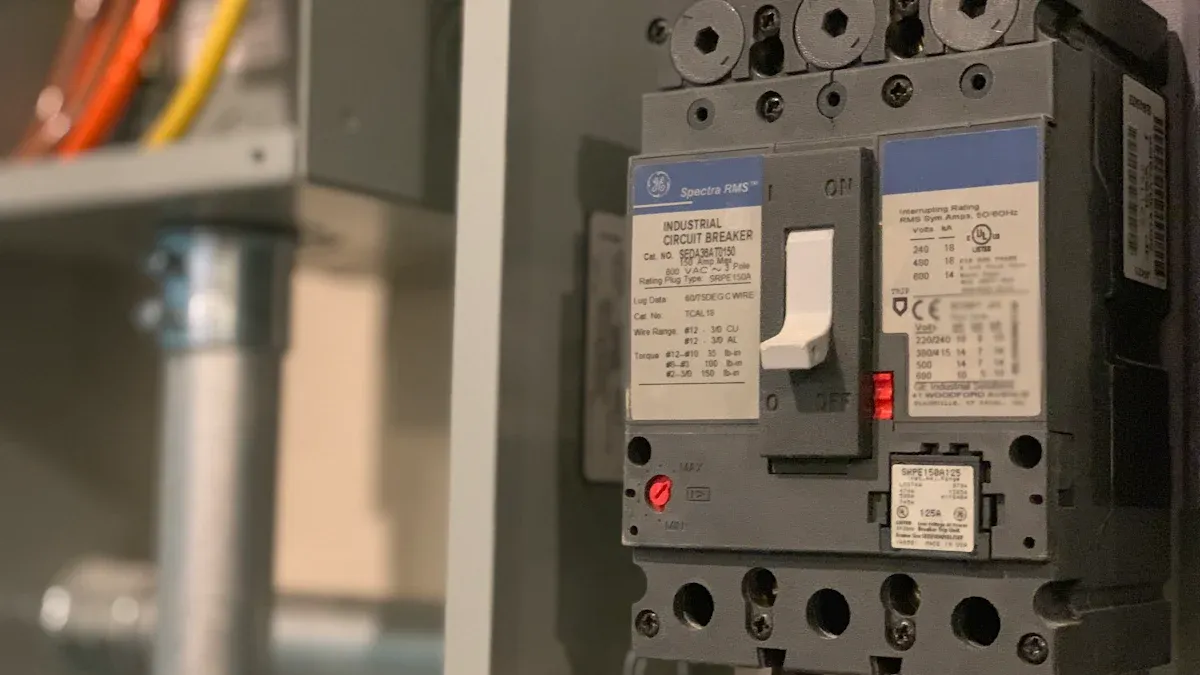
Typical Uses
Circuit breakers are very important in electrical systems. They keep people and equipment safe from electrical problems. Engineers put circuit breakers in many places. These include power plants, power lines, and places that use or make electricity. You can also find them in wind farms, solar fields, trains, data centers, homes, stores, factories, and power grids.
- Power plants use circuit breakers to control big currents and protect machines.
- Power lines and grids use breakers to stop problems and keep the system working.
- Wind and solar farms use breakers to handle changing power and protect equipment.
- Data centers and trains need good circuit breakers to keep running and avoid losing money.
- Homes and stores use low voltage breakers for daily safety.
There are different kinds of circuit breakers for different jobs. Low voltage breakers are for homes and offices. Medium voltage breakers protect factories and power systems. High voltage breakers work in power plants and on power lines. Some breakers are made for inside use. Others are built to handle bad weather outside in power and factory areas.
Note: Circuit breaker sales grow because cities are getting bigger, more factories are built, green energy is growing, and smart grids are used more. Asia Pacific buys the most because they build a lot of new things.
Industry Examples
Many businesses use special circuit breakers for their needs.
- Thermal magnetic industrial circuit breakers protect factory boards. They act fast for surges and long overloads.
- Medium voltage breakers, from 1 to 72 kV, are used outside and in big plants.
- High voltage breakers, over 72.5 kV, help send power and run big motors in heavy industries.
- SF6 gas-insulated breakers stop arcs well in high voltage places, especially where space is tight.
- Low voltage molded case circuit breakers (up to 2,500A) protect motors, HVAC, elevators, and green energy systems in stores and factories.
Companies like ABB and Siemens make special breakers for factories, buildings, and big projects. Eaton makes breakers for green energy and smart power grids. These examples show circuit breakers can be used in many ways to keep things safe and working well.
Comparison
Ratings
Molded case circuit breakers and air circuit breakers have different ratings. MCCBs work best in low voltage systems. Their voltage ratings are 240VAC, 480VAC, and 600VAC. Some MCCBs can handle medium voltages like 2.3kVAC, 4.16kVAC, and 6.9kVAC. MCCBs support currents from 10 amps to 1,600 amps. Most MCCBs can handle small voltage changes, like plus or minus 10% for a 480VAC model. The interrupting capacity of an MCCB must be as high as the system’s fault current to keep things safe.
ACBs are made for higher currents and voltages. They protect main power panels in big buildings and factories. ACBs can handle currents from 400 amps to 6,300 amps. Their voltage ratings are usually higher than MCCBs. ACBs give better protection for complex power systems.
| Breaker Type | Rated Current Range (A) | Voltage Ratings (VAC) | Notes |
|---|---|---|---|
| MCCB | 10 to 800 (up to 1600) | Low voltage: 240, 480, 600 Medium voltage: 2.3k, 4.16k, 6.9k |
Small size, simple features, used for lower currents |
| ACB | 400 to 6300 | Usually higher voltage (medium/high voltage) | Bigger size, higher current, advanced features, used in bigger systems |
MCCBs are good for low and medium voltage systems with normal current needs. ACBs are better for high current, high voltage, and important power systems.
Size
MCCBs are small and easy to fit in tight spaces. Makers design them for crowded panels and small boxes. Their small size is great for places like stores, offices, and small factories. You can put MCCBs next to each other in boards.
ACBs are much bigger. Their open frame makes them easy to check and fix, but they need more space. ACBs are found in main switchboards, big factories, and large buildings. Their size helps them handle more current and extra features.
- MCCB: Small, fits in small spaces, easy to install in panels.
- ACB: Big, needs more space, best for main power boards.
Cost
MCCBs cost less than ACBs. Their simple build and small size make them cheaper to make and install. MCCBs are a good choice for basic protection in low and medium voltage systems.
ACBs cost more because they are bigger and have more features. They can handle more current and have better settings, remote checks, and easier repairs. ACBs cost more, but they are worth it for important and high-power jobs.
Tip: If you have a small budget and need basic protection, MCCBs are a smart pick. For big or very important systems, ACBs are worth the higher price because of their extra features.
Maintenance
MCCBs are easy to take care of. Workers check them sometimes, tighten connections, and move the breaker to make sure it works. They use special cameras to look for hot spots and test the insulation to make sure the case is safe. They also test contacts to find loose or worn parts. Most of the time, you do not need to open the MCCB to do these checks.
ACBs need more care and more often. Their air and gas parts need regular checks and fixing. Workers must look at and change old parts, clean arc chutes, and test digital systems. Taking care of ACBs takes more work and time.
| Maintenance Task | MCCB | ACB |
|---|---|---|
| Inspection | Simple, just looking | Detailed, checks inside parts |
| Connection Tightening | Needed, uses basic tools | Needed, more connections to check |
| Arc Chute Cleaning | Not needed often | Needed often |
| Mechanism Servicing | Very little needed | Often needed, includes air/gas parts |
| Digital System Testing | Sometimes, if it has digital parts | Often, for advanced systems |
MCCBs are quick and easy to maintain. ACBs need more care but work better in tough jobs.
Pros and Cons
MCCB Advantages
Molded case circuit breakers have many good points. Engineers like that they are small and can be used in many ways. MCCBs fit in small spaces and protect lots of equipment. They work well in many places, even tough factories. Tests show MCCBs trip at the right time and handle heat well. These tests use data to see how MCCBs act with different currents and heat. Because of this, people can trust MCCBs to act fast and safe when there is too much power or a problem.
A science study shows MCCBs keep things safe in tricky low-voltage systems. Even when things get hard, like when power is low, MCCBs still meet safety rules. This makes them a good pick for many businesses and factories.
MCCB Disadvantages
MCCBs have some problems people should know about.
- MCCBs cannot be adjusted as much as some other breakers. This can make it hard to get just the right protection.
- Old MCCBs might trip when they should not or not work well with other breakers, especially if they do not have electronic trips.
- MCCBs usually cost more than small breakers and fuses.
- Dust and rust can make MCCBs not work right.
- MCCBs cannot be used for high voltage jobs, so they do not work everywhere.
ACB Advantages
Air circuit breakers are great for big and important power systems. They can handle more power and higher voltages than MCCBs. Their open design makes it easy to check and fix them. ACBs often have smart features like digital relays and remote checks. These help workers find problems early and fix them before things get worse. ACBs can be set up in more ways, so they protect better in tricky systems. They are built strong, so they last a long time in hard places.
ACB Disadvantages
ACBs also have some bad points.
- They need more room because they are bigger.
- They cost more to buy than MCCBs.
- It takes more time and work to keep ACBs working, since there are more parts to check.
- ACBs are not good for small places or where there is not much space.
- They are harder to put in and use if someone does not have much experience.
Choosing the Right Breaker
Selection Factors
Picking the right circuit breaker depends on a few things. Engineers check how much electricity the system needs. MCCBs are good for low or medium currents. ACBs are better for high currents and voltages. Space is important too. MCCBs fit in small panels, so they are great for tight spots. ACBs are bigger and need more room because of their open frame.
How much you can adjust the breaker also matters. MCCBs let you change basic trip settings. This works for normal protection. ACBs have more advanced settings. They can be set with digital tools and checked from far away. This helps in systems that need careful control.
Makers give special tables to help pick the right breaker. These tables use real numbers like let-through current and time curves. They help people see how breakers work together. Rules like NEC and NFPA 99 say these tables are good guides. Using these tables helps engineers choose the best breaker for safety and performance.
Tip: Always look at the maker’s tables before you choose. This makes sure the breaker will work well with other parts in the system.
Application Scenarios
Different jobs need different breakers. MCCBs protect things in offices, stores, and small factories. They are small and easy to take care of, so people like them for these places. ACBs are used in big factories, data centers, and main power boards. They can handle more power and have smart features for important jobs.
- Real-time data shows when a breaker needs fixing or changing.
- Performance numbers tell how long a breaker lasts and how repairs help.
- Studies show ACBs work better than MCCBs where there are lots of big power surges.
| Scenario | Recommended Breaker | Reason |
|---|---|---|
| Small commercial panel | MCCB | Small size, easy to put in |
| Main switchboard in factory | ACB | Handles more power, better protection |
| Renewable energy system | MCCB | Works with changing loads |
| Data center main distribution | ACB | Can be checked from far away, reliable |
Both MCCBs and ACBs stop overloads and short circuits. The best one depends on how big and complex the system is and how safe it needs to be.
Picking the right circuit breaker keeps things safe and working well. MCCBs can be adjusted and work for low or medium voltage. ACBs can handle more power in big systems but need more care. The table below shows how different breakers are not the same:
| Circuit Breaker Type | Voltage Range | Arc Quenching Medium | Key Advantages | Key Disadvantages |
|---|---|---|---|---|
| MCCB | Low to Medium | Air | Adjustable, higher current | Larger than MCB |
| ACB | Low to Medium | Air | High capacity, customizable | More maintenance needed |
| VCB | Medium | Vacuum | Long lifespan, compact | Higher initial cost |
| OCB | Medium-High | Oil | Good for high voltages | Environmental, maintenance issues |
| SF6 | High | SF6 gas | Compact, durable | Environmental concerns |
Always pick a breaker that fits what your system needs. If your project is tricky, ask an expert to help you choose the best one.
FAQ
What is the main difference between MCCB and ACB?
MCCBs are used for low or medium voltage circuits. They fit into small spaces easily. ACBs work with higher currents and voltages. They are used in big systems. MCCBs are good for small panels. ACBs are best for main switchboards in factories or big buildings.
Can MCCBs and ACBs both protect against short circuits?
Yes, both types can stop short circuits and overloads. They use different ways to trip and break the circuit. Each one stops dangerous currents to keep people and equipment safe.
How often should maintenance occur for MCCBs and ACBs?
Experts say to check MCCBs once every year. ACBs need checks more often, about every six months. Doing regular checks helps the breakers last longer and work well.
Are MCCBs or ACBs better for renewable energy systems?
MCCBs are often used in solar and wind systems. They can handle changing loads and fit in small panels. ACBs are used in bigger renewable plants. They are good when higher currents or special features are needed.
Do MCCBs or ACBs require special installation skills?
Electricians with normal training can put in MCCBs. ACBs are bigger and have more features. They need more skill to install. Always follow the maker’s rules and safety steps when installing.
The following information may be of interest to you
Choose the appropriate ACB that suits your needs
What Situations Call for the Use of a Molded Case Circuit Breaker
What You Need to Know About How Molded Case Circuit Breakers Work