
Over 70% of project delays in international electrical installations trace back to one root cause: specifying a breaker built to the wrong standard. The differences between IEC vs ANSI circuit breaker standards go far beyond geography — they affect voltage ratings, short-circuit testing methods, trip curve designations, physical dimensions, and certification pathways. This guide breaks down the five most critical distinctions so you can spec the right breaker the first time, whether your project sits in Houston, Hamburg, or Ho Chi Minh City.
IEC vs ANSI Circuit Breaker Standards at a Glance
Two families of standards dominate circuit breaker design worldwide—and they are not interchangeable. IEC 60947 (low-voltage) and the IEC 62271 series (medium/high-voltage), published by the International Electrotechnical Commission in Geneva, govern most markets outside North America. ANSI C37 and UL 489, maintained through the American National Standards Institute and Underwriters Laboratories, set the rules for the U.S. and Canada.
Why does the split between IEC vs ANSI circuit breaker standards matter? Voltage ratings, short-circuit test methods, trip-curve designations, and even physical dimensions differ enough that specifying the wrong standard can delay a project by weeks or trigger costly panel redesigns. Engineers, specifiers, and procurement teams need to know which framework applies to their installation jurisdiction before issuing a single purchase order.
Quick rule of thumb: if the project feeds from a 480 V, 60 Hz North American utility, start with ANSI/UL 489. For 400 V, 50 Hz systems—or any export project—default to IEC 60947-2.
The five differences covered in this guide—voltage philosophy, short-circuit ratings, trip curves, form factor, and certification pathways—account for roughly 90% of the specification conflicts engineers encounter when comparing IEC vs ANSI circuit breaker standards.
Origins, Governance, and Geographic Reach of Each Standard
The IEC was founded in 1906 in London, making it one of the oldest international standards organizations. Its circuit breaker requirements live primarily in IEC 60947 (low-voltage) and IEC 62271 (high-voltage), adopted by over 170 countries across Europe, Asia, the Middle East, and Latin America.
ANSI’s roots trace to 1918 in the United States. It doesn’t write standards itself—it accredits developers. For circuit breakers, the real technical work falls to IEEE C37 series (performance and testing) and UL 489 (safety listing for molded-case breakers). Understanding how IEEE and UL nest inside the ANSI ecosystem is critical when comparing IEC vs ANSI circuit breaker standards.
Geographic reach tells a clear story: IEC dominates global infrastructure projects, while ANSI-based standards govern North America almost exclusively. Many multinational manufacturers—ABB, Siemens, Eaton—produce dual-rated breakers to bridge both worlds, but the underlying test protocols remain distinct.

5 Key Differences Between IEC and ANSI Circuit Breakers
The debate around IEC vs ANSI circuit breaker standards usually boils down to five technical areas where the two frameworks diverge most sharply. These aren’t minor footnotes—each difference directly affects equipment selection, system coordination, and project cost.
Here’s a quick preview of what the next five sections will unpack in detail:
- Rated Voltage Philosophy — IEC uses a single rated operational voltage (Ue), while ANSI defines voltage in terms of maximum system voltage with specific slash ratings.
- Short-Circuit Current Ratings & Testing — Different test sequences, different peak-current assumptions, and different ways of expressing interrupting capacity.
- Trip Curves & Utilization Categories — IEC classifies breakers by trip curve type (B, C, D) and utilization category; ANSI leans on frame-based thermal-magnetic settings.
- Physical Form Factor & Mounting — DIN-rail dominance in IEC markets versus bolt-on and plug-in configurations under ANSI/UL enclosures.
- Marking, Labeling & Certification — CE marking with IEC test reports versus UL or CSA listing with ANSI/IEEE compliance.
Each distinction carries real engineering consequences. Mixing standards without understanding these gaps has caused failed inspections, warranty disputes, and—worst case—protection coordination failures during faults. The sections ahead give you the specifics you need to avoid exactly that.
Difference 1 — Rated Voltage and System Voltage Philosophy
IEC and ANSI take fundamentally different approaches to voltage ratings, and this single distinction causes more specification errors than any other gap between the two frameworks.
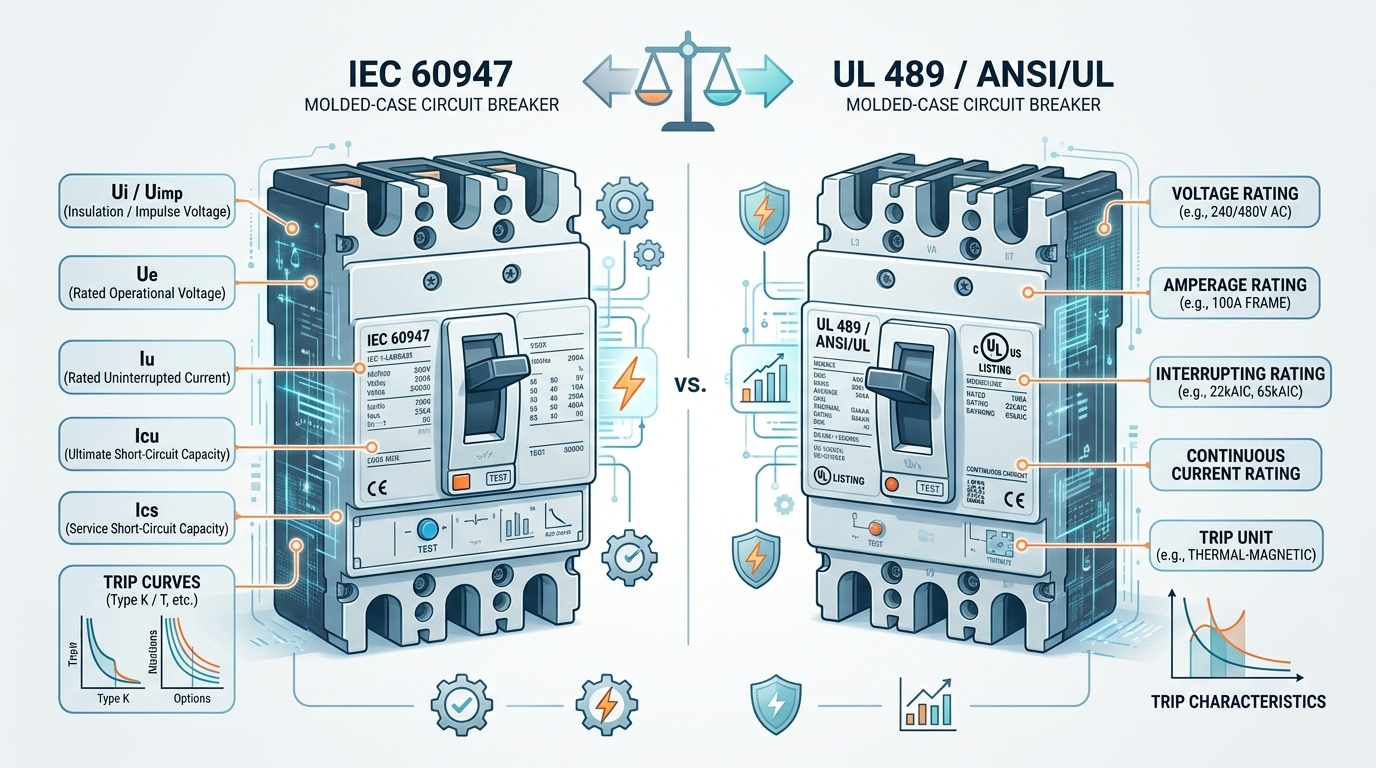
IEC 60947-2 defines two separate voltage parameters: rated operational voltage (Ue), the voltage at which the breaker performs its intended function, and rated insulation voltage (Ui), the upper limit for dielectric testing. A breaker might carry a Ui of 690 V but a Ue of only 400 V—meaning it’s insulated for 690 V yet rated to switch loads at 400 V. This layered approach gives engineers granular control when matching breakers to specific system conditions.
ANSI/UL 489 simplifies things. Each breaker gets a single maximum voltage rating—say, 480 V or 600 V. If your system voltage stays at or below that number, you’re covered. No Ue/Ui split, no secondary dielectric tier. Clean and straightforward, but less flexible for multi-voltage installations common in industrial plants.
Why does this matter when comparing IEC vs ANSI circuit breaker standards? A 690 V IEC breaker isn’t automatically equivalent to a 600 V ANSI breaker, even though 690 exceeds 600. The Ue might be rated lower than 600 V, making a direct swap non-compliant. Always verify both Ue and Ui against your actual system voltage before cross-referencing between standards.
Difference 2 — Short-Circuit Current Ratings and Testing Protocols
This is where IEC vs ANSI circuit breaker standards diverge most sharply. IEC 60947-2 defines two interrupting capacities: Icu (ultimate short-circuit breaking capacity) and Ics (service short-circuit breaking capacity). Icu represents the maximum fault current a breaker can interrupt—but the breaker may not be reusable afterward. Ics, expressed as a percentage of Icu (25%, 50%, 75%, or 100%), confirms the breaker still functions normally after clearing the fault.
ANSI/UL 489 collapses this into a single metric: AIC (ampere interrupting capacity). One number, one test. Pass or fail.
The test sequences differ significantly. IEC mandates an O–t–CO–t–CO sequence (open, pause, close-open, pause, close-open) at a specified power factor—typically 0.25 for breakers rated above 25 kA. ANSI tests use a higher power factor of 0.45–0.50, which actually produces a less severe asymmetrical peak current. Post-test, IEC requires dielectric withstand verification and a temperature-rise retest, while UL 489 checks primarily for insulation integrity.
Bottom line: an IEC-rated 50 kA breaker has survived a more punishing test protocol than an ANSI-rated 50 kA breaker—the numbers are not directly equivalent.
Difference 3 — Trip Curves, Overload Categories, and Utilization Classes
IEC 60947-2 classifies breakers into utilization categories A and B. Category A breakers offer no intentional short-circuit delay—they trip instantly. Category B breakers can withstand a rated short-time current (Icw) for a defined period, enabling selective coordination with downstream devices. This distinction is critical for cascade and zone-selective interlocking schemes.
Trip curve designations add another layer. IEC breakers carry B, C, or D curves, each defining the instantaneous magnetic trip threshold: B trips at 3–5× rated current, C at 5–10×, and D at 10–20×. Choosing the wrong curve undermines selective protection entirely.
ANSI/UL 489 takes a different path. Thermal-magnetic trip characteristics are specified by the manufacturer rather than standardized letter codes. When comparing IEC vs ANSI circuit breaker standards on trip behavior, the IEC system gives engineers a universal shorthand, while ANSI breakers require consulting individual time-current curves published in each manufacturer’s catalog.
For coordination studies, IEC’s structured categories simplify upstream-downstream selectivity calculations. ANSI designs demand more manual overlay analysis—workable, but slower.
Difference 4 — Physical Form Factor, Mounting, and Enclosure Requirements
Open any IEC-rated panel and you’ll see DIN-rail mounting everywhere. IEC breakers—especially molded-case types up to about 630 A—snap onto 35 mm DIN rails per EN 60715, keeping panel assembly fast and tool-light. ANSI breakers favor bolt-on or plug-in mounting into standardized cradles, which adds mechanical rigidity but demands more panel depth and labor during installation.
Frame sizes diverge too. ANSI breakers from manufacturers like Eaton and GE follow NEMA-defined frame widths (e.g., 100 A, 250 A, 600 A frames), while IEC frame sizing from Schneider Electric or ABB follows metric conventions that often yield more compact footprints—sometimes 20–30% narrower for equivalent ratings.
Enclosure protection ratings highlight another split in IEC vs ANSI circuit breaker standards. IEC uses the IP (Ingress Protection) system defined in IEC 60529, rating dust and water resistance on a two-digit scale like IP54. ANSI-world panels rely on NEMA enclosure types—NEMA 3R for outdoor rain protection, NEMA 4X for corrosion resistance. These systems don’t map one-to-one; a NEMA 4X enclosure exceeds IP66 in some tests but not others. Specifying the wrong rating can void warranties or fail inspection, so always verify equivalency tables before cross-referencing.
Difference 5 — Marking, Labeling, and Certification Pathways
Flip an IEC breaker over and you’ll find a nameplate referencing IEC 60947-2, the CE mark for European market access, and often a CB Scheme test certificate number. ANSI breakers carry UL Listed or CSA Certified marks, with ratings stamped per UL 489 or ANSI C37 series requirements. These aren’t cosmetic differences—they dictate whether your equipment clears customs and passes inspection.
The CB Scheme, administered by IECEE, lets a single test report gain acceptance across 50+ member countries. ANSI-side certification is more localized: a UL listing satisfies U.S. authorities of jurisdiction (AHJs), while CSA covers Canada. Exporting an ANSI-rated breaker into an IEC market typically requires retesting or a dual-certification arrangement, adding 8–16 weeks and $5,000–$20,000 per product family.
Nameplate data requirements also diverge. IEC mandates markings for rated operational voltage (Ue), rated impulse withstand voltage (Uimp), and utilization category. ANSI nameplates emphasize interrupting capacity in kAIC at specific system voltages. When evaluating IEC vs ANSI circuit breaker standards for a multinational project, verify that every label, test report, and declaration of conformity matches the destination country’s regulatory framework—missing a single marking can stall an entire shipment at port.
How to Choose Between IEC and ANSI Breakers for Your Project
Start with jurisdiction. If the project sits in the United States or Canada and must comply with the National Electrical Code (NEC/NFPA 70), ANSI-rated breakers are the default requirement. Projects governed by national wiring rules aligned with IEC 60364—common across Europe, the Middle East, and most of Asia—demand IEC-rated equipment instead.
But jurisdiction alone doesn’t settle every case. Ask these three questions before specifying:
- What does the Authority Having Jurisdiction (AHJ) accept? Some Middle Eastern municipalities accept both; others mandate IEC exclusively.
- Where is your supply chain strongest? Lead times for IEC breakers from Schneider Electric or ABB may be 4–6 weeks shorter in Europe than sourcing ANSI equivalents from Eaton or GE.
- Is the facility a multinational operation? Dual-listed breakers—tested to both IEC 60947-2 and UL 489—eliminate the guesswork. Manufacturers like Siemens and Schneider offer these, though they typically cost 15–25% more than single-standard units.
When evaluating IEC vs ANSI circuit breaker standards for cost, remember that the breaker price is only part of the equation. IEC panels often use smaller enclosures, reducing sheet-metal costs, while ANSI gear may lower engineering hours because NEC compliance paths are well-documented domestically.
Rule of thumb: choose the standard your local inspectors know best. A technically correct breaker that triggers inspection delays costs more than the “other” standard ever would.
Frequently Asked Questions About IEC and ANSI Circuit Breaker Standards
Can IEC-rated breakers be legally installed in the United States?
Yes—but only if they carry a UL or CSA listing. NEC Article 110.2 requires all equipment to be “approved,” which in practice means listed by a Nationally Recognized Testing Laboratory (NRTL). Many manufacturers like Schneider Electric and ABB offer dual-listed breakers tested to both IEC 60947-2 and UL 489, solving this problem at the product level.
Are ANSI-rated breakers accepted internationally?
Rarely without additional certification. Most countries outside North America require CE marking and IEC compliance. Exporting an ANSI-only breaker to the EU or Southeast Asia typically means retesting to IEC standards—a process that can add 8–16 weeks and $15,000+ in certification costs.
Can you directly convert ratings between the two standards?
No simple conversion factor exists. When comparing IEC vs ANSI circuit breaker standards, differences in test duty cycles, recovery voltage requirements, and ambient temperature assumptions make a 1:1 translation unreliable. Always consult the manufacturer’s cross-reference tables rather than applying a generic multiplier.
Is one standard safer than the other?
Neither is inherently safer. Both enforce rigorous dielectric, thermal, and short-circuit testing—just through different methodologies. Safety depends on correct application, proper installation, and matching the breaker to actual system conditions, not on which logo appears on the nameplate.
Choosing the Right Standard Starts with Knowing the Differences
Five differences separate IEC and ANSI circuit breaker standards: voltage philosophy, short-circuit testing protocols, trip curve classifications, physical form factor, and certification markings. Miss any one of them during specification, and you risk failed inspections, costly retrofits, or—worse—an unsafe installation.
Before you finalize a breaker spec, do two things. First, confirm which codes your local authority having jurisdiction (AHJ) enforces—NEC/NFPA 70, the Canadian Electrical Code, or an IEC-aligned national standard. Second, bring a qualified protection engineer into the conversation early, ideally before single-line diagrams are locked. A 15-minute review of Icu/Ics ratings against your actual fault-current study can prevent months of procurement headaches.
Quick rule of thumb: if your project crosses borders, default to dual-listed equipment or request a formal equivalency analysis referencing both IEC 60947-2 and UL 489.
Want a side-by-side reference you can hand to your procurement team? Download our IEC vs ANSI Circuit Breaker Comparison Checklist or contact a specialist to review your project requirements directly.
See also
A Practical Guide to Comparing IEC 60898-1 and IEC 60947-2 Standards
A Practical Guide to Translating NEC and IEC Electrical Terms
IEC and UL certification requirements for air circuit breakers
Miniature circuit breakers that keep homes and factories safe
Circuit Breaker Certification Requirements for UL, IEC, and CE