
Choosing the right Solar DC Miniature Circuit Breaker starts with knowing your system’s current and voltage. You must match these numbers to your equipment for safe use. The table below explains why each part is important:
| Parameter | Description | Importance in Solar DC MCB Sizing |
|---|---|---|
| Current Rating | Highest current the breaker can handle | Stops unwanted trips or missed problems |
| Breaking Capacity | Highest fault current the breaker can stop | Deals with short circuits safely |
| Voltage Rating | Highest voltage the breaker can stop | Matches solar panel voltage for safe use |
| Type of Protection | Type B or C, based on inrush current | Works with different loads in solar systems |
You keep your system safe by picking a breaker that fits these needs. Always use a safety factor and make sure the breaker meets rules like UL 489B or IEC 60947-2.
Key Takeaways
- Always make sure the Solar DC Miniature Circuit Breaker matches your solar system’s voltage and current. This helps keep your system safe and working well.
- Use a safety factor, which is usually 1.25 times the highest current. This helps the breaker handle sudden jumps in current and stops it from turning off by mistake.
- Pick a breaker with a breaking capacity that is higher than your system’s biggest fault current. This will help stop short circuits safely.
- Choose a DC-rated breaker that has clear polarity markings. Never use an AC breaker in a solar DC system. This can cause fires or damage.
- Check and take care of your breaker and system often. This keeps everything working right, stops problems, and helps your solar setup last longer.
What Is a Solar DC Miniature Circuit Breaker
Purpose in Solar Systems
A Solar DC Miniature Circuit Breaker helps keep your solar system safe. It stops electricity if the current gets too high. This helps stop fires and keeps your equipment from breaking. It also saves you money on repairs.
- DC Miniature Circuit Breakers stop too much current and short circuits. This keeps your solar panels and batteries safe.
- The National Renewable Energy Laboratory says good circuit protection helps your solar system last longer and make more energy.
- If you pick the wrong breaker, your system might lose up to 10% of its energy. That is why you need the right voltage and current ratings.
- Some Solar DC Miniature Circuit Breakers have automatic reset or remote monitoring. These features make your system safer and easier to take care of.
| Characteristic | Solar DC Miniature Circuit Breaker (MCB) | Fuses / AFCI / GFCI |
|---|---|---|
| Size | Small, less than 2 inches wide | Fuses are smaller; AFCI/GFCI are bigger |
| Current Rating | 10-63A | Can be many different amounts |
| Interrupt Rating | 6,000-10,000A | Fuses work fast but can only be used once |
| Reset Capability | Can be reset by hand or automatically | Fuses must be changed after use |
| Protection Type | Stops too much current | Fuses/AFCI/GFCI can do more things |
| Maintenance | Needs to be checked and serviced | Fuses are changed after a problem |
You can see that a Solar DC Miniature Circuit Breaker can be used again and fits most solar systems.
DC vs. AC Breakers
You may wonder why you cannot use a normal AC breaker in your solar system. DC and AC breakers are not the same because electricity moves differently in each one. AC breakers use the zero-crossing point to stop the flow easily. This makes them good for home wiring.
DC breakers, like the Solar DC Miniature Circuit Breaker, do not have a zero-crossing. The current goes in one direction and does not stop. This makes it harder to break the flow, so DC breakers need special parts. They use fast switches and strong contacts to stop the current safely.
- DC breakers can handle higher and steady currents without breaks.
- They work quickly but are a little slower than fuses because they have moving parts.
- You need a DC breaker for your solar system to make sure it can stop the current and keep your equipment safe.
Tip: Always pick a breaker made for DC systems. Using an AC breaker in a solar system can be very dangerous.
MCB Sizing Steps
Picking the right Solar DC Miniature Circuit Breaker keeps your solar system safe. It stops overloads and short circuits from hurting your equipment. You need to follow some easy steps to get the best breaker for your setup.
Check System Voltage and Current
First, measure the voltage and current in your solar system. Use a good meter to find the highest current your solar panels can make. This is called the maximum power point (MPP) current. Getting the right numbers helps you avoid problems later.
Modern tools, like power quality analyzers, give you exact readings. These tools check voltage and current at different spots in your system. They also help you find power quality issues, like harmonics or voltage drops. By checking these numbers, you make sure your Solar DC Miniature Circuit Breaker fits your system.
Tip: Always write down the highest voltage and current you see. This helps you pick a breaker that will not trip too soon or miss a problem.
Apply Safety Factor
After you know your system’s voltage and current, add a safety factor. This keeps your system safe during current spikes or hot days. Rules like NEC and IEC say to multiply your highest current by 1.25, or 125%. Some experts use 1.56 for extra safety, especially if your system gets hot or has many surges.
Here is the formula you should use:
Breaker Size (A) = Maximum Current (A) × Safety Factor
For example, if your solar string makes 28A, you multiply:
28A × 1.25 = 35A
So, you need a breaker rated for at least 35A. The safety factor stops the breaker from tripping too much and keeps your cables and equipment safe from heat.
Note: The breaker’s voltage rating must be as high as your system’s voltage. Never use a breaker with a lower voltage rating than your solar array.
Select Standard Breaker Size
Now, pick the closest standard breaker size above your number. Companies make standard sizes like 16A, 20A, 25A, 32A, 40A, and 63A. Always round up to the next size. For the 35A example, you would pick a 40A breaker.
Here is a table of common standard breaker sizes:
| Calculated Value (A) | Standard Breaker Size (A) |
|---|---|
| 12–16 | 16 |
| 17–20 | 20 |
| 21–25 | 25 |
| 26–32 | 32 |
| 33–40 | 40 |
| 41–50 | 50 |
| 51–63 | 63 |
You must also check that the breaker’s interrupting capacity is high enough for your system’s fault current. Some breakers let you change the trip setting for better protection. If your system is in a hot or dusty place, pick a breaker that can handle tough conditions.
Reminder: Always think about inrush currents and sudden surges. Solar systems can have quick spikes when turning on or when clouds move. A well-sized Solar DC Miniature Circuit Breaker will handle these without tripping for no reason.
By following these steps, you make sure your breaker fits your system’s voltage and current, has a safety margin, and matches standard sizes. This keeps your solar setup safe and working well.
Selection Criteria for Solar DC Miniature Circuit Breaker
KC3-H-4-pole-circuit-breaker.webp)
When you pick a Solar DC Miniature Circuit Breaker, you need to think about a few key things. These things help keep your solar system safe and working well. If you skip any step, your system could get damaged or even catch fire.
Voltage and Current Ratings
You must match the voltage and current ratings to your solar system. If you use a breaker with lower ratings, it might not work during a problem. Always check the highest voltage and current your solar panels can make. The breaker should handle these numbers without tripping too early or missing a fault.
- Make sure the breaker’s voltage rating is the same or higher than your system’s voltage.
- The current rating should be above your calculated value, including the safety factor.
- If your system has short wires in combiner boxes, the current rating can drop by about 25%. This is called derating. If you forget this, the breaker may not protect your system during a problem.
Tip: Always look at the manufacturer’s datasheet for the right voltage and current ratings.
Provide your needs and obtain customized DC solar miniature circuit breakers

Breaking Capacity
Breaking capacity means how much fault current the breaker can safely stop. If the breaking capacity is too low, the breaker might not open during a short circuit. This can damage your equipment or cause a fire.
- Pick a breaker with a breaking capacity higher than your system’s biggest fault current.
- Most solar systems use a breaking capacity from 6,000A to 20,000A.
- If your system is large, you might need a breaker with an even higher breaking capacity.
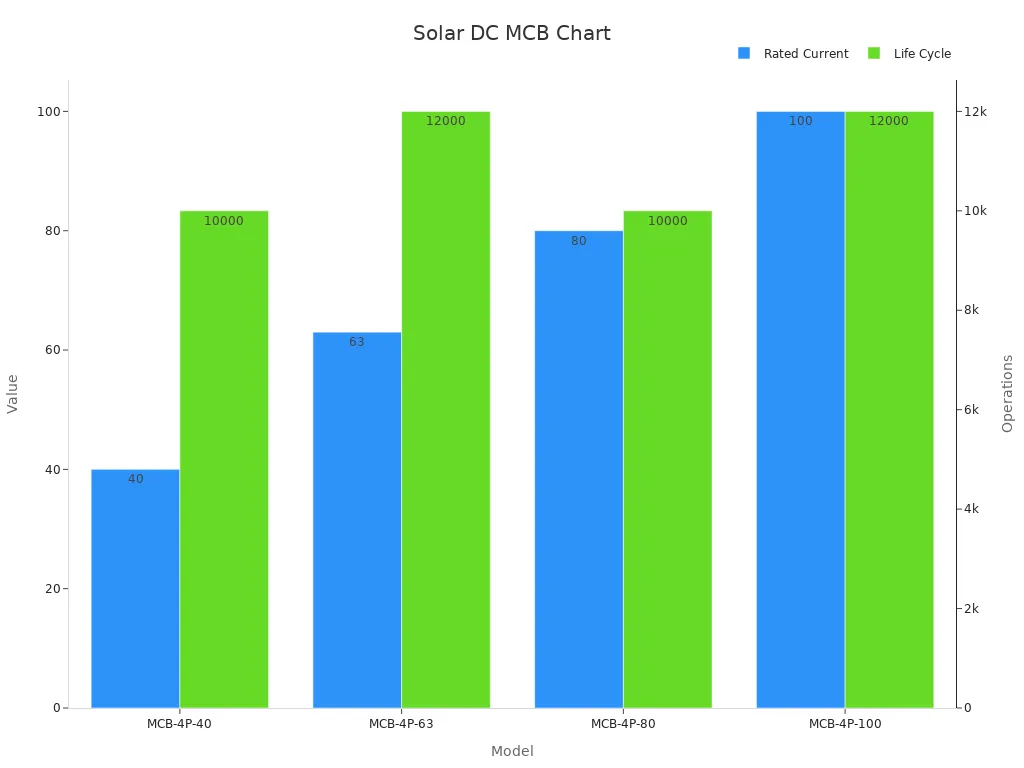
| Model | Rated Current (A) | Tripping Capacity | Standards Compliance |
|---|---|---|---|
| MCB-4P-40 | 40 | 6kA | IEC 60947-2 |
| MCB-4P-63 | 63 | 10kA | UL 489 |
| MCB-4P-80 | 80 | 15kA | IEC 61009-1 |
| MCB-4P-100 | 100 | 20kA | BS EN 61009-1 |
Trip Curve
The trip curve shows how fast the breaker reacts to different currents. You need to pick the right trip curve for your solar system.
- Type B breakers trip fast and are good for small loads.
- Type C breakers can handle bigger current spikes and are better for larger solar systems.
- If your system has devices that cause quick current jumps, pick a breaker with the right trip curve so it does not trip for no reason.
Note: The trip curve is usually on the breaker or in the datasheet.
Polarity and Markings
Solar DC Miniature Circuit Breakers need clear polarity markings. DC current only goes one way, so you must connect the positive and negative wires correctly.
- Look for “+” and “–” signs on the breaker.
- Only use breakers made for DC systems. AC breakers do not have the right markings and may not work safely in solar systems.
- Some breakers also show the highest voltage and current on the label. Always check these before you install the breaker.
Alert: Using an AC breaker in a DC system can be very dangerous.
Environmental Factors
Your breaker must work well where you put it. Temperature, dust, and humidity can change how the breaker works.
- Check the temperature range in the datasheet. Some breakers work from -25°C to +70°C.
- If you put the breaker outside or in a hot place, pick one that can handle high heat.
- Dust and water can cause trouble. Use enclosures or pick breakers with better protection if needed.
Compliance and Standards
You must use breakers that meet world safety standards. Certifications like IEC, UL, and CE mean the breaker passed tough tests.
- Look for standards like IEC 60947-2, UL 489, IEC 61009-1, or BS EN 61009-1.
- Certified breakers fail less and work better.
- Some good breakers can trip in just 10 milliseconds, which helps protect your equipment.
| Model | Temperature Range (°C) | Life Cycle (Operations) | Standards Compliance |
|---|---|---|---|
| MCB-4P-40 | -25 to +70 | 10,000 | IEC 60947-2 |
| MCB-4P-63 | -20 to +60 | 12,000 | UL 489 |
| MCB-4P-80 | -30 to +65 | 10,000 | IEC 61009-1 |
| MCB-4P-100 | -20 to +70 | 12,000 | BS EN 61009-1 |
Tip: Always ask your supplier for proof of certification. This helps you avoid bad or fake products.
Mistakes and Tips
Common Errors
You can stop many problems if you know what mistakes to avoid with Solar DC Miniature Circuit Breakers. Here are some things people often do wrong:
- Picking an MCB with the wrong voltage or current rating can make it trip too much or not trip at all.
- Using an AC breaker instead of a DC breaker is not safe because DC systems need special breakers for one-way current.
- Not using the safety factor when sizing means your breaker might not protect your system during current spikes.
- If you forget to check breaking capacity, the breaker might not stop a short circuit and your equipment could get hurt.
- Putting the breaker in backwards is bad because DC breakers have a positive and negative side that must be connected right.
- Not thinking about heat, dust, or water can make your breaker work poorly.
Tip: Always look at the markings and ratings on your breaker before you put it in. This easy check can save you from expensive problems.
Installation and Maintenance
Putting in your breaker the right way and checking it often keeps your solar system safe and working well. Always follow the maker’s instructions and local rules. Here are some good habits:
- Check your system at least once a year to find and fix small issues before they get worse.
- Clean off dust and dirt from your breaker and its box because dirt can make it overheat or cause bad connections.
- Look for loose wires or damage. Tighten wires and change broken parts right away.
- Write down all the times you fix or check your system. This helps you see how healthy your system is.
Doing these things gives you lots of good results:
- You have fewer problems that can lower your energy.
- Your solar panels work better and make more power.
- You stop big repairs and system shutdowns.
- You make sure your system is safe and keeps its warranty.
- You help your solar panels last longer.
Checking your system often and installing it right makes your solar setup safer, more dependable, and saves you money.
You can keep your solar system safe by doing a few easy things. Make sure the Solar DC Miniature Circuit Breaker matches your system’s voltage and current. Choose a breaker that can handle enough breaking capacity. Always check the polarity before you use it. Many real-life examples show the right breaker and testing your circuit first can stop fires and damage. Check your math again and use online tools or ask an expert if your setup is hard. Safety and following the rules help your system last longer.
FAQ
What happens if you use an AC breaker in a solar DC system?
You risk fire or equipment damage. AC breakers cannot safely stop DC current. Always use a DC-rated breaker for your solar system.
How often should you check your Solar DC MCB?
You should check your breaker at least once a year. Look for dust, loose wires, or signs of wear. Regular checks help you catch problems early.
Can you use a higher-rated MCB for extra safety?
No, using a much higher-rated breaker can leave your system unprotected. Always size your breaker based on your system’s current and voltage, including the safety factor.
What does the trip curve mean for your solar system?
The trip curve shows how fast the breaker reacts to high current. Pick the right curve for your system. Type B trips fast. Type C handles bigger spikes.
Do you need to turn off the solar system before installing an MCB
Yes! Always turn off all power before you install or replace a breaker. This keeps you safe from electric shock or injury.
The following information may be of interest to you
Understanding DC Miniature Circuit Breakers for Beginners
How to Choose a DC Circuit Breaker for Solar and Battery Systems
How to Match the Type of MCB to Your Electrical Load
Why Your Solar Panel System Needs the Right Circuit Breaker
Circuit Breakers vs Miniature Circuit Breakers: What Sets Them Apart