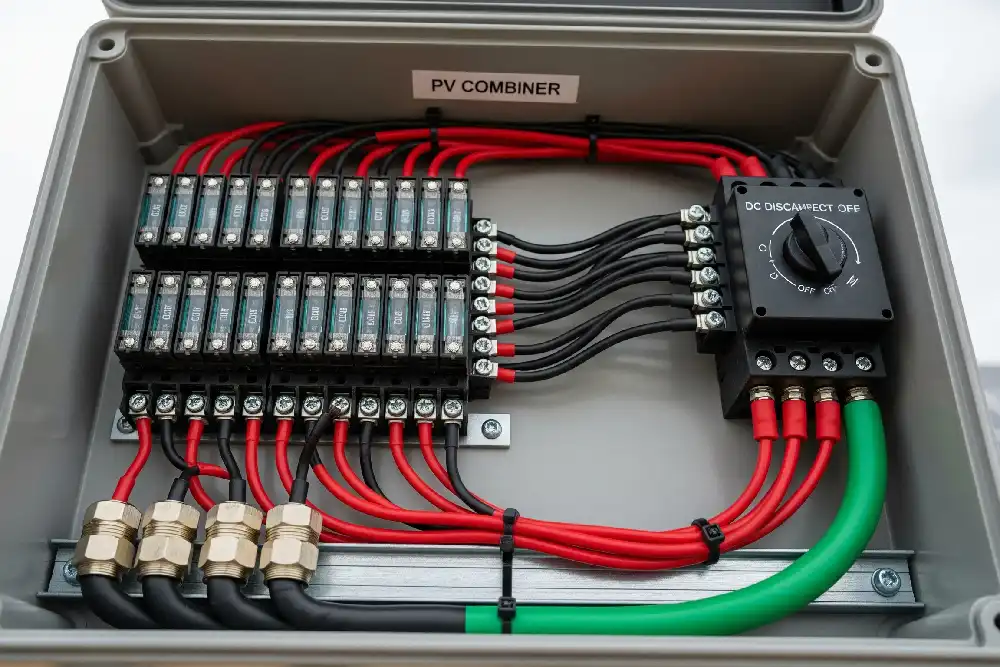
You will see many important parts inside a solar combiner box. These parts are DC circuit breakers, DC fuses, surge protection devices, busbars, and enclosures. Each part helps keep your solar system safe. They also help it work well.
| Component | Function |
|---|---|
| DC Circuit Breaker | Stops the flow of electricity if there is too much or if there is a short circuit. |
| DC Fuse | Cuts off bad circuits, so other strings can still work safely. |
| Surge Protection Device | Protects equipment from sudden high voltage or lightning. |
| Busbar | Joins many wires together into one output. |
| Enclosure | Protects all the parts from weather and sunlight. |
It is important to know about these parts. They keep your equipment safe. They help your system work better. They also help you control your solar power.
Key Takeaways
- Learn about the main parts of a solar combiner box. These include circuit breakers, fuses, and surge protection devices. Each part helps keep your solar system safe. They also help it work well.
- It is important to check your solar combiner box often. Look at it every 6 to 12 months. Check for loose wires, rust, or damage. This helps stop problems before they start. It also helps your system work better.
- Pick the right fuses and circuit breakers for your solar panels. These devices stop too much current from flowing. This keeps your equipment safe. It also helps your solar panels last longer.
- You can use remote monitoring for your solar combiner box. This lets you watch how your system works. You can find problems fast. It saves time and lowers maintenance costs.
- Make sure your combiner box matches your system’s voltage and current. Picking the right box keeps your solar setup safe. It also helps your system work well.
What Is a Solar Combiner Box
Definition
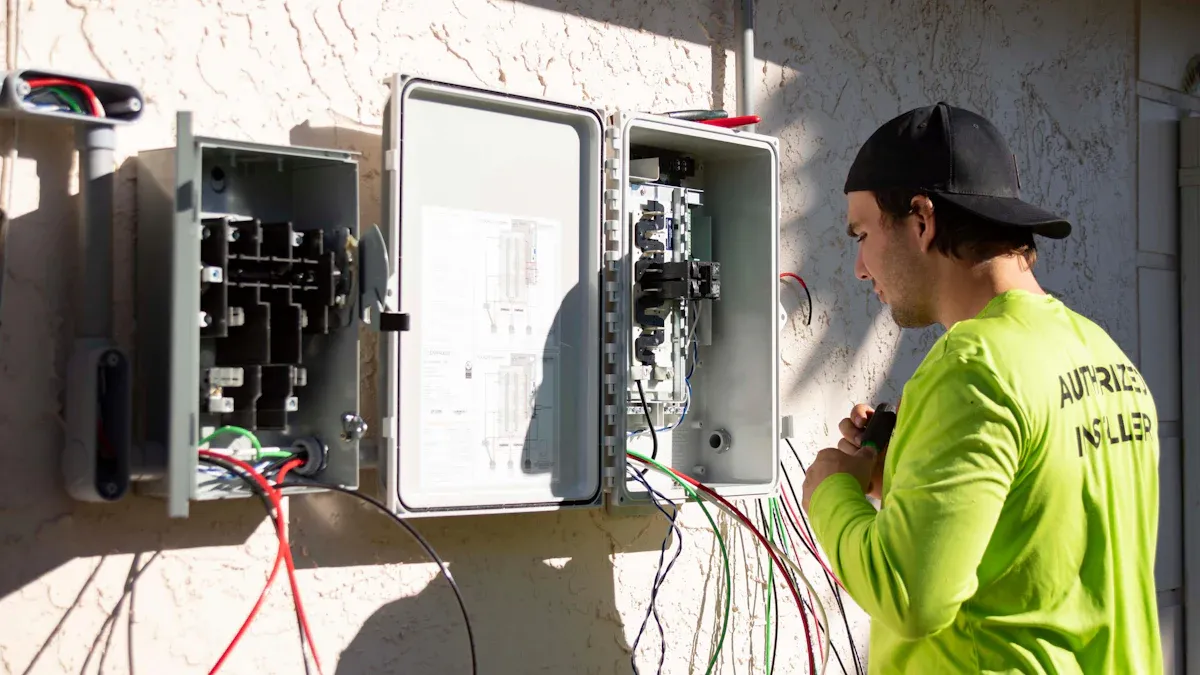
A solar combiner box is found in most solar power systems. It is a main place where wires from many solar panel strings meet. The box gathers electricity from each string. Then, it sends the power to the inverter. This box helps you manage your solar system better. It also makes the system safer to use.
DC combiner boxes have protection against too much current and surges. They also protect against lightning and voltage changes. These features keep PV systems safe from damage.
Many groups around the world set rules for solar combiner boxes. These rules say what the box is and how it should work. Here is a table with some of these rules:
| Standard Organization | Description |
|---|---|
| IEC Standards | International Electrotechnical Commission (Europe/global) |
| UL Standards | Underwriters Laboratories (North America) |
| NEC Code | National Electrical Code (USA) |
| CE Marking | European Union regulatory compliance |
| CCC Certification | China Compulsory Certification |
Main Function
The main job of a solar combiner box is to join power from many solar panel strings into one. This makes wiring easier and keeps your system safer. The box gets the power ready for the inverter. This way, you get solar energy that is easy to use.
- Combiner boxes make it simple to handle wires by joining power from many panels into one circuit.
- They keep your system safe by using fuses or circuit breakers to stop too much current.
- It is easier to check and fix your solar system because all the wires are in one place.
Each solar panel string connects to a fuse or breaker inside the box. If something goes wrong, the fuse blows or the breaker trips. This stops power from moving in the broken string. The rest of your system keeps working.
- Each PV string connects to a fuse or breaker in the box.
- If there is a problem, like a short circuit, the fuse blows or breaker trips.
- This stops the power in the bad string and keeps the rest safe.
You need the solar combiner box to keep your solar system safe, neat, and easy to take care of.
Solar Combiner Box Components
Input Terminals
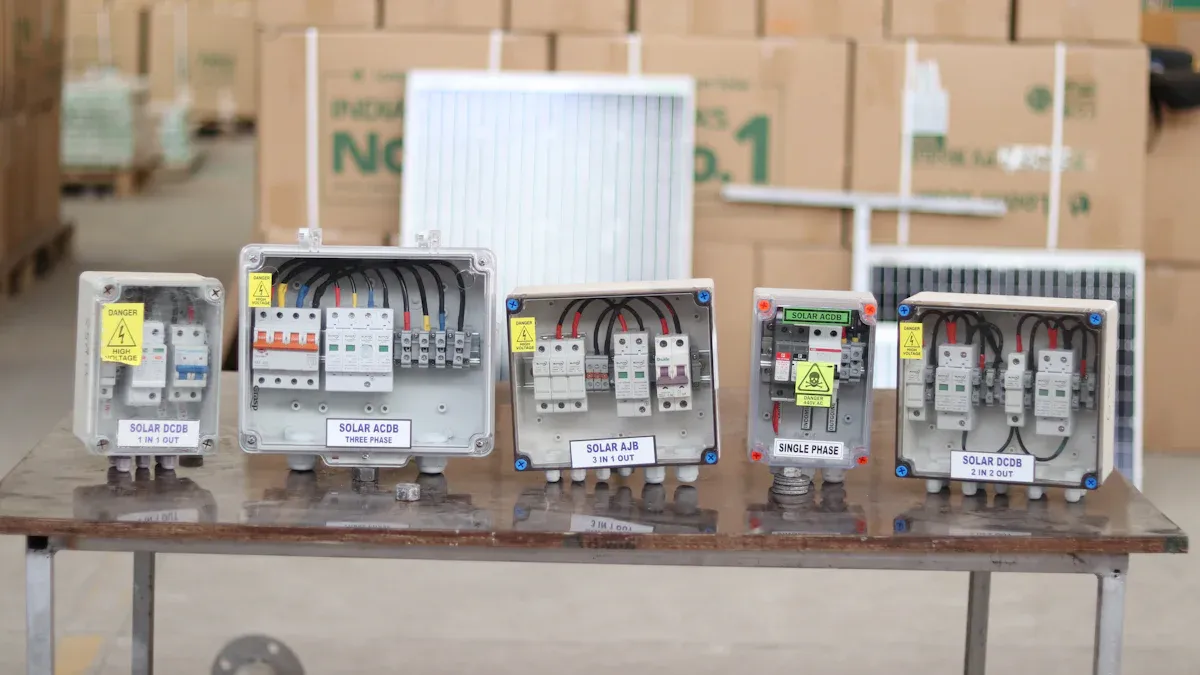
You connect each solar panel string to input terminals. These terminals hold both positive and negative wires. Good input terminals help you make strong connections. They also keep your system safe. Manufacturers design these terminals for high currents. They keep wires tight and secure. You should check if the terminals match your system’s voltage and current. Most combiner boxes follow safety rules like IEC 61439. This means you get good and safe performance.
Tip: Always use terminals that fit your wire size. Pick ones that do not rust. This keeps your system safe and working for a long time.
String Fuses
String fuses protect each solar panel string from too much current. If there is a problem, the fuse breaks the circuit. This stops damage to your system. You pick the fuse size based on the current from your panels. For example, if your panel string makes 9 amps, you need a fuse for at least 11.25 amps. Most solar combiner boxes use fuses between 10A and 56A. Fuses help keep your system safe and stop fires.
| Parameter | Calculation Formula | Example Value | Recommended Specification |
|---|---|---|---|
| Fuse/Circuit Breaker Rating | Isc × 1.25 or Isc × 1.56 | 9 A × 1.25 = 11.25 A | 15 A fuse or breaker |
| Combiner Box Total Current | Number of strings × Isc | 10 × 9 A = 90A | ≥ 100 A rated combiner box |
Circuit Breakers
Circuit breakers act like switches that protect your box. They stop short circuits and overloads. You can reset them after a problem. Fuses cannot be reset. There are different types of circuit breakers. Some are standard, GFCI, AFCI, and DC circuit breakers. DC circuit breakers work best for solar systems. They handle direct current. Circuit breakers keep your system safe. They also make repairs easier.
| Circuit Breaker Type | Application |
|---|---|
| Standard | General use in many places |
| GFCI | Protects from ground faults in wet areas |
| AFCI | Stops arc faults in homes |
| DC Circuit Breaker | Protects circuits in solar combiner boxes |
Surge Protection Devices
Surge protection devices (SPDs) guard your box from voltage spikes. They also protect against lightning. You pick an SPD that matches your system’s voltage. It should handle strong surges. Fast SPDs lower the risk of damage. Look for SPDs with weatherproof covers. Check for certifications from trusted groups. Good SPDs help your system last longer. They keep it safe outside.
- Pick SPDs with the right voltage rating.
- Make sure the SPD can handle big surges.
- Use SPDs that react fast for better protection.
- Install SPDs that meet IEC and other standards.
Disconnect Switches
Disconnect switches let you turn off power safely. You use them during repairs or emergencies. These switches have different voltage and current ratings. Some are 600VDC, 1000VDC, or 1500VDC. They can handle high breaking capacities. You find switches that meet codes like NEC Articles 690 and 705. Weatherproof switches work best for outdoor boxes.
| Specification Type | Details |
|---|---|
| Voltage Ratings | 600VDC, 1000VDC, 1500VDC |
| Current Ratings | 32A, 63A, 125A, 250A+ |
| Breaking Capacity | 4000A-10000A |
| Environmental Ratings | IP65, IP66, IP67, NEMA 4X |
| Compliance Codes | NEC Articles 690, 705 |
Wiring Terminals
Wiring terminals join all the wires inside the box. You need to match cable size to system current. This stops wires from getting too hot. Use good terminals that do not rust. Protect your connections with enclosures rated IP65 or higher. Label every wire and terminal. This makes repairs easy. Test connections often to keep your system working well.
- Use the right wire size for your current.
- Seal all entry points to keep water out.
- Label wires and parts for easy repairs.
- Pick terminals that keep connections tight and safe.
Monitoring Devices
Monitoring devices help you see how your box works. You can measure voltage, current, and temperature. You can also check door status. Some boxes use Hall-effect sensors, voltage modules, and temperature probes. Advanced boxes connect to computers or phones. They use RS485, Modbus, or Ethernet. You can see data in real time. You get alerts if something goes wrong. Monitoring helps you fix problems fast. It keeps your system running well.
Note: Modern solar combiner boxes often have smart monitoring. They check string-level voltage, current, SPD health, and temperature. This helps you spot problems early and improve performance.
Component Functions
Input Terminals
You connect each solar panel string to input terminals. These terminals hold wires tight. This helps stop loose connections. Strong terminals lower the chance of overheating. They also help stop electrical faults. Input terminals help you keep wires neat. They make it easy to manage wiring in your solar combiner box.
String Fuses
String fuses keep your solar panel strings safe from harm.
- They cut off power fast if there is too much current or a short circuit.
- This stops small problems from spreading to the whole solar array.
- Fuses protect your PV modules and inverters. This helps them last longer.
Circuit Breakers
Circuit breakers protect against too much current.
- You can shut off parts of the system to stop damage to panels and wires.
- Circuit breakers trip if they find faults, shading problems, or short circuits.
- Each string has a fuse or breaker. This keeps every part of your system safe.
Surge Protection Devices
Surge protection devices guard your system from lightning and big surges. These devices keep solar panels and inverters safe from outdoor dangers. Surge protection lowers repair costs. It helps your system last longer.
| Benefit | Description |
|---|---|
| Equipment Protection | Stops damage from surges and lightning. |
| Cost Savings | Cuts down on repair and replacement costs. |
| Performance Maintenance | Keeps energy output and system working well. |
Disconnect Switches
Disconnect switches let you turn off power safely for repairs or emergencies.
| Function | Explanation |
|---|---|
| Safety First: Electrical Isolation | You make a clear break in the circuit. No current flows during repairs. |
| System Segmentation for Efficient Operation | You can fix one part without turning off the whole array. |
| Grid Interconnection Safety | You fully disconnect during grid outages. This keeps line workers safe. |
Wiring Terminals
Wiring terminals bring all your solar panel wires together. This setup lets you test and check each string easily. You can find bad panels or wires fast. You do not need to take apart the whole array. Good wiring terminals help you fix and care for your solar combiner box.
Monitoring Devices
Monitoring devices show you real-time data about your system.
| Feature | Description |
|---|---|
| String imbalance detection | Tells you if any string current is much higher or lower than others. |
| Fuse status monitoring | Lets you know if one string stops working but others are fine. |
| Thermal drift alerts | Warns you if the box gets hot too fast. This may mean airflow problems. |
| SPD status | Shows when surge protection needs fixing. This lowers risk during storms. |
You use monitoring devices to make your system work better. They help keep it safe and lower repair costs. Online tools help you watch performance and find problems early.
System Safety and Efficiency
Protection Mechanisms
You need strong protection to keep your solar system safe. The solar combiner box uses different ways to guard against electrical problems. These ways include surge protection devices, overvoltage protection, and voltage spike protection. Surge protection devices (SPDs) are very important. They find high voltage and quickly send extra energy to the ground. This keeps your inverter and other electronics safe from harm.
| Protection Mechanism | Description |
|---|---|
| Transient Overvoltage | Handles sudden voltage changes to stop equipment failure. |
| Surge Protection Devices | Stops big surges that can hurt or break your system. |
| Voltage Spike Protection | Shields your system from spikes caused by lightning or grid changes. |
Voltage spikes can really damage your equipment. Using SPDs helps you avoid expensive repairs and keeps your solar system working longer.
Efficient Power Transmission
A solar combiner box helps move power from panels to the inverter with less loss. It joins the output from many solar panel strings into one circuit. This makes your wiring simple and neat. You get better current control and steady power flow. The box also has overcurrent protection, which stops power spikes from reaching your inverter. This helps your inverter last longer.
- Combines current from several panels into one output.
- Makes wiring easier and lowers energy loss.
- Can reach up to 90% efficiency in power transmission.
- Keeps your inverter safe from harmful power surges.
Maintenance and Monitoring
Regular care keeps your solar combiner box working well. You should follow a maintenance plan every 6 to 12 months. Start with a visual check for any color changes, rust, or damage. Test all connections and tighten terminals so wires do not get loose. Always check if your surge protection devices work and change them if needed. Use thermal scanning to find hot spots that could mean trouble. Clean the box and vents to keep everything cool and safe.
- Do maintenance every 6–12 months.
- Look for damage or rust.
- Tighten all wire terminals.
- Test and change surge protection devices if needed.
- Scan for hot spots with a thermal camera.
- Clean the box and its vents.
Good monitoring and regular care help you find problems early. This keeps your solar power system safe and working well.
Advanced Features
Remote Monitoring
Remote monitoring lets you check your solar combiner box from anywhere. You get live data about current, voltage, and temperature inside the box. You can see problems right away. Maintenance teams can fix things fast. This keeps your solar system working well. You do not have to visit the box as much. This saves time and money. In big solar farms, remote monitoring helps manage many boxes at once.
Tip: Remote monitoring helps you find small problems early. This keeps your solar panels working their best.
Arc Fault Detection
Arc faults can start fires in solar systems. Arc-fault detection helps keep your system safe. Arc-Fault Circuit Interrupters (AFCIs) look for signs of arcs. When they find a problem, they turn off the circuit fast. This stops fires before they begin. Arc faults cause most home electrical fires. That is why this feature is important. The National Electric Code says PV systems must have arc-fault protection. Using AFCIs protects your equipment and your building.
- Arc faults cause most electrical fires in homes.
- AFCIs turn off circuits before fires can start.
- PV systems must have arc-fault protection by code.
Customization Options
You can pick options to make your solar combiner box fit your needs. Manufacturers let you choose different features for your project. Here is a table with some common choices:
| Customization Option | Description |
|---|---|
| CAD Drawings | Get detailed drawings for your project plans. |
| On-Site Support | Receive help during installation for better results. |
| Branding | Add your company’s logo or custom printing to the box. |
| Packaging | Pick special packaging for shipping or storage needs. |
| Technical Requirements | Ask for special features or setups to match your system. |
You can work with the manufacturer to get the right size and features. This helps your project go well and look good.
Note: Features like surge protection, rapid shutdown, and strong enclosures make your system safer. Many new combiner boxes have these features today.
You help keep your solar PV system safe and working well. Every part in the combiner box protects your equipment. These parts also help power move better.
- Choose a combiner box that fits your system’s voltage and size.
- Use fuses and circuit breakers to stop too much current.
- Add arc-fault protection and rapid shutdown for more safety.
A good combiner box stops fires and keeps your solar panels working. When you know about these parts, you can make smart choices. This helps with design, setup, and taking care of your system.
FAQ
What does a solar combiner box do?
You use a solar combiner box to join wires from several solar panel strings. The box protects your system with fuses, breakers, and surge devices. It helps you manage and monitor your solar power safely.
How often should you check your combiner box?
You should check your combiner box every 6 to 12 months. Look for loose wires, rust, or damage. Test all safety devices. Regular checks help you find problems early and keep your system safe.
Can you install a combiner box outdoors?
Yes, you can install a combiner box outdoors. Make sure you use a weatherproof enclosure with a high IP rating, such as IP65 or higher. This protects the box from rain, dust, and sunlight.
Why do you need surge protection in a combiner box?
Surge protection keeps your solar equipment safe from voltage spikes and lightning. It sends extra energy safely to the ground. This helps you avoid costly repairs and keeps your system working longer.
What happens if a string fuse blows?
If a string fuse blows, only that string stops working. The rest of your solar system keeps running. You should replace the blown fuse to restore full power. Monitoring devices can help you find which fuse needs attention.
See also
Solar Combiner Boxes and Voltage Changes: What to Know
Combiner box solutions for your AC and DC needs
How to Choose the Best Combiner Box for Your Solar Project
What Determines How Many Solar Combiner Boxes You Need
How to Calculate Max Strings for Solar Combiner Box