
Introduction
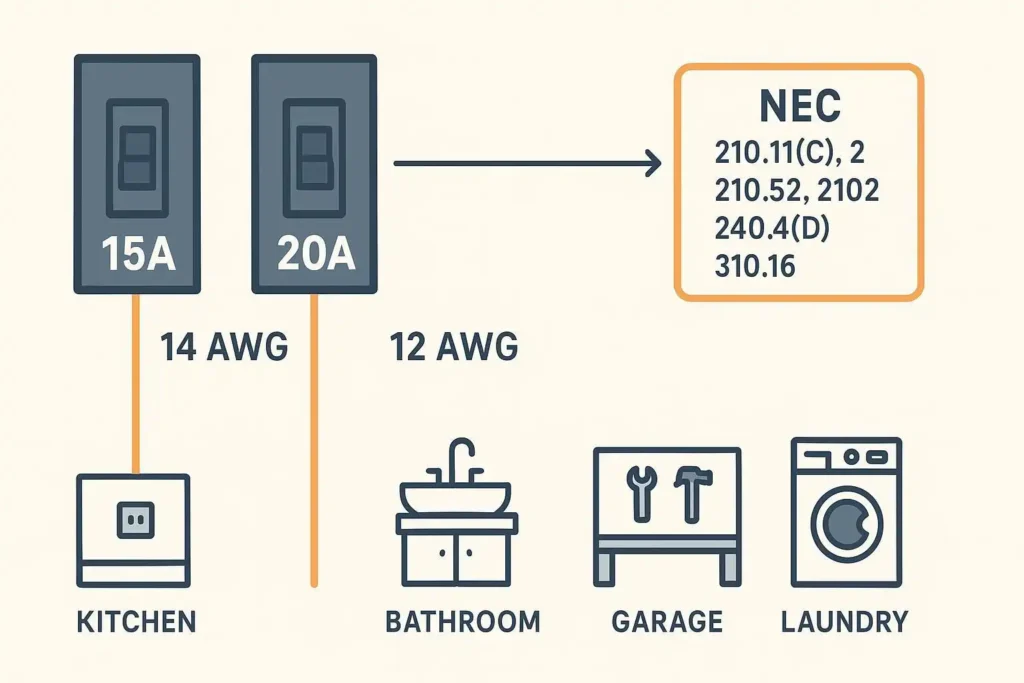
Your goal on every dwelling unit project is simple: choose safely and pass inspection. For branch circuits serving kitchens, bathrooms, garages, and laundry areas, the practical question is usually “15 vs 20 amp breaker?” The answer comes from three levers you can verify on-site: location, wire gauge, and load type—backed by the NEC.
Scope and code basis: This guide prioritizes the 2023 NEC. Where relevant, it notes 2020 differences—especially kitchen island/peninsula receptacles and GFCI expansions. Always confirm local amendments and adoption timelines with your AHJ.
Key takeaways
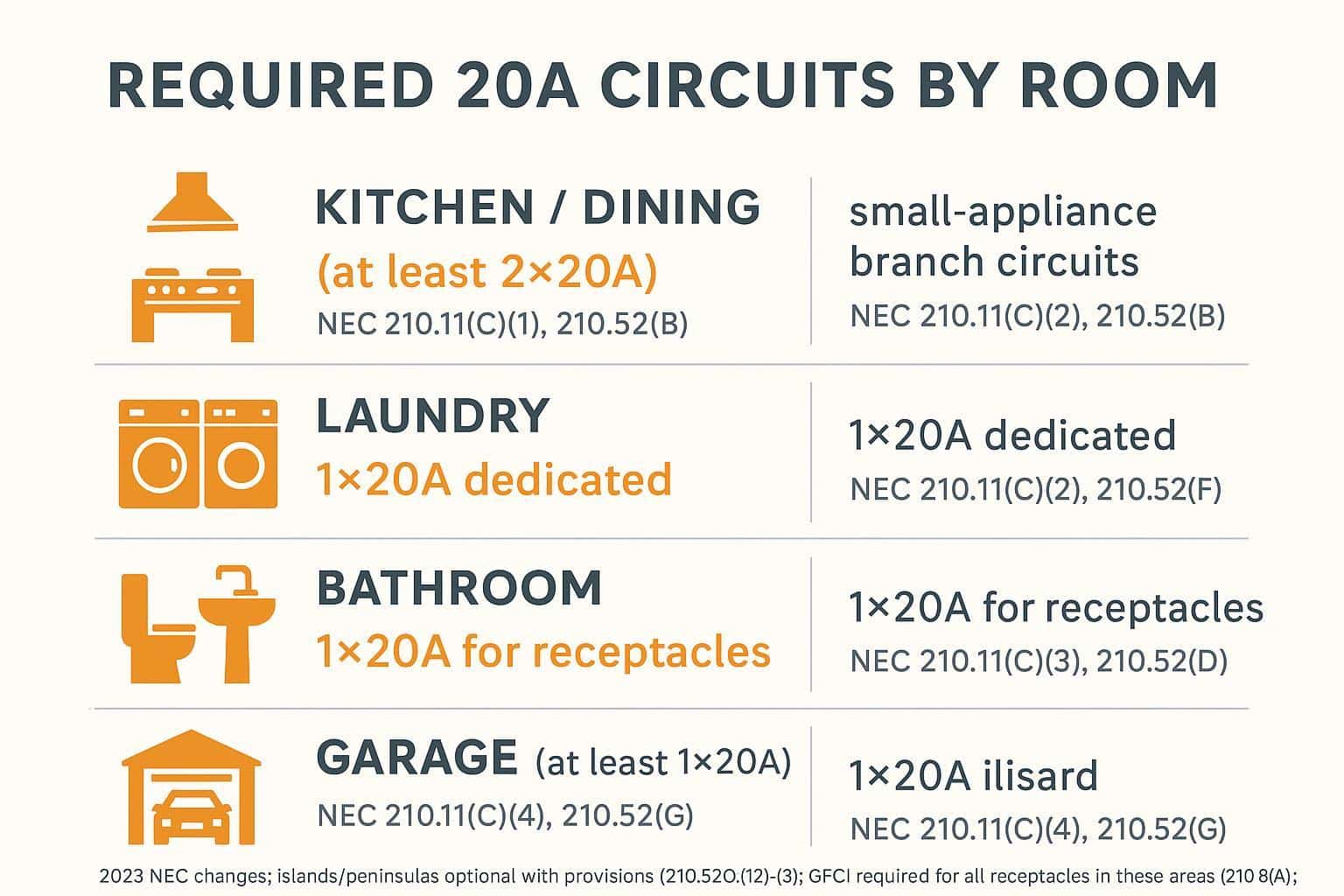
- Kitchens/dining SABC and laundry require 20A circuits; bathrooms require a 20A branch circuit for receptacles; garages require at least one 20A circuit (NEC 210.11(C)(1)–(4) with 210.52(B)/(D)/(F)/(G)).
- A 15A duplex receptacle is permitted on a 20A multi-outlet branch circuit, but a single receptacle must match the branch-circuit rating (NEC 210.21(B) and Table 210.21(B)(3)).
- 14 AWG copper is limited to 15A OCPD; 12 AWG copper is used with 20A OCPD; apply the 60°C termination rule unless all equipment permits higher (NEC 240.4(D), 110.14(C), and 310.16).
- Size for continuous load at 125% per 210.20(A) and 210.19(A)(1); the practical “80% rule” applies to standard 80%-rated breakers.
- 2023 NEC: islands/peninsulas are optional (with provisions) and below-countertop outlets no longer qualify to serve the work surface; GFCI protection applies to all receptacles in these rooms (NEC 210.52(C)(2)–(3), 210.8(A)).
Room rules: 15 vs 20A
Kitchens & laundry (20A SABC)
- Kitchens, pantry, breakfast room, dining room, and similar areas require at least two 20A, 120V small-appliance branch circuits (SABC) to serve receptacle outlets in those spaces and they cannot serve lighting or other rooms. See 210.11(C)(1) and 210.52(B). A clear summary is provided in Mike Holt’s 210.52 handout under kitchens and dining areas. Reference: Mike Holt 210.52 summary (2023)
- Laundry areas require one dedicated 20A branch circuit that supplies only laundry-area receptacles (210.11(C)(2) with placement at 210.52(F)). See the IAEI guidance on laundry area provisions and GFCI. Reference: IAEI on laundry receptacles and GFCI (2023)
- 2023 change for islands/peninsulas: Receptacles serving these work surfaces are now optional, but provisions for future installation are required. If installed, location limits apply—on/above the surface within 20 in. or in the top via a listed assembly; below-surface outlets don’t qualify (210.52(C)(2)–(3)). NFPA explains the rationale and details. Reference: NFPA island/peninsula update (2023)
- GFCI and AFCI: All receptacles in kitchens and laundry areas require GFCI (210.8(A)); 120V 15/20A branch circuits require AFCI per 210.12(A). See Mike Holt’s overview of GFCI/AFCI scope. Reference: Mike Holt GFCI/AFCI overview
Bathrooms (dedicated 20A)
- Provide at least one 20A branch circuit for bathroom receptacle outlets as required by 210.52(D) and supplied per 210.11(C)(3). Multiple bathrooms may share this 20A circuit only if it serves receptacles only in those bathrooms; lighting and fans must remain separate in that case. The exception allows the 20A circuit to serve a single bathroom’s receptacles plus that same bathroom’s lighting/fan if permitted by local AHJ and load limits in 210.23(A)(1)/(A)(2). A concise explanation appears in ELR’s treatment of bathroom circuits. Reference: ELR on 210.11(C)(3) and 210.52(D)
- GFCI and AFCI: All bathroom receptacles require GFCI per 210.8(A); AFCI applies to 120V 15/20A branch circuits in dwelling units per 210.12(A). See Jade Learning and Mike Holt summaries. Reference: JADE Learning bathroom branch circuits (2020 context)
Garages (at least one 20A)
- Provide at least one 20A branch circuit for required garage receptacle outlets per 210.11(C)(4) and 210.52(G)(1). At least one receptacle is required for each vehicle bay, generally mounted no higher than 5.5 ft above the floor; see ELR for details and exceptions. Reference: ELR on 210.52(G) garage outlets
- 2023 clarifications: The garage 20A circuit is primarily dedicated to the garage receptacles, with limited allowances (e.g., certain outdoor receptacles and single-bay cases) as coordinated with 210.23(A)(1)/(A)(2). Leviton’s Captain Code and JADE Learning offer concise overviews. Reference: Leviton Captain Code on 210.11(C)(4) | Reference: JADE Learning on required garage circuits
- GFCI and AFCI: All garage receptacles require GFCI per 210.8(A); AFCI in garages varies by jurisdiction—verify with your AHJ.
Wire–breaker–receptacle match
Wire sizing & 125% rule
- Conductor and OCPD pairing: 14 AWG Cu is limited to a 15A overcurrent device per 240.4(D); 12 AWG Cu pairs with a 20A device. Use the lowest termination temperature rating per 110.14(C) to select the correct ampacity column from Table 310.16. For most 15A/20A branch circuits, the 60°C column governs even if the cable is 90°C rated. Mike Holt’s fundamentals handout covers the small-conductor limits succinctly. Reference: Mike Holt on 240.4 small conductor limits
- Continuous load sizing: Per 210.20(A) (and 210.19(A)(1) for conductors), size the OCPD at not less than 125% of the continuous load plus the noncontinuous load. In practice, standard breakers are 80% rated, so plan continuous currents at ≤12A on 15A circuits and ≤16A on 20A circuits. IAEI explains 80% vs 100% ratings. Reference: IAEI on 80% vs 100% OCPD
- Example (kitchen appliance group on SABC): Suppose the expected continuous portion is 10A (1200 VA at 120V) and noncontinuous is 3A. Required OCPD ≥ 1.25×10A + 3A = 15.5A. A 20A breaker on 12 AWG meets the requirement with margin; a 15A breaker would be undersized for that continuous profile.
Receptacle ratings per 210.21(B)
- Single receptacle on an individual branch circuit must be rated not less than the circuit rating (210.21(B)(1)). A single 20A receptacle is required on a 20A individual branch circuit serving a single outlet; a single 15A receptacle isn’t permitted in that case.
- Multiple receptacles on a 20A branch circuit (e.g., duplex outlets) may be 15A or 20A per Table 210.21(B)(3). On a 15A branch circuit, the receptacles are 15A maximum. Mike Holt’s newsletter illustrates the table behavior clearly. Reference: Mike Holt on 210.21(B) table
- Internal reading: For a deeper discussion of household breaker selection and wire gauges, see the SENTOP knowledge base article on selecting household appliance breakers.
Listed, tested devices
Disclosure: SENTOP is our product. In residential work, breakers and receptacles must bear appropriate listing/marking—commonly UL 489 for circuit breakers and UL 498 for receptacles in North America—verified on the device and in documentation; internationally, comparable compliance is shown via IEC/CE marks with RoHS for materials. SENTOP supplies breakers and receptacles designed for these categories; verify actual listing marks, installation instructions, and certificates with the project submittal and AHJ. Any UL-listed breaker or receptacle meeting the cited standards is acceptable for the installations described. For context on breaker formats, compare single- vs double-pole fundamentals in our guide: Single vs. double pole breakers.
Quick-reference matrix
| Room/Area | Required Breaker(s) | Typical Wire | Receptacles | GFCI/AFCI | Core NEC |
|---|---|---|---|---|---|
| Kitchen/dining SABC | ≥2×20A, 120V | 12 AWG Cu | 15A duplex permitted on 20A multi-outlet; 20A single if individual | GFCI: all; AFCI: yes | 210.11(C)(1); 210.52(B); 210.8(A); 210.12 |
| Laundry | 1×20A dedicated | 12 AWG Cu | Laundry area receptacle(s) only | GFCI: all; AFCI: yes | 210.11(C)(2); 210.52(F); 210.8(A); 210.12 |
| Bathroom | 1×20A for receptacles; single-bath exception for lights/fan | 12 AWG Cu | Within 3 ft of basin edge | GFCI: all; AFCI: yes | 210.11(C)(3); 210.52(D); 210.8(A); 210.12 |
| Garage | ≥1×20A (primarily dedicated) | 12 AWG Cu | ≥1 receptacle per vehicle bay; ≤5.5 ft high | GFCI: all; AFCI: per AHJ | 210.11(C)(4); 210.52(G); 210.8(A) |
Field checks & safety
Confirm breaker amp rating
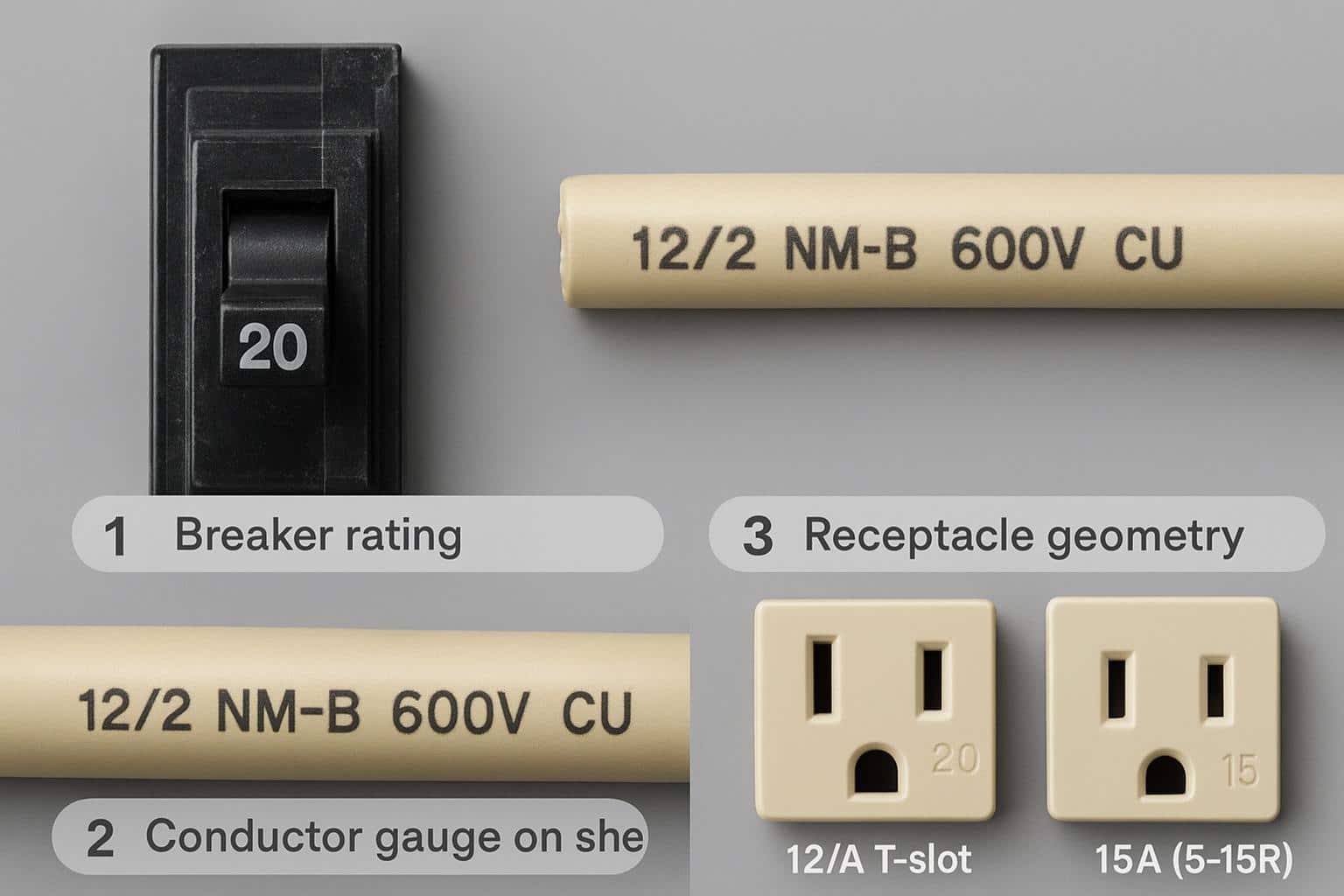
- Visual: Breakers ≤100A carry a numeric amp rating on the handle or escutcheon, enabling fast identification of 15 vs 20A. UL’s guidance on molded-case breaker markings offers detail. Reference: UL breaker marking guide
Verify conductor gauge on sheath
- Read the NM-B jacket legend (e.g., “12/2 NM-B 600V CU”). Pair 12 AWG with 20A OCPD and 14 AWG with 15A OCPD unless exceptions apply; use 110.14(C) to choose the correct temperature column from Table 310.16. Southwire’s Romex NM-B specification shows typical sheath markings. Reference: Southwire NM-B spec legend
Apply GFCI/AFCI and avoid mistakes
- GFCI: 210.8(A) extends to all receptacles (125–250V, ≤50A) in kitchens, bathrooms, garages, and laundry areas; 210.8(D) adds appliance-based requirements (dishwashers, ranges, ovens, microwaves, counter-mounted cooking units, sump pumps). See ELR and ABB for 2023 scope. Reference: ELR on 210.8(D) appliances | Reference: ABB 2023 NEC GFCI summary (PDF)
- AFCI: 210.12(A) requires AFCI protection for 120V 15/20A dwelling circuits in these areas by one of the methods listed in 210.12(A)(1)–(6). See Mike Holt’s AFCI summary. Reference: Mike Holt 210.12 AFCI (2023)
- Common field mistakes to avoid:
- Mixing 14 AWG on a 20A breaker or vice versa.
- Installing a single 15A receptacle on a 20A individual (single-outlet) branch circuit.
- Placing island/peninsula receptacles below the work surface in 2023 NEC jurisdictions.
- Missing GFCI on non-countertop kitchen receptacles (remember: it’s now all receptacles).
- Overlooking AFCI where required or not using listed combinations when employing OBC devices.
Conclusion
Where is 20A mandatory by code? Kitchens/dining SABC (two or more), bathrooms (receptacle circuit), laundry (dedicated), and at least one garage circuit per dwelling unit. When is a 15A circuit acceptable? General lighting/outlet circuits outside those areas and any load that calculates to 15A with 14 AWG under the small-conductor rule and 125% continuous-load sizing. Final check on every run is simple: location, wire, load—then layer in GFCI/AFCI as required and confirm device ratings per 210.21(B). Finally, verify local amendments and interpretations with your AHJ so the installation passes on the first inspection.
See also
UL 489 and UL 1077: Understanding Electrical Protection
Recommended Circuit Breaker Size for Laundry Room Washers
Which Rooms Need AFCI Arc Fault Circuit Breakers in 2026
GFCI vs. RCD Outlets: Essential Safety for Bathrooms and Kitchens.
What Locations in Your Home Need Surge Protection Devices Most