
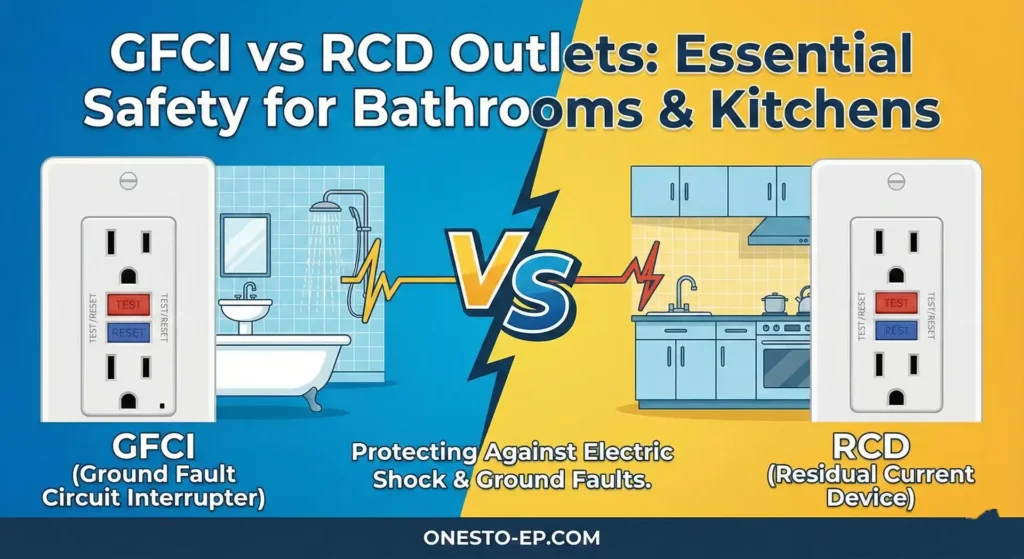
You must keep yourself and your family safe from electrical dangers in bathrooms and kitchens. GFCI outlets, which stand for Ground Fault Circuit Interrupters, stop shocks by turning off power quickly if something goes wrong. In the United States, rules state that all kitchen outlets need GFCI protection, not just the ones on counters. Places with sinks and areas for preparing food, like break rooms, also require this safety feature. In many countries outside North America, RCD outlets, or Residual Current Devices, provide similar protection. Understanding the differences between GFCI vs. RCD helps you choose safer options for your home. Inspect your outlets and adhere to the regulations.
Key Takeaways
- GFCI outlets help stop electric shocks in wet places. These places include bathrooms and kitchens. They turn off power fast when there is a problem.
- RCD outlets do the same job outside North America. They keep people safe by watching electricity flow. They cut power when something goes wrong.
- Test your GFCI or RCD outlets every month. Use the TEST button to check if they work right. This helps keep your home safe.
- Check local electrical rules to see where outlets are needed. GFCI or RCD outlets are important in places with water.
- Think about hiring a licensed electrician to install outlets. This makes sure safety rules are followed. It also meets local laws.
What Are GFCI and RCD Outlets?
GFCI Outlets Overview
GFCI outlets are found in bathrooms and kitchens. They help protect you from getting shocked. These outlets watch how electricity moves. If something is wrong, they turn off the power fast. This can happen if water touches an appliance or you touch a wire.
A GFCI outlet looks for changes in electricity. It shuts off power if it finds a problem. This keeps you safe from shocks. It works faster than a fuse. A fuse stops fires, but a GFCI outlet stops shocks. It can sense tiny changes in current. It reacts in less than a second to keep you safe.
Most GFCI outlets are used in North America. You need them in places with water, like kitchens and bathrooms.
RCD Outlets Overview
RCD means Residual Current Device. You see these outlets in many places outside North America. An RCD outlet works like a GFCI. It checks electricity in wires. If there is a problem, it turns off power quickly. This helps stop shocks and fires.
An RCD uses a coil to watch the wires. If you touch a wire or there is a fault, electricity may go to the ground. The RCD sees this and shuts off power right away. Some RCDs are in outlets. Others protect whole circuits.
People talk about GFCI vs. RCD when they compare safety. The main difference is the name and where you find them. Both help keep you safe.
| Region | Device Type | Application |
|---|---|---|
| North America | GFCI | Can work without a ground wire, marked ‘no equipment ground’. |
| Europe | RCD | Used in appliances with safety risks, fits on DIN rail with circuit breakers. |
| General | RCD/GFCI | Both protect against ground faults, but rules are different in each region. |
Tip: Always check your outlets at home. Use the right type for your area. Follow safety rules for your region.
How GFCI and RCD Work

Protection Mechanisms
You need to know how these outlets keep you safe. Both GFCI and RCD outlets watch the flow of electricity. They look for problems that can cause shocks or fires. When you plug in a device, the outlet checks if the electricity going out matches the electricity coming back. If the numbers do not match, something is wrong.
- GFCI outlets monitor the current that flows through them.
- Under normal conditions, the amount of electricity going in and out stays equal.
- If there is a difference of 4 to 6 milliamps, the outlet senses a ground fault.
- RCD outlets work in a similar way. They use a coil to check for changes in the wires.
- Both types can protect you from dangerous shocks, especially in wet areas.
Tip: You can spot a GFCI outlet by its TEST and RESET buttons. These buttons help you check if the outlet works right.
Fault Response
When a problem happens, you want your outlet to act fast. GFCI and RCD outlets do not wait. They cut off the power right away if they find a fault. This quick action can stop you from getting hurt.
- A ground fault happens when electricity takes a path it should not, like through water or your body.
- The outlet detects this unsafe path and shuts off the power in less than a second.
- GFCI outlets have TEST and RESET buttons for you to use. You can press TEST to make sure the outlet works. If it trips, you press RESET to turn it back on.
- RCD outlets may protect one outlet or a whole circuit. Some RCDs sit in your breaker panel and guard many outlets at once.
You see that GFCI vs. RCD is not just about names. Both devices protect you, but they may look different or work in different places. Always test your outlets to make sure they keep you safe.
GFCI vs. RCD: Key Differences
Technical Comparison
You might ask how GFCI and RCD outlets are not the same. Both keep you safe from electric shock, but they have different features and rules for putting them in. When you compare GFCI vs. RCD, you notice each one works in its own way to protect your family.
Here is a table that shows the main technical differences between GFCI and RCD outlets:
| Feature | GFCI Circuit Breaker | GFCI Receptacle Outlet |
|---|---|---|
| Protection Scope | Entire circuit (all outlets, lights, devices) | Single outlet (and plugged devices) |
| Installation Location | Main electrical panel | Individual wall outlets |
| Reset Process | Requires accessing the breaker panel | Reset locally via a button on the outlet |
| Cost | $50-$150 per breaker (higher upfront) | $15-$30 per outlet (lower upfront) |
| Code Compliance | Required for whole-circuit protection in new builds | Mandatory in wet/damp areas (bathrooms, kitchens) |
GFCI circuit breakers protect everything on a circuit. GFCI outlets only protect what you plug into them. You can reset a GFCI outlet with a button. For a GFCI breaker, you must go to the breaker panel to reset it. RCDs work almost the same, but you often see them in the main panel or as part of a split-load board in other countries.
Let’s look at the installation rules for both devices:
| Aspect | GFCI Requirements | RCD Requirements |
|---|---|---|
| General Requirement | Required for outdoor outlets and specific circuits | Required for all socket outlets <32A and in bathrooms |
| Circuit Protection | Individual GFCIs for each circuit | Split-load boards or individual RCBOs for circuits requiring protection |
| Exemptions | Limited exemptions for certain appliances | Exemptions for dedicated circuits like refrigerators and heaters with double insulation |
Note: In the United States, you must put GFCI outlets in bathrooms, kitchens, laundry rooms, garages, and outside. This is not just a tip. It is part of the electrical code. In many other countries, RCDs are needed for almost all outlets, especially in wet places.
Usage by Region
Where you live changes which outlet you use. The rules and names are not the same in every country. Knowing these differences helps you stay safe and follow the law.
- In North America, you use GFCI outlets to stop electric shock. The law says you must have them in bathrooms and kitchens.
- In Europe, RCDs are normal. You find them in most homes, and they protect many outlets at once.
- Australia and New Zealand also use RCDs. These countries need RCD protection for new home circuits.
- Malaysia and the United Kingdom need RCDs with special sensitivity for wet places and most socket outlets.
Here is a table that shows where you find each type:
| Region/Country | Outlet Type | Description |
|---|---|---|
| North America | GFCI | Ground Fault Circuit Interrupters are used to protect against electric shock. |
| Europe | RCD | Residual Current Devices are commonly used, tripping once a current threshold is reached. |
| Australia | RCD | Similar to Europe, RCDs are standard for electrical safety. |
| Malaysia | RCD | Requires RCDs with specific sensitivity for residential wiring and wet areas. |
| New Zealand | RCD | Mandates RCD protection for new circuits in domestic buildings since 2003. |
| United Kingdom | RCD | Requires RCD protection for most socket outlets and specific installations under regulations. |
Tip: GFCI outlets trip at a lower current (4-6mA) than most RCDs (30mA). This means GFCIs can react to smaller problems, which gives you extra safety in places like bathrooms and kitchens.
When you compare GFCI vs. RCD, you see both try to keep you safe, but the rules and how they work can change depending on where you live. Always check your local rules before you put in or change outlets. This helps you avoid mistakes and keeps your home safe.
Why Wet Areas Need Protection

Bathroom Hazards
Bathrooms are risky places for electricity. Water is on many surfaces. The air is also wet. You use things like hair dryers and shavers near sinks and tubs. If electricity touches water, you can get shocked.
Some common dangers in bathrooms are:
- Electrical outlets close to water
- Hair dryers and curling irons
- Lights and wires that are not covered
- Outlets near sinks or tubs without GFCI protection
- Plug-in heaters and other devices
It is very important to be safe with electricity in bathrooms. Wet areas make it easy for electricity to go through your body. GFCI outlets help by turning off power fast if there is a problem.
Note: Before GFCI outlets were used, many people died from electric shocks at home every year. Now, GFCI protection has made electrocutions much less common.
Here is how electrocutions have changed over time:
| Time Period | Average Electrocutions | Consumer Product Electrocutions |
|---|---|---|
| 1971 – 1980 | 1,101 | 491 |
| 2011 – 2023 | 249 | 41 |
Kitchen Hazards
Kitchens also have many electrical dangers. You use water to cook and clean. You plug in lots of appliances. Without the right protection, you could get shocked or start a fire.
Here are some kitchen dangers:
| Hazard Type | Description |
|---|---|
| Water and Electricity Proximity | Water carries electricity, so spills or wet hands can shock you. |
| Faulty Electrical Appliances | Old or broken appliances can spark or stop working. |
| Uncovered Electrical Outlets | Open outlets can shock you, especially kids. |
| Improper Use of Extension Cords | Too many things plugged in can make cords hot and cause fires. |
Before GFCIs, about 800 people died each year from electric shocks at home. Now, fewer than 200 people die each year. GFCI outlets have lowered electrocutions by 81%. The Consumer Product Safety Commission says almost half of electrocutions today could be stopped with GFCI protection.
⚡ Tip: If your house was built before GFCIs were needed, you might not have them. Many homes still need upgrades to be safe.
Choosing the Right Outlet
Local Code Requirements
You must follow local electrical codes to stay safe. These rules say where GFCI or RCD outlets go. In the United States, GFCI outlets are needed in kitchens and bathrooms. You also need them in break rooms and outside. GFCI outlets are required near swimming pools too. These rules help stop electric shocks when water is close.
Here is a table that lists some main rules in the U.S.:
| Requirement Description | Details |
|---|---|
| GFCI in Kitchens | Needed for all outlets, even for fridges and microwaves. |
| GFCI in Bathrooms | Not needed for outlets inside exhaust fans unless the code says so. |
| GFCI in Break Rooms | Needed for places with sinks and where you make food. |
| GFCI for Outdoor Outlets | Needed for outlets 50 amp or less in garages and other buildings. |
| GFCI near Swimming Pools | Needed for outlets 60 amp or less within 20 feet of a pool wall. |
Tip: Always look up your local code before you put in or change outlets. Rules can be different in each state or city.
Location-Based Recommendations
Pick the right outlet for each room in your house. Kitchens and bathrooms need more protection because of water. In North America, use NEMA 5-15 or 5-20 outlets with GFCI features. These outlets help stop shocks and keep your family safe. Tamper-resistant outlets make things safer for kids.
Here is a table with good outlet choices for bathrooms and kitchens:
| Country | Outlet Type | Safety Features |
|---|---|---|
| Canada | NEMA 5-15, 5-20 | Tamper-resistant outlets, GFCIs |
| U.S. | NEMA 5-15, 5-20 | Tamper-resistant outlets, GFCIs |
If you live outside North America, you may need RCD outlets or circuit protection. Always use the outlet type that matches your local rules. You stay safest when you follow both the code and safety tips.
⚡ Note: Changing old outlets to GFCI or RCD models makes wet areas safer. You lower the chance of shock and fire.
Installation and Maintenance
Safe Installation Tips
You can make your home safer by installing GFCI or RCD outlets in the right places. Always turn off the power at the service panel before you start any work. Use a voltage tester to check that the power is off. This step keeps you safe from electric shock.
If you want to replace an old outlet, follow these steps:
- Turn off the power to the area at the switchboard.
- Use a voltage tester to confirm the power is off.
- Remove the old outlet and disconnect the wires. Remember where each wire goes.
- Connect the wires to the new outlet. Black goes to “LINE,” white to “neutral,” and green to “ground.”
- Secure the outlet, restore power, and test the safety switch.
You should always use a licensed electrician for installation. This ensures your outlets meet safety standards and local codes. In some countries, like Australia, you must follow rules that require RCD protection within two meters of kitchen sinks. Planning outlet locations for easy access and safety coverage helps protect your family.
⚡ Tip: Install GFCI outlets in kitchens, bathrooms, laundry rooms, outdoors, and garages. These areas have the highest risk for electric shock.
RCDs at the main electrical panel give whole-circuit protection. This setup helps prevent electrocution and lowers the risk of electrical fires. Type B RCDs can even detect faults from modern appliances.
Testing and Upkeep
You need to test your GFCI and RCD outlets every month. Press the “TEST” button to make sure the outlet trips. Then, press “RESET” to restore power. If the reset button does not stay in, the outlet may need replacement.
Here are some maintenance tips:
- Check outlets monthly by pushing the test button.
- Never paint over outlets. Replace them if they get covered with paint.
- Do not insert objects other than plugs.
- Keep liquids away from outlets to avoid damage.
- If an outlet stops working, check for faulty appliances or a tripped breaker.
🛠️ Note: Regular testing and proper upkeep keep your outlets working and your home safe.
You keep your home safer when you know about GFCI vs. RCD outlets. These outlets lower the chance of getting shocked by more than 70%. They also help stop fires from starting. In the U.S., GFCI outlets must be in all kitchens and bathrooms. You should test your outlets often and have an expert put them in. If you are unsure or need new outlets, talk to a licensed electrician.
| Safety Benefit | Explanation |
|---|---|
| Preventing electrical shocks | Outlets shut off power quickly to stop injuries, especially where water is present. |
| Reducing fire hazards | They find problems early and turn off electricity before a fire can begin. |
| Meeting code requirements | GFCI outlets in wet places help keep your home safe and follow the law. |
🛠️ Test your outlets often and ask a professional to install them safely.
FAQ
What is the difference between a GFCI and an RCD outlet?
You see GFCI outlets in North America and RCD outlets in other countries. Both protect you from electric shock. GFCI reacts to smaller faults. RCD covers more outlets or circuits.
How often should you test your GFCI or RCD outlets?
You should test your outlets every month. Press the “TEST” button. If the outlet trips, press “RESET.” This keeps your home safe.
Can you install a GFCI outlet yourself?
You can install a GFCI outlet if you know basic wiring. Always turn off the power first. If you feel unsure, call a licensed electrician.
Do you need GFCI outlets in every bathroom and kitchen?
You must install GFCI outlets in all bathrooms and kitchens in the United States. This follows safety codes and lowers the risk of electric shock.
See also
How to Select RCCB Sensitivity for Your Home
Comparison between residual current device and GFCI
Why Ignoring Ground Faults and GFCI Protection Can Be Risky
Do I need a GFCI socket if I have an AFCI circuit breaker?
How many RCCBs are needed for a house