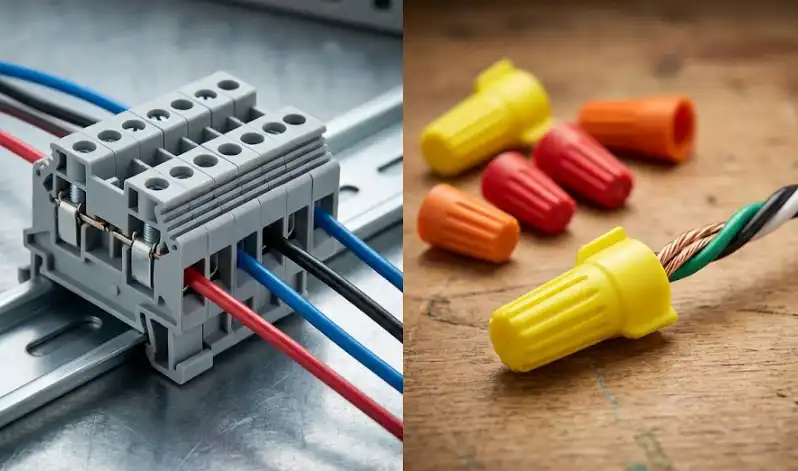
Over 70% of electrical connection failures in residential and light commercial settings trace back to one root cause: the wrong connector for the job. The debate over terminal block vs wire nut — which is better doesn’t have a single winner, because each connector dominates in fundamentally different scenarios. Terminal blocks deliver superior reliability in high-density, multi-conductor, and vibration-prone environments, while wire nuts remain the faster, cheaper choice for standard residential junction box splices — and picking the wrong one costs you time, money, or worse, a fire risk.
Terminal Blocks vs Wire Nuts — The Short Answer on Which to Use
Use terminal blocks when you need reusable, vibration-resistant connections — think industrial panels, outdoor enclosures, and any circuit you’ll troubleshoot later. Use wire nuts for quick, low-cost splices inside residential junction boxes where connections are made once and left alone.
Quick rule: If the connection will be opened more than once, use a terminal block. If it’s a permanent splice in a standard junction box, a wire nut does the job for a fraction of the cost.
So, terminal block vs wire nut — which is better? Neither wins universally. A $0.08 wire nut is perfectly code-compliant for a 15A residential lighting circuit. But that same wire nut inside a machine control cabinet? That’s asking for a loose connection and a service call. Context dictates the right connector, not brand loyalty.
Terminal blocks excel at organization, rated connections up to 600V, and tool-free re-termination. Wire nuts excel at speed — an experienced electrician can twist one on in under five seconds. The sections below break down reliability, cost, NEC compliance, and real-world preferences from working electricians so you can match the connector to your specific project.
What Are Terminal Blocks and How Do They Work
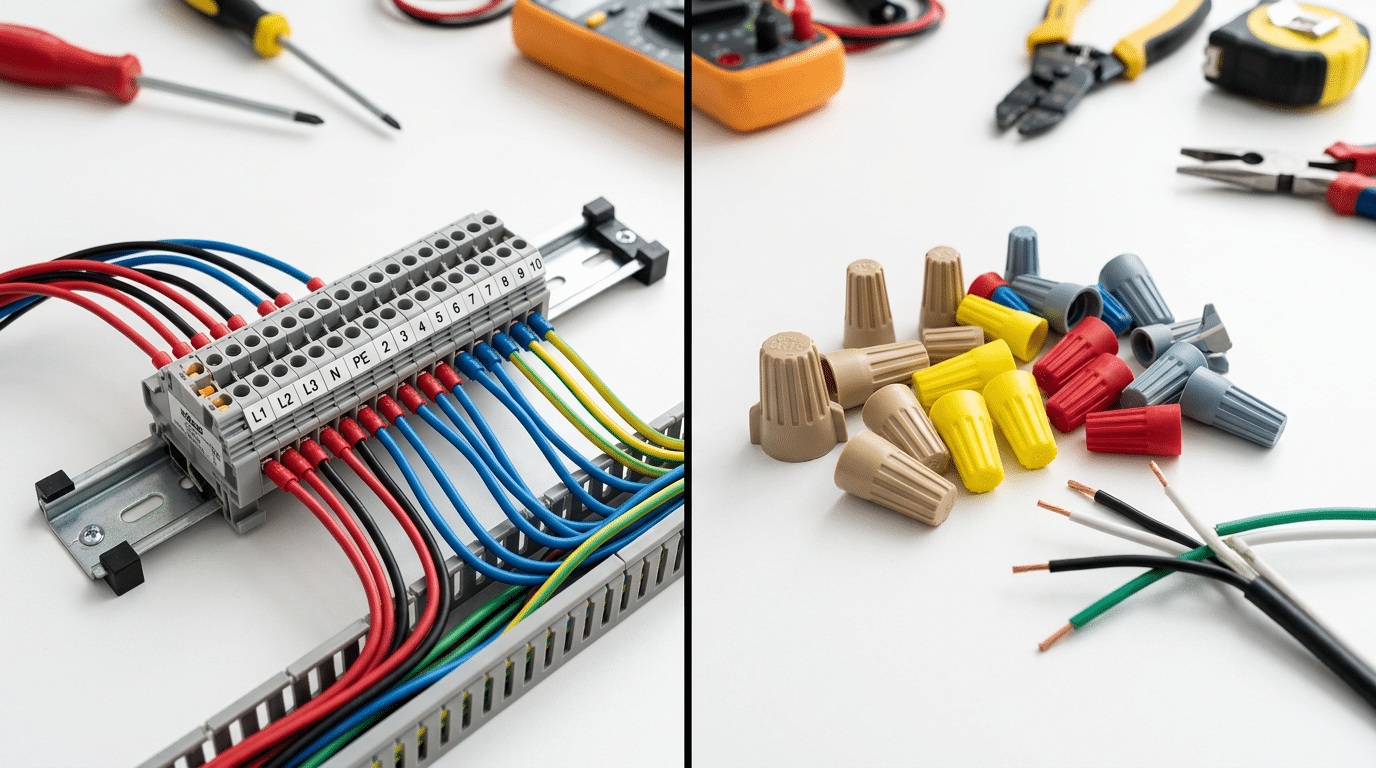
A terminal block is a modular connector that joins two or more wires through a clamping mechanism housed inside an insulated body — typically nylon or polycarbonate. Unlike twist-on connectors, terminal blocks create a mechanical connection without deforming the conductor, which means you can disconnect and reconnect wires repeatedly without degrading the joint.
Three main varieties dominate the market:
- Screw-type terminal blocks — a screw tightens a metal plate against the stripped conductor. Common in panel wiring and DIN rail applications.
- Push-in (spring-cage) connectors — brands like Wago lever nuts (221 series) use a spring-loaded clamp you engage with a small lever. No tools required, solid or stranded wire accepted.
- Barrier terminal blocks — feature raised walls between each connection point, preventing accidental shorts in high-voltage or multi-circuit environments.
Why does this modular design matter when debating terminal block vs wire nut — which is better? Troubleshooting. Pull one lever or loosen one screw, and you isolate a single conductor without disturbing the rest of the circuit. In a junction box stuffed with six connections, that difference saves real time.
Each connection point is rated for specific wire gauges (commonly 24–10 AWG) and amperage limits. Wago’s 221 series, for example, handles up to 20A at 600V per IEC standards — specs verified on Wago’s official product page. Always match the block’s rating to your circuit requirements.

What Are Wire Nuts and When Should You Use Them
A wire nut — technically called a twist-on wire connector — is deceptively simple. It’s a tapered plastic shell housing a conical steel spring coil. You strip about ¾ inch of insulation from each conductor, hold the bare ends together, and twist the connector clockwise. The spring coil threads onto the conductors, biting into the copper and pulling the wires tighter as you turn. No tools beyond a wire stripper required.
Size matters here. Manufacturers like Ideal Industries and 3M use a color-coded system — typically gray (smallest, for 22 AWG), blue, orange, yellow, and red (largest, handling up to three 10 AWG conductors). Each color corresponds to a specific wire gauge range and maximum conductor count, printed right on the packaging. Mixing up sizes is one of the most common DIY mistakes and a leading cause of loose connections.
So where do wire nuts still make sense? Residential junction boxes, light fixture hookups, and single-circuit splices inside walls — anywhere the connection is made once and left alone. They’re UL Listed, fully NEC-compliant, and cost roughly $0.05–$0.15 each. When debating terminal block vs wire nut which is better, wire nuts win on raw simplicity for straightforward residential splices that won’t be revisited.
Quick rule of thumb: if you’re joining 2–3 solid copper wires of the same gauge in a standard junction box, a properly sized wire nut is hard to beat on cost and speed.
Side-by-Side Comparison of Terminal Blocks and Wire Nuts
Deciding the terminal block vs wire nut debate requires looking at measurable criteria, not opinions. The table below distills six factors that matter most in real installations.
| Criteria | Terminal Block | Wire Nut |
|---|---|---|
| Connection Reliability | High — mechanical clamp maintains consistent contact pressure | Moderate — depends on proper twist technique and correct sizing |
| Ease of Installation | Requires strip length precision; tool-free on push-in types | Fast for experienced hands; beginners often under-twist |
| Reusability | Fully reusable — wires release cleanly | Single-use in practice; spring deforms after removal |
| Vibration Resistance | Excellent — screw or spring clamp locks wire in place | Poor — vibration loosens twisted conductors over time |
| Wire Gauge Range | Broad — many models accept 28 AWG to 4 AWG on a single block | Narrow — each nut size covers roughly 2–3 gauge combinations |
| Space Required | Larger footprint; needs DIN rail or panel mounting | Compact; fits easily inside standard junction boxes |
Wire nuts win on compactness and upfront cost — roughly $0.05–$0.15 each versus $0.50–$2.00 per terminal position. But that cost gap narrows fast when you factor in troubleshooting time from a failed twist connection.
Which is better? The answer shifts with your environment. A cramped residential box favors wire nuts. An industrial panel where circuits get reconfigured quarterly demands terminal blocks. Use the criteria above to match the connector to your specific conditions rather than defaulting to habit.
Connection Reliability and Long-Term Performance
Every electrical connection degrades over time. The real question when comparing terminal block vs wire nut — which is better for long-term reliability — comes down to one factor: consistent contact pressure across thermal cycles.
Copper expands roughly 0.0000165 per degree Celsius. Under load, a 20-amp circuit heats conductors enough to cause micro-movement at the connection point. Terminal blocks counter this with spring-loaded or screw-clamped mechanisms that maintain force even as wires expand and contract. Wire nuts rely entirely on friction between twisted conductors and the spring insert — and that friction weakens with every thermal cycle.
A study referenced by the CPSC (Consumer Product Safety Commission) found that loose connections are a leading contributor to electrical fires in residential settings, with improperly installed twist-on connectors frequently cited.
Oxidation compounds the problem. Exposed copper inside a wire nut can develop a resistive oxide layer over years, generating heat at the junction. Terminal blocks with gas-tight clamping — particularly Wago 221 lever connectors and Phoenix Contact push-in types — compress the conductor enough to break through oxide layers and prevent new formation.
Does this mean wire nuts always fail? No. A properly torqued wire nut on solid copper in a dry, temperature-stable junction box can last decades. But “properly installed” is doing heavy lifting in that sentence. Terminal blocks remove the installer-skill variable almost entirely, delivering repeatable contact pressure every time.
Installation Speed and Skill Level Required
A seasoned electrician can twist on a wire nut in roughly 10–15 seconds per splice. Strip, twist conductors together, cap, and move on. For a single two-wire junction in a residential box, nothing beats that pace. But speed without consistency is a liability — and that’s where the skill gap matters.
Wire nuts demand proper technique: matching the connector size to wire gauge, twisting conductors the right number of turns, and pulling to verify a secure hold. Get any step wrong and you’ve created a latent failure. Apprentices and DIYers routinely under-twist or skip the tug test, which is why inspectors flag loose wire nuts more than almost any other defect.
Terminal blocks flip the equation. Each connection takes 20–30 seconds — slightly slower per wire — but the process is nearly foolproof. Wago 221 lever connectors, for example, require only a strip and a click. No torque judgment, no guesswork on rotation count. When you’re weighing terminal block vs wire nut which is better for a less experienced installer, the lower error rate of terminal blocks often outweighs the few extra seconds per splice.
Where terminal blocks truly save time is in complex, multi-conductor junctions. Splicing five or six wires under a single wire nut is awkward and unreliable. A DIN-rail terminal strip handles the same junction cleanly, and adding or removing a circuit later takes seconds instead of unraveling an entire bundle.
Rule of thumb: wire nuts win on raw speed for simple two-wire splices; terminal blocks win on total project time whenever you have more than three conductors per junction or anticipate future modifications.
Safety and NEC Code Compliance for Each Connector Type
Both wire nuts and terminal blocks are legal under the National Electrical Code — full stop. NEC Article 110.14 requires all splicing devices to be UL Listed (or equivalent NRTL certified) and installed according to manufacturer instructions. If a connector carries a UL listing, an inspector has no grounds to reject it based on type alone.
Here’s where confusion creeps in. NEC 314.29 mandates that all junction boxes remain accessible — no burying splices behind drywall without a cover plate. This rule applies equally regardless of whether you use a Wago lever connector, a traditional wire nut, or a DIN rail terminal block. The connector doesn’t exempt you from accessibility requirements.
A common misconception: push-in connectors like Wago 221 series aren’t “code approved.” They absolutely are. Wago’s lever-style connectors hold UL 486C listing, the same standard governing twist-on wire connectors.
When evaluating terminal block vs wire nut which is better for code compliance, the real differentiator is installation quality, not product category. A poorly torqued wire nut that loosens over time creates an arc fault hazard — the #1 cause of electrical fires according to the U.S. Consumer Product Safety Commission. Terminal blocks with spring-cage or screw-clamp mechanisms reduce this human-error variable significantly.
For commercial applications governed by NEC Article 409 (industrial control panels), terminal blocks aren’t just preferred — they’re essentially required for maintainability. Residential work under NEC Article 334 (NM cable) permits either method freely.
Real Cost Breakdown Per Connection
A bag of 100 wire nuts costs roughly $8–$15, putting each connection at about $0.10. A comparable Wago 221 lever connector runs $0.50–$0.75 per port, and DIN-rail terminal blocks land between $1.00–$3.00 each. On sticker price alone, wire nuts win by a landslide. But sticker price is a terrible way to evaluate the terminal block vs wire nut question.
Labor is where the math flips. If a commercial electrician bills at $85/hour and spends 30 extra seconds per wire nut connection (stripping, twisting, taping, tucking), that’s roughly $0.70 in labor per splice. Terminal blocks with tool-free lever clamps cut that time nearly in half. Multiply the difference across a 200-connection panel, and you’ve saved $70+ in labor — more than offsetting the higher material cost.
Rework and maintenance costs seal the deal for larger projects. Industry data from electrical contractors suggests wire nut callbacks account for a disproportionate share of warranty service calls, each costing $150–$300 in truck rolls and diagnostic time. Terminal blocks, being individually removable and re-testable, slash troubleshooting time by 60% or more.
Rule of thumb: Under 20 connections in a residential setting, wire nuts are cheaper overall. Above that threshold — especially in commercial or industrial work — terminal blocks deliver a lower total cost of ownership.
So which is better from a pure cost standpoint? For a single junction box in your garage, grab the wire nuts. For a control panel with dozens of circuits, terminal blocks pay for themselves before the project is even commissioned.
Which Connector Is Better for Specific Applications
There’s no universal winner in the terminal block vs wire nut debate — the right answer shifts with every application. Here’s a quick-reference breakdown:
| Application | Best Choice | Why |
|---|---|---|
| Residential junction boxes | Wire nuts | Cheap, inspector-familiar, plenty of box space |
| Outdoor / wet locations | Terminal blocks (IP-rated) | Sealed housings resist moisture ingress far better than tape-wrapped wire nuts |
| High-amperage circuits (40 A+) | Bolted terminal blocks | Torque-spec fasteners prevent heat buildup at high current loads |
| Control panels & automation | DIN-rail terminal blocks | Labeled, organized, and easy to troubleshoot without disrupting adjacent circuits |
| Low-voltage (doorbells, thermostats) | Either — lean toward lever connectors | Wago-style blocks simplify multi-conductor splices in tight spaces |
| Temporary / construction wiring | Wire nuts | Fast to install, fast to remove, disposable cost |
Outdoor installations deserve extra attention. A standard wire nut rated for dry locations will corrode within a single season if exposed to condensation. Gel-filled variants help, but an IP67-rated terminal enclosure is the more reliable long-term fix.
Asking which connector is better for a specific application forces you to weigh environment, current draw, and maintenance frequency — not just price. Match the connector to the demand, and you’ll avoid callbacks.
Residential Junction Boxes and Home Wiring
Walk into any American home built after 1960, crack open a junction box, and you’ll find wire nuts. Lots of them. They dominate residential electrical work for one straightforward reason: electricians can splice 14 AWG and 12 AWG Romex (NM-B cable) in seconds, and a box of 100 connectors costs less than a fast-food lunch. For standard 15A and 20A branch circuits — lighting, outlets, switches — wire nuts remain the default choice among licensed pros.
But the landscape is shifting. Wago 221 lever connectors have carved out serious territory in residential junction boxes, especially among DIY homeowners tackling switch replacements or ceiling fan installs. Why? No twisting, no guessing about torque, and a transparent housing that lets you visually confirm a solid strip-length insertion. The learning curve drops to nearly zero.
When debating terminal block vs wire nut — which is better for home wiring, the honest answer depends on who’s doing the work. A journeyman electrician with 10,000 hours of wire-nut experience won’t gain much from switching. A homeowner replacing a three-way switch for the first time absolutely benefits from lever-style terminal blocks that eliminate the most common amateur mistake: under-twisted splices that loosen over years of thermal cycling.
Practical tip: If your junction box is already crowded with wire nuts, switching to compact Wago connectors can reclaim 20–30% of box fill volume — meaningful when NEC 314.16 box-fill calculations are tight.
For new-construction residential projects, wire nuts still win on cost at scale. For remodels, repairs, and homeowner-accessible boxes, Wago-style connectors are gaining ground fast — and for good reason.
Industrial, Outdoor, and High-Amp Circuits

Wire nuts have no place inside an industrial control panel. That’s not opinion — it’s practical reality backed by UL 508A standards for industrial control panel fabrication, which demand organized, serviceable terminations on DIN rails. When asking terminal block vs wire nut — which is better for these environments, the answer is unambiguous.
Vibration kills wire nut connections. A motor control center or outdoor HVAC enclosure endures constant mechanical stress, and twist-on connectors gradually loosen under those conditions. DIN-rail terminal blocks from manufacturers like Phoenix Contact, Weidmüller, and Allen-Bradley use spring-cage or screw-clamp mechanisms rated for vibration levels exceeding IEC 60068-2-6 standards — something no wire nut can match.
Why High-Amp Circuits Demand Terminal Blocks
- Current capacity: Power distribution terminal blocks handle 100A+ on 4 AWG conductors; wire nuts top out around 20A in practical use.
- Serviceability: Swapping a VFD or relay means disconnecting individual wires — terminal blocks let technicians do this in seconds without cutting conductors.
- Outdoor durability: NEMA 4X-rated enclosures paired with terminal blocks resist moisture, UV, and temperature swings from −40°F to 230°F.
For any circuit above 30 amps, any panel subject to vibration, or any outdoor enclosure exposed to the elements, the terminal block vs wire nut comparison isn’t even close. Spend the extra $2–$5 per connection point — your maintenance crew will thank you for years.
Common Installation Mistakes to Avoid with Each Connector
Choosing the right connector only matters if you install it correctly. The debate over terminal block vs wire nut — which is better becomes irrelevant when a sloppy connection causes arcing, overheating, or a failed inspection.
Wire Nut Mistakes
- Under-twisting: A loose wire nut that spins freely hasn’t engaged the conductors. Pre-twist bare wires clockwise before threading the nut on — this alone prevents most failures.
- Mismatched sizing: Cramming four 12 AWG conductors into a small yellow nut exceeds its fill rating. Always check the manufacturer’s wire combination chart printed on the packaging.
- Uneven strip lengths: If one conductor is 1/4″ shorter than the others, it won’t seat properly and creates a high-resistance point.
Terminal Block Mistakes
- Over-stripping insulation: Exposed copper outside the housing invites shorts. Strip exactly to the strip-gauge mark on Wago or Phoenix Contact connectors.
- Incorrect torque on screw-type blocks: Too loose and the wire pulls free; too tight and you nick the conductor, weakening it. Use a torque screwdriver set to the manufacturer’s spec — typically 0.5–0.8 Nm for blocks rated up to 24 AWG.
- Wrong voltage or amperage rating: A 300V-rated block on a 480V circuit is a code violation and a fire risk, period.
One universal rule applies to both: never reuse a wire nut that’s been heated or deformed, and never force a stranded wire into a spring-cage terminal block designed exclusively for solid conductors. The UL White Book lists acceptable conductor types for every listed connector — consult it when in doubt.
What Professional Electricians Actually Prefer and Why
Ask ten electricians the terminal block vs wire nut — which is better question, and you’ll get answers shaped more by jobsite context than by any spec sheet. Residential pros increasingly reach for Wago 221 lever connectors, citing faster rough-in times and fewer callbacks from loose splices. A 2022 poll on the Electrician Talk forum showed roughly 60% of respondents had switched to lever-nut connectors for most residential splicing.
Commercial and industrial electricians tell a different story. DIN-rail terminal blocks from Phoenix Contact, Weidmüller, and Allen-Bradley dominate panel work — not because they’re trendy, but because troubleshooting a 40-circuit control panel wired with twist-on connectors would be a nightmare. The ability to disconnect and re-land a single conductor without disturbing neighboring wires isn’t a luxury; it’s a requirement when downtime costs $500+ per hour.
“Wire nuts work. They’ve worked for decades. But I stopped defending them in junction boxes once I tried lever connectors on a 200-device remodel.” — Licensed journeyman, 14 years residential experience
Trade experience reveals a clear pattern: the more complex or serviceable a system needs to be, the harder pros lean toward terminal blocks. For simple homerun splices in a single-gang box, many still grab a wire nut out of habit — and that habit isn’t wrong. What matters is matching the connector to the demand, not loyalty to one product.
Frequently Asked Questions About Terminal Blocks and Wire Nuts
Can you mix wire gauges in the same connector? Yes — with limits. Most wire nuts are rated for specific gauge combinations (e.g., one 14 AWG + two 12 AWG). Check the manufacturer’s chart on the packaging. Wago 221 lever connectors accept 24–12 AWG in any port combination, making mixed-gauge splices far simpler. DIN rail terminal blocks typically handle a single gauge range per block, so mixing requires separate terminals.
Are Wago connectors considered terminal blocks? Technically, Wago classifies its lever-nut and push-in models as “splicing connectors,” not terminal blocks. Their DIN rail–mounted products are terminal blocks. The distinction matters for panel labeling and NEC documentation, even though casual conversation lumps them together.
Are wire nuts being phased out? No. Wire nuts remain UL-listed, NEC-compliant, and widely stocked. However, push-in connectors are steadily gaining residential market share — particularly among DIYers asking terminal block vs wire nut which is better for ease of use.
Can I use terminal blocks in a residential junction box? Absolutely. Nothing in the NEC prohibits them. The connection just needs to remain accessible and housed in an approved enclosure. Many homeowners now retrofit Wago-style connectors into existing boxes without any code issues.
Making the Right Choice for Your Project
Stop asking terminal block vs wire nut — which is better as a blanket question. Ask instead: what does this specific circuit demand?
Here’s a quick decision framework:
- Budget under $20, simple residential splice, 14–12 AWG? Wire nuts. They’re proven, NEC-compliant, and every hardware store stocks them.
- Vibration, frequent maintenance access, or multi-conductor terminations? Terminal blocks — DIN-rail or lever-style — win every time.
- First-time DIYer uncomfortable twisting conductors? Wago 221 lever connectors eliminate the biggest installation error: under-torqued splices.
- Industrial panel, outdoor enclosure, or circuits above 30A? Skip wire nuts entirely. Use rated terminal blocks with proper torque specs.
Skill level matters more than most guides admit. A professional electrician with 20 years of muscle memory makes flawless wire nut connections. A homeowner doing their first junction box does not. Match the connector to your honest ability, not your ambition.
The best connector is the one installed correctly for the environment it lives in — not the one you’ve always used out of habit.
Budget, application, environment, and your own skill — weigh all four. That’s the real answer to the terminal block vs wire nut debate, and it will always be project-specific.
See also
Which terminal blocks do I need for my solar system?
Terminal Block or Connector Which One Fits Your Project
Why Choose Customized Terminal Blocks for Unique Electrical Needs
Combiner box and junction box: main differences