

Surge protectors (SPDs) and lightning arresters are common protective devices in electrical systems. Although they are all used to prevent device damage, their working principles, applicable situations, and protection mechanisms are completely different. This article will discuss the differences between surge protectors and lightning arresters in a systematic way, helping you make a scientific and reasonable choice.
What is a lightning arrester
Lightning arrester is a lightning protection device designed specifically for high-voltage power systems, mainly used to resist direct lightning strikes and operational overvoltages. Its core function is to quickly discharge lightning current or overvoltage energy to the ground through the nonlinear characteristics of metal oxides (such as zinc oxide), while limiting the duration and amplitude of the current, and protecting high-voltage equipment such as transformers and transmission lines
Typical scenarios: High voltage substations, transmission towers, large industrial distribution systems.

What is a surge protection device
Surge protectors (SPDs) are designed specifically for low-voltage distribution systems and electronic equipment, providing protection against induced lightning and internal surges. It uses voltage limiting or switching technology to clamp transient overvoltage within a safe range in nanoseconds, protecting sensitive electronic instruments such as computers and communication equipment
Typical scenarios: household distribution boxes, data centers, communication base stations.
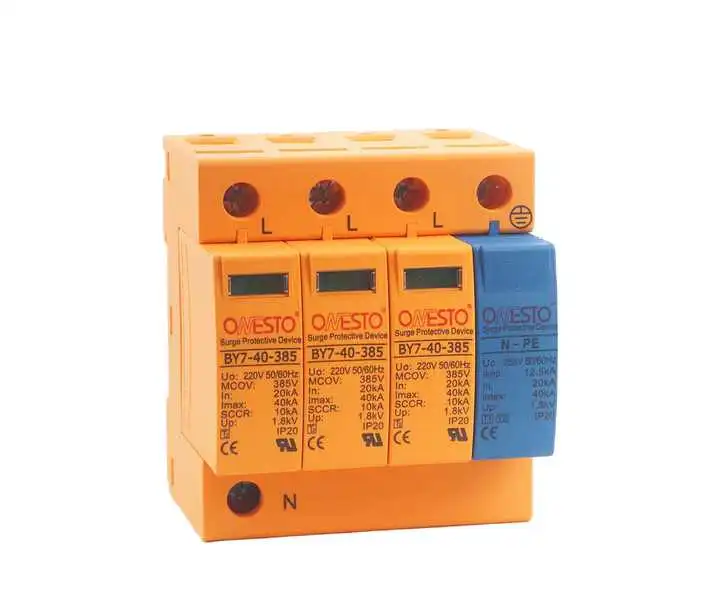
Surge Protection vs. Lightning Arrester
Surge protectors and lightning arresters both have the function of preventing overvoltage, especially lightning overvoltage, but there are still significant differences between the two in terms of application.
1. Surge protectors have multiple voltage levels, ranging from 0.38KV low voltage to 500KV ultra-high voltage, while surge protectors generally only have low voltage products.
2. Surge protectors are often installed on primary systems to prevent direct intrusion of lightning waves, while surge protectors are mostly installed on secondary systems as a supplementary measure after the lightning arrester eliminates the direct intrusion of lightning waves or when the lightning arrester has not completely eliminated the lightning waves.
3. Lightning arresters are used to protect electrical equipment, while surge protectors are mostly used to protect electronic instruments or meters.
4. Surge protectors, due to their connection to the electrical primary system, require sufficient external insulation performance and have a relatively large appearance size, while surge protectors, due to their connection to low voltage, can be made in a very small size.
| Parameter | Lightning Arrester | Surge Protective Device (SPD) |
|---|---|---|
| Core Element | Zinc oxide valve plate, spark gap | Metal Oxide Varistor (MOV), gas discharge tube |
| Response Time | Above 100ns | 1-25ns |
| Current (In) | 1kA-20kA (resisting direct lightning current) | 3kA-120kA (multi-stage pool inductive lightning current) |
| Residual Voltage (Up) | >10kV | <3kV |
| Typical Types | Discharge type, tube type, zinc oxide lightning arrester | Voltage switch type, clamping type, combination type |
Read the following article for more information:
Type 1 and Type 2 surge devices explained in 5 steps
What You Need to Know About Surge Protection Device Lifespan
How to Replace a Surge Protector Safely and Efficiently
