You must pick the right DC circuit breaker to keep your RV or boat safe. Fires can happen in 12- and 24-volt battery systems if circuits get too full or are not protected well. Many boat fires start because of DC electrical issues, especially when wires get too hot from high amperage. There are different breakers you can use, like ELCI, toggle, or thermal types. Always look at the device ratings and make sure the breaker fits your system for safe and steady power.
Key Takeaways
- Make a list of all electrical devices in your RV or boat. This helps you know how much power each device needs. It also helps you pick the right DC circuit breaker size.
- Use the 125% rule when you pick a circuit breaker. Your breaker should be rated for at least 1.25 times the highest current in your system. This keeps things safe.
- Match your circuit breaker to the ampacity of your smallest wire. This stops wires from getting too hot. It also helps prevent fires.
- Think about inrush currents when you choose breakers. Some devices use more power when they start up. Pick breakers that can handle these power spikes.
- Check and test your circuit breakers often to find problems early. Use a multimeter to check for continuity and resistance.
Identify Loads and Power Ratings
List All Devices
Start by making a list of every electrical device you plan to use in your RV or boat. This step helps you see which items will draw power from your battery system. Write down things like lights, fans, heaters, kitchen appliances, entertainment systems, and chargers. You should include both small and large devices. If you forget something, you might choose the wrong DC circuit breaker size and risk damaging your system.
Here is a table showing the typical amperage draws for common RV and boat equipment:
| EQUIPMENT | AMPERAGE DRAWS |
|---|---|
| RV Converter (charging) | 1-8 Amps |
| Lights (per bulb) | 0.5 -1.5 Amps |
| Water Heater (6-gallon, heating) | 8-13 Amps |
| RV Air Conditioner (Start-up) | 16-18 Amps |
| RV Air Conditioner (Running) | 13-16 Amps |
| Refrigerator | 5-8 Amps |
| Microwave Oven (Standard) | 7-13 Amps |
| Coffee Maker | 5-8 Amps |
| Electric Kettle | 6-12 Amps |
| Television HD, Digital | 1.5-4 Amps |
| Computer (Laptop) | 2-3 Amps |
| Golf Cart Charger | 13-21 Amps |
Tip: You can find the power ratings for most devices on their labels or in the user manual. If you cannot find the information, search for the model online.
Find Amperage and Power Ratings
After you list your devices, check each one for its power rating. You need to know how much current each item uses. Look for the amperage or wattage on the device label. If you see only watts, you can use the formula:
Amps = Watts ÷ Volts
For example, if your microwave uses 1200 watts and your system runs at 12 volts, the current draw is:
1200 ÷ 12 = 100 Amps
To get accurate numbers, follow these steps:
- Check the maximum expected current draw for each device.
- For devices that run for 30 minutes or longer, increase the load current by 25% when choosing wire size.
- Estimate your total electrical load by adding up the devices you plan to use and how long you use them.
This process helps you select the right DC circuit breaker and keeps your system safe.
Calculate Total Amperage
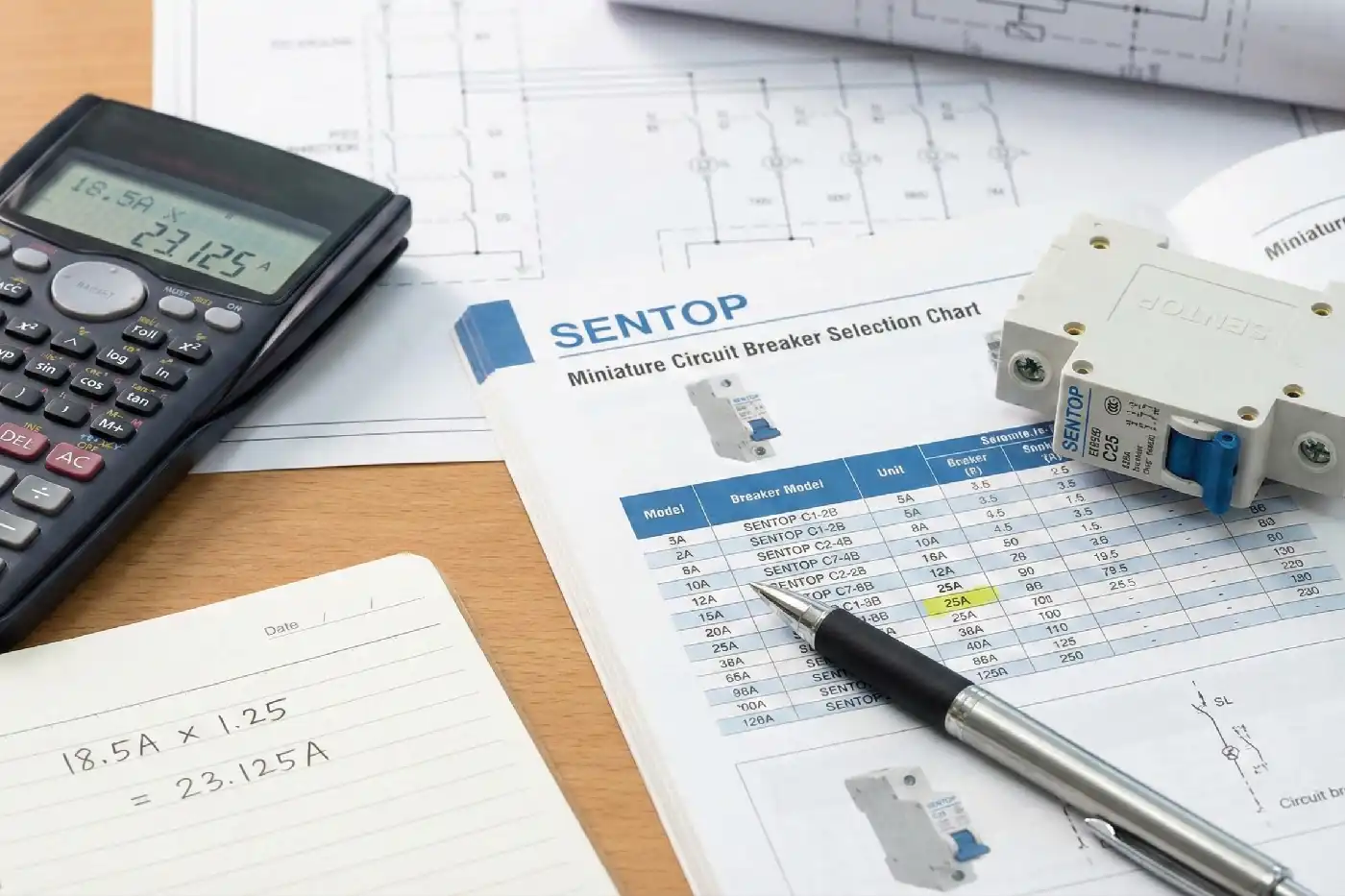
Use the Power Formula
You need to know how much current each device will draw before you choose a DC circuit breaker. The easiest way to do this is by using the power formula. Most devices list their power in watts and their voltage. You can use these numbers to find the amperage. The formula looks like this:
| Watts | Volts | Amps |
|---|---|---|
| P | V | I |
| P = V × I |
To find the amps, divide the watts by the volts. For example, if a device uses 240 watts and your system runs at 12 volts, you get:
Amps = 240 ÷ 12 = 20
You should repeat this step for every device on your list. This helps you see how much current each item will pull from your battery.
Tip: Always use the highest watt rating listed for each device. This gives you a safer estimate and helps prevent overloads.
Add Up All Loads
After you calculate the amps for each device, you need to add them together. This gives you the total amperage your system will use. Follow these steps:
- Calculate the amp sage for each device by finding its wattage and voltage. Use the formula: watts divided by voltage equals amps.
- Sum the amp values for all devices to get the total system amperage.
- For devices using inverters, double the calculated amps to account for power loss during conversion.
You should include every device that might run at the same time. If you plan to use an inverter, remember that it uses extra power. Doubling the amps for inverter loads helps you avoid surprises. When you know your total amperage, you can pick the right DC circuit breaker for your system. This step keeps your wires safe and helps prevent overheating.
DC Circuit Breaker Sizing Rules
Apply the 125% Rule
You should pick a DC circuit breaker with a safety margin. The 125% rule is the most common way to do this. It means your breaker should be rated for at least 1.25 times your system’s highest current. This extra amount helps stop wires and devices from getting too hot. Safety groups say this is a good idea. Choose breakers rated for at least 125% of your system’s top voltage and current. Some experts say you can go up to 150% for more protection.
The 125% rule comes from important electrical codes. These codes help keep wiring and breaker sizing safe. Here is a table that shows where this rule is found in the National Electrical Code (NEC):
| NEC Section | Description |
|---|---|
| 210.19(A)(1) | Sizing of conductors for continuous loads |
| 210.20(A) | Overcurrent protection for conductors |
| 215.2(A)(1) | Sizing of feeders for continuous loads |
| 215.3 | Sizing of branch circuits for continuous loads |
| 230.42 | Sizing of service conductors for continuous loads |
| 690.8(B) | Sizing of PV system circuits as continuous loads |
Note: Always use the highest load you expect when using the 125% rule. This keeps your system safe when you use lots of power.
Match Breaker to Wire Ampacity
You must match your DC circuit breaker to the ampacity of your smallest wire. Ampacity is the most current a wire can safely carry. If your breaker is too big for your wire, it can get too hot and start a fire. The breaker should never be bigger than the wire’s ampacity.
Bad things can happen if you skip this rule. Here are some problems you might see:
- More voltage drop
- Wires getting too hot
- Safety risks in your electrical system
Always check your wire size before you pick your breaker. If your wire is too small, it cannot handle the current. This can hurt your RV or boat and cause danger.
You also need to think about voltage drop, especially if your wires are long. Voltage drop means you lose voltage as electricity moves through the wire. If your wire is too thin or too long, your devices may not work right. You can fix this by using thicker wires or picking a breaker for higher current.
Here are some tips for sizing your DC circuit breaker to stop voltage drop:
- Size your cable and main panel breaker to avoid too much load. This keeps your system safe and working well.
- Try to keep line loss under 3%. Too much loss can make voltage drop a lot.
- If you think you will use 40 amps, try sizing your breaker for 50 amps. This gives you a safety margin and helps lower line loss.
Tip: Always check both wire ampacity and expected load before you put in a DC circuit breaker. This helps you avoid mistakes and keeps your system safe.
Special Considerations
Inrush Currents
When you turn on certain DC appliances in your RV or boat, you may notice a quick surge in current. This surge is called inrush current. It happens for a short time when motors or compressors start up. If you do not size your circuit breaker for these spikes, your breaker might trip even though your system is safe.
Here is a table showing typical inrush currents for common DC appliances:
| Appliance | Inrush Current (Amps) | Duration (Seconds) |
|---|---|---|
| Refrigerator | 13 | 0.5 |
| Well Pump | 18 | 0.2 |
You should always check the inrush current for your devices. If your refrigerator or pump starts, the current can jump much higher than the running value. Choose a breaker that can handle these short bursts without tripping. Some breakers have a delay feature that helps with inrush currents.
Tip: Look for circuit breakers with time-delay ratings if you use appliances with high inrush currents. This keeps your system running smoothly.
Voltage Drop and Distance
Voltage drop can cause problems in DC circuits, especially when you run wires over long distances. If the voltage drops too much, your devices may not work right or may get damaged. You need to think about wire size and distance when you plan your system.
- An 8-foot run for a 50 amp cable needs 2 AWG wire. An 18-inch run with 6 AWG wire works for the same amperage.
- Longer wires mean more voltage drop. You must use thicker wires for longer runs.
Here are some ways to reduce voltage drop:
- Oversize your main cables to improve efficiency and cut down heat loss.
- Keep voltage drop under 3%. This is a good target for most DC systems.
- If you use a large inverter, even a small voltage drop can waste a lot of energy. For example, a 3000W inverter using 250A can lose 7A with just a 3% drop.
Busbars made from highly conductive materials help lower voltage drop and resistance. They make power transmission more efficient and keep your system working well.
Note: Always measure the distance and choose the right wire size. This protects your devices and helps your system last longer.
Sizing Example
Step-by-Step Calculation
Let’s look at a real example. You need to pick a DC circuit breaker for a 12V battery system. This system powers a 2000W inverter. You must think about inverter efficiency. Efficiency changes how much current your system uses.
- Find the inverter’s efficiency. Most inverters work at about 91% efficiency. Some energy is lost as heat.
- Calculate the current draw. Use this formula:
Breaker Amps = Inverter Power in Watts ÷ Battery Voltage ÷ Inverter Efficiency × 1.25 - Plug in the numbers.
- Inverter Power: 2000W
- Battery Voltage: 12V
- Inverter Efficiency: 0.91
- Safety Margin: 1.25 (for 125% rule)
- Do the math.
- First, divide 2000W by 12V:
2000 ÷ 12 = 166.67 Amps - Next, divide by efficiency:
166.67 ÷ 0.91 ≈ 183.2 Amps - Finally, multiply by 1.25:
183.2 × 1.25 ≈ 229 Amps
- First, divide 2000W by 12V:
- Choose your breaker. Pick a DC circuit breaker rated for at least 229 amps. Always round up to the next standard size. A 230A breaker is a safe choice.
Note: Inverter inefficiency means your system uses more current than you might think. Always include this in your calculation.
You can use this method for any inverter size. Just change the numbers to match your system.
Mistake Examples
Many people make errors when sizing DC circuit breakers. These mistakes can make your system unsafe or damage your equipment. Here are some common problems and how to avoid them:
| Mistake Description | Explanation |
|---|---|
| Using breaker as on/off switch | Breakers protect circuits. Use a separate switch for daily use. |
| Mixing breaker and conductor sizes | Never use a breaker larger than your smallest wire’s ampacity. |
| Installing breaker after the load | Put breakers close to the power source to protect the whole circuit. |
| Ignoring ambient temperature | High temperatures can make breakers trip early. Use proper derating. |
| Daisy-chaining multiple loads | Connect each high-current load to its own breaker to stop hot spots. |
| Using AC-rated breakers | Only use breakers rated for DC circuits. AC breakers do not work for DC. |
Tip: Always check your wire size, breaker rating, and installation spot before you finish your project.
You can avoid most mistakes by following these steps and checking your work. If you feel unsure, ask a professional for help.
Installation and Safety Tips
Breaker Placement

You need to place your DC circuit breaker in the right spot to protect your RV or boat. Always install the breaker as close as possible to the power source. This setup helps stop damage if a short circuit happens near the battery. You should put the breaker on the positive side of your DC circuit. This placement protects the whole circuit from overloads and faults.
Here are some key points for breaker placement:
- Mount the breaker within 7 inches of the battery if possible.
- Use a breaker that matches your system’s voltage and current.
- Make sure the breaker is easy to reach for inspection or reset.
- Avoid placing the breaker in areas with high heat or moisture.
Tip: A breaker close to the battery gives you the best protection. It stops problems before they reach your wires or devices.
Secure Connections
You must make strong and safe connections when installing your DC circuit breaker. Good connections keep your system reliable and prevent fires or power loss. Follow these best practices:
- Use mechanical connections instead of relying only on soldering. This method meets ABYC standards and gives you a solid bond.
- Crimp your wires with a quality crimper made for your terminal size. Crimping resists vibration and strain better than twisting or using wire nuts.
- Never twist wires together or use household wire nuts. These methods can loosen over time and cause hot spots.
- Support your wires every 18 inches. This step stops wires from flexing and breaking due to movement.
- Choose the right terminal for your wire size. For example, a 16 AWG connector can handle a 15-pound pull, while a 10 AWG terminal is rated for 40 pounds. A 00 battery cable terminal can withstand up to 150 pounds.
Note: Secure connections keep your system safe and help your DC circuit breaker work as designed. Always double-check your work before powering up.
Maintenance and Troubleshooting
Inspection and Testing
You should inspect your DC circuit breakers regularly to keep your RV or boat safe. Dust, moisture, and vibration can affect how well your breakers work. You can test your breaker with simple tools like a multimeter. Here are three reliable steps you can follow:
- Continuity Check: Set your multimeter to continuity mode. Place the probes on the terminal screws while the breaker is in the ‘ON’ position. If you hear a continuous tone, your breaker works well.
- Resistance Measurement: Keep the breaker in the ‘ON’ position. Measure the resistance across the terminals. A good breaker shows a very low resistance, close to zero ohms. If you see a high resistance, your breaker may have a problem.
- Voltage Test: Power the circuit and measure the voltage across the breaker. If you find voltage on one side but not the other when the breaker is ‘ON,’ the breaker may be faulty.
Tip: Test your breakers at least once a year. Regular checks help you catch problems early and avoid electrical failures.
When to Replace
You may need to replace your DC circuit breaker if you notice certain signs. Breakers can wear out over time, especially in marine environments where salt and moisture speed up corrosion. Using a breaker as an on/off switch can also wear out the trip mechanism and reduce its lifespan.
- Circuit breakers in boats often have a shorter lifespan than those in RVs.
- If your breaker trips often or feels loose, you should consider replacing it.
- Corrosion, rust, or visible damage means your breaker may not protect your system.
- If you notice burning smells or melted plastic, replace the breaker right away.
Note: Always use a breaker rated for DC circuits. Replace old or damaged breakers before they fail to keep your RV or boat safe.
You can pick the right DC circuit breaker by making a list of all your devices. Add up how much current they use. Use the 125% safety margin to stay safe. Make sure your breaker matches your wire’s ampacity. Watch out for inrush currents and voltage drop. Check your math before you install anything. If you need help, look at trusted resources:
| Resource/Organization | Description |
|---|---|
| American Boat and Yacht Council (ABYC) | Gives rules and standards for marine electrical systems, including how to size circuit breakers. |
| Circuit Wizard (Blue Sea Systems) | This online tool helps you choose wire sizes and circuit protection using your input. |
If you are not sure, ask a professional for help.
FAQ
How do you know if a breaker is rated for DC?
Check the label on the breaker. You should see “DC” or a voltage rating like “12V DC” or “24V DC.” If you only see “AC,” do not use it for your RV or boat.
Can you use the same breaker for AC and DC circuits?
No, you cannot. AC and DC breakers work differently. DC breakers handle constant current and higher arc energy. Always use a breaker designed for DC circuits in your system.
What happens if you oversize the breaker?
If you choose a breaker that is too large, it may not trip during an overload. Your wires can overheat and start a fire. Always match the breaker to your wire’s ampacity.
How often should you test your DC circuit breakers?
Test your breakers at least once a year. Use a multimeter to check for continuity and resistance. Regular testing helps you catch problems early and keeps your system safe.
See also
What Appliances Require a 30 Ampere Circuit Breaker
Why a bad circuit breaker can cause low voltage
What Is the Maximum Number of Sockets on a 20A Circuit Breaker
What is the Right Socket for Your Home, 15 Ampere or 20 Ampere
Price of molded case circuit breaker what you need to know