

The main difference between a high voltage circuit breaker and a low voltage circuit breaker is the level of electrical voltage each is designed to safely manage. A high voltage circuit breaker is typically used in factories and large buildings, where it can control significant amounts of power and protect against major short circuits or sudden electrical surges. On the other hand, a low voltage circuit breaker is commonly found in homes and smart cities, making it ideal for smaller electrical tasks while being safer and more cost-effective. Understanding when to use a high voltage circuit breaker and when to use a low voltage circuit breaker is essential for preventing electrical hazards and ensuring compliance with safety regulations.
Key Takeaways
- High voltage circuit breakers work with voltages over 35kV. They are used in factories and power plants.
- Low voltage circuit breakers handle up to 600V. They are good for homes and small businesses. They help keep things safe and save money.
- Regular maintenance is very important. High voltage breakers need checks every 6 to 12 months. Low voltage breakers need checks every 1 to 3 years.
- Knowing what voltage you need is important. It helps stop electrical dangers and keeps people safe.
- Pick the right circuit breaker for your needs. This protects you from overloads and problems. It makes your place safer.
High voltage circuit breaker and low voltage circuit breaker: definitions
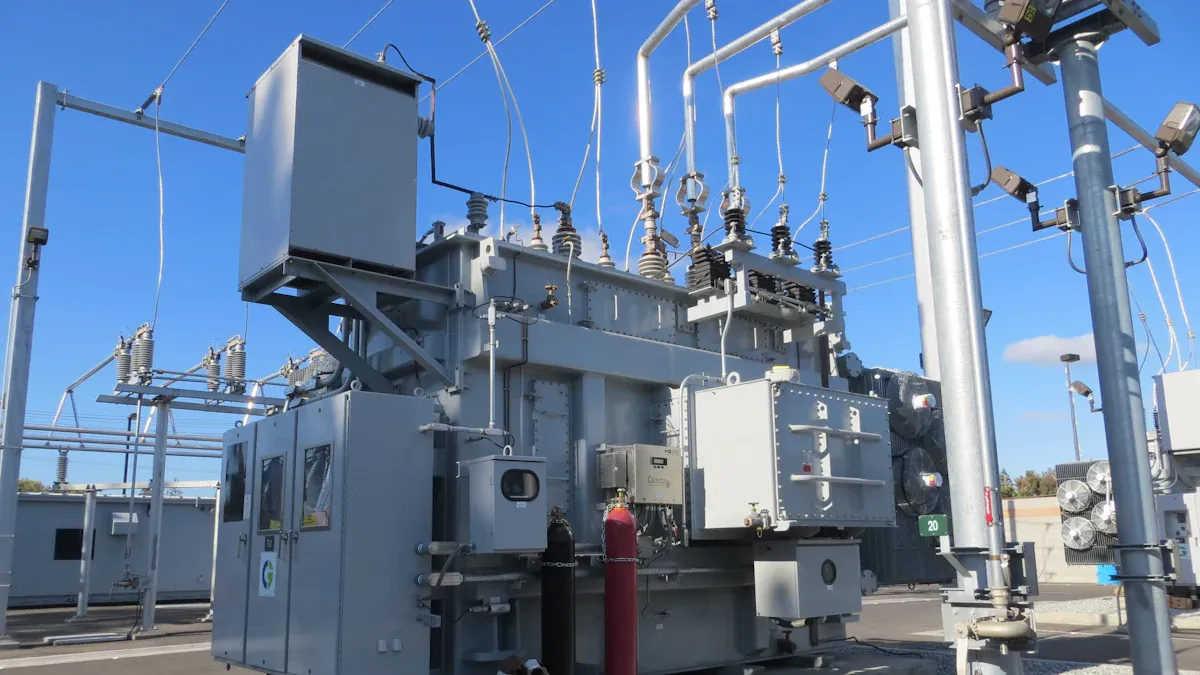
High voltage circuit breaker
A high voltage circuit breaker controls and protects systems with very high voltages. People use them in places like power plants and big factories. These devices work with voltages from 3.6kV to 126kV, or even more. You often see them outside because they move electricity over long distances. High voltage circuit breakers have special arc-extinguishing parts. These parts stop dangerous arcs fast and safely. They break high short-circuit currents and keep big electrical networks safe.
Tip: High voltage circuit breakers help with power transmission and distribution. Use them for voltages above 35kV.
Here is a table that shows the main technical features:
| Characteristic | High-Voltage Circuit Breakers |
|---|---|
| Rated Voltage | 3.6kV to 126kV |
| Rated Current | Up to 3150A |
| Rated Breaking Current | Can break high short-circuit currents |
| Arc-Extinguishing Mechanism | Advanced mechanisms for high-voltage applications |
Low voltage circuit breaker
A low voltage circuit breaker protects circuits in homes, schools, offices, and small factories. These devices work with voltages up to 600V, and sometimes up to 2kV for special jobs. You find them inside buildings. They keep people and equipment safe from electrical problems. Low voltage circuit breakers have simpler arc-extinguishing parts. They break lower short-circuit currents. They are easy to install and take care of. People pick them for smaller jobs because they cost less and work well.
Here is a table showing common types and their uses:
| Circuit Breaker Type | Typical Voltage Range | Applications |
|---|---|---|
| Miniature Circuit Breaker (MCB) | Up to 125 amps | Household circuits, small commercial setups |
| Moulded Case Circuit Breaker (MCCB) | Up to 1600 amps | Industrial plants, high-power electrical systems |
| Air Circuit Breaker (ACB) | Up to 6300 amps | Large industrial facilities, main power distribution |
| Residual Current Circuit Breaker (RCCB) | Up to 100 amps | Residential buildings, commercial properties |
Note: Use low voltage circuit breakers indoors for everyday protection.
Voltage ranges
You can tell the difference between high voltage circuit breaker and low voltage circuit breaker by looking at their voltage ranges. High voltage circuit breakers work with voltages above 35kV. In power transmission, you see ranges from 110kV to 765kV. Low voltage circuit breakers work up to 600V, but some go up to 2kV for special cases.
Here is a table that shows the voltage ranges:
| Voltage Range (kV) | Classification |
|---|---|
| Up to 2 | Low Voltage |
| 3.6 – 35 | Medium Voltage |
| 35 – 765 | High Voltage |
International standards like IEC and ANSI help you know the differences. IEC 62271-100 talks about performance and design for high voltage circuit breakers. ANSI/IEEE C37 series gives rules and testing for both types.
If you want to pick the right circuit breaker, check the voltage and where you will use it. High voltage circuit breaker and low voltage circuit breaker do different jobs. Knowing what they mean helps you stay safe.
Applications
High voltage uses
High voltage circuit breakers are used where lots of electricity needs control. They help keep power systems safe and working well. You find them in power plants. They protect generators and help send out electricity. They are in transmission networks that move power far away. They are in big factories to protect high voltage machines. Wind farms and solar plants use them for safety. Substations need them as important parts of the grid. People pick high voltage circuit breakers because they handle big fault currents. They also meet tough safety rules. Workers test these breakers every month to make sure they work. Rules say you must put them on the surface, not underground. You must follow safety steps to avoid dangers like X-radiation.
Low voltage uses
Low voltage circuit breakers keep homes, schools, and offices safe. They are used for daily safety and easy use. Here is a table with types and where they are used:
| Type of Circuit Breaker | Applications |
|---|---|
| Molded-case Circuit Breakers (MCCBs) | Used in homes, businesses, and factories; protect systems from 15A to 1000A. |
| Insulated-case Circuit Breakers | Used for low-voltage power in factories; replace old air circuit breakers. |
| Air Circuit Breakers (ACBs) | Stop overloads and short circuits in factories; used for 800A to 10K A. |
| Miniature Circuit Breakers (MCBs) | Used instead of fuses; found in homes, stores, and factories. |
People choose low voltage circuit breakers because they are easy to put in and fix. They are good for small jobs and cost less than high voltage ones.
Environments
High voltage circuit breakers go in big factories, data centers, utilities, and substations. These places need strong equipment for hard jobs and big fault currents. You often see these breakers outside or in special safe rooms.
Low voltage circuit breakers are best for office buildings and small factories. You usually put them inside, where things are simpler and power needs are lower.
When you look at high voltage circuit breaker and low voltage circuit breaker, you see each one fits different places and jobs. Picking the right one keeps electrical systems safe and working well.
Design and construction
Size and materials
When you look at circuit breakers, you see they are not the same size. Low-voltage circuit breakers are small and light. You can put them in regular panels or boxes. Electricians can install and fix them without trouble. High-voltage circuit breakers are much bigger. They need more space and strong support. You often find them outside or in special rooms.
Here is a table that shows the main differences:
| Feature | Low-Voltage Breakers | High-Voltage Breakers |
|---|---|---|
| Interrupting Medium | Air, small SF₆ units | SF₆, Vacuum, Oil, Air blast |
| Trip Mechanism | Thermal-magnetic, electronic | Separate protective relays |
| Arc Energy | Tens of kJ | Hundreds to thousands of kJ |
| Contact Design | Simple, single interrupter | Multiple breaks in series |
| Insulation | Air gaps, solid insulation | Complex dielectric systems |
Low-voltage breakers use simple things like plastic and copper. High-voltage breakers use special metals, ceramics, and strong insulation. These help them handle big electric forces.
Mechanisms
Each type uses different ways to stop the arc. Low-voltage circuit breakers use tricks to put out the arc fast. They might stretch the arc, use magnets, or push it into metal grids. These ways work well in homes and offices.
High-voltage circuit breakers need better ways to stop the arc. Some use a vacuum to end the arc. Others use gases like SF₆ or oil. These ways handle more energy and keep the system safe during big problems.
| Circuit Breaker Type | Arc Extinguishing Method | Description |
|---|---|---|
| Low-Voltage | Mechanical, Magnetic, Grid, Slit | Stretch or split the arc for quick extinguishing |
| High-Voltage | Vacuum, Gas, Oil | Use vacuum or special gases to quench high-energy arcs |
Features
High-voltage circuit breakers have special features not found in low-voltage ones. Some have parts you can change or upgrade. Others can switch and disconnect in one device. This saves space in substations. You can pick porcelain or composite insulators for more safety.
New technology makes high-voltage breakers safer and cleaner. Some use supercritical CO₂ to stop arcs, which helps the environment. Others have smart sensors to watch them in real time. Hybrid designs mix mechanical and electronic parts to stop dangerous arc flashes.
Low-voltage circuit breakers are easy to use and fix. You can reset them fast after they trip. They fit in most building panels and cost less to replace. Both types keep people safe, but their designs fit where they are used.
Operation
High voltage operation
High-voltage circuit breakers protect big electrical systems. They can handle strong currents and high voltages. If there is a problem, the breaker opens fast to stop power. These breakers use special ways to put out arcs. Some use gases or vacuum chambers to stop the arc. You usually see these breakers outside in rough weather. They need regular checks because dust and water can hurt their parts. Hot weather can make insulation weak. Wet air can cause rust or electric leaks. You must follow strict safety rules when working with these breakers.
Tip: Always look at the insulation and moving parts before using a high-voltage breaker.
Low voltage operation
Low-voltage circuit breakers are used in homes, schools, and offices. They protect smaller wires and devices. If something goes wrong, the breaker trips and stops the power. Most low-voltage breakers can be reset by flipping a switch. These breakers use simple ways to stop arcs, like stretching or splitting them. You put them inside buildings where it is safer. But wet air can still cause rust or make insulation fail. Hot weather can lower how much power the breaker can handle. You should check for dust and water in the panel to keep the breaker working well.
- Wet air can make water drops and hurt insulation.
- Hot weather can lower the breaker’s power and make it trip too soon.
Performance
You check how well circuit breakers work by looking at some main things. The ampere rating shows how much current the breaker can take. The voltage rating tells you the highest voltage it can handle. Interrupting capacity is the biggest fault current the breaker can stop. Temperature rating shows the safe range for the breaker to work.
| Metric | Description |
|---|---|
| Ampere Rating | Most current the breaker can take without tripping |
| Voltage Rating | Highest voltage the breaker can handle safely |
| Interrupting Capacity | Biggest short-circuit current the breaker can stop |
| Temperature Rating | Safe temperature range for the breaker |
Weather and room conditions change how well breakers work. Hot weather can make parts break or lower their power. Wet air can cause rust or insulation problems. You need to think about these things when picking and taking care of circuit breakers.
| Environmental Condition | Impact on High-Voltage Breakers | Impact on Low-Voltage Breakers (MCCBs) |
|---|---|---|
| Temperature | Insulation gets weak, parts can break | Lower power, parts may not work right |
| Humidity | Rust, electric leaks | Rust, insulation can fail |
Note: Always make sure the breaker’s ratings fit your room and job for safe use.
Safety and maintenance
Safety features
Safety is very important with circuit breakers. High voltage systems are more dangerous than low voltage ones. Working with high voltage can be risky. You might face arc flashes, flashovers, or equipment breaking. These problems can burn you, make loud noises, or even cause explosions. Here is a table that lists the biggest safety risks for high voltage circuit breakers:
| Safety Risk | Description |
|---|---|
| Arc Flash Hazard | A sudden blast of energy from a fault. It makes a lot of heat, light, and noise. |
| Flashover Risk | This happens when dust in the air starts an arc. It is more likely in crowded places. |
| Equipment Failure | The way the breaker is made can change how bad an arc flash is. |
You need special lessons to work with high voltage. Workers must wear insulated gloves and face shields. They also have to follow strict safety rules. Low voltage circuit breakers are safer, but you still need to be careful. These breakers have many built-in safety features to help you and your equipment:
- Overload Protection: Turns off if too much power is used.
- Short Circuit Protection: Stops power if wires touch by mistake.
- Ground Fault Protection: Stops power if it leaks to the ground.
- Arc Fault Protection: Finds and stops dangerous arcs.
- Under Voltage Protection: Turns off if voltage gets too low.
- Overvoltage Protection: Turns off if voltage gets too high.
- Remote Monitoring and Control: Lets you check and control breakers from far away.
- Mechanical Interlocks: Stops you from doing unsafe things.
- Dual Rating: Works well in different places.
Tip: Always look at the safety features before using any circuit breaker.
Maintenance
You need to keep circuit breakers working well to stay safe. High voltage circuit breakers need more care than low voltage ones. You should check high voltage breakers every 6 to 12 months. For low voltage breakers, check them every 1 to 3 years. Here is a table that shows the main jobs for high voltage circuit breaker maintenance:
| Maintenance Type | Description | Frequency |
|---|---|---|
| Routine Inspection | Look for leaks, check gauges, measure temperature, and look at counters. | Every 6 months to 1 year |
| Minor Maintenance | Test the breaker, change filters, oil, or gas, and fix small things. | Needs to be off the network |
| Major Maintenance | Open the breaker and check inside parts like interrupters and tanks. | Depends on breaker type |
Always turn off the breaker before you do any work. Let out any pressure first. Attach grounding wires to stay safe. Never leave tools on the breaker.
Testing is very important. You need to make sure the breaker can still protect you and your building. If you follow the right steps, both high voltage circuit breaker and low voltage circuit breaker will work well and keep everyone safe.
You can find the main differences in this table:
| Parameter | Low-Voltage Switchgear | High-Voltage Switchgear |
|---|---|---|
| Voltage Range | Up to 1,000 volts AC | Above 1,000 volts AC |
| Design and Size | Small and easy to fix | Big, complex, needs more room |
| Insulation Medium | Air | Air, oil, or SF₆ gas |
| Safety Measures | Fuses, PPE | Special systems, arc protection |
| Maintenance Needs | Fast and simple | Needs tools and trained workers |
| Cost | Lower | Higher |
Picking the right circuit breaker keeps things safe.
- Circuit breakers stop overloads and faults.
- They help prevent fires and damage.
- Hospitals, offices, and hotels work better with them.
Always choose a breaker that fits your voltage and place for the best safety.
FAQ
What is the main job of a circuit breaker?
A circuit breaker stops electricity when there is a problem. You use it to protect wires and devices from damage. It helps prevent fires and keeps people safe.
How do you know which circuit breaker to choose?
You look at the voltage and the place where you need protection. Use high-voltage circuit breakers for big factories or power plants. Pick low-voltage circuit breakers for homes or offices.
Tip: Always check the voltage rating before you buy a circuit breaker.
Can you reset a circuit breaker after it trips?
Yes, you can reset most low-voltage circuit breakers by flipping a switch. High-voltage circuit breakers need special tools and trained workers to reset them.
| Type | Reset Method |
|---|---|
| Low-Voltage | Flip the switch |
| High-Voltage | Use tools, call experts |
Why do circuit breakers need regular checks?
You need to check circuit breakers to make sure they work right. Dust, water, or heat can hurt them. Regular checks help you find problems early and keep your building safe.
See also
What Sets a Low-Voltage Box Apart from Regular Electrical Boxes
Common Scenarios for Using ACB in Power Distribution
Difference Between Multi-Oil and Low-Oil Circuit Breakers
Understanding the Rated Capacity of Air Circuit Breakers
OEM/ODM Guide: Choosing the Right Socket Manufacturer
