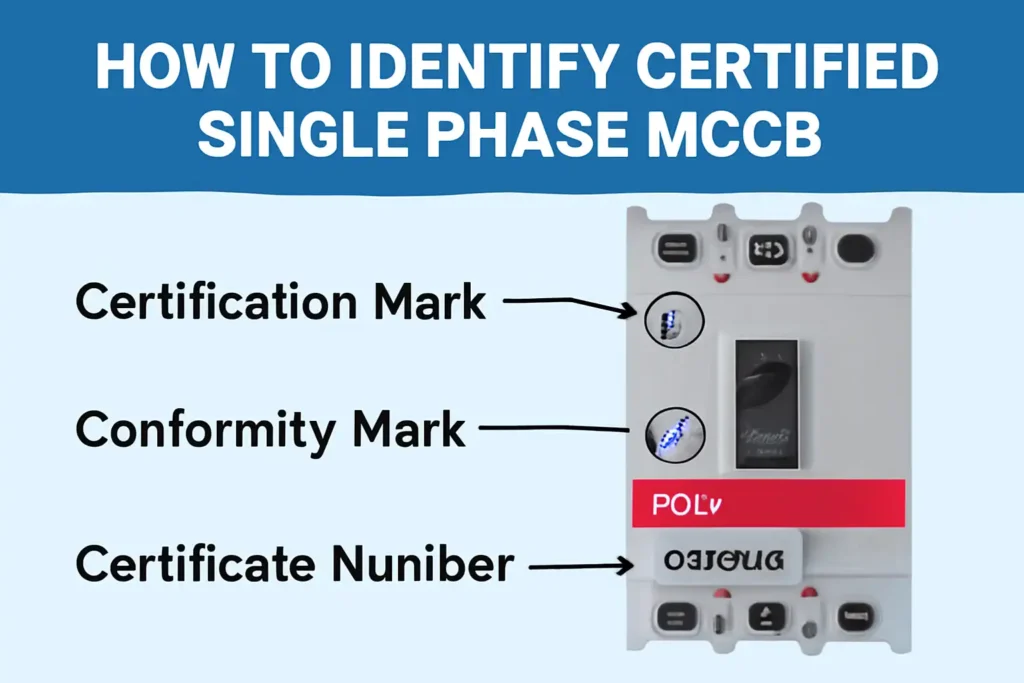
The best way to know if a single phase molded case circuit breaker is certified is to look for official marks like UL, IEC, or CSA. Always check for clear labels and real documents. Certification means the breaker is safe and follows important rules. Here are the steps: look for the marks, read the labels, check the documents, and see if there are special markings. If you are not sure, ask the maker or look at official sources.
Key Takeaways
- Find official certification marks like UL, CSA, or CE on the breaker. These marks show the breaker passed safety tests. – Look at the breaker’s label for the maker’s name, model number, voltage, and current ratings. This helps you use the breaker the right way. – Use online lists and manufacturer help to check if the marks and product are real. – Do not use breakers with missing or faded labels, unclear marks, or no TEST button if needed. These are signs the breaker may not be safe. – Follow a simple checklist: look for marks, read labels, test arc-fault features, read instructions, and check for clear markings.
Certification Importance
Safety and Compliance
Picking a certified single phase molded case circuit breaker keeps people and property safe. Certification shows the device passed tough safety and performance tests. These tests check if the breaker works well with high voltage, heat, and electromagnetic interference. You can trust certified breakers because they follow rules from groups like UL or IEC.
- Certified devices get tested for safety in special labs. Tests look at dielectric strength, temperature, and electromagnetic compatibility.
- Marks like UL and CE mean the breaker meets world safety standards. This lets you use the device in many countries.
- Certification is more than just a test. It also checks design, risks, and keeps reviewing safety.
- Real-life examples, like electric vehicle chargers and medical devices, show how certification stops problems like shocks and overheating.
- International standards, such as IEC 61508 and UL 508, give steps to manage risks and keep products safe.
- Good paperwork and tracking help you prove you follow the rules and fix issues if they come up.
- Certified products get checked even after they are sold. This helps find new risks early.
You help stop accidents by following these safety steps. For example, since OSHA laws started in 1970, electrical deaths in the US dropped from almost 15,000 to about 5,500 in 2022. This proves that safety rules and certification save lives.
Risks of Non-Certified Devices
Using a non-certified circuit breaker is very risky. These devices might not stop electric shock, fire, or equipment failure. Many electrical accidents happen because of bad or uncertified equipment. For example, a worker died after touching live wires while using unsafe tools and not following safety steps. This sad story shows why you must use certified devices and follow safety rules.
- Over 2,000 arc flash accidents happen each year in the US.
- More than 400 people die from arc flashes worldwide every year.
- One in five arc flash accidents causes injury.
- Each accident can cost up to $1 million.
- Common risks are old equipment, missing labels, and no training.
You can lower these risks by picking certified breakers, labeling equipment, and making sure everyone gets training. Regular safety checks and using the right gear also help keep you safe.
Single Phase Molded Case Circuit Breaker Standards
UL 489 and NEMA AB-1
You should always check if your single phase molded case circuit breaker meets UL 489 and NEMA AB-1 standards. These standards set strict rules for safety and performance in the United States. UL 489 requires each breaker to pass tough tests, including performance at 480Vac. This test level is higher than what some international standards require. NEMA AB-1 works with UL 489 to make sure breakers are safe for use in homes and businesses.
Manufacturers like Schneider Electric build QO and QOB circuit breakers to meet these standards. You can find proof of this on their UL File number E84967 and CSA File LR92886. These numbers show that the breakers passed all required tests. UL 489 and NEMA AB-1 also set limits for voltage and current. For example, breakers must be rated up to 1,000 V AC or 1,200 V DC. They must also interrupt at least 5,000 amps of fault current. These numbers help you know the breaker will work safely in real-world conditions.
Tip: Always look for UL or NEMA marks on the breaker label. These marks mean the breaker passed all safety checks.
IEC 60947-2 and International Standards
If you use circuit breakers outside the US, you should look for IEC 60947-2 certification. This standard covers industrial systems and sets high safety levels. IEC 60947-2 breakers can handle up to 1,000 V AC and 1,500 V DC. They also work in harsh environments, like factories or outdoor switchboards. The standard allows for adjustable tripping and many curve types, so you can match the breaker to your needs.
Here is a quick comparison of IEC standards:
| Aspect | IEC 60947-2 (Industrial) | IEC 60898-1 (Residential) |
|---|---|---|
| Rated Voltage | Up to 1,000 V AC, 1,500 V DC | 230/400 V |
| Rated Current Range | 0.5 A to 6,300 A | Up to 125 A |
| Short-circuit Capacity | High (industrial faults) | Max 25 kA |
| Tripping Characteristics | Adjustable, many types | Fixed (B, C, D) |
| Intended Use | Factories, utilities | Homes, offices |
Other certifying bodies include CSA (Canada), CE (Europe), CCC (China), KEMA, ASTA, and TUV. Each group checks that breakers meet local safety rules. When you see these marks, you know your single phase molded case circuit breaker meets strict safety standards.
Certification Marks

Common Markings
When you look at a single phase molded case circuit breaker, you might see special logos. These are called certification marks. They mean the breaker passed safety tests. Some common marks you may find are:
- UL (Underwriters Laboratories): This mark means the product is safe in the United States. UL checks for fire, shock, and other dangers.
- CSA (Canadian Standards Association): This mark is for products approved in Canada. It means the breaker meets high safety rules.
- CE (Conformité Européenne): This mark is used in Europe. It shows the breaker follows European safety laws.
- IEC (International Electrotechnical Commission): This mark means the breaker meets world safety standards.
- CCC (China Compulsory Certificate): This mark is needed for products sold in China.
- TUV, KEMA, ASTA: These marks come from trusted labs in other countries.
Note: Certification marks are more than just pictures. They show a trusted group tested the breaker for safety and performance. These marks help you know the product is real and safe.
Studies show most people trust products with these marks. For example, almost 70% of buyers in North America feel safer with a CSA mark. These marks help you believe the breaker will work and keep your home or business safe.
Here is a table that explains what these marks mean for safety and quality:
| Aspect | What It Means for You |
|---|---|
| Certification Mark Purpose | UL marks show the breaker passed tests for fire, shock, and mechanical safety. |
| Product Suitability | Certified breakers are checked for use in certain panels and systems. |
| Mark Usage Restrictions | Only real certified products can use these marks, so you avoid fake or unsafe items. |
| Ongoing Compliance | Factories get regular checks to keep up with safety rules. |
| Mark Types and Meaning | Different marks show different levels of testing and approval. |
| Risk Mitigation | Certification helps prevent poor connections and overheating. |
| Verification Tools | You can use online databases to check if a mark is real and matches the product. |
Mark Locations
You can find certification marks in a few places on a single phase molded case circuit breaker. Most times, you will see them:
- On the front or side of the breaker, near the brand or model number.
- On the label, which also lists voltage, current, and other ratings.
- Sometimes, inside the panelboard door or on the mounting rail.
Look for marks that are clear and easy to see. The mark should not look faded, scratched, or changed. If a mark looks fake or is missing, do not use the breaker. Always check the mark with the real logo from the certifying group.
Tip: You can use the UL Product iQ® database or other online tools to check if a mark is real. Just type in the number or code from the mark to see if it matches the product.
When you check for these marks, you make sure the breaker is safe and allowed to use. Certification marks help you stay away from dangerous products and give you peace of mind.
Label Information
Manufacturer Details
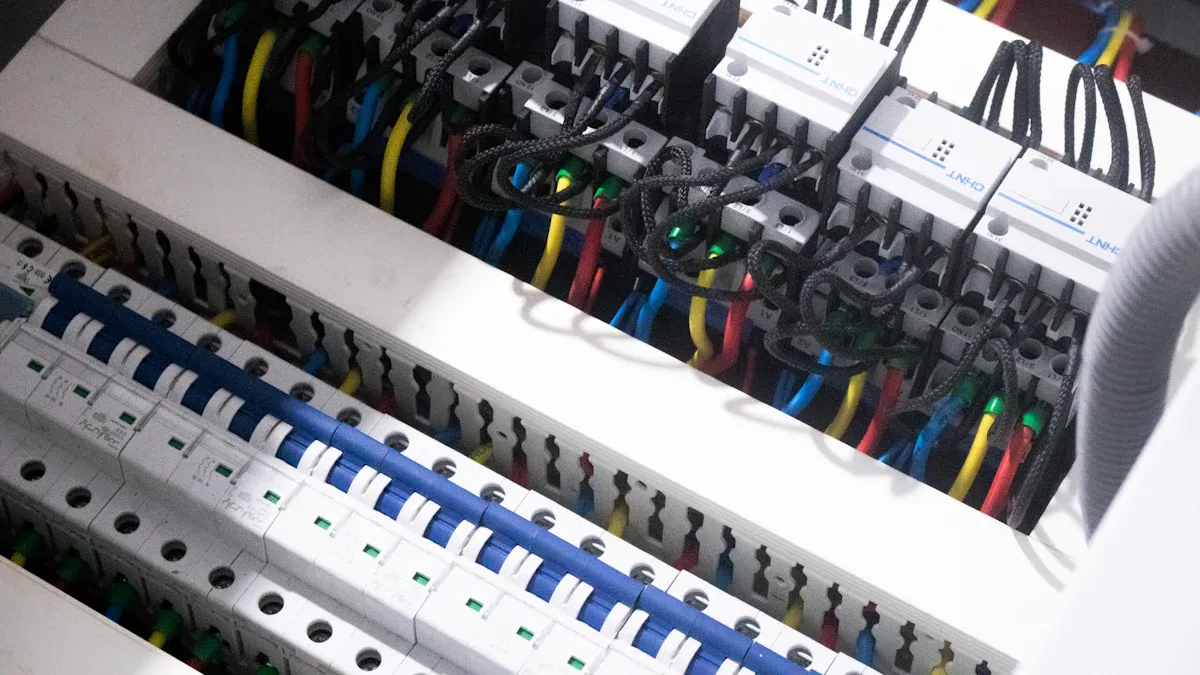
When you look at a single phase molded case circuit breaker, first check for the manufacturer’s name and logo. This tells you who made the breaker. You should also see a model or type number on the label. These details help you find the breaker in catalogs or online. If you need help or want to check certification, start with the manufacturer’s information.
Ratings and Type
You need to look closely at the ratings and type on the label. These markings show the voltage and current the breaker can handle. They also tell you if the breaker is for AC or DC. Using the wrong voltage or current can cause fires or overheating. Labels should be easy to read and last a long time. They must stay clear even if it is hot or wet.
- Markings help you and workers pick the right breaker.
- Voltage and current ratings stop mistakes and keep you safe.
- Labels must show the right voltage to prevent damage.
- Fuse and breaker info should be close to the device for easy changes.
- Good labels help you follow safety rules and stay safe.
Tip: Always match the breaker’s ratings to your needs. For example, the NEC 125% rule says breakers should be at least 125% of the load. This keeps your system safe and working well.
Date Codes
Date codes and batch numbers are important for quality control. Manufacturers use these codes to track when and where each breaker was made. This helps with recalls, warranty claims, and safety checks. If there is a problem, date codes help you find out the product’s history. Many industries, like food and aerospace, use date codes to make sure products are safe. Modern systems use barcodes or serial numbers to link each breaker to its records. This makes it easy to check if your breaker is part of a recall or needs special care.
Documentation and Listings
Datasheets and Manuals
You should look at datasheets and manuals before picking a single phase molded case circuit breaker. These papers tell you important things about the breaker. You can learn about ratings, how to install it, and safety warnings. Makers give you these papers so you use the breaker the right way and stay safe.
1. Technical papers like system drawings and datasheets help get approval. 2. Test reports and certifications show the breaker passed safety checks. 3. Risk files explain how the maker controls dangers. 4. If the breaker has software, you need software papers too. 5. Usability papers show the maker checked for user risks. 6. Warning labels in the manual tell you about hazards. 7. User guides help you install and use the breaker safely.
Reading these papers helps you avoid mistakes and delays when you install or check the breaker.
Certification Certificates
You need to look at certification certificates to make sure the breaker is really certified. The best way is to find the UL Mark on the breaker. UL Solutions tests samples to see if they meet safety rules. You might see different UL Marks, like UL Listed, UL Classified, or UL Certified. Each mark tells you what kind of test and approval the breaker got.
- The UL Mark is the main proof the breaker is certified.
- The special UL Certified Mark has a code you can check online.
- UL Solutions visits factories often to keep products safe.
- Compatibility lists and markings help you check the breaker for special uses.
- All UL Listing and Classification Marks are good and accepted.
The checking process is strong and simple. You can trust the marks and online tools.
Compatibility Lists
You should check compatibility lists before you put in a breaker. These lists show which parts, software, or systems work together. Using the right parts makes your system safer and easier to fix.
- Compatibility lists help you avoid problems with parts that do not match.
- Using parts from the same maker can lower training and repair costs.
- Matching systems make upgrades and fixes easier.
- Shared data files help stop mistakes and save time.
- Version control keeps your system working well.
- Using common standards can save money and help systems work together.
A hardware compatibility list usually has tested and certified parts. This makes sure your breaker will work well in your system. Checking these lists helps you feel sure your setup will be safe and work right.
Application-Specific Markings

PV and Solar
If you use solar power, check for special markings. These markings show the breaker is safe for photovoltaic (PV) equipment. You might see “PV” or “Photovoltaic” on the breaker. This means it can handle high DC voltages and quick current changes.
- Some markings show voltage ratings up to 1,500 V DC.
- A sun symbol or “PV” makes it easy to spot.
- “-LSHF” means low smoke halogen free, which is good for clean energy.
Always check for these before using a single phase molded case circuit breaker in solar projects. This helps you follow safety rules and keeps your equipment safe.
BPS and Battery Systems
Battery systems need breakers with special labels. Look for “BPS” (Battery Protection System) or “ESS” (Energy Storage System). These show the breaker is tested for high inrush currents and DC faults.
- Some markings are “-R” for riser, “-G” for general use, or “-X” for limited home use.
- Breakers may list copper or aluminum for battery connections.
- “RoHS” or “AG14” means the breaker is safe for the environment.
These labels help you pick the right breaker for battery storage. This keeps your system safe and working well.
AFCI and Special Types
Some jobs need special breakers called Arc Fault Circuit Interrupters (AFCIs). You will see “AFCI” or “Combination AFCI” on these breakers. These show the breaker can find dangerous arcs and stop fires.
| Test/Verification Aspect | Description |
|---|---|
| Arcing Fault Tests | Checks AFCI response to hazardous arcs. |
| Nuisance Tripping Tests | Makes sure AFCI does not trip during normal use. |
| Environmental Tests | Tests AFCI in different temperatures and humidity. |
| Endurance and Overload Tests | Checks long-term reliability. |
| Dielectric Voltage-Withstand Test | Verifies insulation strength. |
| Manufacturing and Marking Verification | Confirms correct AFCI markings and compliance. |
Always look for the UL mark and clear AFCI labels. These mean the breaker meets strong safety rules. Over time, more AFCI rules were added because they stop many fires. Using the right labels helps you protect your home and follow the rules.
Tip: Always match the special marking to your project. This makes sure you install it right and stay safe.
Identification Checklist
Step-by-Step Process
You can use a simple checklist to make sure your circuit breaker is certified and safe. Follow these steps:
- Look for Certification Marks
Find marks like UL, CSA, or CE on the front or side of the breaker. These marks show the breaker passed safety tests. - Check Device Labels
Read the label for the manufacturer’s name, model number, and ratings. Labels should also show special types, such as “Branch/Feeder AFCI” or “PV” for solar use. - Find the TEST Button
Some breakers have a “TEST” button. This button lets you check if the arc-fault detection works. Pressing it helps you know the breaker is working right. - Review Instructions
Look for printed instructions, QR codes, or online guides. These resources show you how to wire, operate, and test the breaker. - Confirm General Markings
Make sure all markings are clear and match the information in the manual. Consistent markings help you spot certified breakers quickly.
Tip: A checklist helps you avoid mistakes and keeps your electrical system safe.
Red Flags
Watch out for signs that a breaker may not be certified or safe. Here are some warning signs:
- Missing or unclear certification marks
- Labels that look faded, scratched, or changed
- No “TEST” button on breakers that should have one
- Instructions that are missing, hard to read, or not in your language
- Markings that do not match the manual or catalog
- Breakers with no manufacturer name or model number
- Strange symbols or marks you do not recognize
| Red Flag | What It Means |
|---|---|
| No certification mark | Breaker may not be tested for safety |
| Faded label | Hard to confirm ratings or type |
| No instructions | Risk of wrong installation |
| No TEST button (AFCI) | May not detect arc faults |
If you see any of these red flags, do not use the breaker. Always choose products you can trust.
Official Resources
Manufacturer Support
If you need to check a single phase molded case circuit breaker, start with the manufacturer. Most companies help you on their website, by phone, or by email. Their support teams can answer questions about certification and product ratings. They also help with how to use the breaker. Many companies let you download datasheets, guides, and certification letters. These papers show if your breaker meets safety and performance rules.
Tip: If you are not sure about a breaker’s label, ask the manufacturer. They can look up serial numbers and batch codes for you. This helps you stay away from fake or unsafe products.
Some companies have online tools. You can type in a model or serial number. This shows if your breaker is real and certified. It helps you match your breaker with official records.
Regulatory Databases
You should use regulatory databases to check if your breaker is certified. These databases give you the latest info from trusted groups. The UL Product iQ® Certification Database is a great tool for this.
- The UL Product iQ® database lets you search for molded case circuit breakers by model, maker, or certification number.
- You can sign up for free and see the newest certification info.
- The database lists products that meet ANSI/UL 489, which is the main safety rule for these breakers.
- You can also find info about UL’s rebuilt equipment program. This covers products that are safe even after being fixed.
- UL does field checks for special cases and keeps lists of approved equipment.
Using these databases helps you make safe choices. You can quickly find certified products and avoid ones that do not meet the rules.
When you use both manufacturer help and regulatory databases, you have a strong way to check breaker certification. This keeps your electrical system safe and legal.
You can tell if a breaker is certified by doing a few things. First, look for certification marks on the breaker. Then, check the label for key information. Always make sure the paperwork is real. Look for special markings that fit your use. Following these steps keeps you safe and follows the law. If you are not sure, use official websites or ask an expert for help.
FAQ
How do you know if a circuit breaker is certified?
You should look for official marks like UL, CSA, or CE on the breaker. These marks show the breaker passed safety tests. You can also check the label and ask the manufacturer for proof.
Can you use a breaker without a certification mark?
You should never use a breaker without a certification mark. Breakers without marks may not meet safety rules. Using them can cause fires or electric shocks.
Where can you check if a certification mark is real?
You can visit the UL Product iQ® database or the certifying body’s website. Enter the model or file number from the breaker’s label. These sites help you confirm if the mark is valid.
What should you do if the label is hard to read?
If the label is faded or damaged, do not use the breaker. You should contact the manufacturer or buy a new certified breaker. Clear labels help you stay safe.
Why do some breakers have extra markings like “PV” or “AFCI”?
Some breakers have special jobs. “PV” means the breaker works with solar panels. “AFCI” means it can stop arc faults. These markings help you pick the right breaker for your project.
The following information may be of interest to you
How to Safely Connect Miniature Circuit Breakers Step by Step
How to Select and Replace the Right Circuit Breaker
IEC and UL certification requirements for air circuit breakers
What You Need to Know About Surge Protection Device Lifespan
