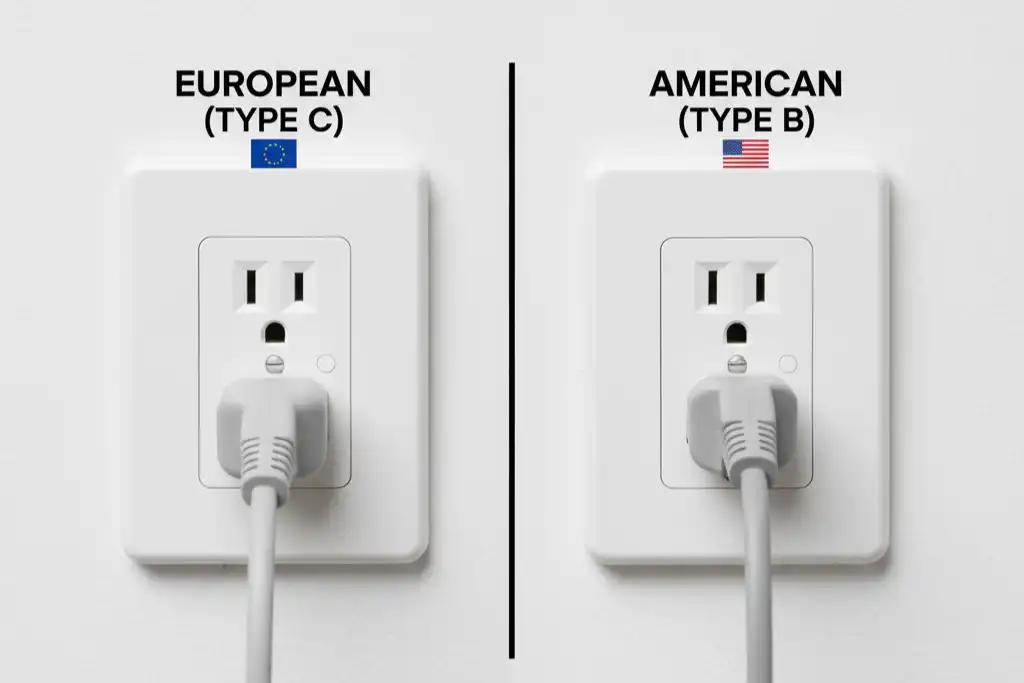
When you look at sockets in Europe and America, you see three big differences. These are shape, voltage, and compatibility. These things decide if your devices work or fit when you travel. For example, a European plug may not fit in an American socket. If you do not pay attention to these things, you could break your electronics or have safety problems. You should know these basics to keep your devices safe and avoid travel trouble.
Key Takeaways
- Learn about plug shapes. American plugs have flat prongs. European plugs have round prongs. Always look at the plug shape before you travel.
- Know that voltage is different. The U.S. uses 120 volts. Europe uses 220-240 volts. Using the wrong voltage can break your devices.
- See if your device is dual voltage. Check for labels that say ‘100-240V’. This helps you avoid needing a voltage converter.
- Pick the right adapter or converter. Adapters help plugs fit into sockets. Converters change the voltage. Choose the right one to protect your electronics.
- Focus on safety features. European sockets often have better grounding. They also have child protection. This lowers the chance of electrical shocks.
Socket Design
Plug Shapes
When you travel, you notice that plug shapes look different in Europe and America. In the United States, you usually see plugs with two flat prongs. These are called Type A and Type B. In Europe, you find many more shapes. Some have two round prongs, while others have three. Here are some common plug types you might see:
- Type A: Two flat prongs, used in the U.S., Canada, Mexico, and Japan.
- Type B: Two flat prongs with a round grounding pin, also common in the U.S. and Canada.
- Type C: Two round prongs, found in most of Europe, South America, and Asia.
- Type E: Two round prongs, used in France, Belgium, and some other countries.
- Type F: Two round prongs with grounding clips, used in Germany, Russia, and much of Europe.
- Type G: Three rectangular prongs, used in the UK and Ireland.
- Type K and L: Three round prongs, found in Denmark and Italy.
You need to know these shapes because American plugs do not fit into most European sockets. You often need an adapter to connect your device.
Tip: Always check the plug shape before you travel. This helps you avoid problems when you try to charge your phone or use your laptop.
Prong Types
The prongs on plugs also show big differences between regions. American plugs use flat prongs, while European plugs use round ones. Some European plugs have three prongs for extra safety. The size and spacing of the prongs can also change from country to country in Europe.
| Plug Type | Design Features | Safety Implications |
|---|---|---|
| American (A, B) | Flat prongs, may lack grounding | Higher risk of electric shock due to less insulation and grounding |
| European (C, E, F) | Round prongs, often include grounding | Enhanced safety with less risk of shock and equipment damage |
European sockets often have less exposed metal. This makes them safer because you are less likely to touch live parts. The grounding in many European plugs adds another layer of protection. You should always look for grounded plugs when you use high-power devices.
Socket Variations
You find many socket types in different countries. This can make travel confusing. In the United States, you mostly see Type A and Type B sockets. In Europe, you see a mix of Type C, E, F, and G sockets, depending on the country. The table below shows some common socket types and where you find them:
| Socket Type | Region |
|---|---|
| A | USA |
| B | USA |
| C | Europe |
| E | Europe |
| F | Europe |
| G | UK |
You need to remember that the shape and voltage of each socket can change. For example, a device from the U.S. will not fit into a European socket without an adapter. Even if you have the right adapter, you must check the voltage to avoid damaging your device.
Note: European plug pins can vary in size. This sometimes causes compatibility issues, even within Europe. Always check the socket and plug type before you travel.
Voltage and Frequency
Voltage Standards
There is a big difference in voltage between Europe and America. In the United States, most homes use 120 volts. In Europe, the voltage is higher, from 220 to 240 volts. This means European sockets give almost twice the power as American ones.
- United States: 120 volts
- Europe: 220–240 volts
Many countries use voltage between 100 and 240 volts. If you plug a U.S. device into a European socket, the high voltage can break it. Always check your device label before you travel. Look for numbers like “110-240V” to see if your device can use different voltages.
Tip: Laptops and smartphones often work with both American and European voltages. You only need a plug adapter for these dual-voltage devices.
Frequency Differences
Frequency is also important. It tells how many times the electric current changes direction each second. In the United States, the frequency is 60 hertz (Hz). In Europe, the frequency is 50 hertz.
- United States: 60 Hz
- Europe: 50 Hz
Some devices, like clocks and things with motors, need the right frequency. If you use a device with a motor or timer in a country with a different frequency, it may run too fast or too slow. This can cause problems or even break the device.
Note: Most new electronics, like chargers and tablets, do not care about frequency. Older devices and appliances may need the correct frequency to work safely.
Device Risks
Using the wrong voltage or frequency can be dangerous. You could have electrical fires, shocks, or broken devices. The table below shows some common risks:
| Risk Type | Description |
|---|---|
| Electrical Fires | Voltage mismatches can lead to electrical fires. |
| Electrical Shocks | Incompatible voltage can cause dangerous electrical shocks. |
| Warranty Issues | Using devices without proper equipment can void warranties. |
If you use a 120-volt device in a 230-volt socket, it may overheat or break. Devices with motors can stop working or get too hot if the frequency is wrong. Many companies warn you not to use their products in the wrong electrical system. You may lose your warranty if you ignore these warnings.
Many new devices are dual voltage. You can find this on the label or in the manual. Look for “110-240V” or “100-240V.” If your device is dual voltage, you only need a plug adapter. If it is not, you need a voltage converter to keep your device safe.
- Laptops, smartphones, and tablets often support dual voltage.
- Dual-voltage devices work safely in both American and European sockets.
- If your device is not dual voltage, use a converter to avoid damage.
⚡ Alert: Always check your device before you plug it in abroad. This simple step can save you money and keep your electronics safe.
Socket Safety
Grounding
Grounding keeps you safe from electrical dangers. Many plugs have a third prong. This prong connects to the earth. It helps stop shocks if something goes wrong inside the plug. European sockets use grounded three-prong plugs for almost all devices. American sockets often use two-prong plugs for things that do not use much power. These are safe because the voltage is lower. The third prong in grounded plugs connects before the other parts. This makes you safer.
- The third contact in plugs connects to earth.
- Grounded plugs are required for Class I equipment.
- Grounding provides a path for extra current.
- European sockets use grounded plugs for most devices.
- American sockets use two-prong plugs for low-power devices.
- The third prong acts as a safety feature.
You should use grounded plugs for things that need a lot of power. Grounding lowers the chance of electric shock. This is very important in places with higher voltage.
Child Protection
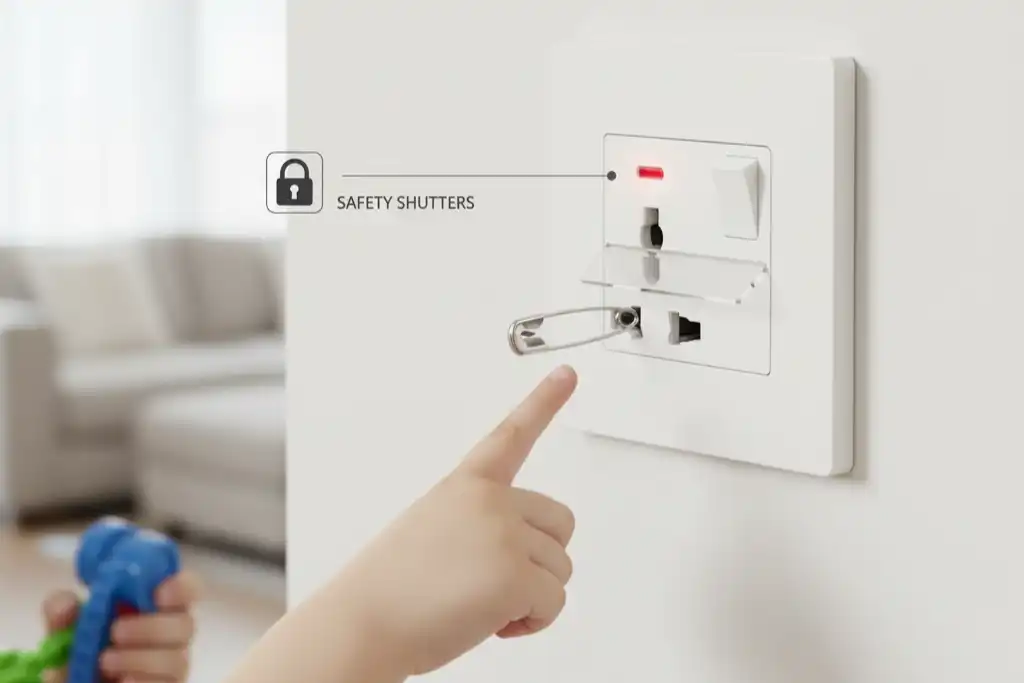
Child protection features help keep kids safe from shocks. European sockets often have shutters that cover live parts. These shutters only open when you put in a plug. American sockets may use plastic covers or special designs to stop tampering. You can buy socket covers for more safety at home.
| Feature | Europe | United States |
|---|---|---|
| Shutter Mechanism | Common in most sockets | Less common |
| Tamper-Resistant Outlets | Available, but less frequent | Increasingly required |
| Socket Covers | Widely used | Widely used |
You should look for child protection when you get new outlets. These features make it less likely for kids to get shocked.
Safety Standards
Safety standards are rules for how sockets and plugs must work. Europe uses IEC 60309 for industrial plugs. It uses IEC 61439 for low voltage switchgear. These rules make sure sockets are safe. The United States also has safety codes for electrical systems.
- IEC 60309 covers plugs, receptacles, and connectors.
- IEC 61439 sets rules for low voltage assemblies.
- Standards help stop electrical accidents.
Ireland and Germany have about the same number of deaths from electrical accidents. The rates are about 0.62 and 0.65 deaths per million people. A test showed no big difference between the two countries. European sockets are usually safer. They show less metal and use more grounding.
🛡️ Tip: Always pick outlets and plugs that meet safety standards. This helps keep you and your family safe from electrical dangers.
Device Compatibility
Adapters vs. Converters
When you go to Europe or the United States, you see different plug shapes and voltage. You should know what adapters and converters do. Adapters help your device’s plug fit into a new socket. They do not change the voltage at all. Use an adapter if your device matches the local voltage. Converters change the voltage so your device works safely. Use a converter if your device is not dual voltage and needs a different voltage.
| Type | Function | Usage Details |
|---|---|---|
| Adapters | Fit plug shapes to local outlets | Do not change voltage; only change pin configuration |
| Converters | Change voltage for device compatibility | Designed for short-term use; not for continuous operation |
| Transformers | Modify voltage for continuous use | Heavier; suitable for devices needing long-term power |
| Adapter Kits | Provide multiple plug options for different countries | May need to buy grounded adapters separately |
Most travel electronics like phones and laptops only need an adapter. Some devices, like hair dryers or medical equipment, may need a converter if they are not dual voltage.
Dual Voltage Devices
You can check if your device is dual voltage by looking at the label. Look for numbers like “100-240V” or “110~220V.” If you see these, your device works in both places. You only need an adapter for the plug shape. If your device shows just one voltage, you must use a converter. Medical devices, like CPAP machines, often need special voltage and frequency. Using only an adapter with a single-voltage device can cause overheating or damage.
⚠️ Tip: Always check the voltage label before you travel. This helps you avoid expensive mistakes.
Travel Tips
You can keep your electronics safe by following easy steps:
- Learn the voltage and frequency of your destination.
- Use the right adapter for plug compatibility.
- Pack a universal adapter kit for trips to many countries.
- Organize and label your cords to stop confusion.
- Back up your devices before you leave.
- Avoid public Wi-Fi for important tasks.
- Change your passwords after your trip.
🧳 Note: Packing slim adapters and extra chargers helps you stay powered and ready for anything.
By checking your device’s voltage and using the right tools, you avoid damage and keep your electronics safe while you travel.
You can spot big differences between European and American sockets.
- In the United States, sockets use 110-120V and 60Hz. Europe uses 220-240V and 50Hz.
- The shapes and designs of sockets are not the same. This changes how your devices fit and work.
- Safety features are different too. Europe focuses on finding faults. The US uses multigrounded neutral systems.
Check your device’s voltage and plug type before you travel. Use the correct adapter or converter to keep your electronics safe. Being ready helps you avoid damage and keeps you safe.
FAQ
What is the main difference between a European and an American socket?
A European socket has round holes. It also uses more voltage. An American socket has flat slots. It uses less voltage. The shapes and power are not the same.
What happens if you plug an American device into a European socket?
Plugging an American device into a European socket can break it. Many American devices cannot use the higher voltage in Europe. Always read the label before you plug it in.
What adapter do you need for European sockets?
You need a plug adapter for the round holes in Europe. This adapter lets your American plug fit the socket. It does not change the voltage. Check if your device can use the local voltage.
What should you look for before using a socket in another country?
Check the socket shape, voltage, and frequency first. Make sure your device matches these things. If not, use the right adapter or converter to keep your electronics safe.
What devices usually work in both American and European sockets?
Most laptops, smartphones, and tablets work in both places. These devices often support dual voltage. You only need a plug adapter for them.
See also
Introduction to International Standards for Wall Sockets
5 Leading Circuit Breakers for South American Households
What should I do if the circuit is overloaded?
Washing machine socket: Can you use a regular socket?
What are the warning signs of surge protector failure